A journalist has an interview in an hour. A lawyer needs to coordinate a filing before opposing counsel sees the strategy. An incident-response lead is trying to contain a breach while several people exchange instructions from different locations. In each case, the obvious move is to install an encrypted app and start typing.
That move helps, but it doesn't solve confidential planning. A screenshot can outlive disappearing messages. A cloud backup can preserve a file after the channel expires. A legal hold can make deletion improper, and a careless participant can reveal identities through a contact list, filename, notification, or copied passage. The practical problem isn't just how to encrypt a conversation. It's how to control the conversation's identity, access, retention, metadata, human behavior, and destruction from beginning to end.
Confidentiality has always been an institutional problem as well as a technical one. A historical study of U.S. federal statistics documents repeated attempts to obtain data collected under confidentiality pledges between 1910 and 1965, including efforts by another federal agency to access protected Census Bureau information. The lesson remains relevant: formal promises don't remove pressure from organizations with competing interests. Effective confidential planning therefore needs enforceable governance and operating habits, not just a secure algorithm. (Historical study of confidentiality challenges in U.S. federal statistics)
Why Confidential Planning Needs a Playbook, Not Just a Tool
The first mistake is treating the channel as the plan. Encryption can protect content from a relay or an interceptor, but it can't decide whether participants should use real names, whether attachments belong on a device, or whether a message must be preserved for litigation. It also can't stop a participant from photographing a screen or pasting sensitive text into an ordinary email.
A useful playbook treats every conversation as a controlled lifecycle:
- Define the threat. Identify who may want access and what capability they have.
- Name the asset. Decide whether the sensitive element is a person, a document, a strategy, or the relationship between participants.
- Choose the channel. Match identity requirements, key exchange, retention, and metadata exposure to the threat.
- Forge the session. Prepare devices, browser context, handles, permissions, and access keys before substantive discussion begins.
- Operate carefully. Control screenshots, attachments, copy and paste, notifications, and participant verification.
- Check lawful limits. Screen for legal holds, regulatory duties, discovery obligations, and preservation requirements.
- Burn and respond. Close the channel deliberately, and know what to do if access or content is compromised.
Practical rule: Treat every message as if it could be exposed, then use encryption and short retention to reduce the consequences rather than assuming exposure is impossible.
This approach works because it separates problems that tools often blur together. Content confidentiality asks who can read a message. Identity confidentiality asks who can connect the message to a person. Operational confidentiality asks what traces remain on devices, backups, screens, and records systems. A channel may perform well on one dimension and poorly on the others.
Encryption adoption shows why this distinction matters. An Entrust global encryption study reported that the share of respondents whose organizations had an overall encryption strategy rose from 50 percent in 2021 to 62 percent in 2022, a 12-point increase in one year. The same source reported that 94 percent of surveyed IT decision makers said encryption implementation had increased over the prior year, while 64 percent encrypted all laptops and desktops and 54 percent encrypted all USB drives. (Entrust global encryption study) The momentum is clear, but uneven coverage leaves confidential planning exposed wherever people save, forward, export, or discuss sensitive material outside the protected channel.
Build a Threat Model Before You Pick a Channel
A journalist, lawyer, or incident-response lead can choose the wrong channel before sending the first message. Start with the risk, not the product. You do not need a formal workshop. Before a sensitive job, spend roughly fifteen minutes answering three questions in plain language. Clear answers matter more than specialized terminology.
Identify the adversary and the asset
Define who may be trying to learn the information. A curious insider may already have legitimate access to a workplace system. Opposing counsel may obtain records through discovery. A capable state actor may target devices, identities, or communication patterns. These adversaries require different controls, and an elaborate setup can create mistakes that weaken protection when the underlying risk is modest.
Name the asset at stake:
- A source identity: The dangerous link may connect a message to a journalist's contact.
- A legal strategy: The content may be sensitive even when participant identities are known.
- A witness location: Metadata, timing, or attachment details may matter more than the wording.
- An incident-response decision: Speed and access control may matter more than complete anonymity.
Then define the worst realistic outcome if the conversation appears in discovery, on a seized device, or in an adversary's hands. Exposure might identify a person, reveal a planned action, weaken a privilege argument, create physical danger, or cause embarrassment. That consequence determines the protection threshold.
Translate the answer into requirements. If the asset is the connection between participants, choose an identity-light or identity-free room. If the content creates the main risk, prioritize minimal retention and client-side encryption. If an invitation could be intercepted, verify the participant first and share the access key through a separate, out-of-band route. Decide beforehand how long information may remain on devices, whether screenshots are permitted, how attachments are handled, and what happens if someone sends sensitive material to the wrong place. Private communication planning guidance also emphasizes retention, secure deletion, and preparation for failures.
A worked example
Two lawyers are coordinating a filing. Opposing counsel is the relevant adversary. The assets are the legal strategy and draft language, and the worst realistic outcome is a discoverable conversation exposing their argument before filing.
They select a short-lived channel, exchange its access key through a separately verified route, avoid client names in the room, and keep attachments off local storage. Before deleting anything, they check their records policy and any applicable legal hold. If a participant captures a screenshot or loses a device, they stop substantive discussion, notify the other participant, revoke access where possible, and record the incident for later review.
The model does not promise invisibility. It produces controls that address the actual harm. For broader breach-prevention planning, consult Ciphar's data breach protection guidance, then adapt those controls to the people, systems, and legal duties involved in the matter.
Choosing Tools for Identity-Free, Short-Lived Conversations
Tool selection becomes clearer when you score each option against three properties: identity required, retention behavior, and key handling. Don't ask which product has the longest security feature list. Ask which weaknesses your threat model can tolerate.
| Category | Identity Required | Retention | Key Handling |
|---|---|---|---|
| Mainstream messenger with opt-in disappearing messages | Usually a phone number, email, or existing account | Disappearing settings may limit server retention, but screenshots, backups, and exports remain possible | Often managed through the provider's established account and contact model |
| Encrypted email with forward secrecy | Email identities and durable mailboxes | Messages and attachments commonly remain in mail systems unless users delete them and backups also expire | May involve provider-managed encryption or separately exchanged credentials |
| Ephemeral room using a zero-knowledge browser client | Can use a pseudonymous handle or no account, depending on implementation | Designed for short-lived sessions, with retention constrained by the room's policy | Access keys are exchanged by participants, while the relay stores ciphertext rather than readable content |
| Purpose-built OPSEC suite | Often configurable, but setup can be more demanding | May support controlled deletion, local policies, and specialized records handling | Usually gives participants more responsibility for key custody and verification |
Mainstream messengers are convenient for an established group, especially when everyone already understands the contact model. Their weakness is the surrounding ecosystem. A contact list, notification preview, linked desktop, automatic backup, or personal device can reconnect a supposedly temporary conversation to a durable identity.
Encrypted email is better suited to formal correspondence that must be retained and searched. It isn't a natural fit for a conversation that should disappear, particularly when attachments, mail archives, forwarding, and organizational backups are part of the environment. Forward secrecy can reduce the value of a later key compromise, but it doesn't erase copies already delivered to recipients.
Browser-based zero-knowledge rooms fit a narrower scenario: participants need a temporary coordination space, don't want accounts or a shared contacts directory, and can exchange an access key separately. Ciphar, for example, provides browser-based, client-side encrypted one-time channels with no account, phone number, or installation requirement, a server-enforced 60-minute lifetime, and a manual burn control. Its documentation also states that the relay stores opaque ciphertext and related encryption material rather than readable content. Those properties reduce server-side exposure, but they don't prevent screenshots, compromised endpoints, or unlawful deletion.
Use this selection flow:
- Known contacts and durable records required: Use an approved enterprise messenger or encrypted email, with retention and legal-hold controls.
- Temporary content, known participants: Use a disappearing-message channel only after checking backups and endpoint settings.
- No account or contact trail is essential: Consider an identity-free ephemeral room, with careful out-of-band key exchange.
- High-consequence or regulated work: Involve counsel, compliance, or your security lead before choosing a deletion-first system.
Before exchanging a key, review out-of-band key exchange practices. The key is not a magic password. It is part of the participant-verification process.
OPSEC Habits for the Lifecycle of a Confidential Channel
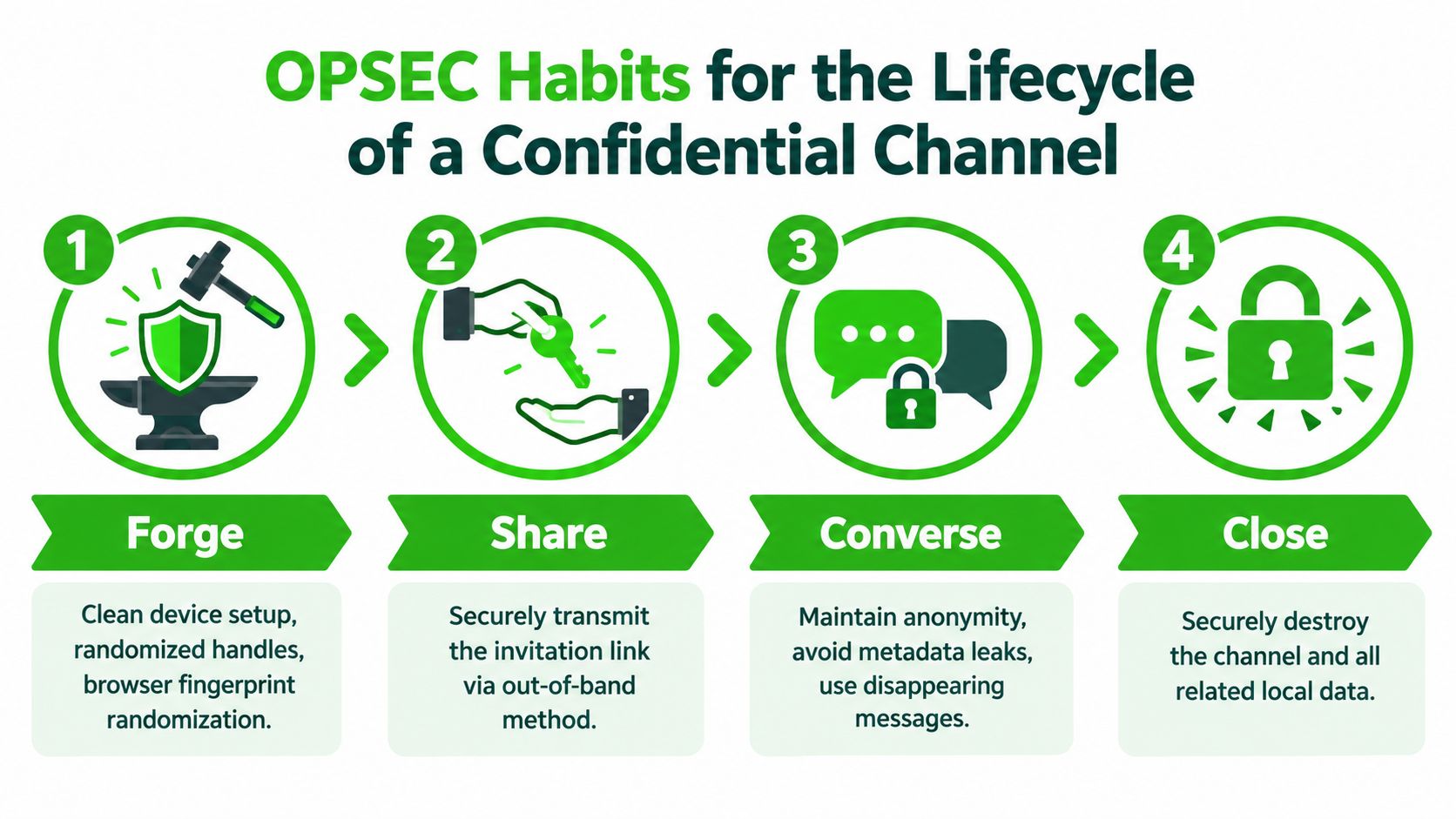
A confidential channel should have a beginning, a controlled working period, and a deliberate end. I use four verbs with teams handling sensitive journalism, legal coordination, and incident response: forge, share, converse, close. Each verb describes a behavior, not a feature.
Forge
Prepare the environment before creating the room. A dedicated device is preferable when the stakes justify it. Otherwise, use a hardened browser profile, disable unnecessary extensions, separate the session from personal accounts, and avoid uploading files whose names or embedded metadata identify the matter.
Choose randomized handles that don't resemble usernames used elsewhere. Browser isolation helps prevent accidental account association, but it doesn't make a device anonymous if the operating system, network, or endpoint is already monitored.
Immediate forge habits:
- Separate context: Don't open the room inside a browser session already logged into work or personal services.
- Minimize identifiers: Use neutral handles and neutral filenames.
- Prepare only what's needed: Don't bring a complete case folder into a temporary conversation.
Share
Send the invitation and access key through different paths. A QR code shown in person, a one-time link delivered through a separately verified channel, or a voice confirmation can work, depending on the threat. Ask the recipient to read back a short verification value or encrypted test result before discussing the subject.
The point is to prevent substitution. If an attacker can replace the invitation or key, strong encryption protects the wrong participants.
Converse
Assume the endpoint is the weak link. Tell participants not to screenshot, screen-record, copy sensitive text into the clipboard, or leave attachments in downloads. Disable notification previews where possible, keep the conversation factual, and avoid unnecessary names, addresses, and descriptive details.
This is also where teams should resist convenience. A temporary room becomes durable when someone pastes its contents into a permanent system, forwards a file, or photographs the screen. For a useful perspective on how information can gain visibility beyond its intended audience, consult the CitationOS citation intelligence report.
Close
Closing means more than closing a browser tab. Use the channel's burn control, invalidate session access, remove local downloads, clear temporary files where appropriate, and ask each participant to confirm what they retained. Don't destroy material that a legal hold or professional duty requires you to preserve. The closing decision belongs in the plan before the first sensitive message.
Lawful Considerations and the Limits of Ephemerality
“Ephemeral” describes how a system handles retention, not a legal status. A server may delete a message after its timer expires, while a recipient has captured it, a device has backed it up, or an organization must preserve it. Retention rules and failure procedures should be decided before sensitive work begins. Automatic deletion can conflict with litigation holds, records-retention obligations, or professional duties.
Content disappearing also differs from metadata surviving. A service may remove readable messages while a provider, network, endpoint, or monitoring system keeps timestamps, connection records, IP information, access attempts, or traffic patterns. An identity-free design can reduce direct account linkage. It cannot guarantee that an observer will be unable to infer who communicated, when they connected, or how often they returned.
| Channel Element | Destroyed on Burn | May Persist |
|---|---|---|
| Message body | The channel's stored copy, if the system is designed to remove it | Screenshots, copied text, exports, backups, or recipient notes |
| Uploaded file | The room copy, subject to the service's deletion behavior | Local downloads, previews, thumbnails, and endpoint backups |
| Session key | The active key material, if participants destroy it correctly | Copies in memory, logs, screenshots, or compromised devices |
| Participant identity | Nothing automatically | Handles, contact records, browser state, network records, and human recollection |
| Access metadata | Some service-side records may expire | Network, device, security, or organizational monitoring records |
Before pressing burn, check for a legal hold notice, regulator request, contractual retention rule, or professional obligation. Lawyers must account for discovery and privilege preservation. Healthcare and financial teams may have sector-specific record duties. Cross-border work can raise questions about where data was processed and which authorities may lawfully request it.
Set the retention decision in the plan, including who can change it and who approves destruction. Keep only what the applicable duty requires, and document why the conversation was temporary and why its retention period was selected. That record should not include unnecessary sensitive content.
Destruction is easier to defend when the conversation was deliberately temporary, no preservation duty had arisen, participants followed an approved policy, and the organization recorded its reasoning. It can create serious problems if someone deletes material after a hold, destroys evidence after anticipating litigation, or assumes a disappearing setting overrides statutory or professional duties. Confidentiality protects legitimate sensitive work. It does not authorize concealment of unlawful conduct or obstruction of an investigation.
Incident Response When a Session Is Compromised
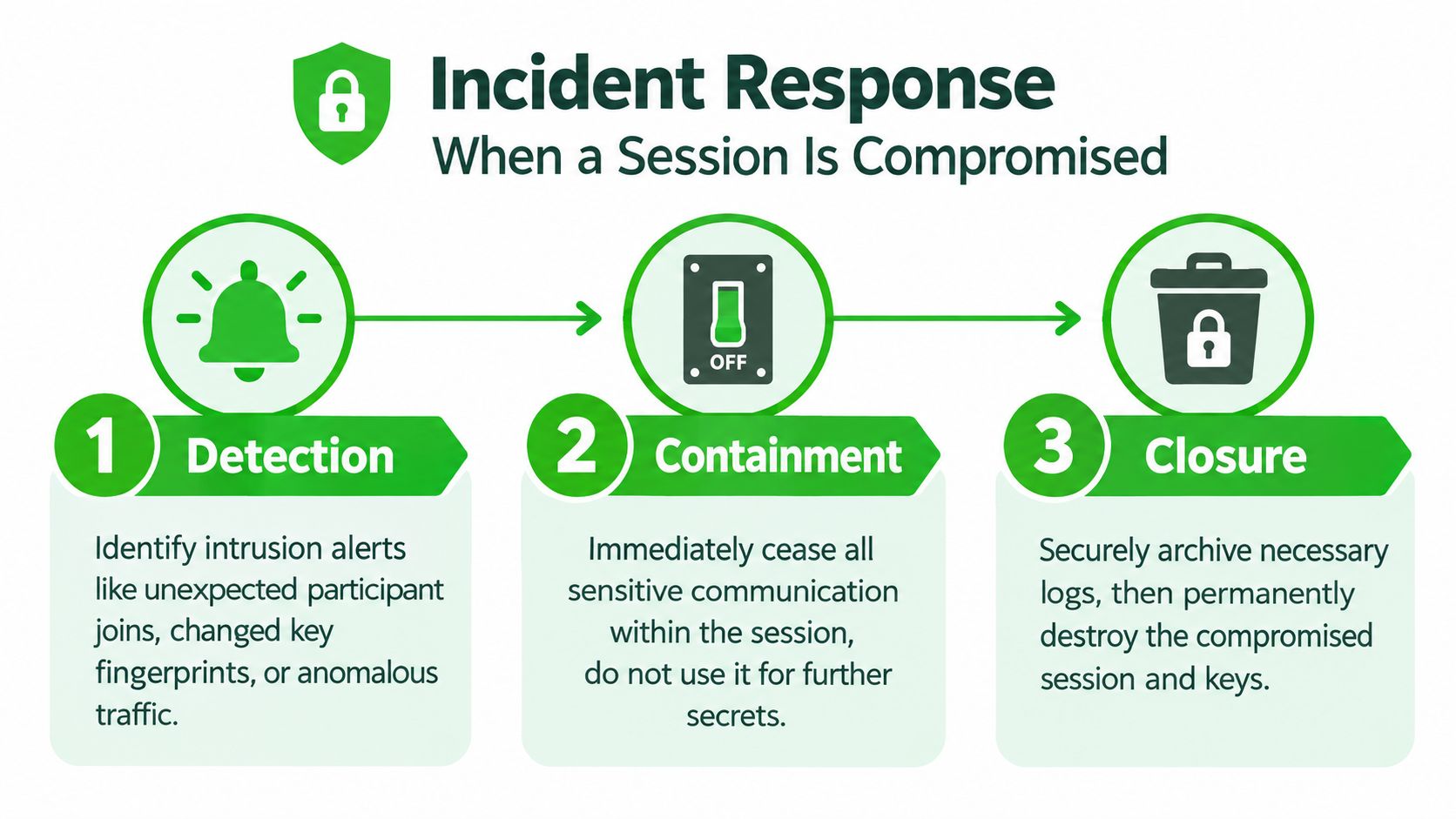
A compromised session needs a calm sequence, not improvisation. Treat unexpected participant joins, changed key fingerprints, unexplained redactions, failed verification, or unusual access notices as signals to stop sharing sensitive information until you understand them.
Detect and contain
Detection begins with the participants. Compare the expected membership with the actual room, check key fingerprints against the previously verified value, and record the time and nature of the anomaly without copying sensitive content into a new insecure channel.
Containment should be immediate:
- Stop substantive conversation. Don't test the compromised room with another secret.
- Remove the suspect client or participant. If that isn't possible, burn the session.
- Re-key from a clean device. Create a fresh channel rather than trusting a possibly exposed state.
- Notify only necessary parties. Broad alerts can reveal the incident and expand the audience.
- Preserve required evidence. Follow counsel's or the incident lead's instructions before deleting records.
Close with facts, then burn
Before destruction, answer three questions: What was said? What was seen? What metadata may have leaked? A participant may have viewed a message without downloading it. A wrong recipient may have received an invitation but failed the access check. A compromised browser may have exposed screen content even though the relay stored only ciphertext.
Know the manual controls before an emergency. A system that supports immediate burn, key invalidation, failed-access notices, and rate limiting gives participants options when the other party is offline. For broader coordination guidance during a breach, use Ciphar's incident-response communication guide.
If the key no longer verifies, the conversation is no longer trusted. Stop, re-key, and investigate from a clean context.
A simple triage tree keeps the response consistent:
- Unexpected participant or failed access alert: Stop, verify membership, burn if unexplained, and create a new room.
- Changed fingerprint: Treat the session as untrusted, move to an out-of-band verification path, and re-key.
- Possible screenshot or endpoint exposure: Stop content sharing, identify what was visible, notify the risk owner, and preserve required records.
- Unknown scope: Contain first, document known facts, involve security or counsel, then decide whether destruction is lawful.
A Reusable Checklist You Can Run on Every Sensitive Job
A checklist turns confidential planning from a rushed preference into a repeatable control. Keep it in an approved note, print it beside the workstation, or pin it where the person opening the channel will see it. The checklist should be short enough to use under pressure and specific enough to expose a missing decision.
Pre-engagement setup
- Classify the information: Separate public, internal, confidential, and privileged material.
- Name the harm: Write down what exposure would change for a source, client, witness, company, or response effort.
- Assign roles and aliases: Decide who may join, what each person is called, and who owns the final decision.
- Screen for preservation duties: Check legal holds, anticipated litigation, regulator requests, contractual retention, and professional obligations.
- Agree on failure actions: Decide who can stop the conversation, who must be notified, and where lawful records belong.
Channel forge
- Match the channel: Choose identity, retention, and key-handling properties against the threat model.
- Prepare the device: Use a dedicated device or isolated browser profile where appropriate, and separate personal accounts.
- Create neutral handles: Avoid names, email addresses, and filenames that reveal the matter.
- Set the lifetime: Use the shortest practical retention period, but don't configure deletion before checking preservation requirements.
- Establish a second path: Arrange out-of-band invitation and key exchange before sending sensitive content.
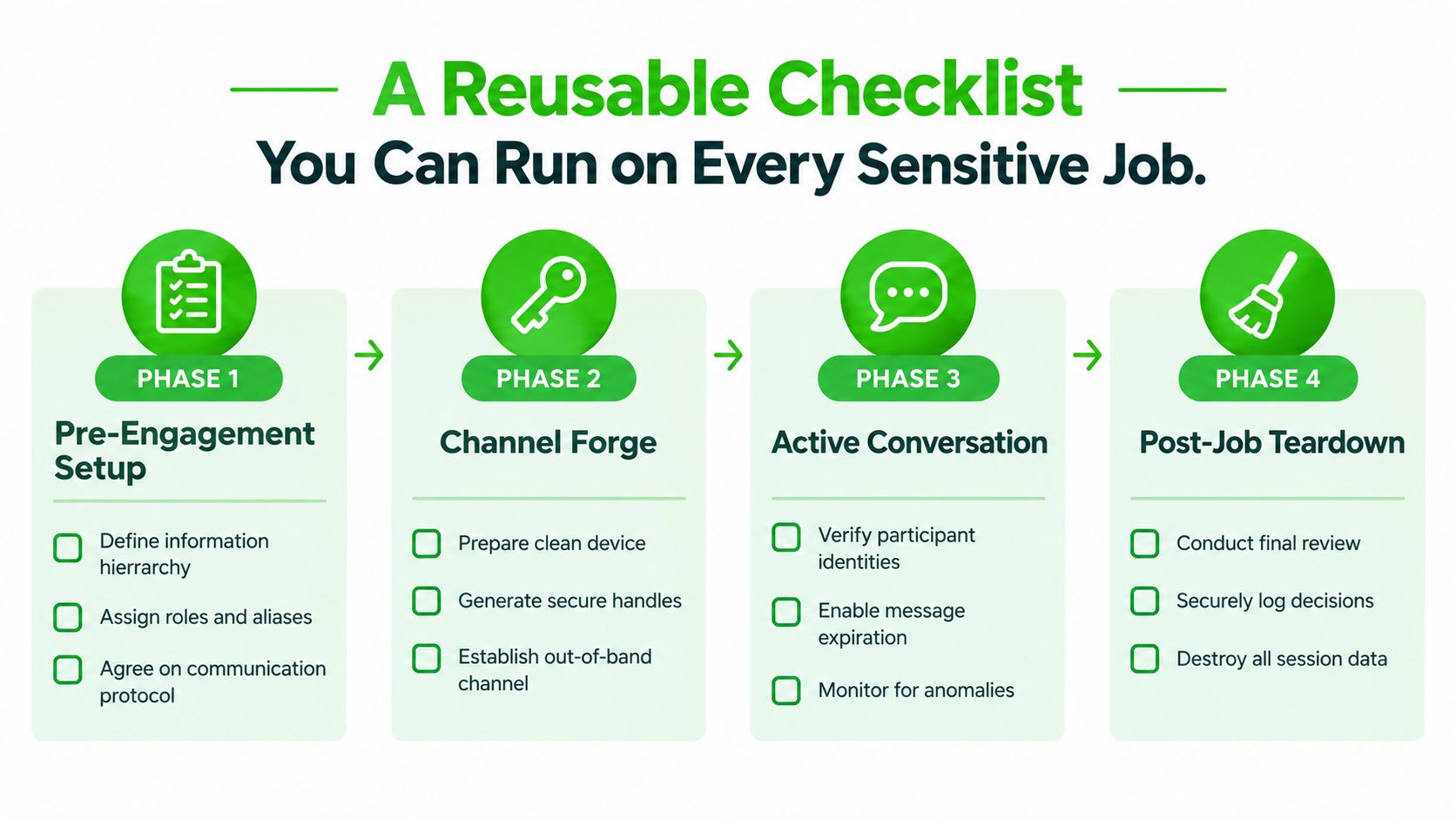
Active conversation
- Verify participants: Confirm the access result or key fingerprint before substantive discussion.
- Assume capture is possible: Don't write anything you couldn't responsibly explain if a recipient recorded the screen.
- Control files: Avoid local downloads, remove unnecessary metadata, and don't use the room as a document repository.
- Protect the clipboard: Copy only what is necessary, then clear temporary copies and avoid pasting into durable services.
- Watch for anomalies: Treat unexpected joins, access failures, changed fingerprints, and altered messages as stop signals.
- Re-verify when circumstances change: Check identities again after a device change, interruption, or unexplained reconnect.
Post-job teardown
- Review the conversation: Identify decisions that must be preserved in an approved system and records that must not be duplicated.
- Secure required records: Store only the necessary material under the organization's retention and access policy.
- Burn the session: Use manual destruction when the work ends or a compromise occurs.
- Clean local traces: Remove downloads, temporary files, screenshots, and copied fragments where lawful.
- Confirm completion: Ask participants what they retained and ensure the next channel isn't a casual continuation of the old one.
Keep four habits visible: assume every message may leak, prefer ephemeral over durable when lawful, separate confidential work from personal accounts, and rehearse the burn step before it matters. A temporary channel reduces exposure only when people know how to open it, use it, and close it without creating a second trail.
Ciphar offers browser-based, zero-knowledge encrypted chat for short, identity-free conversations, with client-side encryption, one-time channels, enforced short lifetimes, and a manual burn control. If that operating model fits your threat model and lawful retention requirements, visit Ciphar to review its security model and create a controlled channel for your next sensitive planning task.