A journalist has a source ready to talk, but neither person wants to exchange a phone number. A lawyer needs a confidential check-in with a client, yet a normal conference platform may retain recordings, transcripts, account details, or call metadata. A healthcare team may need to coordinate quickly without creating another permanent copy of a sensitive conversation.
Voice makes these situations harder than text. A spoken conversation is immediate, personal, and difficult to review before it leaves your mouth. Even when a call is encrypted while traveling across the internet, the service handling the call may still be able to access the audio, process it, or retain related records. Encryption in transit protects the connection, but it doesn't automatically make the conversation private from the service provider.
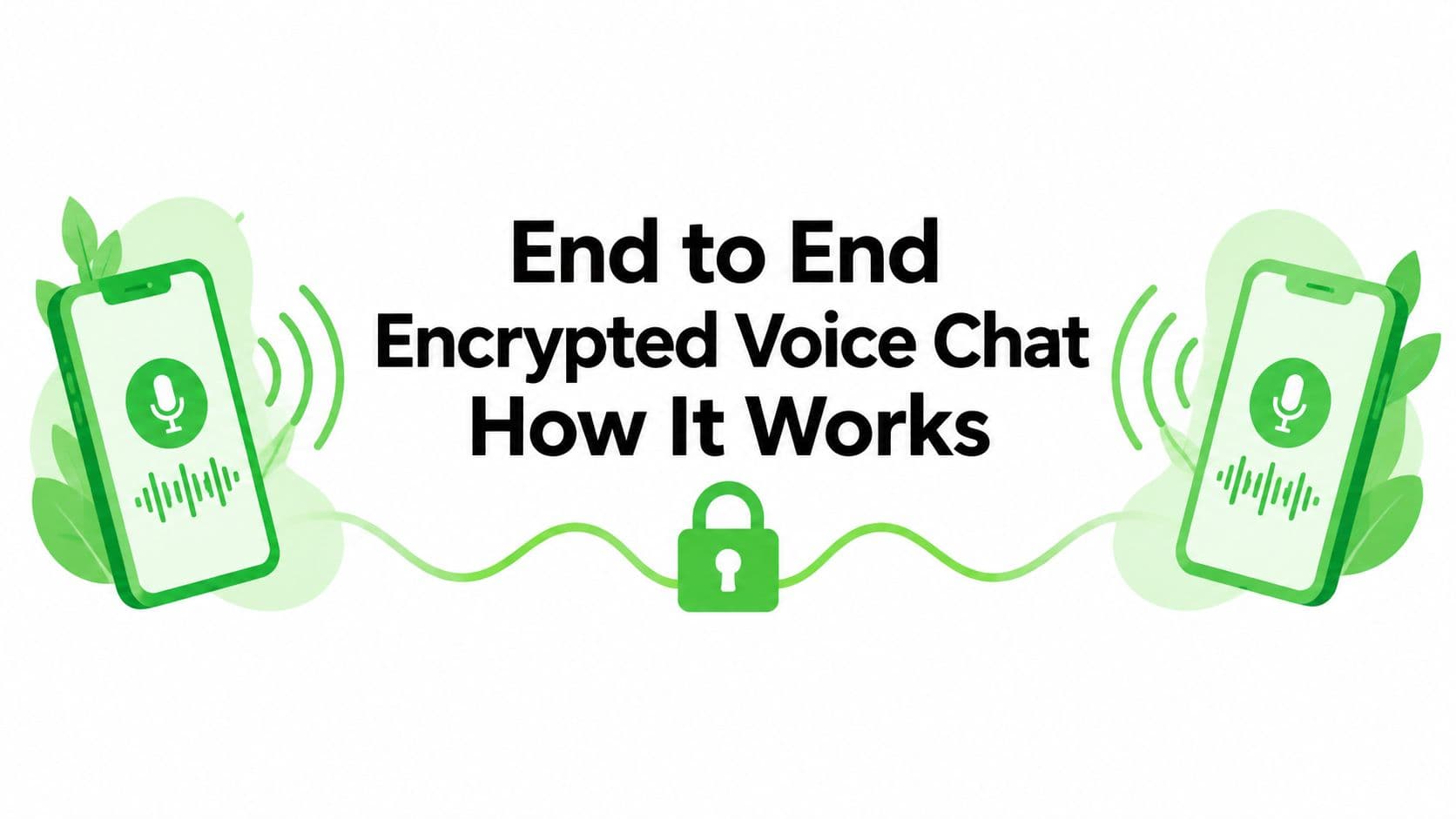
End-to-end encrypted voice chat addresses that gap by moving protection to the participants' devices. Audio is encrypted before it leaves the sender's device and decrypted only by an authorized recipient. The relay can carry packets without receiving the keys needed to understand them.
The details matter, though. You need to distinguish transport encryption from true end-to-end encryption, understand how browser-based calling handles media servers, and verify that the person on the other end is really the person you intended to reach. You also need to know what encryption can't protect, including compromised devices and some forms of metadata.
Introduction to Private Voice Conversations
Consider a first conversation between a reporter and a potential source. The reporter sends a temporary room link through one channel and shares the access key through another. They join without exchanging phone numbers, and the room disappears when the conversation ends. That workflow reduces the number of permanent identifiers attached to the call, but it only works if the voice frames themselves remain unreadable to the relay.
A conventional encrypted call can still leave the participants with an incomplete privacy guarantee. The network may protect packets between the device and the provider, then between the provider and the recipient, while the provider decrypts the media in the middle. This is useful against people watching the network, but it doesn't stop the intermediary from accessing the audio or responding to a legal demand for stored material if the service retains it.
End-to-end protection changes who holds the keys. The sender encrypts each piece of audio locally. The receiving device verifies and decrypts it. A relay may know that packets are moving between participants, but it shouldn't possess the secret that turns those packets back into speech.
That distinction becomes especially important for voice because real-time media has different engineering constraints from ordinary messaging. Audio arrives as a stream of small frames, and the system must protect each frame without introducing delays that make conversation unnatural. NIST described SRTP as a major milestone when it was released as RFC 3711 in March 2004, while its VoIP guidance noted that IPsec-protected voice could add about 80 bytes of overhead and require roughly 40 kbps of bandwidth in its voice security guidance. Those constraints help explain why media-layer encryption became central to practical calling.
This guide follows the call from key exchange to encrypted voice frames and network transport. It also examines the browser-based SFU trade-off, identity verification, temporary rooms, installed apps, and the limits that remain after encryption is enabled. By the end, you should be able to evaluate an encrypted voice tool by its architecture and controls, not merely by a security label on its website.
What End-to-End Encrypted Voice Chat Really Means
Think of a voice call as a sealed envelope. You place the words inside, lock the envelope on your device, and hand it to a courier. The courier can deliver the envelope, but can't read the contents because only the intended recipient has the key.
That analogy describes the essential property of end-to-end encrypted voice chat. The sender's device protects the audio, the recipient's device opens it, and the service in between handles delivery without receiving a usable decryption key.

Three layers of protection
The phrase encryption in transit usually means that data is protected while it travels between your device and a server, or between network services. Once the server receives the media, it may decrypt and process it. Encryption at rest protects stored data, such as recordings or messages, on a server or device, but the service may still have access to the content while its systems operate.
True end-to-end encryption adds a different boundary. Audio frames are encrypted before transmission and remain ciphertext while passing through the relay. Only an authorized participant's device has the material needed to decrypt them.
A zero-knowledge relay follows the same principle. It can route packets, enforce expiry, and sometimes report delivery status, but it shouldn't be able to inspect the voice itself. This doesn't mean the system knows nothing at all. Timing, packet flow, connection information, or room activity may still be visible depending on the design.
Why the key matters more than the label
A provider can advertise encrypted calling while retaining control of the keys. That arrangement may still protect against ordinary network interception, but it doesn't provide server blindness.
Ask a simple question: If the service's voice relay were compromised, could an attacker use the information held there to reconstruct the call? If the answer is yes, the system may provide transport security without complete end-to-end privacy. If the answer is no, inspect how participants obtain, verify, and protect their keys, because the cryptography is only as trustworthy as that surrounding process.
How Voice Encryption Works Under the Hood
A secure call combines several mechanisms. Key agreement establishes a secret, frame encryption protects each audio unit, and transport security carries the resulting packets through the network.
Step one establishes a shared secret
Participants need a matching encryption key without sending that key in readable form. In a browser-based design such as Ciphar's documented model, the browser derives a channel key locally using PBKDF2 with a per-channel salt and 100,000 SHA-256 iterations. The resulting key stays on the device rather than traveling to the relay. The explanation of how encryption keys work provides useful background on why key derivation and key storage are separate security questions.
The salt makes derived keys specific to the channel context. The repeated derivation work makes casual guessing more expensive, although no password-based design can rescue a secret that participants share publicly or choose carelessly.
Step two protects each voice frame
A microphone doesn't send one giant recording. The browser turns captured sound into a sequence of short audio frames. Each frame is encrypted with AES-256-GCM, which provides confidentiality and adds an authentication tag.
The tag is important because encryption should detect tampering, not merely hide content. If an attacker changes ciphertext while it travels, the recipient's device can reject the altered frame instead of treating manipulated data as valid audio. A nonce or IV accompanies the encrypted frame so the algorithm can process each unit safely.

Step three separates media protection from delivery
WebRTC normally protects media in transit with DTLS-SRTP. The DTLS portion helps establish authenticated session keys, while SRTP protects time audio packets as they move across the network. Industry guidance describes DTLS-SRTP as the effective default for browser peer-to-peer media from around 2013 in this WebRTC security overview.
That protection doesn't automatically equal full end-to-end privacy in a group call. Many browser systems use an SFU, or selective forwarding unit, to receive packets and forward them to participants. If the SFU terminates the DTLS session, it may decrypt the media before forwarding it.
Application-layer encryption closes that gap. A scheme such as SFrame can encrypt the voice frame above the transport layer, allowing the SFU to route media without holding the content key. The result is a deliberate trade-off: server-side access makes routing and media features easier, while server blindness requires more careful key management and can restrict features such as recording, transcription, or media processing.
Threat Model Benefits and Limitations You Should Know
Encryption protects a specific path and content boundary. It doesn't turn a device into a private room, erase every connection record, or authenticate a stranger automatically.
What end-to-end protection can provide
The strongest benefit is audio confidentiality. People monitoring the network or inspecting ciphertext at a relay shouldn't be able to listen to the call without a participant's key. Authenticated encryption also protects integrity, because altered frames can be rejected instead of accepted.
A carefully designed temporary system can reduce retained material as well. If the service doesn't record the call, doesn't create transcripts, and deletes its opaque relay data after expiry, there may be no central audio archive to retrieve later. That is different from promising that no trace exists anywhere. Participants' devices, screenshots, notes, operating-system logs, and network observations remain separate concerns.
Identity minimization is another design choice, not a mathematical consequence of encryption. A service that doesn't require an account, phone number, or persistent identifier can reduce the identity information attached to a room. For a plain-language explanation of the surrounding issue, see what metadata means in private communication.
Practical rule: Treat encryption, identity protection, and retention control as separate questions. A tool needs all three if your concern includes both content and traceability.
What remains outside the cryptographic boundary
A compromised endpoint can record the microphone before encryption or capture the speaker output after decryption. Malware, a malicious browser extension, an unattended phone, or an impersonating participant can defeat protections that work perfectly on the network.
Metadata can also survive. A relay may observe that a room exists, when participants connect, how long traffic flows, and how much data passes through it. The exact exposure depends on the service design, but encrypted content doesn't automatically mean anonymous activity.
Identity verification deserves special attention. Discord's privacy code lets participants compare a visible code out of band, but the EFF's coverage of Discord's verification design notes that verification is optional and must be repeated for each call when participants want strong assurance against impersonation or interception. A shared secret protects the channel, not necessarily the identity of the person who received it.
Operational controls can reduce damage when something goes wrong. Intrusion alerts can reveal failed access attempts, rate limits can slow guessing, and a manual burn control can terminate a sensitive room before its planned expiry. These features don't replace careful key sharing, endpoint hygiene, or identity checks. They give participants information and a way to respond.
For teams evaluating adjacent voice analysis tools, choosing a voice detection tool in 2026 is a useful reminder that audio workflows can introduce their own privacy questions. Sending decrypted audio to another service for analysis changes the threat model, even if the original call was end-to-end encrypted.

Browser-Based Voice Rooms Compared to App-Based Calling
Browser calling and installed messaging apps solve different privacy problems. A temporary browser room can minimize onboarding and persistence, while an installed messenger usually provides continuity, contact lists, notifications, and long-running groups.
WebRTC helped make encrypted browser calling ordinary. Browser media is generally protected with DTLS-SRTP, and that shift moved encrypted calling from specialized secure-phone products into mainstream web communication. The remaining question is whether the application adds another encryption layer when an SFU handles the media.
A browser room can fit a first conversation where participants don't want to exchange phone numbers or create accounts. An installed app can be more practical for a known team that needs persistent relationships, recurring calls, and established contacts. Neither choice is automatically safer. Examine defaults, key handling, identity signals, fallback behavior, and retention.
| Feature | Browser Ephemeral Room | Installed Messenger |
|---|---|---|
| Setup | Opens in a browser, often without an account or installation | Requires an app and usually an account or persistent profile |
| Identity exchange | Can support a link and separately shared access key | Often tied to usernames, phone numbers, contacts, or account identities |
| Retention | May be designed to expire and avoid archives | Commonly supports persistent conversations and history |
| Group continuity | Useful for short-lived coordination | Better suited to ongoing groups and recurring contacts |
| Platform coverage | Browser support can vary by browser and device | Installed clients may offer deeper device integration |
| Media architecture | Requires checking whether an SFU can decrypt media | Depends on the provider's calling protocol and server design |
| Fallback risk | A weak fallback can undermine the stated guarantee | E2EE should be default and unencrypted fallback should be clearly handled |
Platform parity remains a practical issue. Discord's migration showed that browser and console support lagged behind other clients until 2025, and the service reported that by March 2026 it had made E2EE standard across direct messages, group direct messages, voice channels, and Go Live while removing unencrypted fallback code in its support documentation. The lesson isn't that every service follows the same schedule. It is that a privacy promise should cover every client participants use.
For a wider comparison of browser-based privacy workflows, secure web messaging offers useful context. If your organization also monitors impersonation concerns across digital interactions, an identity risk alerting platform can address a different layer of the problem. It won't replace call encryption, but it may help teams think about identity threats beyond the media channel.
Real-World Use Cases and Practical Examples
A reporter creates a one-time channel with a human-readable name and sends the access link to a source. The reporter shares the per-channel key through a separate route, then asks the source to confirm an encrypted test blob before discussing details. They can burn the room manually afterward instead of relying only on automatic expiry.
The workflow avoids a phone-number exchange, but it doesn't pretend that the source is verified by encryption alone. The reporter still needs an independent way to confirm the source's identity and must consider whether either device could be monitored.

A lawyer uses a temporary room for an initial privileged check-in with a client who hasn't yet joined the firm's regular communication system. The lawyer shares the access key out of band, checks that the client sees the expected verification result, and avoids recording the call.
That setup can reduce unnecessary copies, but it isn't a substitute for the firm's compliance obligations or approved long-term systems. A temporary room is appropriate only when its retention limits and lack of recovery match the legal workflow.
A healthcare team might use a short-lived channel to coordinate an urgent operational question among known participants. They can use the room's access verification and intrusion notices, then force a burn when the coordination ends. The team should avoid treating a privacy-focused room as a regulated record system unless the organization has independently approved it for that purpose.
Ephemerality is a constraint by design. It helps prevent accumulation, but it also removes recovery.
A security researcher and an incident responder may need an off-the-record disclosure session without adding another account to a contact graph. They can create the room, exchange the key separately, verify access with a test payload, and end the session when the discussion is complete. If the work requires a durable audit trail, searchable history, or repeated collaboration, a persistent encrypted messenger is the better fit.
Across these examples, the pattern stays consistent: initialize the channel, share the secret separately, verify that the participant can decrypt, communicate, and burn or allow expiry. The process protects against careless access sharing, but it can't solve endpoint compromise or prove a participant's identity without an independent check.
Choosing and Verifying Your Encrypted Voice Setup
Before a sensitive call, ask these questions:
- Default protection: Is end-to-end encryption enabled automatically, or can the call use a weaker mode?
- Key control: Does the provider hold a decryption key, or are keys derived and retained only on participant devices?
- Media path: Can an SFU or media server decrypt the audio, or does an application-layer scheme preserve server blindness?
- Identity check: Can participants compare a privacy code, certificate, or encrypted test blob through a separate channel?
- Retention behavior: Does the service record audio, create transcripts, retain history, or enforce a clear deletion rule?
- Incident response: Will failed access attempts trigger alerts, and can participants burn the room immediately?
Share access keys out of band. Don't put the link and its secret in the same exposed message, and don't assume a correct key proves that the recipient is trustworthy. If an intrusion alert appears, stop discussing sensitive material, verify the participant and channel through another route, and terminate the room if the event can't be explained.
A browser-based ephemeral room fits short, identity-light conversations where no installation, account, phone number, archive, or recovery is wanted. A persistent app fits ongoing relationships where contact continuity and history matter more. The right choice follows from your threat model, not from the word “encrypted” alone.
Ciphar provides browser-based encrypted voice rooms with client-side voice-frame encryption, per-channel access keys, and temporary channels that self-destruct after sixty minutes. For a short conversation where you want to avoid accounts and permanent room history, visit Ciphar and review the security model before your next call.