You're probably already having at least one conversation that doesn't belong in a normal inbox, a shared team chat, or a phone text thread. It might be a journalist checking whether a source feels safe enough to talk. It might be a lawyer sending instructions before a filing. It might be a healthcare coordinator trying to safeguard PHI in virtual sessions without creating extra exposure along the way.
In moments like that, people often hear the word “encrypted” and assume the problem is solved. It usually isn't. Many services protect data while it travels across the network, but still allow the provider to read it on the server side. If the server is breached, misconfigured, or compelled to hand over content it can access, your “private” conversation may be less private than you thought.
That's where end to end encryption explained in plain language becomes useful. Not as an app popularity contest, but as a way to understand what's protected, what isn't, and why short-lived browser chat can make sense for first contact when you don't want accounts, phone numbers, or a permanent archive.
Why End to End Encryption Matters Right Now
A lot of sensitive conversations begin before trust exists.
A source doesn't want to install a new app yet. A client doesn't want to give a personal number to a law office intake team. An incident responder needs a fast channel for screenshots and short voice notes, but doesn't want the exchange sitting in a server archive next month. In each case, the first question isn't “which messenger is most popular?” It's “who else can read this, and how long does it stick around?”
Ordinary encryption often protects the road, not the message
Think about the difference between a locked delivery truck and a sealed envelope.
If a service uses transport encryption only, the truck is locked while moving. That matters. It stops casual interception on the network. But once the truck reaches the company warehouse, the service may still open the envelope, index it, back it up, or store it in readable form.
End to end encryption changes that model. The message is sealed before it leaves your device, and only the intended recipient can open it. The provider still helps deliver it, but can't casually inspect the contents.
Private communication isn't just about blocking outsiders on the wire. It's also about limiting what the service itself can know.
Why browser chat changes the conversation
People sometimes dismiss browser-based secure chat because it doesn't look like a traditional encrypted app. That's the wrong starting point. The better question is whether the tool fits the threat model.
For first-contact conversations, a browser can remove friction that causes people to fall back to weak channels. No app install. No account creation. No phone number exchange. A temporary room, a separate access key, and a fixed expiration can be exactly what a journalist, lawyer, or responder needs when the goal is to speak briefly and leave as little behind as possible.
That's also why ephemeral and zero-knowledge matter. Ephemeral means the system is designed to forget. Zero-knowledge means the relay can move data without holding the keys needed to read it.
The practical stakes
When people get confused about encryption, they often ask the wrong question. They ask, “Is it encrypted?” The more useful questions are:
- Who holds the keys
- Can the provider read the content
- What metadata is still exposed
- What happens if the server is breached
- Does anything remain in backups or archives
- Can the conversation self-destruct on purpose
Those are the questions that determine whether a tool is merely convenient or protective.
What End to End Encryption Really Means
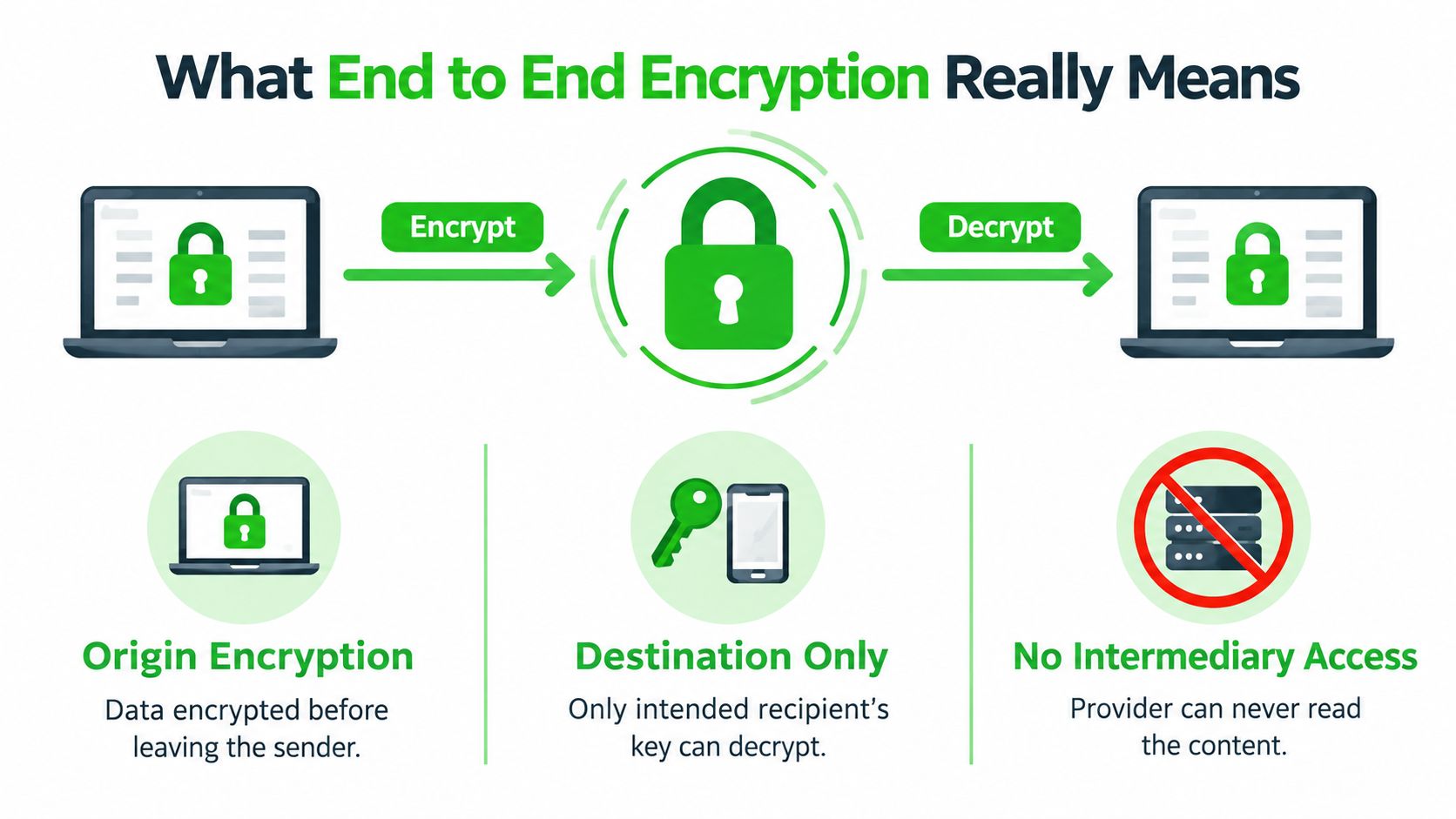
The clearest definition still comes from a historical government framing. A 2008 U.S. Government Accountability Office report defined end-to-end encryption as encrypting information at its origin and decrypting it only at its intended destination, with no intermediate decryption. That date matters because it shows this isn't a marketing phrase from the modern messaging era. It's a specific security model with a long-standing meaning.
The envelope test
Use a simple test. If the provider can open the message at any point in readable form, it isn't true end-to-end encryption in the strict sense.
A postcard is readable by anyone handling it. A sealed envelope hides the contents from the mail carrier. End-to-end encryption works like the sealed envelope, except stronger. The message is encrypted on the sender's device before it leaves, and it's decrypted only on the recipient's device.
What intermediaries can and can't do
Servers still matter in an end-to-end system. They route traffic, buffer messages, and manage delivery. But they should only handle ciphertext, not plaintext.
That distinction is where many readers get tripped up. They hear “the server processes the message” and assume that means the server can read it. Not necessarily. In a real E2EE design, the server can move the package without having the key to open it.
Here's the mental model:
- Sender device: Encrypts before sending
- Network and server: Relay unreadable ciphertext
- Recipient device: Decrypts after receiving
How this differs from encryption in transit
Transport encryption, such as TLS, protects the connection between you and a service. It's important, but it solves a narrower problem. It helps stop interception while data is moving between points.
End-to-end encryption protects the content from the service provider itself. That's why it's more accurately understood as a client-side confidentiality control than a network-layer one. If the keys stay with the endpoints, the provider can't inspect message content from its own systems.
Practical rule: If a company can help you recover the message content without your device keys, the system may be secure in transit, but it isn't zero-knowledge end-to-end in the strongest sense.
For non-technical professionals, that's the key takeaway. End to end encryption explained plainly means this: the service transports your message, but it can't read it.
How End to End Encryption Works Under the Hood
The mechanics sound intimidating until you separate them into jobs.
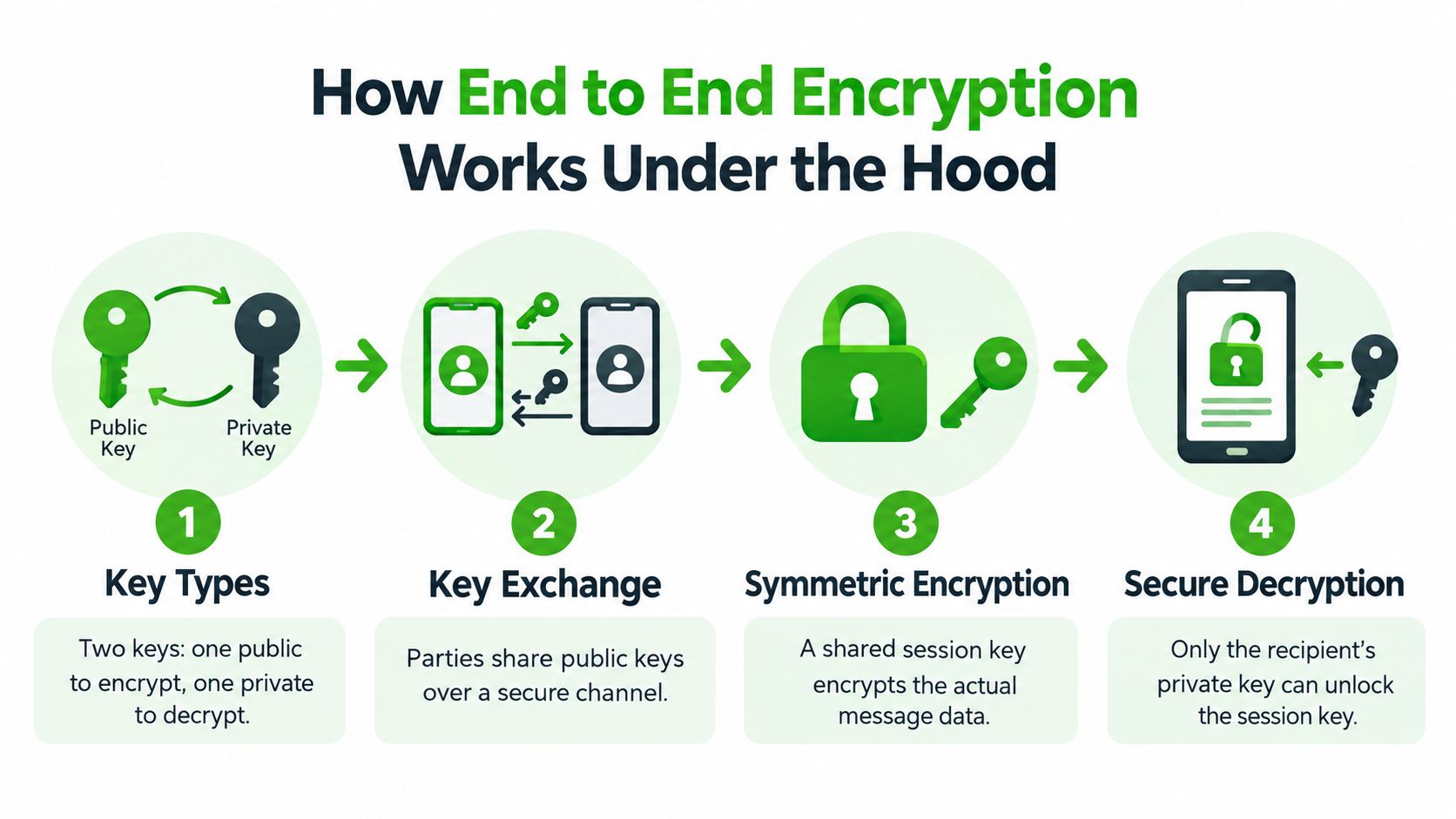
One set of cryptography helps two people establish secret material. Another set encrypts the actual message quickly. A sound design combines both.
Two kinds of keys do different work
Public-key cryptography is useful for introductions. Symmetric encryption is useful for volume.
With public and private keys, you can share something openly and still keep a corresponding secret private. That makes it possible to establish a shared secret without sending that secret itself in readable form. If you want a deeper plain-English walkthrough, how encryption keys work is worth reading alongside this section.
Once a shared secret exists, systems usually switch to a symmetric cipher for the message body because it's faster and better suited to continuous chat traffic.
The elegant part of modern messaging is that it uses slower cryptography to agree on a secret, then faster cryptography to protect the conversation.
The common flow inside a secure chat
A E2EE design typically follows this pattern, as described in technical documentation on key exchange and payload protection.
Key establishment
The participants use an asymmetric method to agree on shared secret material.Key derivation
If a password or channel key is part of the design, a derivation function such as PBKDF2 turns it into a stronger encryption key. A per-user or per-channel salt helps ensure identical passwords don't produce identical keys.Message encryption
The actual message is encrypted with a fast symmetric algorithm. Many modern systems use AES-256-GCM, an AEAD mode that binds confidentiality and integrity together.Integrity check on receipt
The recipient doesn't just decrypt. The system also verifies that the ciphertext wasn't altered. If tampering occurred, decryption should fail rather than produce misleading output.
Why IVs, salts, and authentication tags matter
People often focus only on “what cipher is used,” but supporting details matter just as much.
- Fresh IVs: A new random initialization vector for each encryption reduces the risk of dangerous reuse patterns.
- Salted derivation: Salts make password-derived keys less predictable across channels or users.
- Authentication tags: In AEAD modes like AES-256-GCM, the tag helps detect tampering.
This video gives a helpful visual explanation before you return to the browser-specific trade-offs later in the article.
Why this matters in practice
If someone intercepts ciphertext without the right key, they shouldn't be able to read it. If they alter it, the recipient should see a failure, not a plausible but corrupted message. That combination is what makes modern E2EE trustworthy in day-to-day use.
The important thing for non-technical readers is this. Encryption isn't one lock. It's a sequence of controls that establish secrecy, preserve integrity, and limit who can ever see plaintext.
Common Protocols and Real World Implementations
The phrase “encrypted messaging” covers very different designs. Some tools make end-to-end encryption the default. Some make it optional. Some protect one-to-one chats but not every group scenario. Some are still evolving toward cross-platform coverage.
That's why the useful comparison isn't app branding. It's where E2EE is active.
Why the label on the box isn't enough
A service can say messages are encrypted and still leave readers with the wrong impression. It may mean TLS between your phone and the provider. It may mean server-side encryption at rest. It may mean end-to-end protection only in certain chat types.
A 2025 study of RCS deployment and MLS adoption noted that RCS historically relied on TLS only, Google's E2EE covered only one-to-one chats, and full cross-platform E2EE was still evolving with MLS in Universal Profile 3.0. That's a good example of how “encrypted” can be true while still being incomplete.
Where E2EE Is Actually On by Default
| Platform Approach | E2EE Default | Group Chat Coverage | Key Limitation |
|---|---|---|---|
| Signal Protocol style messaging | Often designed around default E2EE | Strong group protection is a core expectation | May require app adoption and identity onboarding |
| WhatsApp style implementation | Commonly presented as default for chats | Group coverage exists, but users still need to think about backups and linked devices | Metadata and backup choices still matter |
| Telegram Secret Chats model | Not always default across all chats | Limited by mode choice rather than universal coverage | Users can mistake ordinary cloud chats for E2EE |
| RCS with MLS evolution | Historically inconsistent across clients and chat types | Cross-platform and full group coverage are still maturing | Support depends on standards, clients, and rollout state |
| Browser-based ephemeral room model | Can be end-to-end if encryption occurs client-side before relay | Usually designed for short-lived sessions rather than broad social messaging | Browser delivery trust and endpoint hygiene matter more |
Matching the tool to the job
A persistent messenger and an ephemeral browser room solve different problems.
If two colleagues need an ongoing record, stable identity, and long-running group collaboration, a mainstream secure messenger may fit better. If a source needs first contact without sharing a phone number, a temporary browser channel may be safer and simpler.
That's also where adjacent tools matter. If you're designing a broader secure workflow around temporary channels, identity steps, and access sharing, it can help to check usepassflow.com for process ideas that sit around the chat layer rather than inside it.
Questions worth asking before you choose
- Is E2EE on by default, or only in a special mode
- Does it cover groups, attachments, and voice
- Do backups weaken the model
- Does the system require a phone number or account
- Does the conversation persist longer than the risk justifies
Those questions cut through marketing quickly.
Browser Based Encryption Challenges and How Ciphar Mitigates Them
Browser-based secure chat deserves a more honest discussion than it usually gets. People either romanticize it or dismiss it. The truth sits in the middle.
A browser can be a practical place to do end-to-end encryption, but only if the design acknowledges browser realities. The key question isn't whether the browser is magical. It's whether the message is encrypted on the client before the relay sees it.
The clearest plain-language version of that point appears in HP's explanation of encrypted text messaging, which notes that true E2EE means data is encrypted on the sender's device and can only be decrypted on the recipient's device, leaving the service provider unable to read the content even while relaying it.
The real risks in a browser setting
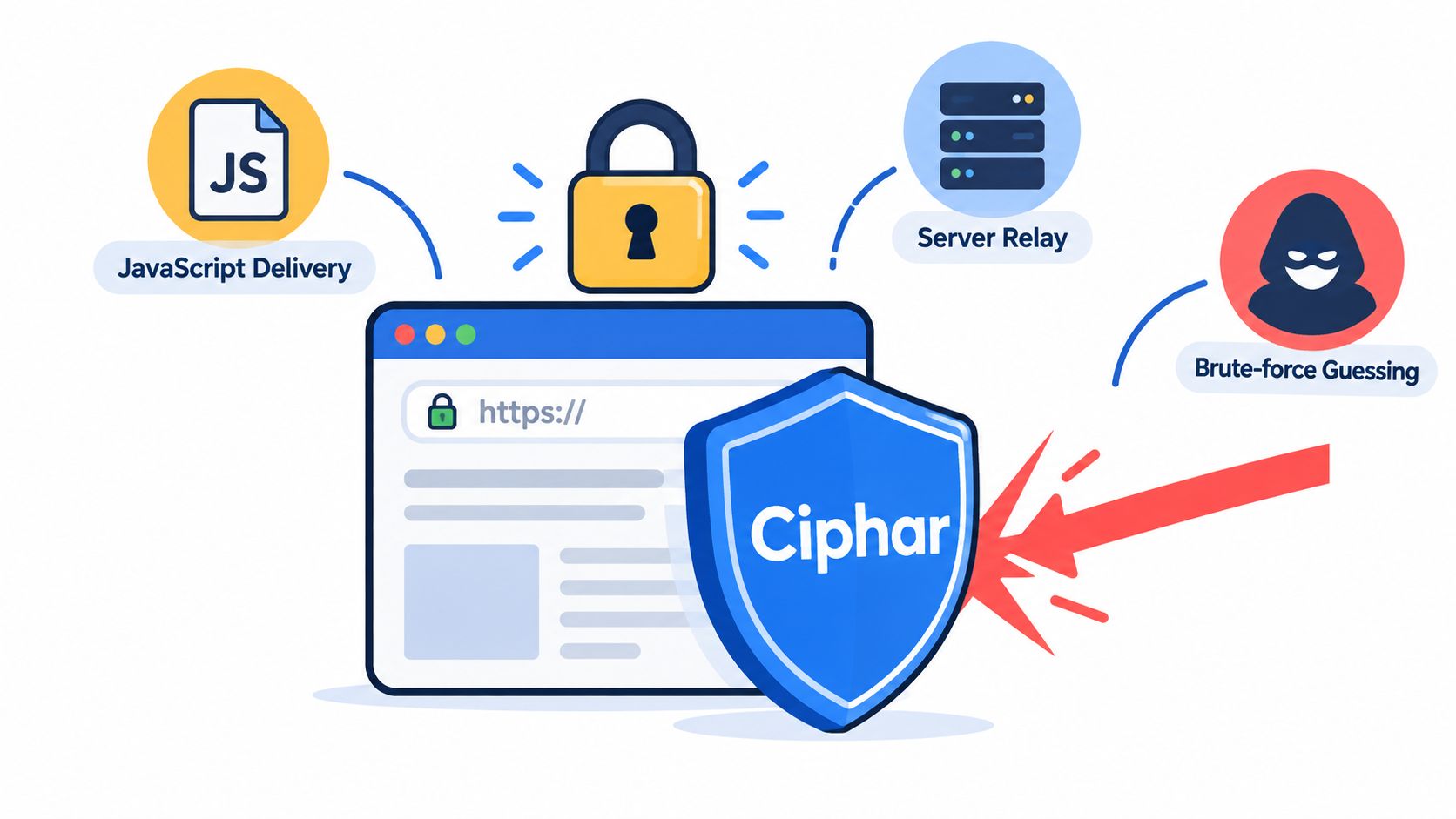
A browser-based system faces several specific concerns:
- JavaScript delivery trust: The code that performs encryption is delivered through the web, so users are relying on the integrity of what the browser loads.
- Relay visibility: Even if the server can't read content, it can still observe that a room exists and route traffic.
- Guessing attacks: If access depends on a shared secret, attackers may try repeated guesses.
- Retention drift: Temporary chat isn't temporary if the system keeps history or allows indefinite room life.
Those are not reasons to reject browser chat. They're design constraints.
What mitigation looks like in practice
One browser-based model is secure web messaging in a zero-knowledge relay design. In that model, Ciphar uses client-side AES-256-GCM for messages, files, replies, edits, and voice frames, and derives keys in the browser with PBKDF2 using 100,000 SHA-256 iterations plus a per-channel salt. That setup keeps decryption keys on the endpoints rather than the relay.
For access control, the system uses an encrypted test blob so only participants with the correct channel key can successfully enter. For abuse resistance, failed access attempts generate intrusion alerts and are rate-limited, which gives participants a signal that someone may be guessing.
Operational insight: Browser encryption becomes much more credible when the relay stores only opaque cryptographic material and expiration data, not readable transcripts.
Why ephemerality changes the threat model
Ephemeral design matters more than many explainers admit.
A hard 60-minute self-destruct window changes the value of a server compromise because there's no long-term archive to seize later. A manual burn function tightens that further by allowing participants to wipe a session immediately. No archive and no recovery aren't feature omissions in this context. They're security choices.
That makes browser-based, zero-knowledge chat especially useful for:
- Journalists and sources: First contact without identity exchange
- Lawyers and clients: Short privileged exchanges before moving to a long-term channel
- Responders and researchers: Fast coordination that shouldn't linger after the incident window closes
It doesn't replace every messenger. It serves a narrower job, and for that job the constraints are part of the protection.
What End to End Encryption Does Not Protect
The most common misunderstanding is simple. People hear “end-to-end encrypted” and translate it to “private in every possible sense.” That's too broad.
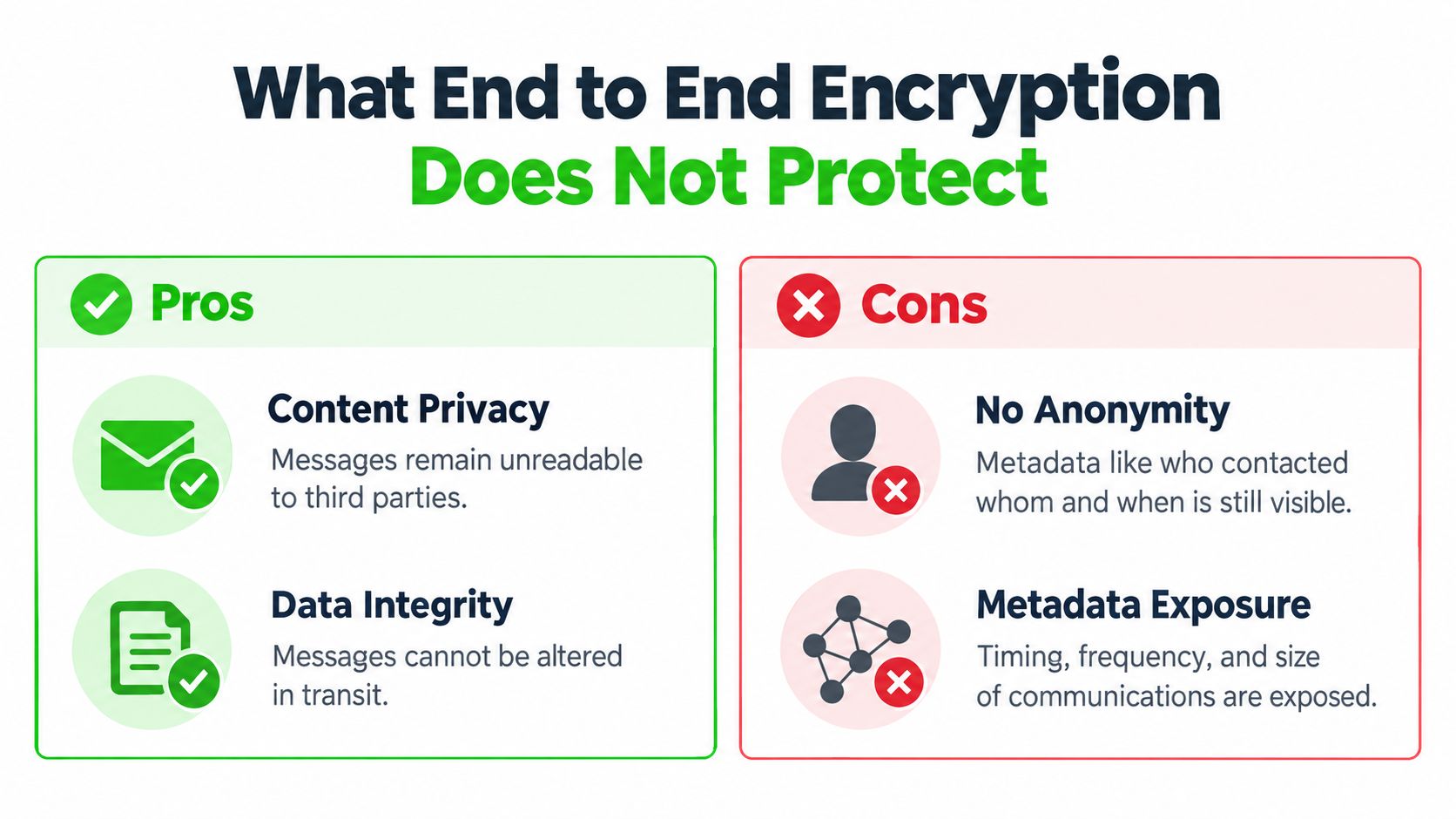
E2EE protects message content from unauthorized reading by intermediaries and providers in a properly designed system. It does not automatically hide the surrounding facts of communication.
Metadata still tells a story
A recent explainer on the limits of secure communications notes that E2EE doesn't provide anonymity because providers can still see metadata such as who contacted whom, when, and sometimes location via IP address in some systems. If you want a plain-English grounding on that point, what metadata means is a useful companion read.
Metadata can reveal patterns even when content stays sealed. Frequency, timing, and communication relationships can all matter. For some users, that distinction is academic. For journalists, legal teams, and high-risk contacts, it can be central.
Backups and endpoints can undo the protection
A second weak point sits outside the encrypted transport path. A neutral explainer on E2EE limitations notes that protection can be undermined by unencrypted backups, devices that have been accessed, or spyware on the endpoint, as described in this overview of what end-to-end encryption does and doesn't cover.
That's why a message can be strongly encrypted in motion and still be exposed later.
- Cloud backup risk: If chat history or attachments are copied into weaker storage, the secure channel no longer tells the whole story.
- Compromised device risk: If malware can read the screen or memory after decryption, the cryptography didn't fail. The endpoint did.
- Shared device risk: If someone else can access the device, they may not need to break encryption at all.
Why policymakers care so much about this now
Encryption isn't a niche issue anymore. A 2026 U.S. Congressional Research Service brief reported that judges authorized 2,297 wiretaps in 2024, encrypted communications appeared in 608 of those cases, and law enforcement could not decrypt content in 533 of the encrypted-communication cases, which is about 88% of the times encryption was encountered in that dataset (Congressional Research Service brief).
Those figures show why E2EE has become a central operational and policy question. They also show the limit of simplistic narratives. Strong encryption can block content access, while metadata, device compromise, and backup practices still create other forms of exposure.
Adoption is real, but maturity is uneven
Coverage also varies across the data lifecycle. One 2025 report found that 81% of organizations use E2EE for supplier communications, while another finding in the same report says 76% use it for data in transit but only 42% use AES-256 for data at rest (global encryption trends report).
So when a team says, “we use encryption,” the next question should be, “where exactly?”
Practical Best Practices for Private Conversations
If you need a short decision framework, start with purpose and retention.
A persistent team messenger is fine when you need continuity, known identities, and a searchable record. A temporary channel is better when you need first contact, minimum friction, and as little retained material as possible. Don't force one tool to serve both jobs.
A workable checklist for real conversations
- Choose for the threat model: If the risk is provider access or server breach, use a tool where keys stay on endpoints and the relay only handles ciphertext.
- Share secrets out of band: If a room or channel uses a separate access key, send that key through a different path than the room link.
- Verify who joined: Don't assume the right person is present just because the room opened. Confirm with agreed details.
- Keep retention intentional: If the exchange should be short-lived, prefer tools with enforced expiry or burn controls over tools that accumulate history.
- Turn off convenience that weakens privacy: Avoid loose backups, synced histories, and unattended unlocked devices when the conversation is sensitive.
- Use the browser for the right phase: Temporary browser chat is often strongest at first contact, triage, and rapid coordination. Long-running collaboration may belong in a different system.
Calibrate your expectations correctly
A major point that many explainers skip is this: encryption alone doesn't equal anonymity. Service providers may still see metadata such as who contacted whom, when, and sometimes location via IP address.
That doesn't make E2EE weak. It means you should use it with clear eyes.
Private content, limited retention, and low-friction access can be a powerful combination, but only when users know exactly what is and isn't being protected.
For journalists, lawyers, healthcare coordinators, and responders, the best practice is often simple. Keep the first conversation brief, separate the access secret from the access path, avoid leaving a durable archive by default, and move to a longer-term tool only after trust and workflow requirements are clearer.
Ciphar offers a browser-based, zero-knowledge encrypted chat option built for short, identity-free conversations, with client-side encryption, separate access keys, and a hard sixty-minute self-destruct window. If this article's threat model sounds like yours, especially for first contact or rapid confidential coordination, visit Ciphar to see how that approach works in practice.