You receive a sensitive message at the worst possible moment. A manager sends HR details over SMS, a doctor confirms a diagnosis through a personal WhatsApp account, or a journalist emails a source whose identity must stay confidential. The sender may believe the conversation is private because the app displays a lock icon. The question is broader: who can read the content, identify the participants, observe the exchange, retain copies, or exploit a compromised device?
A secure communication system is a coordinated set of technical and operational choices that answers those questions. It combines encryption, identity controls, metadata minimization, retention rules, endpoint protection, and recovery procedures. Encryption matters, but it's only one layer.
Secure communication has moved from specialized infrastructure into everyday digital life. Public-key cryptography arrived in 1976, when Whitfield Diffie and Martin Hellman introduced a way to secure communications without first sharing a secret key. The U.S. later adopted the Data Encryption Standard, or DES, in the late 1970s, while military communications had already used one-time tapes and primitive rotor-based key generators for sensitive traffic, as described in this history of secure military communications. Modern encrypted chat, VPNs, and protected web traffic grew from that shift toward scalable digital security.
What a Secure Communication System Is Solving
The everyday problem isn't usually a lack of encryption. It's a mismatch between the conversation and the channel.
A text message may expose sensitive information to a mobile carrier, remain in device backups, appear in notifications, or be forwarded without control. A personal messaging app may protect message content while still linking the participants through phone numbers, contact lists, timestamps, and account records. Email may preserve a complete historical record when the sender needed a short-lived exchange instead.
Four questions define the system
A practical secure communication system should make four decisions explicit:
- Who can read the message? Encryption should prevent unauthorized parties, including the service provider where possible, from reading content.
- Who can identify the participants? Identity controls should help each person verify that the other party is genuine, rather than merely controlling the right account.
- How long does the message exist? Retention should match the workflow. A legal record may need controlled preservation, while a one-time credential hand-off may create risk if it remains readable.
- What metadata is exposed? Even when content is protected, systems may reveal who contacted whom, when the exchange occurred, how often participants communicated, and whether devices were online.
These layers protect different things. A system can keep a message confidential yet expose a contact relationship. It can delete server-side content while leaving screenshots, notifications, browser artifacts, or copied text on an endpoint. It can hide identities from the provider while making impersonation easy for the recipient.
Practical rule: Choose the channel by the consequences of exposure, not by the presence of an encryption label.
For journalists, lawyers, healthcare teams, and incident responders, the right design depends on the workflow. A long-term trusted conversation needs dependable identity and continuity. A regulated exchange needs governance and records. A sensitive first contact may need minimal identity and deliberate non-retention. The rest of the system follows from that choice.
The Core Building Blocks of a Secure Channel
A secure channel is easier to evaluate when you separate its parts. Each primitive answers a different question, and a failure in one layer can undermine an otherwise strong design.
Content protection begins with authenticated encryption
Think of a sealed envelope with a tamper-evident strip. Authenticated encryption aims to provide both confidentiality and integrity. It should stop outsiders from reading the message and detect unauthorized changes.
Modern systems commonly use authenticated suites such as AES-GCM or ChaCha20-Poly1305. A published hybrid-cryptography implementation describes AES-256-GCM for message confidentiality, password-derived protection using PBKDF2 with 100,000 iterations, and client-side key handling in its design documentation on ephemeral messaging and legal preservation. The exact algorithm matters, but so do nonce handling, key storage, implementation quality, and secure updates.
Key exchange lets strangers establish privacy
Two participants need a shared secret without sending that secret in readable form. Diffie-Hellman key exchange, including modern forms such as X25519, solves this problem conceptually like two people mixing paint in public. Each person contributes a private color, exchanges a public mixture, and combines it with their private color to produce a shared result that observers can't easily reproduce.
Key derivation then turns passwords or shared material into cryptographic keys. Strong derivation slows guessing, while per-conversation salts prevent one reused password from producing the same key everywhere. The security model and protocol details should be available for review in a tool's secure communication protocols documentation.
Authentication prevents the wrong person from joining
Encryption doesn't prove who sits at the other end. Identity verification may use safety numbers, cryptographic fingerprints, verified devices, or a trusted out-of-band check. Trust on first use can be useful, but it carries a clear risk: if the first key is replaced by an attacker, the user may trust the impostor indefinitely.
Transport security adds another layer. Certificates help clients authenticate servers and establish protected connections, but certificate failures can also reveal configuration, time, trust-store, or hostname problems. A practical Linux certificate troubleshooting guide can help administrators distinguish certificate-chain issues from broader application security problems.
Metadata and retention complete the picture
A sealed letter still has an address, a delivery route, and a time stamp. Communication systems may expose connection records, message timing, routing details, push notifications, access logs, backups, and contact-discovery activity.
Retention works like disappearing ink, but only if the system enforces it. A delete button that removes a display while preserving server copies isn't equivalent to server-side destruction. The gap between encryption, metadata, and retention is where many operational failures begin.
End-to-End, Zero-Knowledge, and Ephemeral Channels Compared
These architectures solve different problems. Treating them as interchangeable makes tool selection harder.
End-to-end encrypted messengers keep message keys on participant devices and protect message contents from the provider. Signal, WhatsApp, and iMessage are familiar examples. They're designed for continuing conversations, contact continuity, and regular use. Their surrounding systems may still handle phone numbers, contacts, timestamps, delivery events, or device status.
Zero-knowledge relays encrypt content before storage so the relay can't ordinarily read the stored payload. This model suits protected documents and hosted data, but the browser session, account recovery path, client device, and metadata can still affect the overall result. “Zero-knowledge” describes what the provider can do with ciphertext. It doesn't automatically describe every place where readable content may appear.
Ephemeral channels reduce exposure by making short-lived communication the default. They can avoid stable account identity and remove content after a defined period or event. That helps for first contact, one-off disclosures, and brief coordination, but it's a poor fit when a team needs durable history, search, compliance retention, or dependable account recovery.
Architectural patterns at a glance
| Property | End-to-End, Signal or WhatsApp | Zero-Knowledge Relay, ProtonMail-style storage | Ephemeral Channel, Ciphar |
|---|---|---|---|
| Content encryption | Protects content between participating devices | Encrypts content before or during storage | Encrypts content before relay storage |
| Provider visibility of metadata | May retain account and delivery metadata | May retain account, session, and access metadata | Designed to minimize stable identity and retained content |
| Identity model | Usually account or phone-number based | Commonly account based | Can avoid account, phone, or email enrollment |
| Retention default | Persistent conversation history is common | Persistent storage is common | Short-lived storage is the defining control |
| Typical failure mode | Endpoint compromise, impersonation, or metadata exposure | Client session, recovery path, or metadata exposure | Lost access, lack of audit history, or endpoint residue |
The right choice depends on the conversation. Use an end-to-end messenger for ongoing personal communication where participants need continuity. Use a zero-knowledge storage service for controlled document collaboration where retention and recovery are requirements. Use an ephemeral, identity-minimizing design for a sensitive disclosure or short-lived hand-off. The zero-knowledge encryption overview provides useful context for separating provider blindness from complete system privacy.
The Threat Model and Where Encryption Stops Working
A useful threat model has three rings. The center is message content, the middle is metadata, and the outside is the endpoint where keys, notifications, copied text, and sessions live.
End-to-end encryption protects the center well when implemented correctly. It doesn't automatically hide that two devices communicated, when they exchanged messages, or which accounts participated. Independent analysis of secure messaging found that metadata can remain exposed through routing, push delivery, and contact-discovery paths. A 2024 measurement across 21 secure messaging apps found that 11 leaked metadata, such as user IDs or phone numbers, to push services, while 4 leaked actual message content outside the encrypted channel, according to this analysis of metadata exposure in encrypted messaging.
What an observer may still learn
A party with legal compulsion, access to service records, or visibility into network operations may learn:
- Communication relationships, including which accounts or devices interacted.
- Timing patterns, such as when messages were sent and how frequently.
- Device information, including identifiers and delivery status.
- Account relationships, such as phone numbers, group membership, or contact-discovery results.
- Endpoint residue, including notifications, clipboard contents, screenshots, browser data, and synced contacts.
Consider a confiscated laptop. If the disk is accessible, the attacker may not obtain readable server-side ciphertext, but they could still find notification text, copied passages, cached attachments, browser session data, or a synchronized contact list. Malware on the device can read messages before encryption or after decryption, because the endpoint has to display the content to the user.
The misunderstanding is widespread. 52% of security decision-makers incorrectly believe encryption protects metadata, 47% think it prevents impersonation, deepfake, or spoofing attacks, and 41% believe communications remain secure after device compromise, according to BlackBerry's analysis of secure communications in 2026.
The plain-language explanation of communication metadata helps make the outer rings easier to assess. Security isn't binary. Each control reduces one attack surface, while leaving another untouched.
An Assessment Checklist for Any Secure Communication System
A buyer doesn't need to read every protocol specification to ask useful questions. Start with the following checklist, then require clear answers from the vendor.
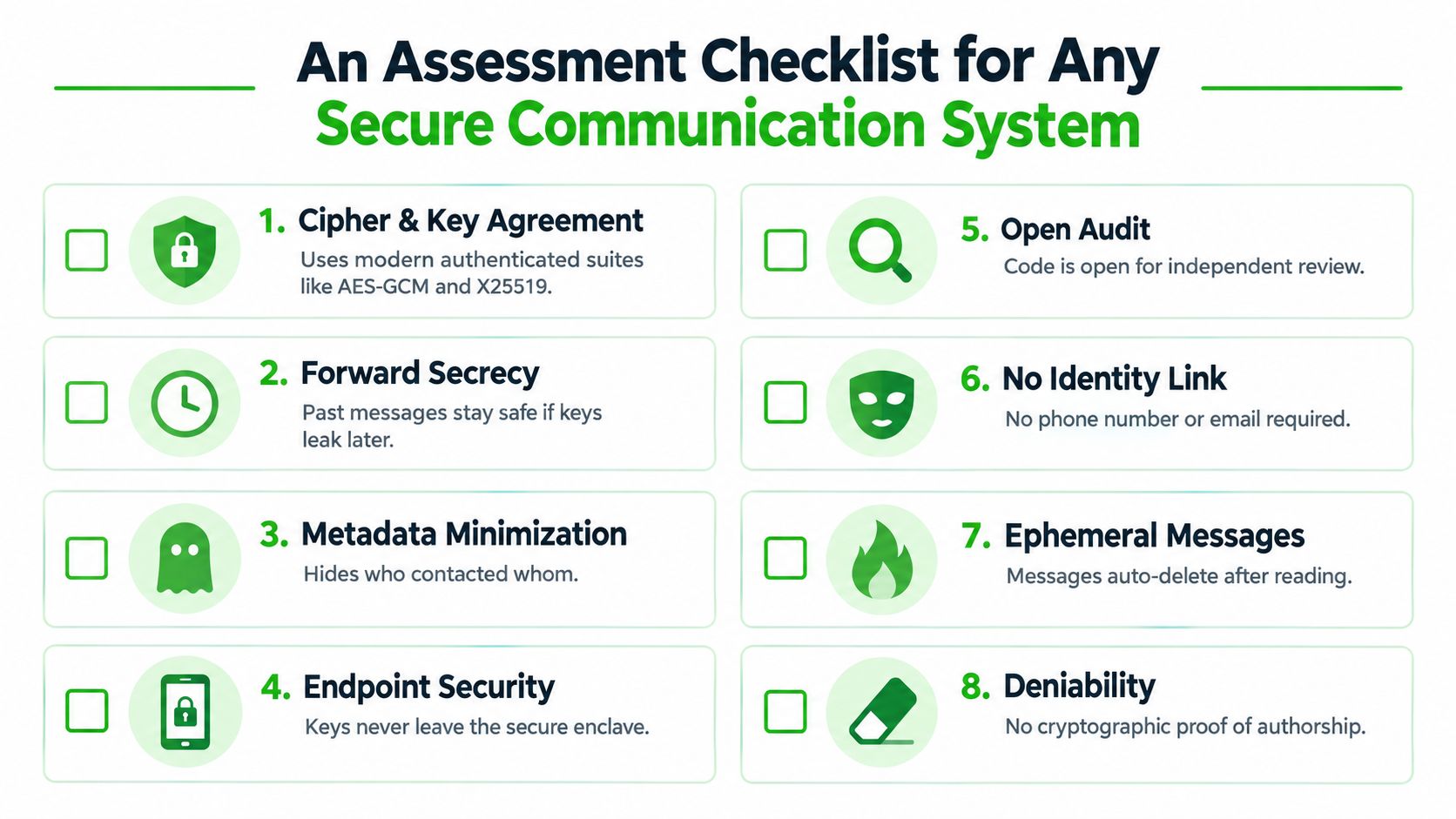
Cipher and key agreement: Look for modern authenticated encryption and a documented key exchange. A pass means the vendor names the algorithms, explains nonce and key handling, and publishes enough detail for meaningful review.
Forward secrecy: Ask whether a later key compromise exposes older conversations. A pass means session keys change so past messages aren't automatically decrypted by one stolen long-term key.
Key custody: Determine whether the provider can decrypt stored content. User-held keys reduce provider access, while provider-held recovery keys create a different trust model that must be documented.
Identity verification: Check whether participants can compare fingerprints or safety numbers through a separate trusted channel. A phone number or email address alone proves account control, not necessarily human identity.
Retention enforcement: Find out whether deletion removes server-side ciphertext, backups, logs, and indexes, or only hides the message in the interface. A fixed expiration policy is easier to evaluate than an optional promise.
Metadata minimization: Ask what the relay records, why it records it, and how long records remain. A strong answer distinguishes message content from access events, routing data, contact information, and device state.
Endpoint hardening: Use screen locks, device encryption, updates, restricted notifications, and remote-wipe capability. A secure protocol can't protect readable content from malware or an accessible device.
Recovery and audit posture: Treat account recovery as part of the security boundary, then look for independent review and public technical documentation. Convenient recovery can become a backdoor, while unsupported marketing claims don't establish trust.
A good assessment asks what happens after the normal path fails. Lost phone, wrong recipient, stolen session, subpoena, and malware should all have documented answers.
Who Uses Them and Why the Workflows Differ
The same encrypted channel can serve four very different jobs, but the surrounding requirements change sharply.
A journalist meeting a confidential source may prioritize minimal metadata, no persistent account linking the contact to a real name, and a way to remove the conversation if a device is searched. The journalist may also need to verify the source's identity without forcing the source to reveal a phone number or create a durable profile.
A lawyer exchanging privileged documents has a different obligation. The firm may need verified identities, controlled access, audit records, retention rules, and a defensible chain of custody. Automatic deletion could undermine the matter file, so the lawyer needs a governed enterprise platform rather than a channel designed to disappear.
A healthcare coordinator sharing information about a patient needs organizational controls around access, roles, agreements, and records. Encryption protects the transfer, but it doesn't by itself establish the governance, retention, or administrative safeguards required for regulated care operations. Personal messaging accounts can blur those boundaries.
An incident responder handing a credential, recovery code, or emergency runbook to a teammate needs the opposite of a permanent collaboration archive. The exchange should be brief, participants should verify one another, and the payload should not remain available after the immediate task. A separate secure process should rotate or revoke credentials when appropriate.
Workflow requirements by role
| Role | Primary Need | Retention | Identity | Metadata Tolerance |
|---|---|---|---|---|
| Journalist and source | Confidential first contact | Minimal or deliberate deletion | Low persistence, strong verification | Low |
| Lawyer and client | Privilege, governance, chain of custody | Controlled long-term record | High | Moderate if governed |
| Healthcare team | Access control and regulated handling | Policy-driven record | Verified organizational identity | Low to moderate |
| Incident responder | Rapid, short-lived coordination | Minimal | Verified teammate | Low |
The distinction is operational, not merely cryptographic. A journalist may value deniability and limited identity linkage. A lawyer may need reliable attribution and preservation. A healthcare team may need administrative oversight. An incident responder may need speed without creating another permanent account.
How Ciphar Maps to These Requirements
Ciphar fits the short-lived, identity-free end of the design spectrum. It runs in a browser, uses client-side encryption with AES-256-GCM, and provides one-time channels with a 60-minute lifetime. The publisher states that channels don't require an account, phone number, email address, or installation, and that the relay stores opaque ciphertext rather than readable content.
Mapping controls to risks
- Browser-native delivery reduces installation and onboarding friction. It doesn't make the endpoint invisible, so users still need device locks, private browsing practices, and careful handling of displayed content.
- Client-side AES-256-GCM encryption protects message payloads before they reach the relay. That addresses content confidentiality, not screenshots or malware on a participant's device.
- Browser-side key derivation uses PBKDF2 with 100,000 SHA-256 iterations and a per-channel salt, according to the product information provided for this guide. Keys remain on the device rather than being handed to the relay.
- A fixed 60-minute lifetime provides retention control. The channel has no archive or recovery path, and a manual burn option can end the session sooner.
- No account identity avoids tying a channel to a phone number, email address, or real name. Participants still need an out-of-band method to share and verify the access key.
- A ciphertext-only relay limits what the server can read or recover. It doesn't remove delivery metadata or protect a compromised browser session.
Ciphar also supports browser-based real-time voice rooms, with no call recordings or transcripts described in the supplied product information. Access verification uses an encrypted test blob, while failed access attempts can generate notices and trigger rate limiting.
Scope matters: A short-lived channel is not a replacement for a long-term messenger, regulated communications platform, group archive, or file store.
That limitation is part of the design. Journalists and confidential sources may use it for first contact. Researchers or incident responders may use it for a brief sensitive hand-off. Lawyers and healthcare teams should confirm whether their retention, access, contractual, and regulatory requirements call for a different system.
Choosing the Right Tool for the Conversation You Need to Have
Start with three questions:
- Does the conversation need a durable history? If yes, use a long-term messenger or governed enterprise platform.
- Must participants prove their identities? If yes, establish verification before sharing sensitive content.
- Would retention create risk? If yes, consider an ephemeral channel with enforced expiry, while checking endpoint exposure separately.
An ongoing identity-bound chat usually benefits from a mature messenger with verified contacts, device management, and recovery procedures. A regulated exchange needs an enterprise communications or document platform that supports access governance, auditability, and policy-controlled retention. A sensitive one-off disclosure or credential hand-off may fit an ephemeral, identity-minimizing channel such as Ciphar.
The decision is less about finding one universally secure application and more about matching encryption, identity, retention, metadata, and endpoint trust to the actual job. Write the threat model first, then select the channel that leaves the fewest unacceptable gaps.
For short-lived, identity-free conversations, Ciphar provides browser-based encrypted channels with client-side protection and enforced expiry. Visit Ciphar to assess whether its deliberate non-retention model fits your next sensitive disclosure, credential hand-off, or first-contact workflow.