The United States averaged USD 10.22 million per data breach in 2025, a record high and up 9% year over year, while the global average fell for the first time in five years, according to IBM's 2025 Cost of a Data Breach report. Same threat, same twelve months, wildly different bills.
That gap is the first clue that the consequences of a data breach are decided less by the size of the incident than by its context. Three variables do most of the work: what kind of data was exposed, who took it and what they wanted, and how long the exposure stayed live. A stolen mailing list can damage someone more than a stolen card number. A 40-day intrusion can cost less than a 300-day one with a smaller footprint.
This guide works through the evidence in that order: the money, the personal harm that outlasts the fraud alerts, the way one reused password becomes an organization-wide problem, the legal duties that follow, and where encryption helps and where it falls short. If you're a journalist protecting a source, a lawyer holding privileged material, a clinician coordinating a case, or the person who has to answer the regulator's letter, you should finish knowing what to do first.
What a Data Breach Really Costs in Numbers
A headline average is a blended bill. Two incidents can look alike in a news alert and still produce very different invoices, because the bill follows how long the exposure stays open and how quickly someone contains it.
IBM studied breaches at 600 organizations between March 2024 and February 2025: the global average reached USD 4.44 million in 2025, down 9% from USD 4.88 million in 2024; cases open longer than 200 days averaged USD 5.01 million against USD 3.87 million when closed inside 200 days (about USD 1.14 million apart); extensive AI and automation averaged USD 3.62 million against USD 5.52 million with none of it; and the United States averaged USD 10.22 million, according to IBM's announcement of the 2025 study. IBM attributes part of that higher U.S. figure to regulatory fines plus the cost of detecting and escalating incidents.
Duration works like a tap left running. The first drip is the intrusion. The water bill is the weeks afterward, while an attacker reaches more systems, copies more records, and leaves a larger rebuild of infrastructure and trust. Closing the case inside 200 days is the difference between shutting the tap and letting it run. Automation is whether anyone is in the building to hear it: teams that use AI and automation extensively triage alerts, isolate systems, and reconstruct what happened faster, and that speed is the USD 1.9 million gap above.
Average breach cost by scenario (2025)
| Scenario | Average cost | Key difference |
|---|---|---|
| Global average, all breaches | USD 4.44 million | Down 9% from USD 4.88 million in 2024 |
| United States | USD 10.22 million | Record high, up 9% year over year |
| Lifecycle under 200 days | USD 3.87 million | Faster identification and containment |
| Lifecycle over 200 days | USD 5.01 million | About USD 1.14 million more than faster cases |
| Extensive AI and automation | USD 3.62 million | USD 1.9 million less than organizations without it |
| No AI or automation | USD 5.52 million | Highest average in this comparison |
Read those rows as scale markers, not a price list for your own incident. A four-person clinic and a multinational bank both sit inside the sample. Their bills share categories (investigation, containment, fines, rebuilding trust) rather than magnitudes. What transfers is the structure of the spending and the two levers above: how long the exposure stays open, and how quickly the response moves. The kind of data and who holds it still change who is hurt, but the dollar range in this study moves first with time and response speed. If you want the legal definition settled before anything else, browse the 2026 breach guide from By Design Law Firm & Legal Consultancy, PLLC, which sets out what counts as a breach and which duties follow.
Personal Harms That Outlast Stolen Money
A 2025 study of 552 Australian data-breach victims found that breach-related losses were associated with emotional, health, relational and financial harms, and that the harms were not limited to money lost. Even the exposure of an email address was linked to physical and financial impacts, while phone-number exposure was tied to emotional harm. The headline dollar figure is one outcome. It is a weak guide to what follows the person whose data left the building.
Harm here works like a spill, not a bill. A bank can reverse a fraudulent charge. A name, an address, or a private conversation stays useful to whoever holds it for as long as that detail still points at a real life. Who has it, and how long it stays useful, decides the harm more than the size of the news story.
A source messages a journalist from a work laptop during a lunch break about a safety complaint inside their own company. Months later, the employer's systems are breached, and among the stolen files is an access log tying that employee's account to an out-of-hours conversation with a reporter. No card number changes hands. No fraudulent transaction ever appears on a statement. The person's job, and possibly their physical safety, is now in question. A lock on stored files helps only while those files stay locked. An access log that has already been copied is readable by anyone who has the copy.
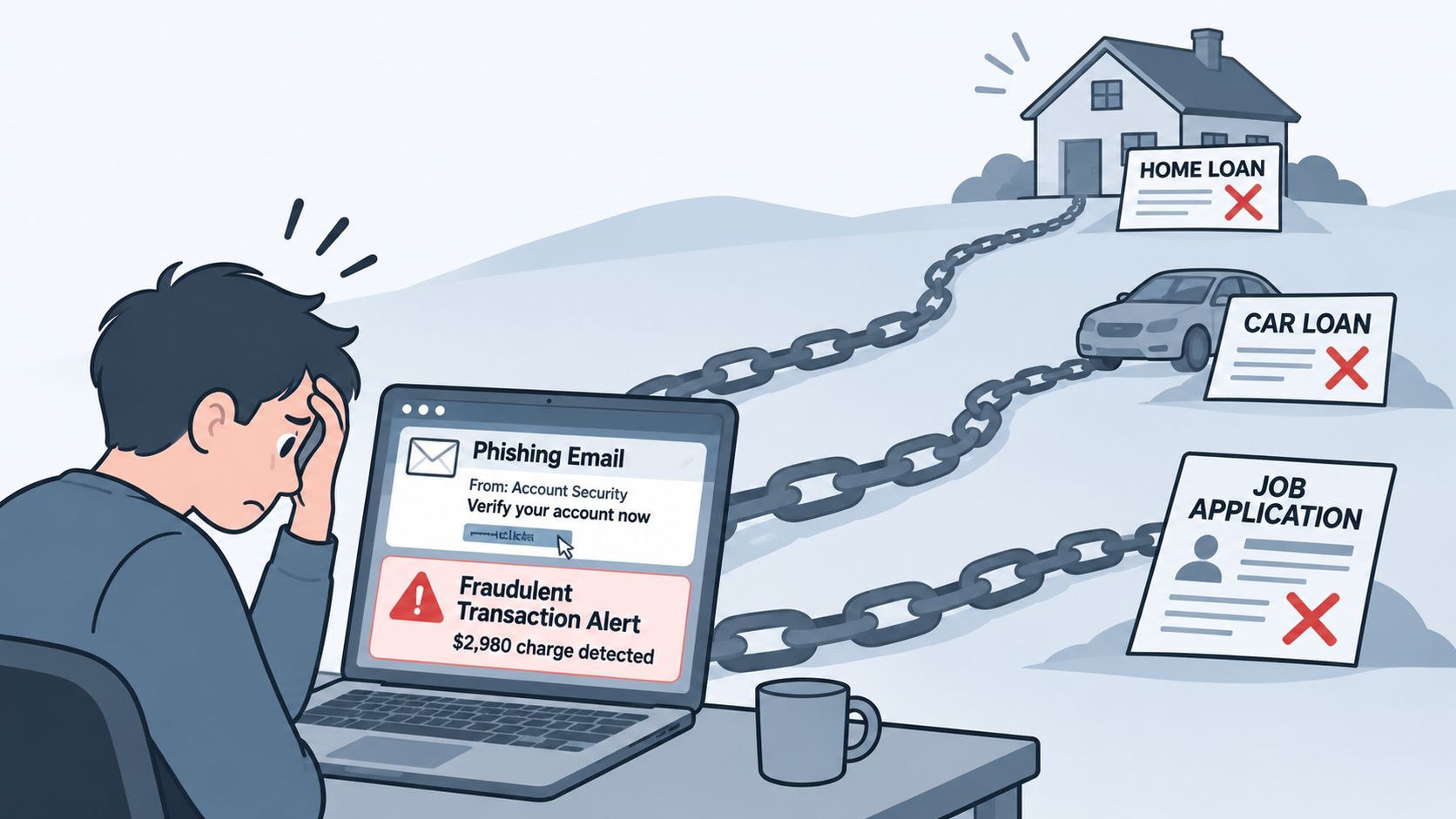
The image below captures the version of this story many people picture, where the damage is financial and a call to the bank contains it. That version is real, and it's only the visible layer.
Three cases worth holding in mind
The patient whose appointment type tells the story. A clinic's scheduling system leaks, and no diagnosis text is involved. The department name is enough. Oncology, fertility, mental health: the appointment says what the record doesn't. The patient pays in privacy and in how colleagues, insurers, or family treat them afterward, not in a line on a credit-card statement.
The family whose address is now public. A leaked database plus one public social media post tells a stranger where someone sleeps. That's a safety problem before it's a privacy problem, and it changes decisions about schools, routes and who gets listed on a doorbell. The exposure lasts as long as the address stays current and the person who wanted it still wants it.
The clinician named in a case file. Professional reputation is a financial asset. Being named in a breach connected to a sensitive case can cost referrals, a promotion, or a licence review, none of which a credit freeze addresses. The clinician bears that cost. The freeze only watches the credit file.
The three-question test: Ask what type of data was exposed (a government ID, a health record, a private message), who obtained it and what they wanted, and how long that information stays useful to them. Those answers tell you more about your risk than the breach's headline cost ever will.
Work through those three questions before you decide what to do. A leaked loyalty card number calls for a password change. A leaked home address with a credible threat attached calls for safety planning, a conversation with your employer's security team, and possibly legal advice. Persistent distress, sleep loss or intrusive worry after a breach is a reason to seek mental-health support, not a sign you're overreacting. Identity protection services help with one slice of the problem and do nothing for the rest.
How Breaches Start and Why Harm Escalates
A facilities contractor uses the same password for a client's maintenance portal and for a hobby forum. The forum is breached and its password table dumped. Within a week, someone tries the same email and password against the portal, gets in, and follows a mapped drive to a folder of client files shared across a dozen organizations. Nobody phished anyone. Nobody needed a zero-day. One reused credential did the work of an entire intrusion team.
That pattern is the norm rather than the exception. Verizon's 2025 Data Breach Investigations Report analyzed more than 22,000 security incidents, including 12,195 confirmed breaches. Credential abuse accounted for 22% of initial access vectors and vulnerability exploitation for 20%. Ransomware appeared in 44% of breaches, a 37% increase from the prior report.
Why a reused password reaches so far
Credentials are the quiet entry point because a stolen login looks like a legitimate user. No malware signature fires, no unusual file appears, and the session arrives from a normal address at a normal hour. Detection slows down, which is exactly the variable that turns a cheap incident into an expensive one.
Unpatched software behaves differently but ends in the same place. One exploitable flaw serves every organization running the same version, so a single working exploit becomes a campaign. Ransomware then converts access into pressure: encrypt the systems, threaten to publish what was copied, and let the victim do the arithmetic.
Vendors add a second perimeter you don't control. A supplier's weak access management can expose its clients' data without the client doing anything wrong, which is why procurement questionnaires now ask about incident history, not just certifications.
Two controls, not one: patching doesn't prevent credential replay, and strong authentication doesn't fix vulnerable infrastructure. Most organizations fund one and assume the other is covered.
Treating entry points as risks rather than incidents is a discipline in its own right, and ISO Security's ISO 27001 risk assessment guidance is a useful structure for it: score likelihood against impact so patching, credential hygiene and vendor review compete for budget on evidence instead of habit.
Detection is the other half of the equation. Intrusion detection is how an organization shortens the window between entry and discovery, and that window is the one driving the cost gap between a fast case and a slow one. For an individual or a small team, the equivalent is unglamorous: store fewer records, keep them for less time, and a stolen credential reaches almost nothing.
Where Breach Costs Land Inside an Organization
A breach rarely arrives as one bill. The money leaves through a dozen suppliers across eight or nine quarters, and a large share of it is payroll for people who stopped doing their normal jobs. The headline total also hides a causation problem. The same intrusion costs more when sensitive records stay exposed for weeks than when a short outage touches systems that hold little anyone can misuse.
Where breach costs appear inside an organization
| Cost component | What it covers | What to expect |
|---|---|---|
| Investigation and forensics | Finding how the intrusion happened and what data was taken | Outside forensic fees and internal staff hours |
| Containment and restoration | Isolating systems, rebuilding servers, rotating credentials | Downtime while systems are offline |
| Notification and support | Letters, call centers, credit monitoring offers | Support volume that stays high for weeks |
| Legal and regulatory | Counsel, regulator correspondence, fines and litigation | Fines and lawsuits can outlast the incident itself |
| Ransom demand | Payment sought to restore access or stop publication | Median ransom payment USD 115,000; 64% of victims did not pay |
| Lost business | Customers leaving, contracts paused, reputation damage | Revenue loss that rarely appears in the incident report |
Investigation is usually the only line approved without a fight. An outside firm bills hourly to establish how the intrusion happened and what left the network, while internal engineers, lawyers, and communications staff drop their normal work to support that effort. On day one nobody knows the scope, so this phase is where response budgets get set badly. It works like a house fire: the inspector's invoice is small next to the weeks the household spends living somewhere else.
Containment and restoration run at the same time. Teams isolate systems, rebuild servers from clean images, and rotate every credential that touched the compromised environment. The organization keeps paying for downtime and overtime long after the last server is back. Duration is the multiplier. A weekend outage and a month of partial service do not produce the same payroll or lost-output bill, even when the entry point was identical.
Notification and support start once the scope is roughly known. Letters and call centers are the visible part. The quieter cost is the queue that stays busy for weeks with questions the first letter did not answer. Data type changes that load. A leak of customer financial records fills the queue. A leak of internal system logs often does not.
Legal and regulatory costs carry the longest tail. Counsel, regulator correspondence, fines, and litigation can outlast the incident by years, and they continue whether or not the technical rebuild is finished. Those lines grow when the exposed data is the kind regulators and customers treat as sensitive, and when the exposure lasted long enough that people can point to a specific loss.
Ransom is the line everyone asks about, and the one most often misread. In the 2025 Verizon Data Breach Investigations Report, the median ransom payment reached USD 115,000, down from USD 150,000 in the prior report, and 64% of victim organizations did not pay, compared with 50% two years earlier, according to Verizon's 2025 Data Breach Investigations Report. Skipping the ransom still leaves restoration, investigation, and downtime on the books.
Lost business arrives last and rarely shows up in the incident report. Customers leave, a renewal gets postponed, and a procurement team adds a security questionnaire that slows the next deal. A vendor failure can place that same stack of forensics, notification, and legal work on the client, even when the client's own systems were not the weak point.
The largest cost in many breaches is the work your own staff stop doing while they respond, and no supplier invoice ever captures it.
Legal Duties and Why Notification Timing Matters
A notification letter feels like the end of a breach. Legally, it's closer to the start of a second set of questions, and the answers depend on dates.
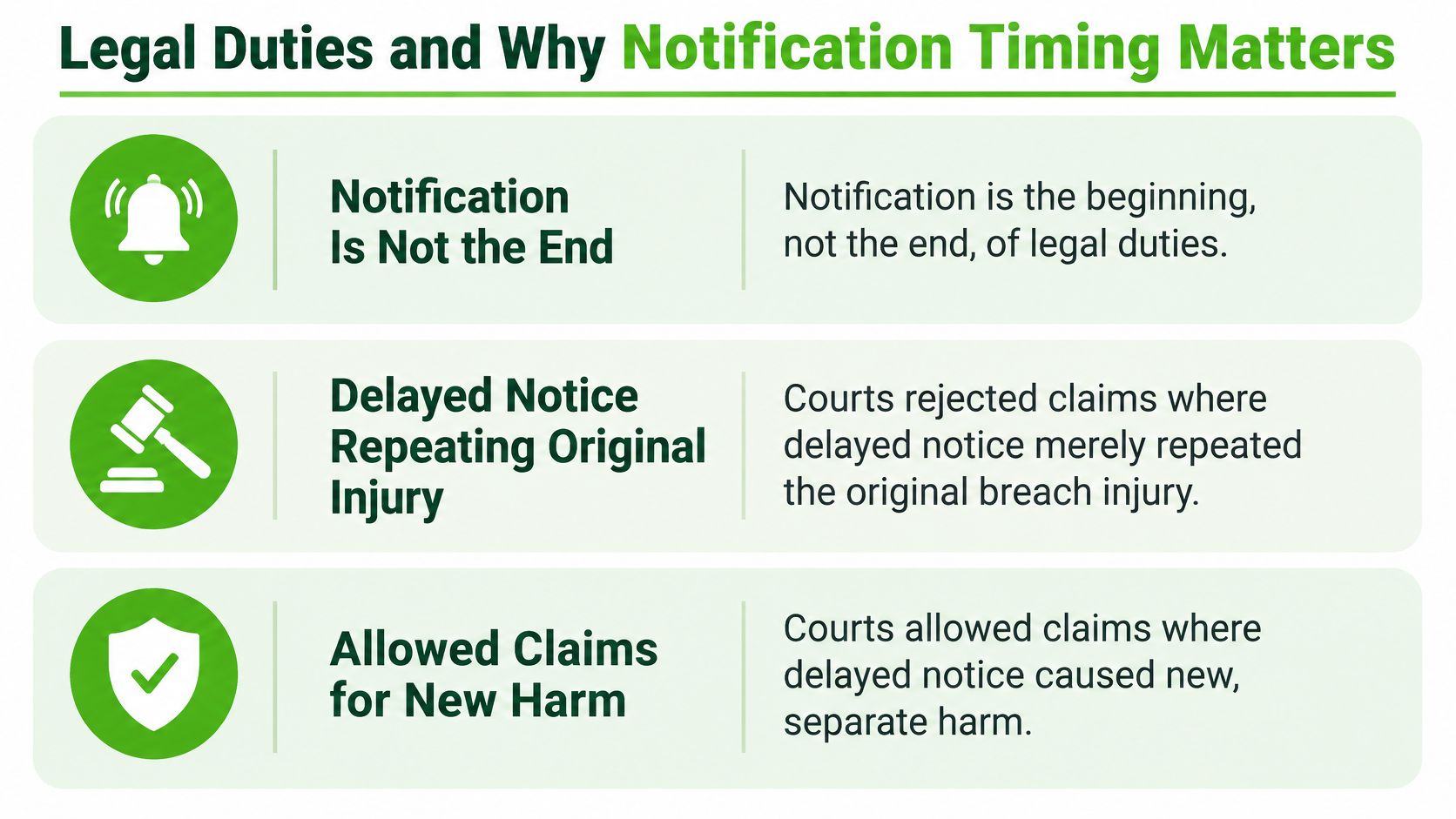
Courts have drawn a specific line. Claims were rejected where an alleged delay in notification merely duplicated the injury from the original breach, and allowed where the alleged harm was concrete and timely notice could have prevented it, as this review of consumer data breach litigation sets out. The difference between those two outcomes isn't the breach. It's what the victim could have done with earlier warning, and whether anything in the record connects the delay to a specific loss.
What the organization owes regardless
Timing arguments sit on top of duties that exist either way: a forensic investigation to establish scope, legal review of what must be disclosed, correspondence with regulators, customer support at volume, and preparation for litigation. Each of those costs money and each takes time, which is why organizations under pressure sometimes move faster on the letter than on the facts inside it.
One detail worth knowing if you rely on encrypted tools: in response to lawful process, an operator like ours can provide only encrypted blobs that expire on a one-hour clock, because it holds no plaintext, keys, or message history. That limits what a subpoena can produce. It doesn't limit what a regulator can require of the organization that was breached.
What to keep if you're the affected person
- Keep the notice and date it. Note the day it arrived, the channel it came through, and the sender. Screenshot the envelope or email header.
- List the data types it names. Write them down exactly. "Contact information" and "government identification number" imply very different risks.
- Document every attempted fraud. Record the date, the sender, the amount, and any fee or lost time. A pattern with dates is evidence. A memory is not.
- Preserve alerts and bank correspondence. Account alerts, declined transactions and letters from your bank establish what happened and when you learned of it.
- Note any harm you can link to delay. If a warning a week earlier would have stopped a transfer or closed an account, write that sequence down while it's fresh.
For a worked example of how granular these duties get, this data breach notification compliance checklist from Nutmeg Technologies walks through the Massachusetts requirements, and it's instructive even outside that state because it shows the level of detail regulators expect.
If you'd rather watch than read, the video below is a useful companion to the checklist above.
None of this is legal advice, and how any claim applies to a specific case is a question for counsel. What you can control is the record, and the record is what a lawyer works from.
Shrinking Exposure Through Minimization and Encryption
Think of a warehouse. Minimization means keeping fewer boxes on the shelves and emptying them on a schedule, so a break-in yields less. Encryption means each box is locked and the key is kept somewhere else, so a thief who carries boxes out owns nothing but sealed containers. Neither stops the break-in. Together they decide what the break-in is worth.
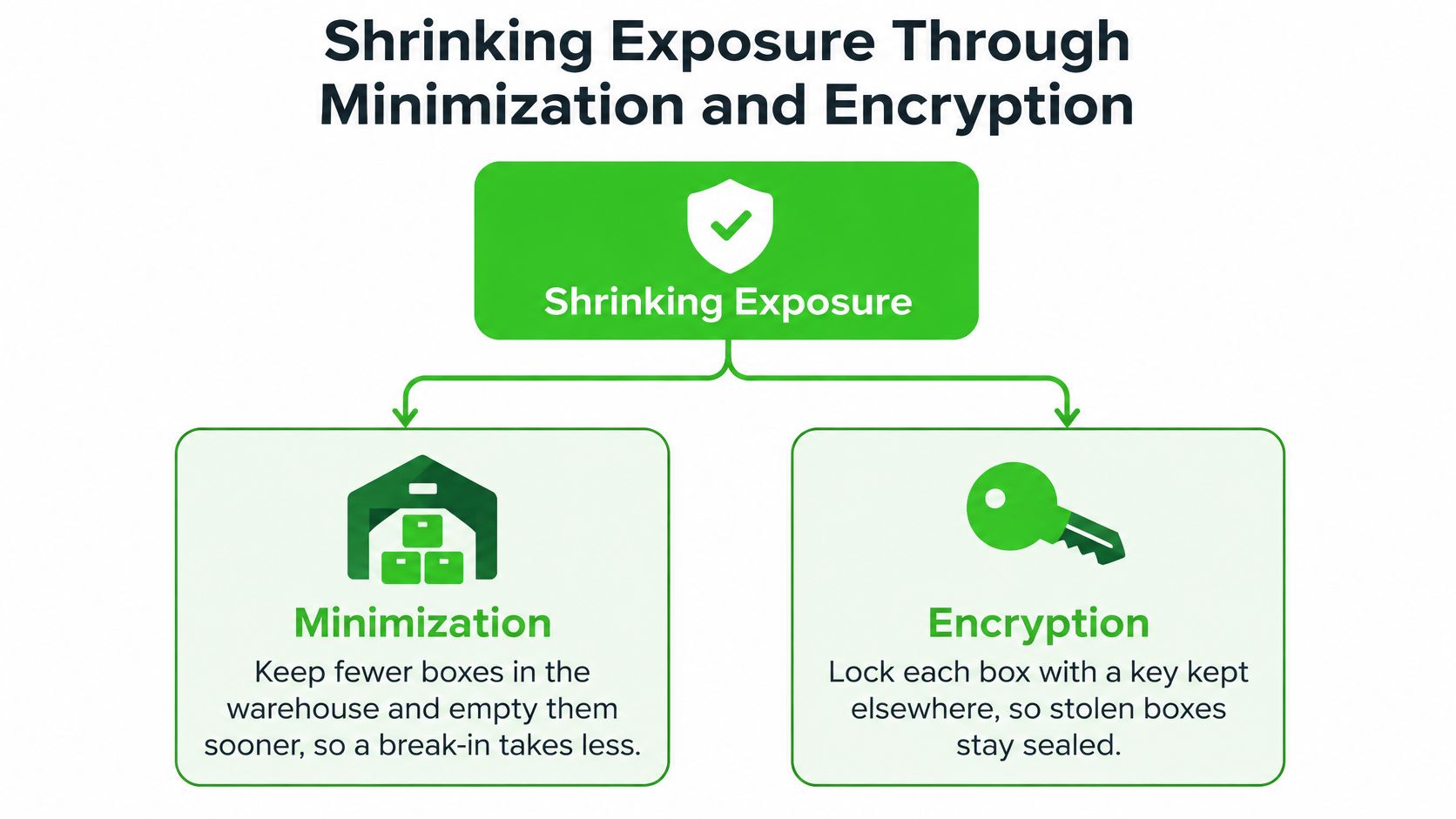
The same breach produces very different outcomes depending on what the organization chose to keep and how it stored it.
How data choices change what a breach exposes
| Data practice | What an attacker gets | Example |
|---|---|---|
| Keep full message history indefinitely | Every conversation ever held | Years of archived threads in one database |
| Collect phone numbers, emails and real names | Identities linked to every message | A contact list tied to sensitive topics |
| Encrypt data with keys held only by users | Ciphertext without keys | Relay stores ciphertext, IVs, tags and expiry times |
| Delete on a fixed timer | Only what remains before expiry | Channels self-destruct after 60 minutes |
| Encrypt, but leave plaintext on infected devices | Readable content from compromised endpoints | Malware reading an open screen or file |
What AES-256-GCM actually guarantees
AES-256-GCM protects confidentiality and integrity together. The authentication tag is the integrity half: if anyone alters a message in transit or in storage, decryption fails rather than returning tampered text. That matters for a legal or clinical conversation, where a subtly edited message is worse than a missing one.
Key handling decides whether any of this holds. In our design, the decryption key is derived in the browser with PBKDF2 at 100,000 SHA-256 iterations and a per-channel salt, and it never reaches the server. The relay sees only opaque ciphertext, an initialization vector, an authentication tag and an expiry timestamp, and it never sees passwords, derived keys, messages or files. Because the server holds only ciphertext and has no key, it cannot read messages or hand cleartext to a court, an attacker, or an employee.
Messages, files, replies, edits and voice frames are encrypted in the browser before they leave the device, and channels expire after sixty minutes with no archive. A breach of that relay months later yields expired blobs rather than a transcript.
Where the protection stops
Encryption doesn't protect a screen on an infected laptop. It doesn't stop a participant taking a photograph of a display, and it doesn't stop a malicious participant who was legitimately invited. Weak or shared access keys can be guessed, and stolen credentials walk straight past the cryptography.
That's why guessing has to be slowed and made visible. Rate limiting buys time, and each wrong access key in our system posts a system alert into the channel, escalating from a first-attempt notice to an under-attack warning and a prompt to burn the session. Alerts carry no IP address or identifier, only the fact that a guess happened. Getting key handling right is a discipline in itself, and encryption key management covers rotation, storage and the mistakes that undo strong ciphers.
The practical summary fits in three lines: collect less, keep it for less time, and protect the keys and the endpoints as fiercely as the data.
Choose Your First Response to a Breach Notice
Start with who you are. The first move for an individual and the first move for an organization have almost nothing in common, and doing them in the wrong order wastes the hours that matter most.
If the notice is about your own data
- Read it once, then list the data types. Write down exactly what it names and set the letter aside. You need the list, not the reassurance.
- Change the affected password and every reuse of it. Then turn on multi-factor authentication everywhere it's offered, starting with email and banking.
- Freeze your credit if identification or financial records were exposed. A freeze is free in most jurisdictions and blocks new accounts; it's a different tool from a monitoring subscription, which only tells you afterwards.
- Keep the evidence from the previous section. The notice, the dates, the attempted fraud, the alerts. If a claim ever needs to connect a delay to a loss, that file is the claim.
- Escalate beyond credit if the exposure touches safety or work. Money lost, a credible threat, or distress that doesn't settle within a few weeks are all reasons to involve a specialist rather than a helpline script.
If you run the organization that was breached
- Confirm what was taken and from where. Scope before statement. Public commitments made before the forensics are done become the facts you're held to.
- Contain access and rotate every exposed credential. Assume anything that touched the compromised environment is compromised, including service accounts and API tokens.
- Preserve evidence without copying sensitive content unnecessarily. Logs and metadata usually prove the point; duplicating the plaintext records spreads the exposure you're investigating.
- Notify people and regulators as the law applicable to you requires. Timing rules differ by jurisdiction and sector, so the notification decision belongs with counsel, not with the incident commander alone.
- Audit what you collect, how long you keep it and who holds the keys. The cheapest breach is the one where the stolen database contains almost nothing readable.
If you rely on any encrypted tool, know its recovery model before you need it. If the access key is lost, the channel cannot be recovered, even by Ciphar, which is the point of holding no keys and no escrow. Store access keys out of band, in a password manager rather than the same thread you're using to share them.
Coordinating all of this under pressure is its own skill, and incident response communication covers who says what to whom, and in which order, while the clock runs.
Our own tool is deliberately narrow: a browser-based channel for one short, sensitive conversation, with no account, no phone number and no archive, and it isn't built for long-term messaging, group chat or regulated communications. Whatever you use, the single next step is the same. Decide today, before the notice arrives, which channel you'd open and which key you'd never write down.
If a breach exposed your last six months of messages, the retention policy would matter more than the encryption. Ciphar runs short, identity-free channels that encrypt messages, files and voice frames in the browser, store only ciphertext, and expire after sixty minutes, so there's no archive waiting to be stolen later. Open a channel before the next sensitive conversation, and give the people who trust you one fewer thing to lose.