You're a journalist, and a source has offered to explain what happened inside their organization. They won't install a messaging app, share a phone number, or stay on a call while colleagues are nearby. You need somewhere to meet that doesn't turn a sensitive first conversation into a permanent contact relationship.
An encrypted chat room can fit that situation. But a room that hides your words doesn't necessarily hide your presence, and a conversation that disappears might also remove evidence you need later. The useful question isn't just whether the room uses encryption. It's what the whole conversation exposes, to whom, and for how long.
What an Encrypted Chat Room Actually Is
Think of a private meeting room with a temporary door code. Participants receive directions and the code, enter under names they choose, talk, and leave. The room provides a boundary around the exchange without requiring everyone to become a permanent contact.
An encrypted chat room applies that idea online. Participants exchange messages within a shared space, while encryption controls who can read the content. The room might support files or voice, but neither capability changes the central questions: who gets admitted, who holds the decryption keys, and what remains afterward?
A room is a meeting boundary
In the journalist's situation, the source needs a place to explain a concern, not necessarily an ongoing messaging relationship. A browser-native room can be designed around a room identifier and a separate access credential rather than an account directory.
That differs from other familiar communication patterns:
- A persistent messenger supports returning to established conversations and contacts.
- A forum organizes discussion around topics and retained contributions.
- A direct message connects participants within an existing service or identity system.
- A temporary room organizes access around a bounded exchange, potentially with an enforced ending.
These categories can overlap. A messenger can contain rooms, and a room can retain history. “Room” describes the conversation space, not a security guarantee.
The idea predates mobile messaging
The channel-and-nickname model has deep roots. The history of encrypted IRC connections traces it to Internet Relay Chat, created by Jarkko Oikarinen in August 1988, with approximately 40 servers operating globally by mid-1989. Those early channels supported synchronous conversation without requiring formal identities, but conventional IRC traffic wasn't automatically end-to-end encrypted.
For a modern room, look beyond the familiar channel interface. Establish whether participants encrypt locally, whether the provider can recover content, and whether expiration is enforced or merely optional.
Professional users also need to distinguish confidentiality from governance. Doczen's explanation of what E2EE means for compliance is a useful companion when evaluating those separate questions. A private meeting space may suit an initial exchange without qualifying as an approved place to keep business records.
How the Encryption Models Actually Differ
A locked courier van protects packages while they travel. It doesn't stop the courier from opening them at the depot. That's the easiest way to understand why a secure connection and a private message aren't the same thing.
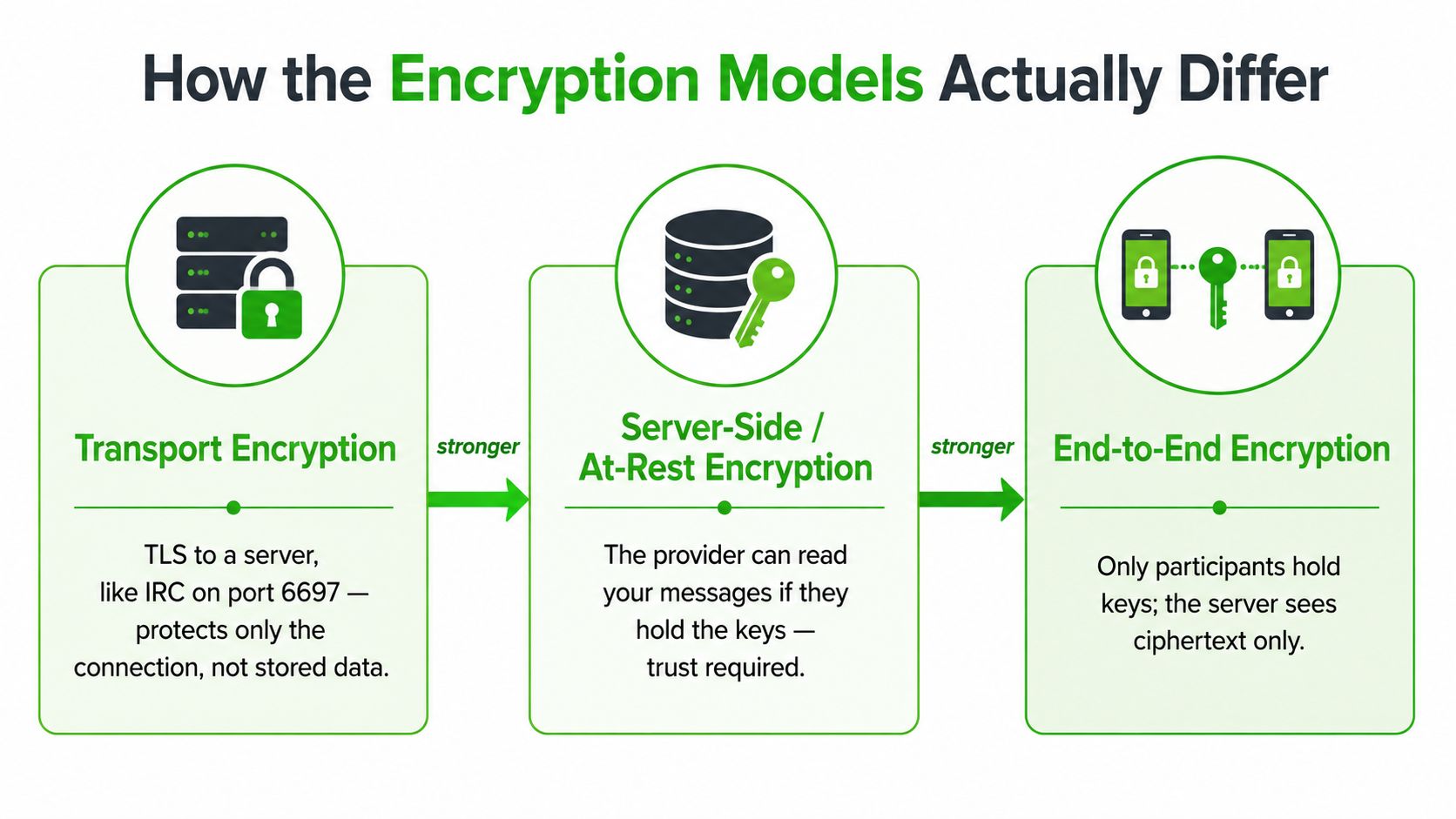
The important distinction is where readable content exists and who holds the keys. These models address different threats, so they're often layered rather than substituted for one another.
The diagram separates connection protection from protection against the service itself.
Follow the message through the courier
With transport encryption, your device establishes a protected connection to the server. The server receives the message at the end of that connection. This protects the network journey, not the message from the destination service.
With server-side or at-rest encryption, the provider locks stored messages. If the provider holds the necessary keys, it can open them. Think of a courier placing your package in a locked warehouse while keeping a spare key.
With end-to-end encryption, the sender encrypts before transmission, and intended participants decrypt on their devices. The courier carries a sealed envelope it can't open. Client-side encryption supports that model only when the service doesn't also obtain the decryption key.
Practical rule: Ask where the message first becomes unreadable and where it becomes readable again. “Encrypted” alone doesn't answer either question.
A guide to secure communication protocols can help distinguish these layers when comparing implementation descriptions.
What happens inside the browser
AES-256-GCM combines confidentiality with an authentication check. A modified encrypted record should fail verification rather than produce an accepted, altered message. The implementation must use a unique nonce, an operation-specific value, under each key for every message, edit, file chunk, or voice frame.
The browser may derive a key from a shared access secret using PBKDF2. This deliberately makes each password guess computationally expensive; a unique channel salt prevents attackers from reusing precomputed results across rooms.
OWASP's password-storage guidance recommends 600,000 PBKDF2-HMAC-SHA-256 iterations and hardware-specific calibration; a deployment using 100,000 iterations is below that recommendation. Password-storage guidance isn't a complete chat protocol specification, but it provides a useful benchmark for evaluating guessing costs.
Even an expensive derivation process can't make a predictable secret unpredictable. Nor does authenticated encryption prove that the person holding the key is the person you intended to invite.
What an Encrypted Room Still Leaks
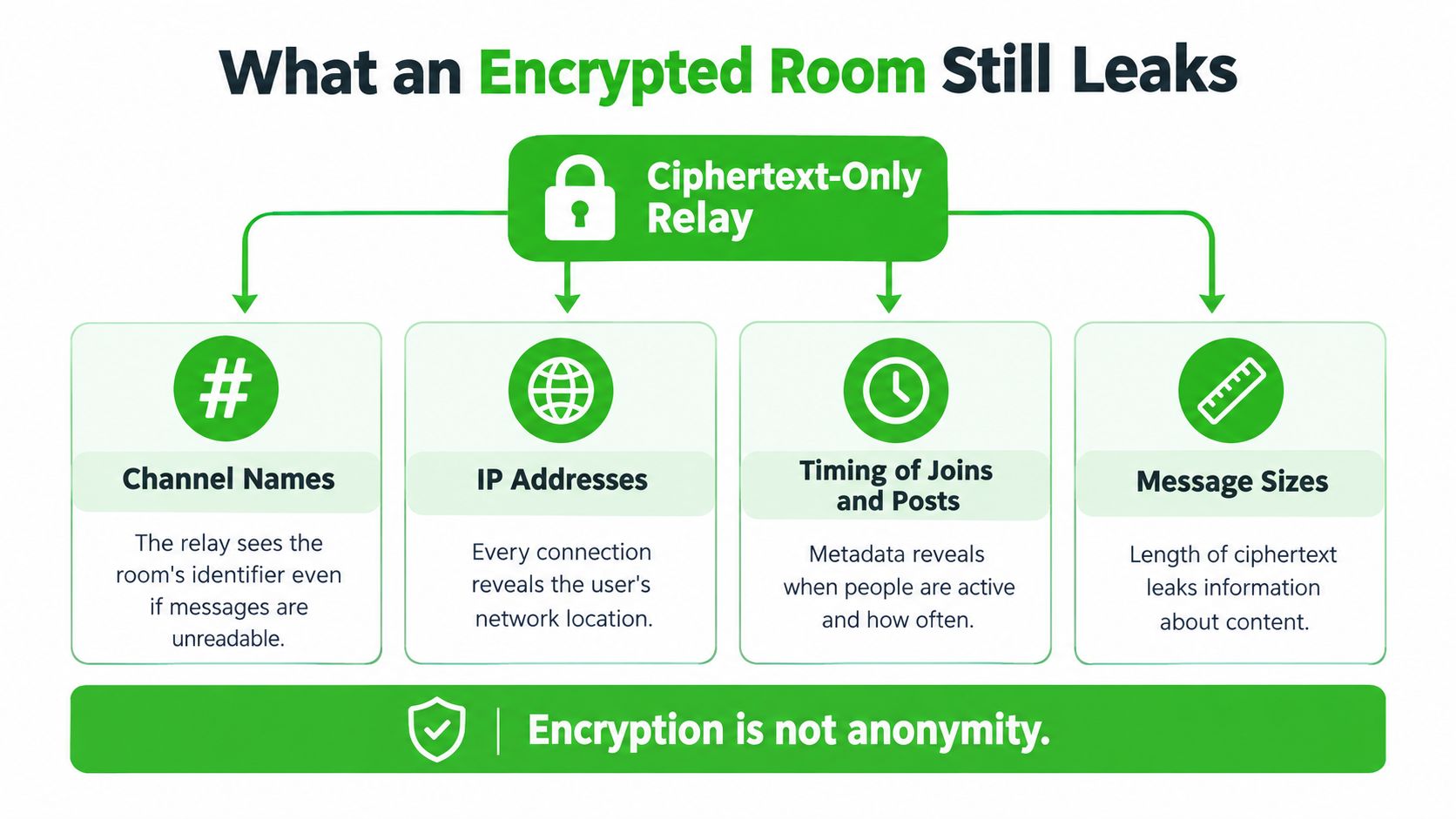
A locked meeting room can hide the discussion while a receptionist still sees who arrives. Encrypted chat rooms have the same distinction: content confidentiality is not anonymity.
Berkeley's secure-communications briefing highlights how observers may infer who communicated, when, how often, and under what circumstances without reading messages. For a confidential source, a relationship or a pattern of activity may be sensitive even when the conversation itself remains unreadable.
This visual identifies metadata to investigate, not a guarantee that every room exposes or retains every item identically.
Map observers to artifacts
Start with a concrete question: if someone investigates the exchange, what could they obtain from each layer?
| Observer | Potentially visible artifacts | What content encryption doesn't resolve |
|---|---|---|
| Room relay | Room identifiers, connection addresses, access attempts, timing, encrypted-record sizes | Whether those observations identify participants |
| Network provider | Service connections, traffic timing, traffic volume | Whether activity can be correlated with another event |
| Browser or compromised device | Displayed plaintext, local files, accessible credentials | Whether malicious software captures the conversation |
| Other participant | Received messages and files | Whether they copy, photograph, or redistribute them |
Visibility depends on design. A relay may see an opaque room identifier rather than a descriptive name, and what it observes during delivery may differ from what it retains afterward. A network observer also doesn't automatically see every artifact available to the application server.
That distinction matters when reading a “no logs” claim. Ask separately about live visibility, retained records, and third-party infrastructure. A guide to what metadata means provides useful vocabulary for asking those questions precisely.
Plaintext still exists at the endpoints
The recipient has to read the message somewhere. At that point, a malicious browser extension, compromised device, notification preview, or deliberate screenshot can defeat the confidentiality you expected from the relay.
For example, a source might choose a neutral nickname but upload a document containing identifying details. Alternatively, a lawyer might protect the exchange in transit, then paste its contents into ordinary email. Neither problem is a failure of the cipher.
Use this compact threat-model checklist:
- Ciphertext protection asks whether infrastructure can decrypt message bodies.
- Metadata minimization asks what observers can associate with the exchange.
- Endpoint hygiene asks what happens where plaintext appears.
- Participant trust asks whether recipients will honor the agreed handling rules.
A short room lifetime can reduce historical exposure. It doesn't stop an observer watching while the conversation happens.
Encrypted Rooms Compared to Signal, WhatsApp, and Telegram
Choose the tool around the relationship you need, not a league table of brands. An initial source conversation and an ongoing client relationship are different jobs, even when both involve sensitive information.
For continuing contact, evaluate persistent messengers such as Signal, WhatsApp, and Telegram. For a time-boxed exchange where account creation would prevent participation, evaluate browser-native rooms. Neither category should receive an automatic security pass.
Compare workflows before feature lists
The matrix below is a selection guide, not a claim that every app version or every encrypted room offers identical capabilities. Read each entry as a question to test against your actual workflow.
Encrypted rooms vs mainstream messengers
| Capability | Encrypted room (browser-native) | Signal | Telegram | |
|---|---|---|---|---|
| First-contact workflow | Consider when participants want room-based access | Consider if both parties agree to use it | Consider if it's already their agreed contact route | Consider if it's already their agreed contact route |
| Ongoing contact continuity | Check whether deliberately temporary access is acceptable | Evaluate for recurring conversations | Evaluate for recurring conversations | Evaluate for recurring conversations |
| Joining requirements | Verify whether accounts and installation are unnecessary | Check current onboarding requirements | Check current onboarding requirements | Check current onboarding requirements |
| Content confidentiality | Confirm local encryption and participant-only keys | Verify the intended conversation's security model | Verify the intended conversation's security model | Verify the intended conversation's security model |
| Retention and recovery | Check enforced expiry and recovery limits | Check settings and approved retention workflow | Check settings and approved retention workflow | Check settings and approved retention workflow |
| Professional records | Don't assume suitability | Don't assume suitability | Don't assume suitability | Don't assume suitability |
Familiarity can determine whether a conversation happens at all. CSIS's analysis of encrypted messaging adoption reported that four of the twelve largest mobile messaging applications had unrecoverable end-to-end encryption enabled by default, collectively representing more than 2 billion users; it also reported WhatsApp use among approximately 66% of Internet users in Latin America and the Middle East. These figures describe application reach, not anonymous-room adoption or hidden metadata.
Identify the wrong fit
A temporary room is a poor choice if someone needs to return to the transcript, reconnect reliably, or retrieve a lost attachment. A persistent contact workflow may be a poor choice if a source won't establish that relationship in the first place.
Business communication adds another question: will participants recognize a legitimate contact and resist impersonation? Nutmeg Technologies' WhatsApp scam protection update for businesses is relevant reading alongside an encryption assessment.
A private delivery channel doesn't establish that the sender is honest or that the recipient is the right person.
Test admission, identity verification, continuity, and retention separately. That gives you a defensible choice instead of brand loyalty disguised as a threat model.
Best Practices for Using an Encrypted Chat Room Safely
Set the operating rules before anyone shares sensitive material. Once a participant has uploaded a document or exposed an identity, changing the room settings may be too late.
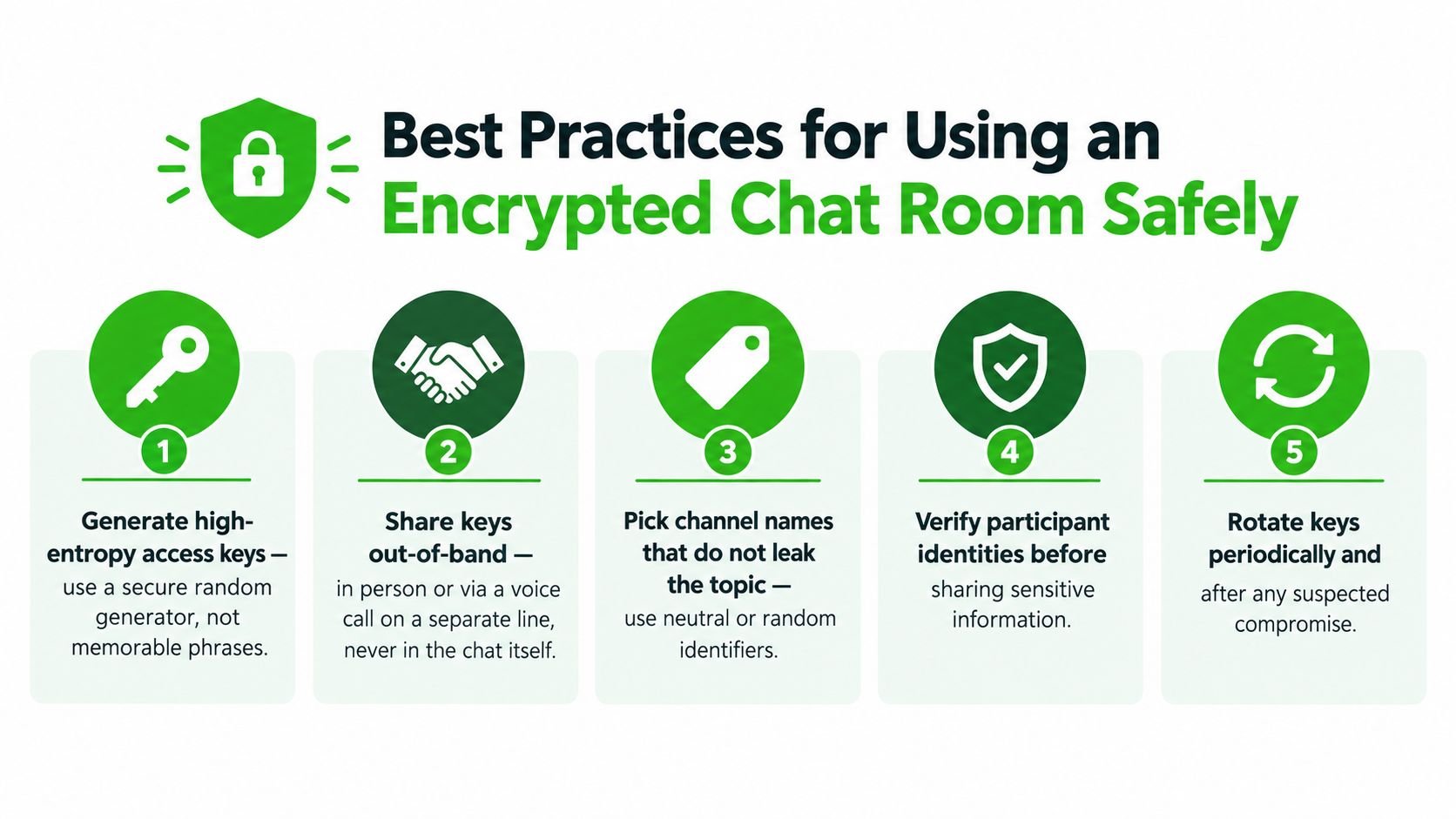
A good session begins with decisions about credentials, devices, participant verification, and the permitted content. The checklist summarizes those decisions.
Prepare the invitation carefully
- Generate an unpredictable access key. Use a secure random generator rather than a project name, birthday, or familiar phrase. Don't reuse credentials from another room.
- Separate the invitation from the secret. Share the access key through an independently trusted route, such as in person or through a verified call on a separate line. Sending everything together gives anyone who captures that invitation the complete entry package.
- Choose an uninformative room name. Avoid names containing a source's employer, a client's surname, or the allegation being discussed. Use a neutral identifier.
- Agree on device conditions. Don't assume a managed work device is appropriate for a confidential source conversation. Use a device you trust, review extensions, and disable sensitive notification previews.
Keep credential distribution narrow. If an additional participant needs access, establish who they are and why they need to join before sharing the secret.
Verify people, not just possession of a key
An encrypted test blob can confirm that a joining browser possesses the correct access key. It cannot independently confirm the operator's real-world identity. Someone who stole the credential could pass the same check.
Verify the other party through an agreed trusted route before sharing high-risk information. When a source needs pseudonymity, verify continuity with the expected source rather than demanding unnecessary personal details.
During the conversation, treat failed-access notices as signals to investigate. They don't prove that someone entered, but they can justify pausing the exchange, checking credential distribution, or starting a fresh room. Online rate limits also don't replace a strong secret against offline guessing.
Use burn controls deliberately when a session is no longer needed or access may be compromised. If a shared room key might have leaked, re-establish credentials through a trusted route rather than announcing a replacement inside the suspect room.
Before sharing: Agree on what participants may download, retain, or forward. Don't make the encryption interface stand in for that agreement.
The Ephemerality Tradeoff Most Guides Skip
An empty room after a meeting can be reassuring. An empty records system when you need to explain a professional decision is a different outcome.
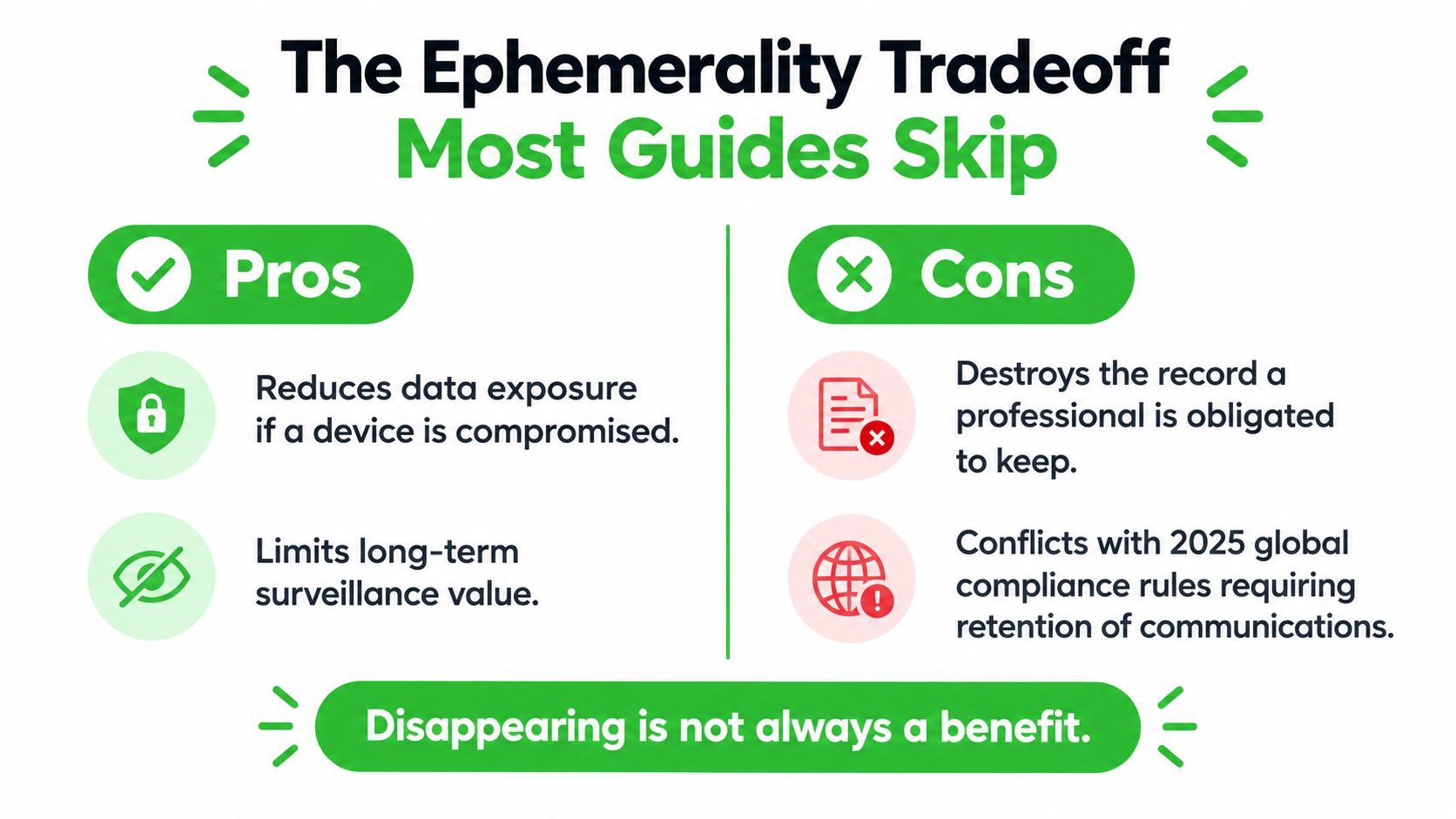
Ephemerality is a retention choice, not an automatic security upgrade. It can reduce the material available after a breach, but it can also remove the record needed to verify what happened. The right choice depends on both confidentiality risks and preservation duties.
The benefits and costs belong in the same decision.
Decide what must survive before the exchange
White & Case's 2025 global compliance survey reported that 48% of respondents expressly prohibited ephemeral messaging for business, while 72% of organizations permitting off-network messaging required employees to actively back up or manually save business messages. Those are survey findings, not universal legal rules, but they show why professional use can't be decided by a disappearing-message toggle.
A preliminary tip or sensitive introduction may be suitable for a short-lived room if the applicable rules permit it. A conversation subject to a preservation requirement is different, even when it's highly confidential.
Privilege, sensitivity, and deletion aren't interchangeable. A privileged exchange may still need preservation; clinical documentation, newsroom verification, and incident-review material may also need an approved record.
Use a guide to what ephemeral messaging is to distinguish optional message timers from enforced room expiration. Either way, determine whether your organization permits the workflow before using it for business.
Make the handoff explicit
A workable pattern separates initial coordination from durable documentation:
- Define the boundary. Agree that the room is for establishing contact or arranging the next step, not for recording final decisions.
- Identify the record owner. Decide who will create the required record and where it belongs.
- Move before the deadline. Transfer necessary material to an approved system while participants can still verify it.
- Honor preservation instructions. Don't use expiry to bypass a litigation hold or another retention requirement.
Screenshots aren't a dependable substitute for a complete, authenticated record. They may omit context, and copying material ad hoc can create an unmanaged retention problem.
For an additional perspective on disappearing communication, consider the accompanying video.
Deletion also can't retract copies someone already made. Evaluate what should disappear and what must survive as separate decisions.
Who Uses Encrypted Rooms and Why
The strongest use cases involve a bounded task with a clear next step. The following scenarios are examples of suitable workflow questions, not claims that a particular profession routinely uses a particular product.
Sensitive first contact
A journalist and confidential source might need to establish whether a tip warrants further investigation without creating a persistent contact relationship. A browser-native room can lower the practical barrier to that introduction. The journalist should agree on handling expectations and plan how to preserve any material needed for verification.
A lawyer and prospective client might want to arrange an initial discussion without exchanging personal contact details. The useful boundary could be a preliminary description and instructions for entering an approved intake process. A temporary room shouldn't be treated as a substitute for conflict checks, engagement procedures, or required matter records.
These scenarios share a decision point: when does a tentative introduction become a relationship that needs continuity and documentation? Make that transition explicit rather than waiting until the temporary conversation ends.
Coordination with professional constraints
For healthcare professionals, the relevant question isn't whether a permanent message trail feels undesirable. It's whether the proposed exchange is permitted and whether required clinical information will reach the approved record. An unapproved room is the wrong destination for regulated documentation, regardless of how convenient or confidential it appears.
A security researcher or incident responder might consider a temporary room for arranging a vulnerability discussion or coordinating a limited working session. Before substantive disclosure, participants should establish who receives the report and where evidence, remediation decisions, and follow-up will be recorded.
Use these boundaries to assess other situations:
- A clear purpose gives participants a reason to meet and a point at which to stop.
- A permitted information scope prevents the room from becoming an accidental records system.
- A planned next destination supports any work that must continue after the exchange.
- An acceptable exposure model accounts for the people and devices involved, not just the relay.
Encrypted chat rooms are general-purpose meeting spaces. Their usefulness comes from matching a limited conversation to an honest security model, not from promising that every trace of a relationship can disappear.
Ciphar offers browser-based, identity-free encrypted rooms with client-side protection and self-destructing channels, without requiring an account, phone number, or installation. Visit Ciphar to review its security model and decide whether a short-lived room fits your next confidential exchange and your retention obligations.