You're about to send a sensitive document over a public network. Perhaps you're a source contacting a reporter, and the message will pass through infrastructure neither of you controls. You want those intermediaries to deliver it without being able to read it. That's what properly designed end-to-end encryption makes possible, but it doesn't make every part of the conversation invisible.
Encrypted Communication in Plain Language
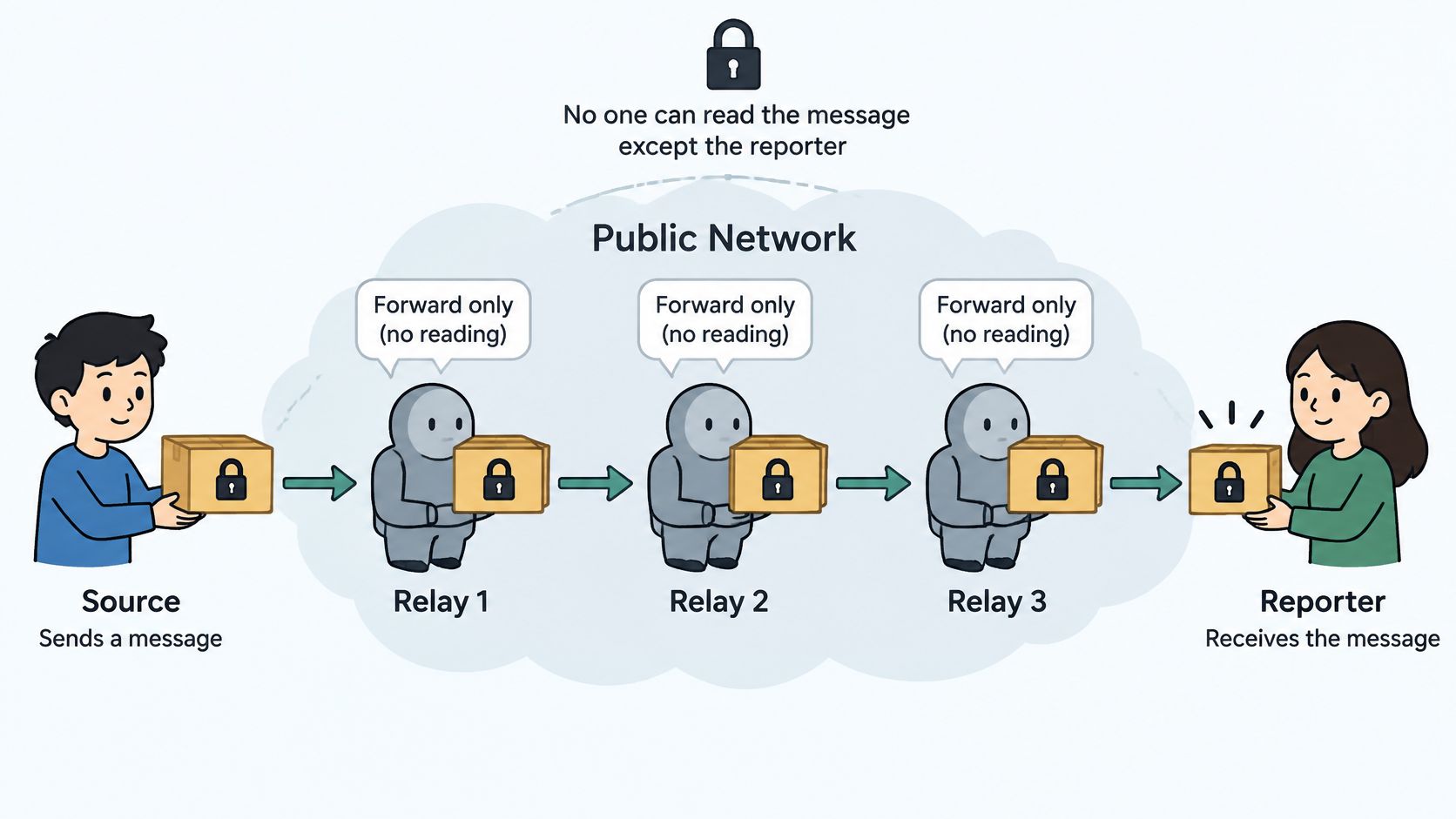
A source sends a reporter a message. The source's device secures the contents before transmission, and the reporter's device opens them after delivery. The intervening network and messaging relay carry the protected message without needing the means to access it.
Think of a locked box passing through several couriers' hands. The couriers can deliver the box, but only someone holding the matching key can open it. A tamper-evident seal adds another protection: the receiver can detect interference instead of unknowingly accepting altered contents.
The analogy helps, but digital encryption does not seal a container. Software transforms readable information into a form that someone without the correct cryptographic key cannot meaningfully interpret.
What a Secure Conversation Should Provide
A useful encrypted communication definition is the exchange of information transformed with cryptographic keys to prevent unauthorized reading. A complete secure messaging design also needs protections beyond secrecy:
- Confidentiality: Intermediaries can't read the message contents.
- Integrity: The receiver detects unauthorized changes.
- Authenticity: The receiver can establish that a message came from an expected key holder.
That last distinction matters. Possession of a shared key doesn't, by itself, prove someone's real-world identity. A reporter still needs a trustworthy way to establish that the person receiving the key is the intended source.
This diagram shows the basic journey from sender through relays to receiver.
People increasingly look for this protection when choosing services. In 2025, 76% of U.S. respondents to a Proton-commissioned survey said end-to-end encryption was either “very important” or “somewhat important” when choosing online services.
An app's encryption label isn't enough to establish who can read what. Some services encrypt a connection while retaining access to messages at the server; others keep decryption under participants' control.
Working definition: Encrypted communication protects readable information with cryptographic keys. Secure messaging also checks for tampering and establishes who is authorized to participate.
Before trusting an app, ask: Who holds the key, and can the provider read the message?
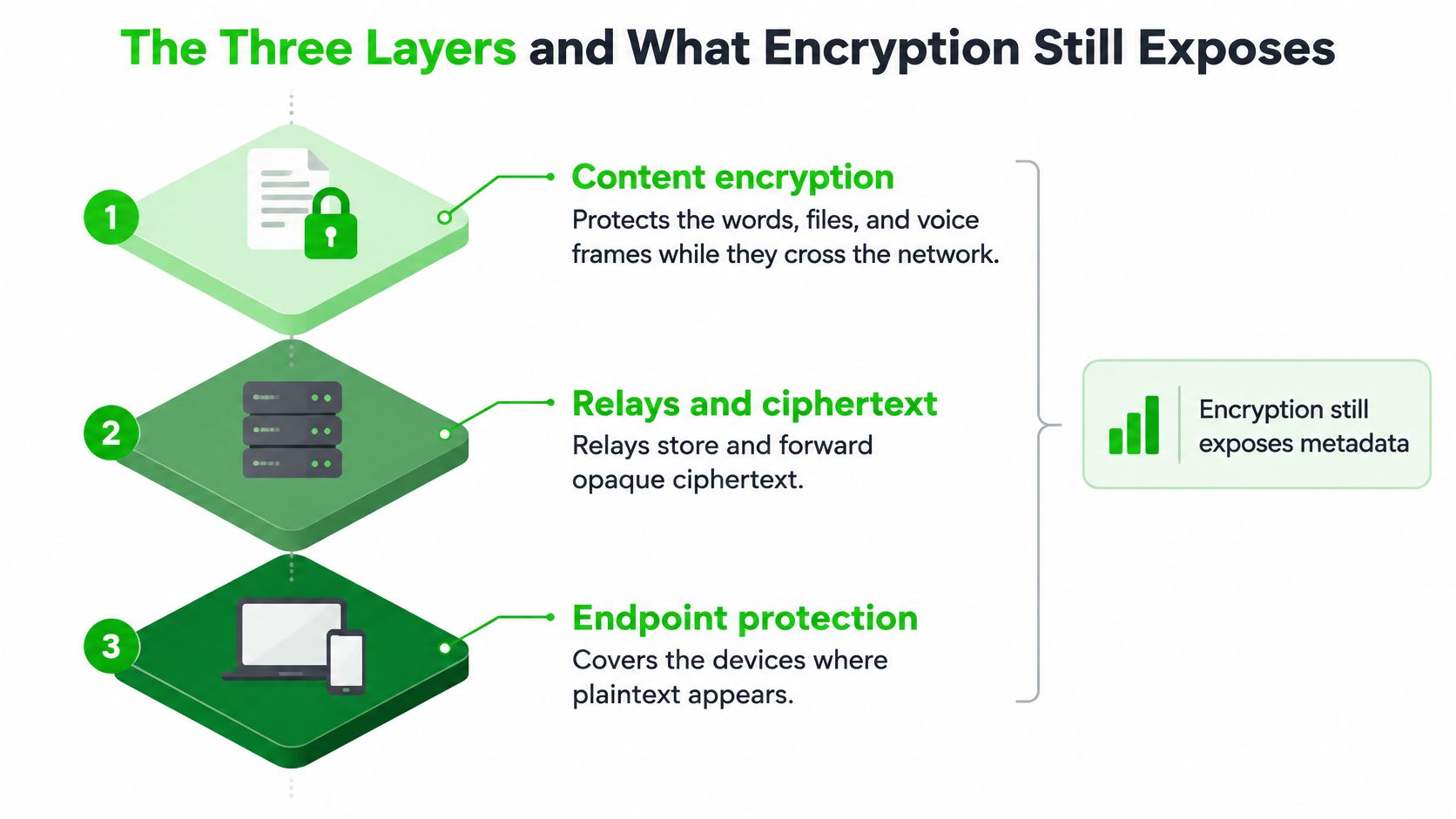
The Three Layers and What Encryption Still Exposes
Content confidentiality isn't the same as anonymity. A service can protect every word of a conversation while leaving clues about the people involved, their devices, and their habits.
Treat communication security as a stack of distinct concerns: content encryption, endpoint protection, and metadata exposure. Success in one layer doesn't automatically fix the others.
The diagram separates the protected content, the relays carrying it, and the devices where it becomes readable.
Content, Devices, and Observable Activity
Content encryption protects message text, files, and voice frames. With end-to-end encryption, the protection extends between the communicating endpoints, rather than ending at an intermediary. NIST's definition of end-to-end encryption describes this origin-to-destination boundary.
Transport encryption, such as a protected browser connection to a server, serves a different purpose. It protects that connection, but the receiving server may decrypt the data. A padlock in the browser therefore doesn't establish that a messaging provider can't read your messages.
Endpoint protection concerns the devices where people compose and read information. Metadata exposure concerns the observable facts surrounding delivery, including timing, volume, and routing.
The three layers of encrypted communication
| Layer | What It Protects | What Stays Visible |
|---|---|---|
| Content encryption | Message text, files, and voice frames in transit | No readable content to relays or network observers, but delivery information can remain visible |
| Endpoint protection | Keys and plaintext on each device | Malware, screen capture, and compromised devices can expose readable content |
| Metadata exposure | Requires separate controls for communication relationships, timing, and message size | Network observers, relay operators, and recipients may see different portions of this information |
The metadata row isn't another encryption guarantee. It's a reminder that protecting communication patterns requires separate design choices.
What an Observer Can Still Learn
Suppose, hypothetically, a source and reporter exchange traffic late at night, followed by a burst of large packets. An observer may infer that substantial material moved, without knowing whether it contained photographs, documents, or something else. Timing correlations can suggest relationships, although a suggestive pattern isn't proof of a particular conversation.
Different observers have different views:
- The relay operator: Sees ciphertext and whatever operational information the service retains, such as expiry timestamps or account records.
- The network observer: May see connection destinations, timing, and traffic sizes, but doesn't automatically see every participant or application-level relationship.
- The local device: Processes plaintext and keys, making its security critical.
- The recipient: Can read decrypted material and may save or photograph it.
An identified device may also reveal more through its accounts, network connection, or compromised software. Encryption alone doesn't guarantee that an observer can never determine which device participated.
Our explanation of what metadata means helps distinguish these surrounding records from message contents. At our relay, the server has no decryption key, so it can't read messages or hand cleartext to a court, attacker, or employee. That boundary doesn't make any metadata an operator holds immune from lawful disclosure.
An unreadable message can still accompany a revealing pattern of activity.
Practical safeguards include minimizing identifiers, reducing retention, securing browsers and devices, and planning how to end a compromised session. A VPN changes which network intermediary observes parts of your connection; it doesn't eliminate endpoint risk or make a recipient trustworthy. If that network layer matters to your situation, ThriveXDNA's top VPN picks for digital security can support a separate evaluation, not replace end-to-end encryption.
How Ciphertext, Keys and Integrity Work Together
Ciphertext is the unreadable output produced when an encryption algorithm processes plaintext with a key. It isn't an encoding you can reverse by recognizing a pattern. The recipient needs the correct cryptographic key.
AES-256-GCM combines encryption with authentication. NIST's GCM specification standardizes authenticated encryption with associated data and emphasizes unique initialization vectors under each key; AES-256 uses a 256-bit key while retaining AES's 128-bit block size.
The Components Must Work Together
GCM produces an authentication tag covering the ciphertext and any associated data. Associated data can include a channel identifier or message type: information that needs protection against alteration even when it isn't confidential. The receiving application must reject a failed authentication check rather than release unauthenticated plaintext.
A nonce, also called an initialization vector or IV in this setting, distinguishes encryption operations under the same key. Reusing one can undermine both confidentiality and authentication. Messages, edits, file chunks, and voice frames therefore need an enforced per-key uniqueness scheme, including across participants sharing that key.
Human-chosen secrets need separate treatment. In our browser-side process, PBKDF2-HMAC-SHA-256 combines the access secret with a per-channel salt and applies 100,000 iterations to derive the AES key. The salt separates derivations across channels; the computational work slows guessing but also consumes the user's device resources.
| Component | Role | Failure Mode |
|---|---|---|
| Plaintext | Original readable information | Exposure before encryption |
| Secret key | Enables encryption and decryption | Disclosure lets an attacker read protected content |
| Per-channel salt | Separates key derivation across channels | Reuse weakens that separation |
| Nonce or IV | Distinguishes operations under a key | Reuse can break GCM's guarantees |
| Authentication tag | Enables detection of unauthorized alteration | Ignoring verification permits acceptance of unauthenticated data |
| Associated data | Binds context to the protected message | Missing context can enable unintended message reuse |
Following a Message Through Encryption
The browser derives the key, allocates a fresh IV, encrypts the content, and attaches the authentication tag. It sends ciphertext and the required nonsecret parameters to the relay. The recipient reconstructs the same context and uses authenticated decryption, making the message available only if verification succeeds.
Symmetric encryption uses a shared secret for encryption and decryption. Asymmetric cryptography uses public and private key pairs for operations such as key agreement or digital signatures; the public key can be distributed without revealing the private key.
A shared-secret channel instead lets participants derive the same symmetric key from an access secret delivered separately. It's the access secret, not the derived AES key, that participants share out of band.
Successful tag verification establishes consistency with a key holder. It doesn't distinguish among several people who all possess that same secret.
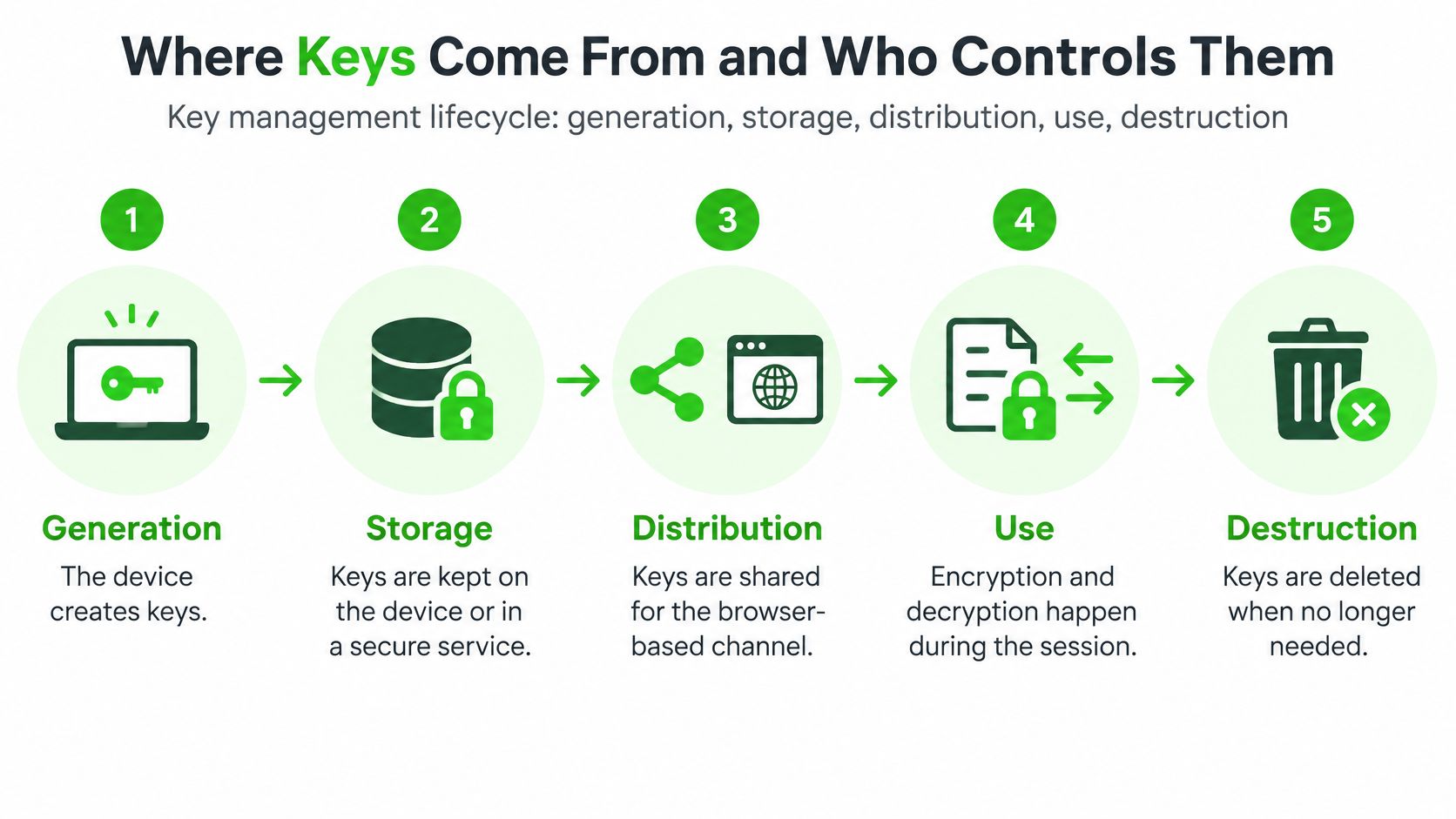
Where Keys Come From and Who Controls Them
Key management covers more than choosing an algorithm. NIST's key-management guidance describes the secure generation, storage, distribution, use, and destruction of cryptographic keys across their lifecycle.
A strong cipher can't compensate for sending its secret to an impostor. The practical question is whether participants maintain control from creation through disposal.
This lifecycle diagram shows where those responsibilities arise.
Following the Browser-Based Lifecycle
Generate locally. When someone creates a channel, our browser process generates its channel name and random access key on the device. Keep the generated secret rather than replacing it with a short, memorable phrase or recycling one from another conversation.
Distribute through a trusted route. The sender shares the channel link and access key over a separate trusted medium. The recipient doesn't need an account, but the sender still needs confidence about who controls that medium. Sending the secret through an already-suspect inbox defeats the purpose.
Derive and hold the key on the device. The recipient opens the link and pastes the access key. The browser derives the encryption key in memory without sending it to the server. Our guide to how encryption keys work explains this distinction between the access secret and the derived key.
Verify access before conversation. The recipient's browser must successfully decrypt an encrypted test blob before admission. Failed-access notices and online rate limits help participants notice guessing attempts, but they don't prevent an attacker with captured ciphertext from testing guesses offline.
End and destroy the session. Our channel and its encrypted blobs are deleted from the relay 60 minutes after creation, or earlier through manual burn. Don't treat this as remote erasure of screenshots, downloaded material, or other copies a participant retained.
Protecting the Secret-Sharing Step
High-entropy access secrets matter because an offline attacker doesn't have to request permission from the server for each guess. Key derivation makes each attempt more expensive; it can't turn an easily guessed phrase into a strong random secret.
Separate authentication decisions also arise when securing the network people use. For administrators evaluating enterprise wireless access, Purple Access on EAP-TLS versus PEAP provides context for that different layer of authentication. Network admission and message-key distribution solve different problems.
For a visual introduction to encryption, the following video offers another learning format.
Practical rule: Treat the access secret as permission to read the conversation, not merely as a convenient invitation code.
Secure Messaging Designs Compared Side by Side
In 2023, an estimated 69% of the U.S. population used at least one point-to-point messaging app, according to the Atlantic Council. The category includes different security designs, so popularity alone doesn't tell you who controls the keys or what remains after a conversation.
The meaningful comparison is between account-based messengers, device-bound encrypted modes, and temporary browser channels. Each makes different choices about continuity, identity, and retention.
Compare the Active Mode, Not Just the Brand
Signal and WhatsApp support ongoing conversations with keys on participants' devices. Phone-number registration and account-related information remain separate considerations from content confidentiality. Contact-discovery mechanisms also differ, so the existence of contact discovery shouldn't be read as proof that a provider retains a readable address book.
Telegram requires particular attention to the conversation mode. Secret Chats are device-bound and end-to-end encrypted; ordinary Telegram cloud chats aren't end-to-end encrypted. A user must check the actual mode rather than assume every conversation in the app has identical protection.
Encrypted messaging designs compared
| Design | Where Keys Live | Metadata Visible to Provider | Message Retention |
|---|---|---|---|
| Signal | Keys on user devices | Phone-number registration; contact discovery uses privacy protections | Device history until deletion or an enabled disappearing-message timer |
| Keys on user devices | Account identifiers, contact-related information, and usage metadata | Device history until deletion or a disappearing-message timer; backups require separate review | |
| Telegram Secret Chats | Keys on the participating devices | Account identifiers; ordinary cloud chats use a different protection model | Secret Chats stay on participating devices, subject to deletion settings |
| Ciphar | Keys derived in the browser from the access key | No account or phone number; relay sees ciphertext and expiry | Channel and ciphertext deleted after 60 minutes |
Retention deserves careful reading. A disappearing-message setting governs specified application behavior, not every possible copy a recipient makes. Backups, exports, and device storage must be considered separately from protection during delivery.
Match Continuity to the Task
Consider a lawyer deciding how to communicate with a client. An ongoing thread can preserve context across repeated discussions, support familiar contact verification, and reduce the friction of reconnecting. That continuity can be useful, but it also creates a longer-lived body of information to manage.
A one-time exchange has a different requirement. The participants may want to avoid sharing persistent contact identifiers and have no legitimate reason to maintain a conversational archive. Our policy is to support short, anonymous, ephemeral conversations under a hard self-destruct, rather than ongoing relationships.
That model isn't a replacement for durable client records, established group communication, or repeated coordination across devices. Nor does it establish that a participant is anonymous to every network observer.
The choice isn't between a universally secure app and an insecure one. It's between different trust and retention arrangements, assessed against the people, devices, and records involved.
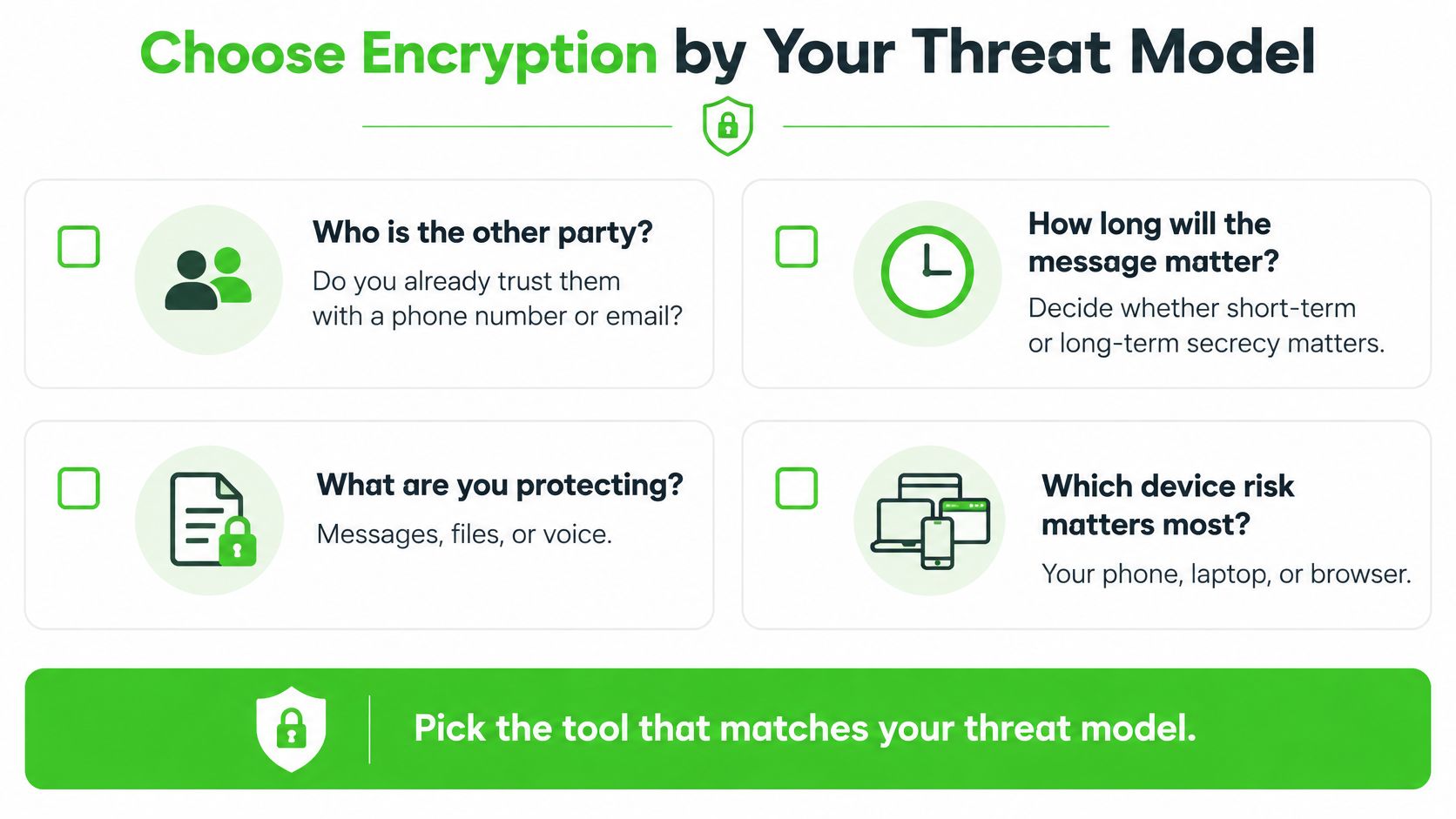
Choose Encryption by Your Threat Model
Before selecting a communication tool, answer these questions in concrete terms. Name the person or organization you're concerned about, the information they might obtain, and the consequence if they succeed.
- Who is the other party? Decide whether you already trust them with a phone number or email address, and how you'll verify their identity.
- How long must the conversation last? Separate a brief exchange from an ongoing relationship, and establish whether anyone needs an archive.
- What are you protecting? Identify whether the sensitive material is message text, files, voice, participant identities, or communication patterns.
- Which observer matters most? Distinguish the service provider, a network observer, someone with access to your device, and the recipient.
- What ends the session? Agree on the signs of compromise and who will stop communicating, destroy the channel, or move to a trusted device.
Our guide to what a threat model is can help turn a general concern about privacy into a specific decision.
Use this checklist to connect the situation to the protections you need.
Choose for the Actual Conversation
For a short, sensitive exchange without account identifiers, an ephemeral browser channel can fit. Our short-session model is not appropriate for regulated communications that require audit trails or message archival. Establish those obligations before choosing deletion as a security control.
For ongoing or group conversations, an end-to-end messenger with an understood identity model and retention policy is generally a better fit. Review the active settings, linked devices, and backup arrangements instead of relying only on the product name.
For suspected endpoint compromise, changing messaging apps isn't a sufficient response. Stop sending sensitive information from the affected device, use a trusted alternative, and address the compromise before resuming.
For communication-pattern risks, evaluate identifiers and network visibility independently of content protection. A service that can't read your words may still be unsuitable if your main concern is someone discovering that the exchange happened.
The useful outcome is a plan, not an encryption label. Choose the design, agree on a separate trusted route for sharing secrets where required, and set the burn or deletion plan before the first sensitive message. Make sure both participants understand what that plan can erase and what remains outside their control.
Ciphar offers browser-based encrypted communication for short, one-time conversations without accounts or phone numbers, with client-side encryption and enforced channel expiry. Visit Ciphar if that model fits your situation, and agree with your recipient on a trusted way to share the access key before you begin.