A threat model is a structured way to decide what you're protecting, from whom, and at what cost. In practice, that means naming the assets, attackers, trust boundaries, and trade-offs before a sensitive conversation starts, rather than after something goes wrong.
If you've ever watched a journalist, lawyer, or researcher pause for a second before sending a first message, you already know the problem. Which channel do you use, what identity do you reveal, how do you share the key, and what do you assume about the device on the other side? Those choices happen fast, often by reflex, and that's exactly where a threat model earns its keep.
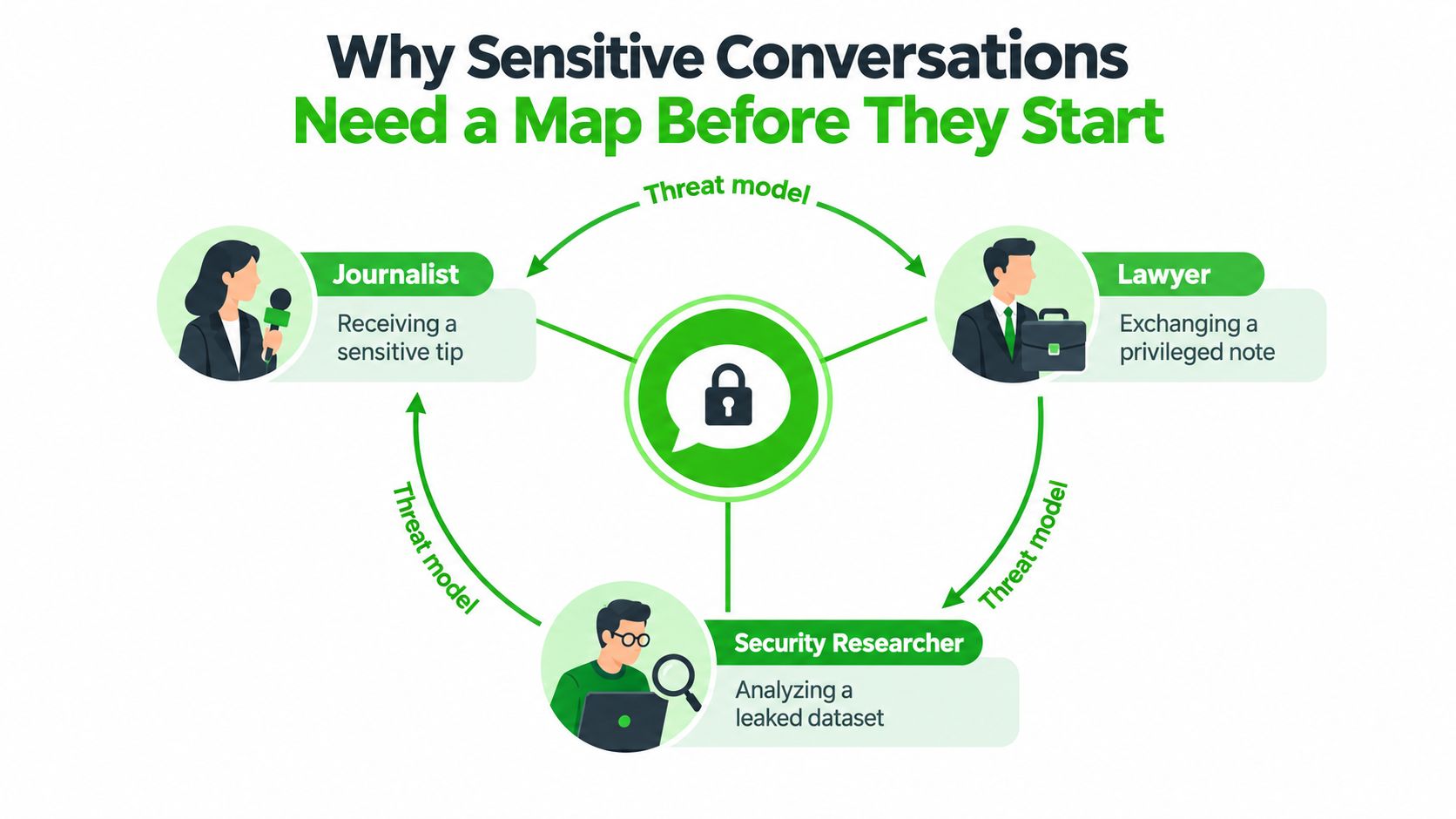
Why Sensitive Conversations Need a Map Before They Start
A journalist gets a message from an unknown source, a lawyer is about to exchange a privileged note, or a security researcher is preparing a disclosure with a vendor. In each case, the first thirty seconds carry more risk than people usually admit. The channel choice, the way identity is handled, the device being used, and whether a key is shared in-band or out-of-band all shape the result.
Without a written model, those decisions come from habit. One person may trust a browser tab, another may insist on a separate device, and a third may skip verification because the conversation feels urgent. That inconsistency is the danger, because it leaves invisible failure modes unspoken until the worst moment.
A useful map turns those reflexes into a shared decision record. It helps a team audit what they assumed, revise the rules when the situation changes, and hand the same judgment to the next person who has to open a channel. For a broader way to think about what belongs in that map, see Purple Shield's feed guidance, which is useful when you're deciding which signals deserve attention and which don't.
Practical rule: if a sensitive conversation depends on memory instead of a written assumption, the model is already too vague.
That's why threat modeling is not paranoia paperwork. It's a way to make a fast, high-stakes conversation deliberate, repeatable, and reviewable when someone else has to continue it later.
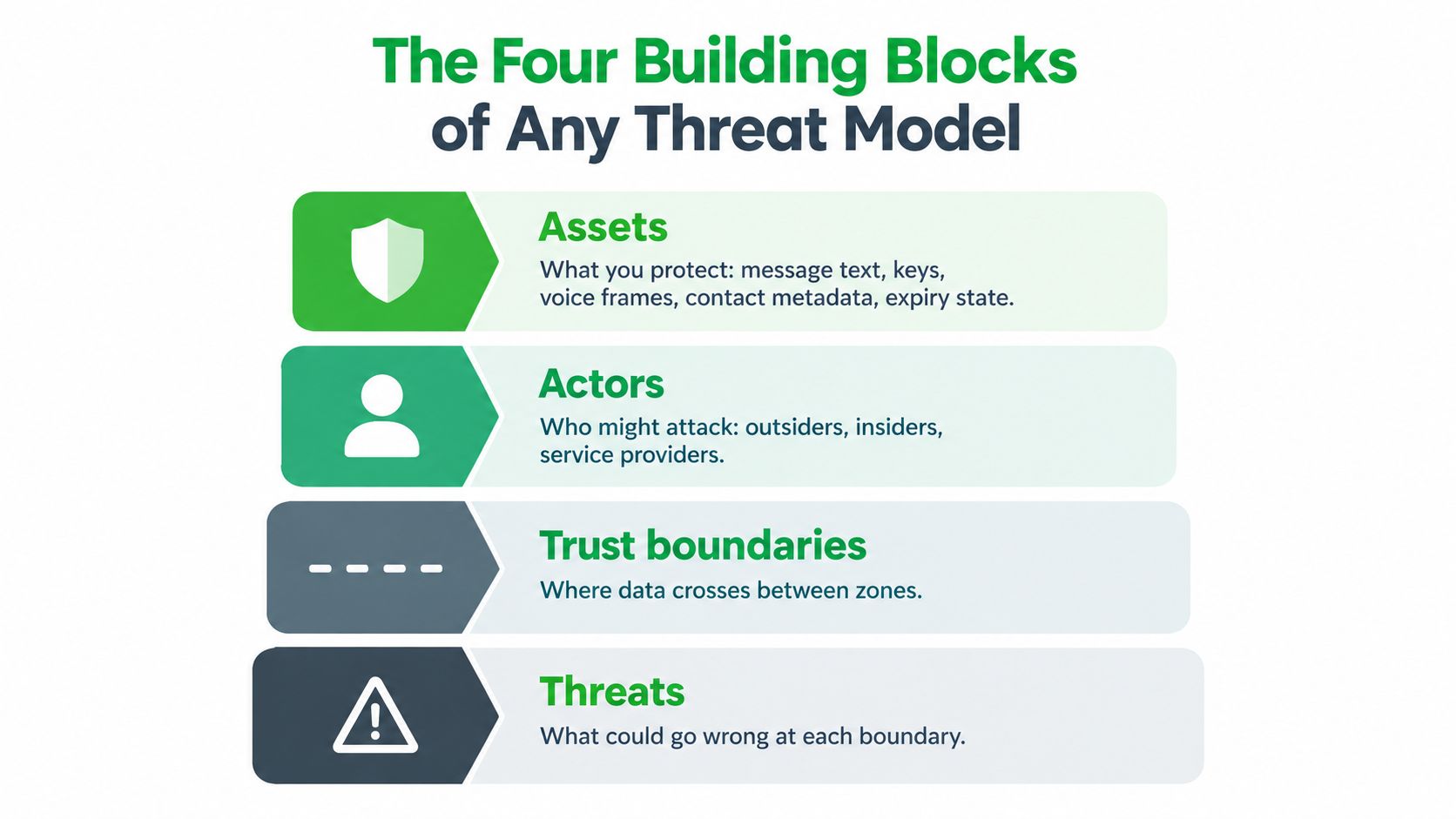
The Four Building Blocks of Any Threat Model
A good model stays simple enough to use and specific enough to matter. Four building blocks show up in every serious version of it, no matter the framework: assets, actors, attack surfaces, and risks. If one of those is missing, the model may look complete, but it will fail when you try to use it.
Assets are what you care about
Think of assets like the valuables in a house. For an encrypted ephemeral chat, the assets aren't just the message text. They also include keys, voice frames, contact metadata, and expiry state, because each one can affect confidentiality or control.
A mini-scenario makes that concrete. If a relay server stores opaque ciphertext but an endpoint leaks the key, the model should still treat the key as a protected asset. If you only write down "messages," you've already missed what the attacker wants.
Actors are who might cause harm
Actors are the neighborhood watch, except they're not always friendly. Some are outsiders probing the service, some are insiders with legitimate access, and some are service providers or participants who can still do damage.
That matters because the same system can face very different motives. A passive relay operator wants different access than a malicious participant, and a coerced user creates a different risk than an external scanner. If you collapse them into one vague “attacker,” you lose the ability to ask the right questions.
Attack surfaces are where contact happens
Attack surfaces are the doors and windows. In a browser chat, that might be the JavaScript bundle, the WebSocket, the access key, the screen, or the microphone.
Trust boundaries become visible here. Data crossing from the browser to the relay is not the same as data staying inside a local device, and a trust boundary tells you where to stop assuming the other side is safe. For a related framing on security models, see the Ciphar security model overview.
Risks are the “what if” sentences
Risk is the sentence that connects the pieces. “If a participant reuses a shared key, another person can join the channel.” That's a model, not a slogan.
The four blocks interlock. Assets tell you what matters, actors tell you who to worry about, attack surfaces tell you where the meeting happens, and risks tell you what can go wrong there. Leave out any one of them, and the rest becomes a diagram with no operational value.
STRIDE as a Thinking Lens Not a Checklist
STRIDE matters because it gives teams a vocabulary for abuse cases instead of vague concern. Microsoft introduced it in 1999, and the six categories still map cleanly to real system questions: spoofing, tampering, repudiation, information disclosure, denial of service, and elevation of privilege. That usefulness comes from the structure, not from the acronym itself.
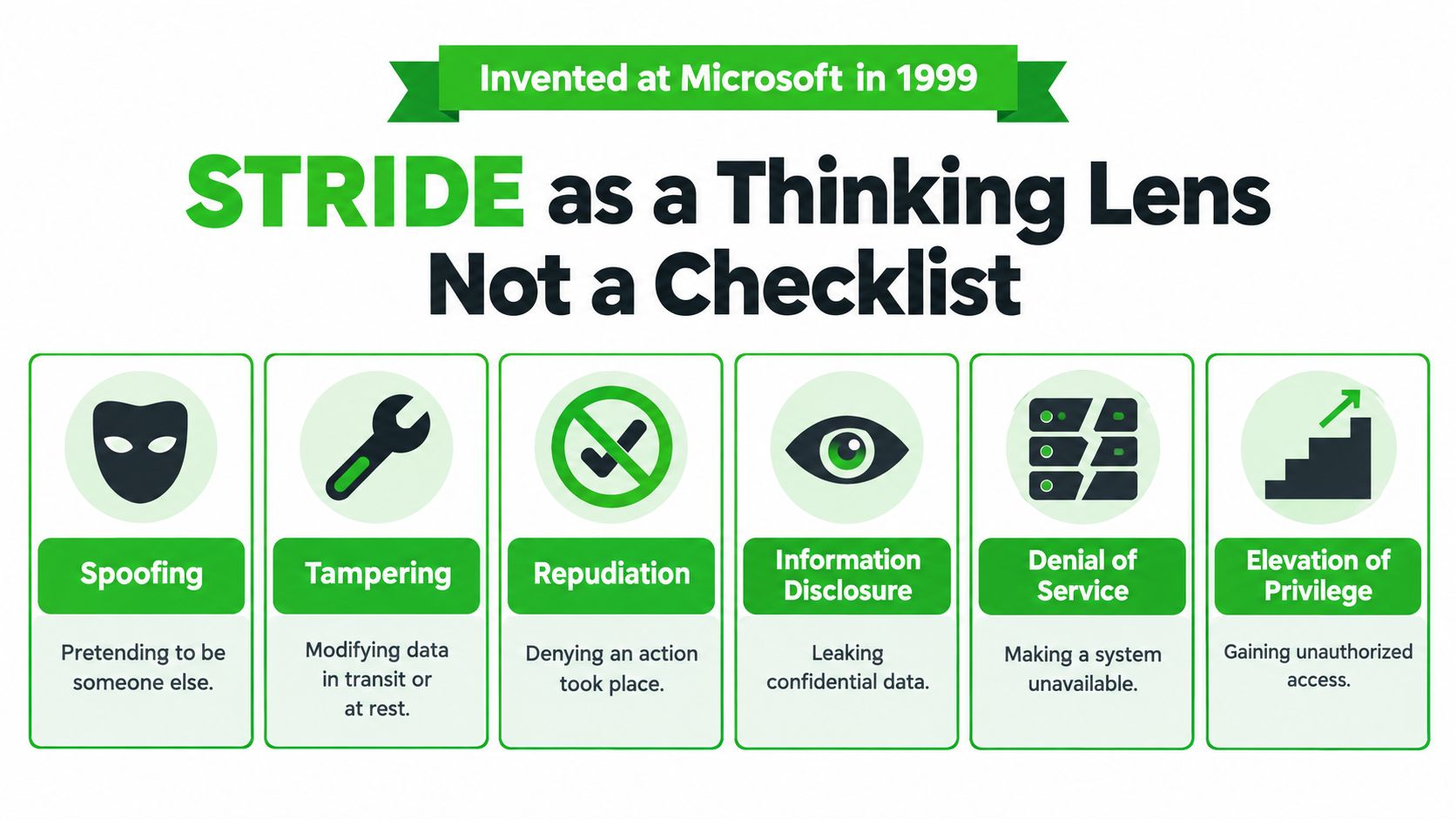
Spoofing means pretending to be someone else. In an encrypted ephemeral channel, that could mean guessing or replaying access material.
Tampering means changing data, such as ciphertext, IVs, salts, expiry values, or WebSocket frames. If the message can be altered, the model should ask whether the recipient will detect it.
Repudiation is denying that something happened. If the system cannot support auditability at all, a participant can dispute who sent what, even if the content stayed encrypted.
Information disclosure is exposure of data that should stay private. That includes plaintext at endpoints and metadata that reveals who connected, when they connected, or how often they tried.
Denial of service means making the service unavailable, through flooding, exhausting channels, or abusing expiry behavior. Elevation of privilege means crossing into a permission level the actor should not have, including administrative controls.
The point isn't to fill six rows because a template says so. The point is to test each category against the same message or flow and see which questions survive contact with reality. For practical risk identification patterns that pair well with STRIDE, practical risk techniques from Rite NRG can help you turn broad concern into concrete abuse cases.
A good taxonomy should force uncomfortable questions. If it only confirms what you already expected, it's not doing enough work.
A Six-Step Workflow for Building Your First Model
A threat model becomes useful when it produces an artifact someone can act on. The cleanest way to do that is to keep the model small, concrete, and tied to one system boundary, such as a browser-based encrypted channel. For a service like Ciphar, the result should fit on a page and still capture the important trust boundaries.
| Step | Reader Job | One-Page Output |
|---|---|---|
| Define scope and terms | State what system you are modeling and what is out of scope | A short scope paragraph |
| Draw data flow and trust boundaries | Show where data moves and where trust changes | A simple diagram or list |
| Enumerate threats | List plausible abuse cases for each component | A threat table |
| Rank by likelihood and impact | Decide what deserves attention first | A prioritization column |
| Choose treatment | Pick eliminate, mitigate, accept, or transfer | A decision note |
| Write a verification test | Define how you'll prove the control works | A test or validation note |
The workflow starts with scope because a model that tries to include everything becomes unreadable. You need to define the browser, the JavaScript delivery path, the WebSocket relay, the ciphertext store, the key exchange, the voice frames, and the destruction process, then say what you're not covering.
Next, draw the boundaries. The critical one is between the user-controlled browser and the server relay, because that's where client-side encryption changes what the server can see. After that, list threats for each component, then rank them instead of treating them all as equal.
Operational note: if a control can't be tested, it doesn't belong in the model as a real defense.
The last two steps are where many teams slip. They write down a mitigation, but they don't record whether they plan to eliminate the feature, mitigate the risk, accept it with documentation, or transfer responsibility. A model that stops at discussion is just an argument with better formatting.
Matching Mitigations to Real Threats
The best mitigations are tied to specific preconditions. Guessing risk calls for one control, tampering for another, and retention risk for a different one. When you match the control to the threat, the model stops being abstract and starts reading like engineering work.
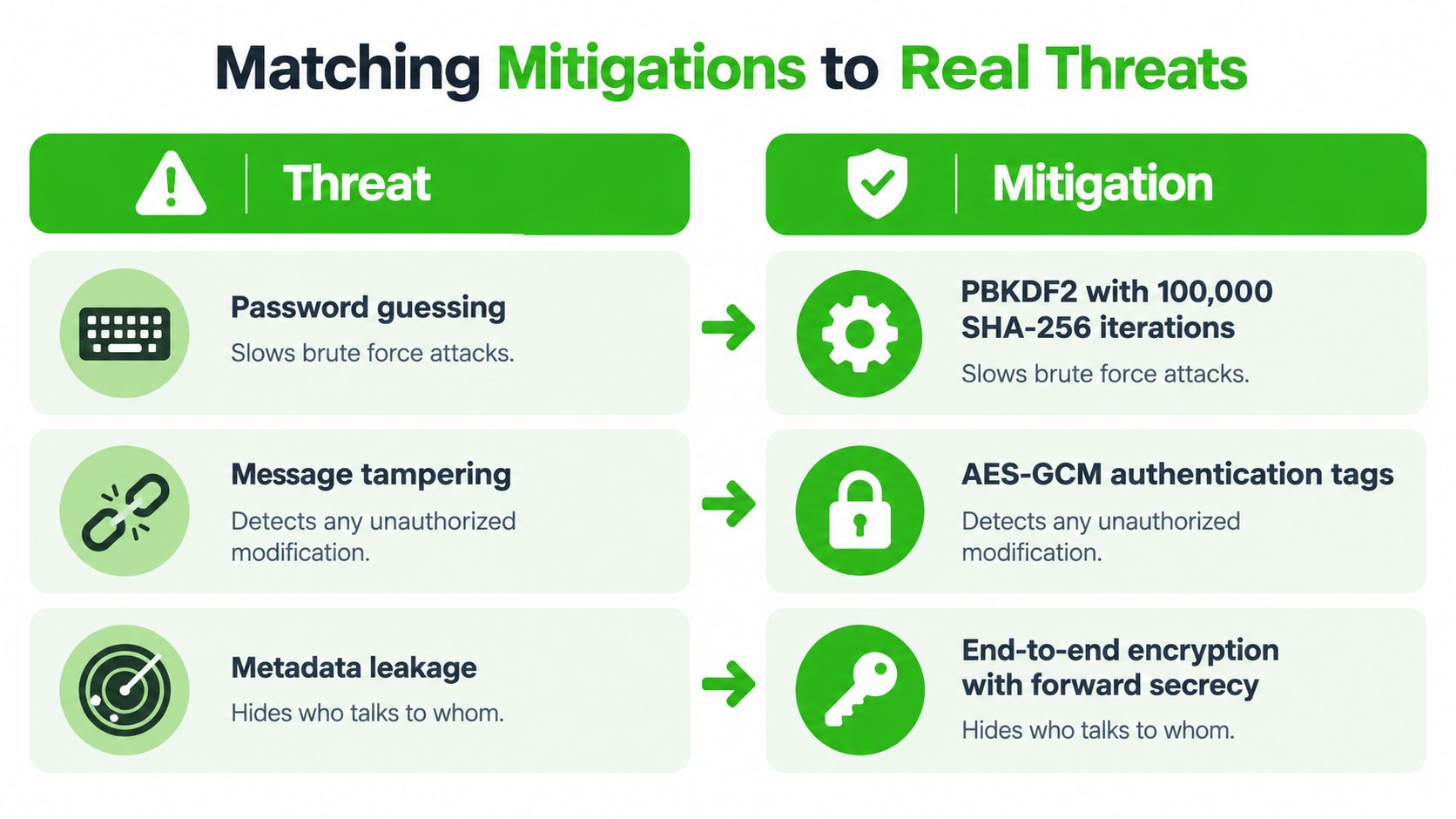
A channel that relies on access keys should treat password guessing as a first-class concern. A browser-side key derivation step such as PBKDF2 with 100,000 SHA-256 iterations raises the cost of brute force, while intrusion alerts and rate limits give participants a chance to shut the channel down if joining attempts look abnormal. Those controls work together, not separately.
Tampering needs integrity protection. AES-GCM authentication tags let the recipient detect unauthorized modification of ciphertext, but they do not magically solve human trust, replay, or endpoint compromise. That's why the model has to note what the tag does and what it doesn't.
Retention risk needs a different answer. A server-side 60-minute expiry limits how long the relay can hold content, and manual burn control can reduce exposure if the conversation turns unsafe. In a browser-native system, that's the difference between short-lived access and accidental archival.
A simple decision matrix helps the team pick the right response:
- Eliminate: remove a feature that creates disproportionate risk.
- Mitigate: add controls and test them.
- Accept: document the residual risk and who approved it.
- Transfer: move responsibility to another party or process.
For adjacent implementation concerns, such as how controls behave in real networks and login flows, find enterprise WiFi security tips can be a helpful reference point for thinking about access conditions and operational friction.
The important thing is not the control list. It's the proof that each control matches a specific threat and that the team knows what remains after the mitigation lands. Untested controls are beliefs, not defenses.
The Threats That Hide Inside the Trust Boundary
The hardest risks aren't always on the network. For short-lived encrypted conversations, the most damaging failures often happen inside the zone you assumed was trusted, where a participant can screenshot, a device can already be compromised, or a key can be shared through a side channel. That's where server-only thinking breaks down.
A 2025 framework for shared-access environments is useful here because it expands the lens beyond classic component risks. It names human-factor categories like Harassment, Access and infiltration, Restrictions, Manipulation and tampering, and Surveillance, which matters for journalists, lawyers, healthcare workers, and security teams. Those roles often face harm from someone who is already admitted, not from a stranger on the internet.
That changes what the model should include. A screen capture, a voice recording, a coerced user, or mistaken identity can all defeat the spirit of a “private” conversation without ever touching the relay. Zero-knowledge encryption can reduce exposure on the server side, but it can't stop a participant from copying plaintext or photographing the screen.
A good model says this plainly. It should record assumptions about device trust, out-of-band verification, screenshot policy, and what happens if a participant shares the access key. It should also admit that endpoint compromise can expose plaintext before encryption or after decryption, which is why the trust boundary belongs on the page, not only in someone's head.
For a closer look at endpoint and participant-side issues in confidential messaging, how to prevent eavesdropping is a useful companion read.
The safest assumption is not that the other party is malicious. It's that the other party, their device, or their habits can fail in ways the server will never see.
Keeping the Model Alive After You Write It
A threat model goes stale quickly if nobody revisits it. New browser dependencies, protocol changes, a voice feature, or a vendor shift can all move the trust boundary without anyone updating the document. That's why a monthly lightweight review and an event-triggered review after major architectural or vendor changes both matter.
The review doesn't need to be long. Check whether the scope still matches the product, whether any new data flow crossed a trust boundary, whether a prior mitigation still exists, and whether any accepted risk has changed shape. If the answer is unclear, the model needs a revision, not a debate.
ISACA's 2025 guidance warns that trying to model everything at once is the leading mistake, because broad analysis can consume weeks while basic flaws stay open. A smaller, sharply scoped model with visible assumptions and review triggers is usually more defensible than an exhaustive one nobody opens again.
Putting It All Together for Your Next Sensitive Conversation
A journalist opening a first contact can now think in four blocks, run the STRIDE lens, and write a six-step model before sending the key. That's the difference between improvisation and a decision-making artifact that can survive handoff, review, and change. For a related workflow on source protection, journalist-source protection guidance is a practical next stop.
Three takeaways matter most. Name the assets, test the trust boundaries, and record what you'll do when the model finds a real risk. Once that's in place, incident response becomes the natural next discipline, because you've already defined what failure looks like and who owns the next move.
If you need a browser-based encrypted chat designed for short, identity-free conversations, Ciphar provides one-time channels, client-side AES-256-GCM encryption, and a hard sixty-minute lifetime. Visit Ciphar to see how the system is scoped and what its security model covers, then use that structure as a reference for your own sensitive conversations.