A journalist has a source ready to talk, but neither person wants to exchange a phone number. A lawyer needs to coordinate with a client during an investigation, while a security researcher must confirm a vulnerability without creating a permanent identity trail. In each case, the challenge isn't finding a messaging app. It's creating a temporary channel, controlling who enters, limiting what the relay can learn, and destroying the conversation when the work is done.
A private chat with no registration can solve that narrow problem well. It shouldn't be treated as a magic anonymity layer or a replacement for every secure communications system. The useful model is a disciplined lifecycle: create, distribute access, communicate, and destroy.
Why Anonymous Encrypted Chat Matters Right Now
The demand for identity-light communication isn't theoretical. In a 2016 international survey by Childnet International, 65% of respondents said they'd communicated online without revealing their identity during the previous year, while 40% had used a service that didn't require registration. The survey included 1,382 participants, giving practitioners a useful baseline for understanding why browser-based, no-account chat remains relevant.
For a source, client, or incident responder, avoiding an account can prevent unnecessary identity exposure at the first point of contact. A phone number, email address, username, or persistent profile can become a durable link between people who only need to coordinate briefly. That doesn't make an unregistered channel invisible, but it removes one category of information from the onboarding process.

The second requirement is confidentiality during transport and storage. With client-side encryption, the browser encrypts content before sending it to the relay. The service can route ciphertext without holding readable message content or a decryption key. That reduces the value of a server breach and limits the amount of plaintext available to an operator or compelled service.
Encrypted messaging has also moved beyond a specialist concern. A 2025 industry summary reported that 68% of new messaging app downloads in Q4 2025 were for apps advertising end-to-end encryption as a core feature. It also estimated that approximately 1.8 billion people actively used messaging apps with end-to-end encryption in 2026, representing 43% of messaging app users globally. Those figures come from the cited 2026 messaging-app industry summary, and they point to a broader shift toward privacy-aware communication.
For high-risk professionals, the strongest use case isn't a permanent inbox. It's first contact, sensitive coordination, and deliberate termination. A short-lived channel can be appropriate when the parties need to exchange context, make a decision, or verify facts, then remove the channel rather than allowing a permanent archive to accumulate.
For a deeper look at the first-contact problem, see this guide to anonymous contact workflows.
How Private Chat No Registration Works in Practice
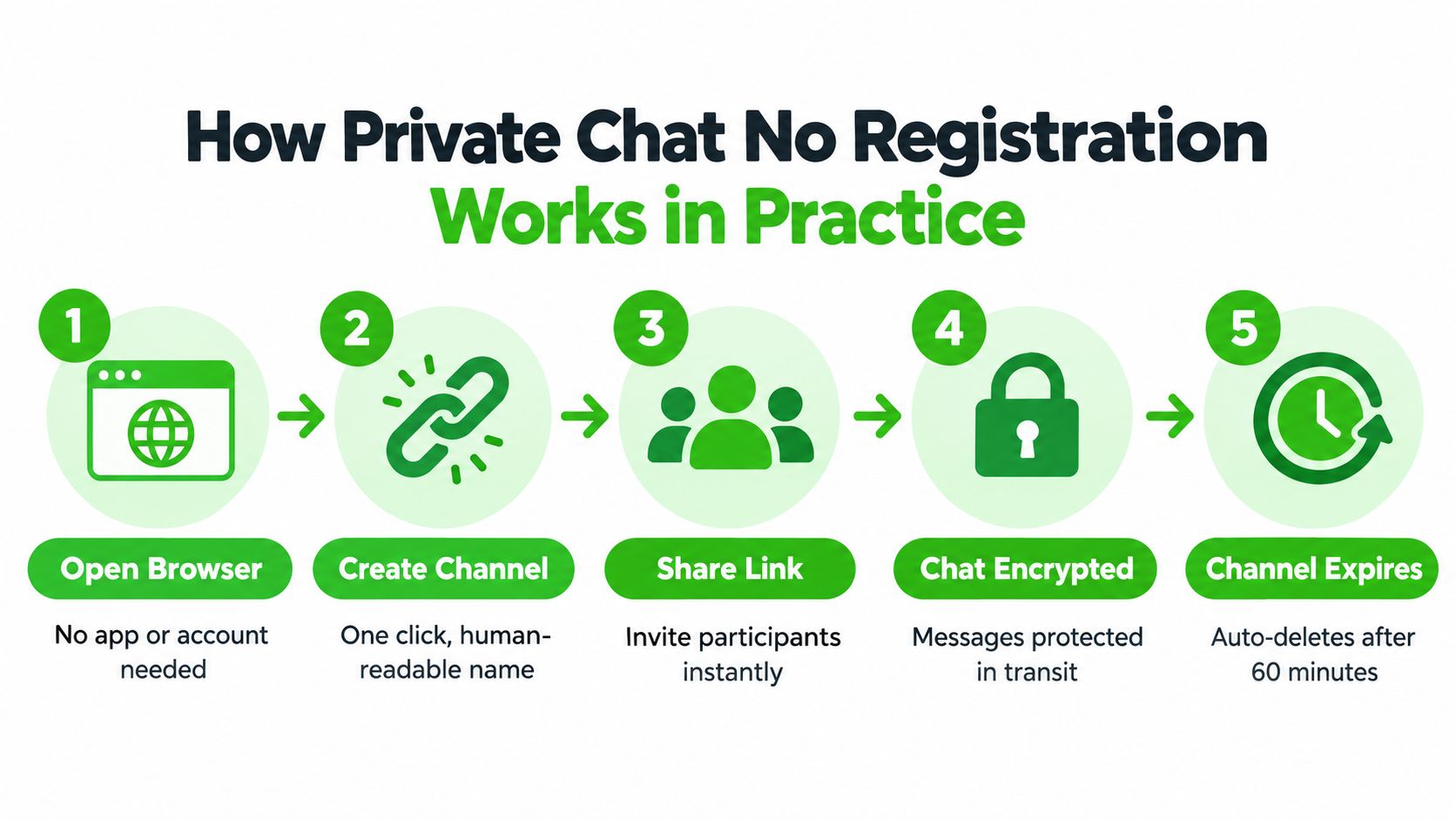
A registration-free encrypted chat should be easy to enter but difficult to misuse. The browser handles the cryptographic work locally, while the server provides a temporary relay. The user shouldn't need to install an application, create an account, or surrender a phone number before opening a channel.
Start with a channel, not an identity
The workflow begins when one participant creates a channel with a human-readable name and a separate access key. The name helps people recognize the intended room. The key is the secret that proves a participant has permission to join. Those two values should be treated differently. A link can identify the destination, but possession of the access key should control entry.
Once both participants have the correct key, the browser derives encryption material locally and uses it to protect messages, files, replies, edits, and voice frames. A common implementation uses AES-256-GCM, which provides confidentiality and authenticated integrity. If an attacker alters the ciphertext, the recipient's browser should reject it rather than displaying modified content.
The relay sees encrypted payloads and the supporting values needed to transport them, such as initialization vectors, authentication tags, salt, and expiry information. It shouldn't receive the decryption key. This is the practical meaning of a zero-knowledge relay in this workflow, not a claim that every part of the user's device or network is invisible.
Follow the four-phase lifecycle
Initialize the channel. Create a fresh room for one purpose. Don't reuse an old channel name or access key for unrelated work.
Distribute the access key. Send the invitation and secret through a controlled, separate route. The person who receives the link shouldn't automatically receive the key in the same exposed message.
Converse in real time. Keep messages focused on the immediate task. Use encrypted file transfer or voice only when the channel's threat model and endpoint controls support it.
Burn or expire the session. End the channel when the work is complete. A hard server-enforced lifetime prevents participants from turning a temporary room into an archive.
The distinction between a temporary browser room and a conventional messenger matters. Resources discussing private chat apps without a phone number can help compare onboarding models, but no-registration access alone doesn't establish confidentiality. Encryption, access control, key handling, and destruction rules determine whether the workflow fits sensitive work.
For the implementation model, review this explanation of web-based secure chat.
Sharing Access Keys Without Exposing the Conversation
The channel is only as private as the way its key travels. A strong encryption design can't help if the invitation and secret are posted together in a public workspace, forwarded to the wrong person, or reused across several conversations.
Use an out-of-band handoff. That means the access key travels through a different path from the one being protected. The goal isn't to make interception impossible. The goal is to avoid giving one compromised channel everything an attacker needs.
Practical distribution patterns
Separate messenger channels: Send the room link through one messenger and the access key through another. Confirm the recipient's identity using a known contact route before sharing either value.
Encrypted email with a separate verbal check: Send the link and ask the recipient to obtain the key through an already trusted voice call. Don't put both pieces in the same email thread.
In-person exchange: For a high-risk meeting, write down a short access key or exchange a verification phrase face to face. This is slower, but it avoids creating another digital copy during handoff.
Known contact confirmation: If a source claims to be using a new account, verify the change through an established route before sending an invitation. An attacker who controls only the new account shouldn't be able to pass that check.
Practical rule: Treat the access key like a meeting credential, not like a username. Never publish it, reuse it, or include it in a public calendar, ticket, issue, or group message.
Don't choose a memorable phrase merely because it's convenient. Human-readable channel names are useful for recognition, but the secret should be difficult to guess and unique to that session. Avoid names, dates, case references, project labels, and other details that help an attacker narrow guesses.
A disciplined operator also watches the channel for failed access attempts. An intrusion notice or rate-limiting event changes the situation, even if nobody successfully joins. Stop sharing the key, confirm the intended participant through another route, and burn the channel early if the attempt suggests targeted guessing.
The access-key usage guide is useful when teams need a repeatable handoff process rather than informal sharing habits. The operational principle is simple: the protected conversation and the credential that opens it shouldn't depend on the same trust assumption.
The Security Logic Behind Self-Destructing Chats
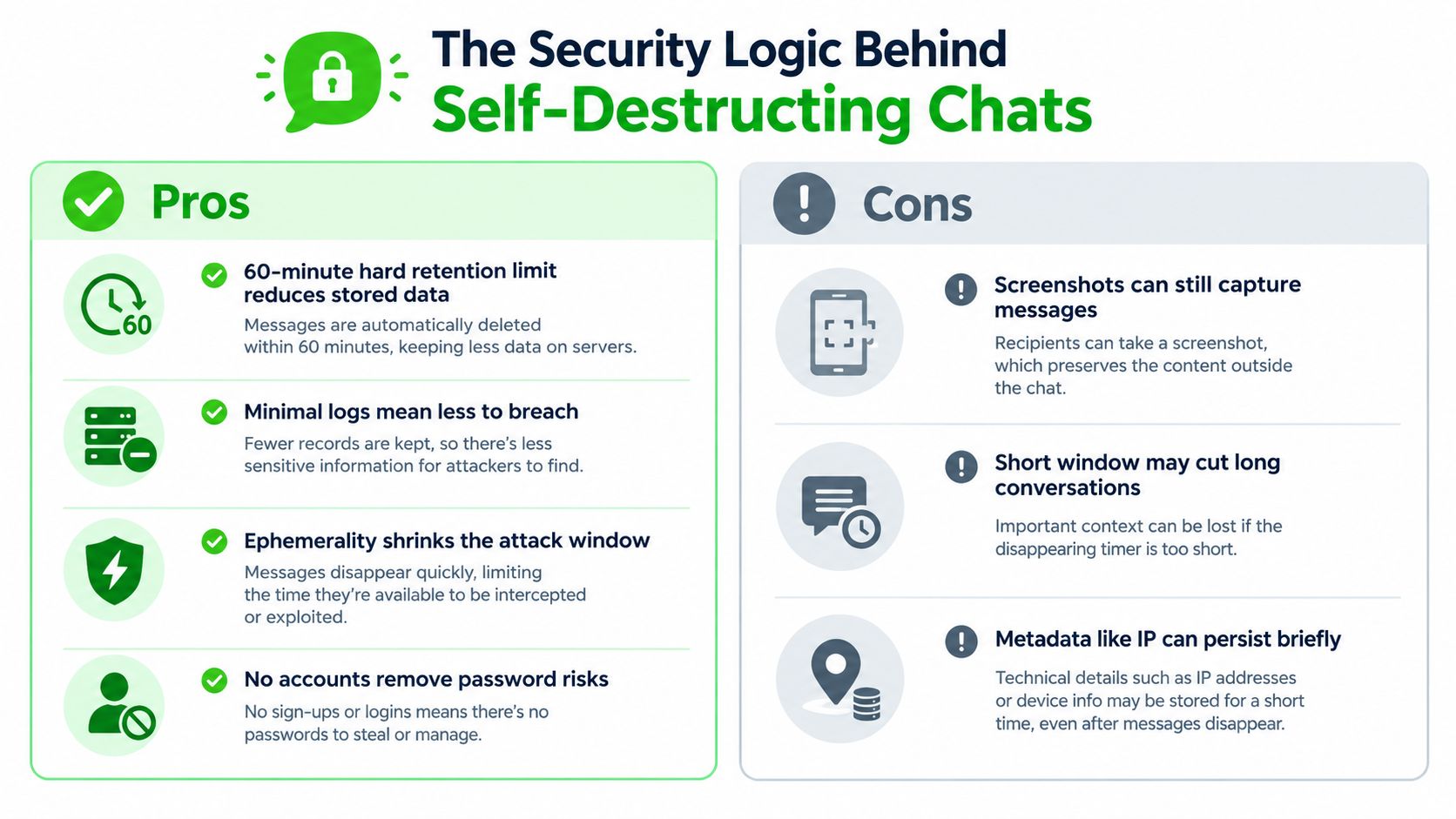
Ephemerality changes the amount of material an attacker can obtain later. If a service keeps a permanent plaintext archive, a breach or legal demand can expose old conversations in addition to current activity. If the relay holds only ciphertext and enforces a hard 60-minute retention limit, the stored attack surface has a defined end.
That limit also changes user behavior. Participants can't extend a room indefinitely or treat it as a project repository. The channel is designed for a bounded task, and manual burn control gives them a way to terminate it immediately when the risk changes.
Why password hardening matters
A shared access key needs protection against guessing. For password-based browser encryption, Web Crypto documentation on PBKDF2 describes the function as a way to turn a low-entropy secret into stronger key material through repeated hashing with a salt. In an AES-GCM design, the resulting key supports both encryption and tamper detection.
PBKDF2 doesn't make a weak password good. It makes each guess more computationally expensive and prevents identical passwords from producing identical derived material when the salt is unique. Strong, random access keys remain preferable, while key derivation provides an additional barrier against straightforward offline guessing.
The security benefit is therefore layered:
- Retention control: Expired ciphertext isn't available for later recovery through the service.
- Manual termination: Participants can destroy the room after a suspected compromise instead of waiting for automatic expiry.
- Authenticated encryption: Modified ciphertext should fail verification rather than produce trusted-looking content.
- Guessing resistance: Salted, repeated derivation raises the cost of testing candidate secrets.
Ephemerality doesn't erase a message from a compromised screen. It limits what the relay can retain and what a later breach can retrieve.
This approach reduces long-term exposure, but it doesn't solve endpoint surveillance. A browser extension, malware, screenshot, or compromised device can capture plaintext before encryption or after decryption. Self-destruction is a storage control, not a guarantee that every participant's device forgot what it displayed.
Real Risks That No-Registration Chat Does Not Solve
“No registration” answers an onboarding question. It doesn't answer every identity or metadata question. A service may avoid collecting an email address while still exposing connection details, session behavior, browser characteristics, cookies, or other identifiers to itself or to third parties.
The analysis of anonymous chat tools highlights an important gap in common privacy messaging. Products often emphasize the absence of accounts, phone numbers, or email addresses, while giving less attention to whether browser and network signals can link sessions over time. For a journalist, lawyer, or incident responder, that distinction matters because identity-free access isn't the same as unlinkability.
Endpoint threats remain decisive
Client-side encryption protects content before it reaches the relay, but the browser still handles plaintext. The technical discussion of end-to-end encrypted chat identifies the remaining endpoint risks clearly:
- A malicious browser extension can read content as the user types or views it.
- Device malware can capture keystrokes, screen contents, or decrypted files.
- A participant can take a screenshot or copy the conversation.
- A phishing page can imitate the expected channel and collect the access key.
- A hostile network can observe connection metadata even when it can't read message content.
A private chat with no registration also doesn't remove traffic analysis. The network path may still observe that a device connected, when it connected, and how long the session lasted. Even if the service has no readable transcript, an observer may correlate access patterns with other events.
Threat-model check: Ask whether you need to hide message content, participant identity, connection metadata, or all three. One browser tool rarely provides the same protection for every category.
This is why an ephemeral room shouldn't become a long-term messenger, group platform, file repository, or regulated-communications system. Those environments need durable history, retention policies, access administration, audit controls, and often organizational compliance features. A short-lived channel deliberately leaves those capabilities out.
The discussion of anonymous chat abuse controls also points to the tension between open access and resistance to intrusion. Lightweight controls such as private links, nicknames, join alerts, and rate limits can reduce opportunistic abuse, but they don't replace identity verification or endpoint security. Users in sensitive roles should combine the channel with hardened devices, verified contacts, careful browser hygiene, and an agreed destruction procedure.
When to Use Private Chat No Registration
Choose this model when sensitivity is high, the conversation is short, and exchanging permanent identities creates unnecessary risk. It can fit journalist-source first contact, privileged legal coordination, sensitive healthcare logistics, vulnerability disclosure, incident response, or an executive discussion that shouldn't become a standing record.
Use another system when you need a permanent history, a large group, searchable files, formal retention, regulated archiving, or reliable identity administration. The deciding question isn't whether registration feels inconvenient. It's whether the work benefits more from controlled ephemerality than from continuity.
A practical workflow is to create a fresh room, share its key out of band, verify the participant, keep the discussion narrow, and burn the channel when the task ends. Treat the browser and endpoint as part of the security boundary, not as invisible infrastructure.
Use Ciphar for browser-based, identity-free channels that encrypt messages, files, and voice client-side and self-destruct after sixty minutes. Review the Ciphar security model, establish an out-of-band key-sharing procedure, and forge a channel only when a short-lived conversation is the right fit.