The most popular advice about an end-to-end encrypted chat app is also the least useful: “Choose a service with strong encryption.” Cipher strength matters, but it doesn't answer the operational questions that expose people in real incidents. Who can connect a conversation to your phone number? What metadata survives after a message disappears? Can the provider recover an archive, identify a participant, or comply with a request because the server retained more than the payload?
End-to-end encryption protects message content from the relay and other intermediaries. It doesn't automatically hide identity, relationships, timing, device compromise, screenshots, backups, or the existence of a conversation. A persistent messenger and a temporary browser room can both use serious cryptography while serving completely different threat models.
The practical choice is therefore not “encrypted or unencrypted.” It's whether you need a durable social tool, or a short-lived channel for first contact where exchanging a phone number, installing an app, or leaving a recoverable archive creates unnecessary risk.
The Hidden Costs of Mainstream Encrypted Messaging
Popular encrypted messaging has changed the baseline for private communication. By 2026, four of the world's top twelve mobile messaging apps by monthly active users had enabled unrecoverable end-to-end encryption by default, and more than 2 billion people globally were using end-to-end encrypted messaging applications, according to the Center for Strategic and International Studies. That's a major security improvement, but it doesn't make every surrounding data flow private.
The common mistake is treating encryption as a complete privacy state. E2EE normally protects the message body while it travels between devices and while encrypted data sits on a service. It may not conceal who holds an account, which contacts are connected, when a session occurred, what devices are registered, or how long encrypted material remains available for delivery and synchronization.
WhatsApp illustrates both the benefit and the limitation. It became one of the earliest large-scale services to deploy E2EE broadly, and by 2016 its messages, calls, and video calls were protected for users worldwide, as summarized by Kaspersky's messaging app security guide. That decision helped normalize private messaging at global scale, but a phone-linked account still creates a persistent identity relationship around otherwise protected content.
Payload privacy is not relationship privacy
A source may care less about an intercepted sentence than about the fact that the source contacted a particular journalist. A lawyer may protect the contents of a consultation while still exposing a client relationship through account identifiers, address books, notifications, backups, or access logs. A security researcher may encrypt a vulnerability discussion while leaving a durable account trail that connects the researcher to the affected organization.
This is why users need to understand what metadata means before comparing cipher suites. Metadata can answer operational questions that plaintext encryption never addresses, including timing, participation, and account linkage.
Mainstream apps win adoption because they reduce social friction. People already have the app, their contacts are discoverable, and conversations persist across devices. Consumer Reports found that in April 2025, 57% of U.S. adults reported using Facebook Messenger, 39% iMessage, 27% WhatsApp, 23% Google Messages, and 4% Signal, with usage changing little year over year, as shown in its 2025 Consumer Cyber Readiness Report. Convenience often outweighs an abstract privacy concern until a user faces a specific first-contact problem.
The default setting decides the real protection
A secure mode that users must find and activate creates downgrade risk. Comparisons of Signal and Telegram note that Signal protects messages and calls with default-on E2EE and limits metadata, while Telegram's secret chats require an explicit choice and do not cover every conversation by default, according to Priviy's 2026 secure messaging comparison.
For users reviewing their current setup, a practical step by step WhatsApp privacy walkthrough is useful because it turns broad privacy concerns into concrete checks. But settings can't remove the underlying identity model. If a service requires a phone number, the account remains tied to that number even when the message content is unreadable to the provider.
Operational rule: Treat the message, the identity, and the surrounding metadata as three separate security assets.
How Client-Side Encryption and Zero-Knowledge Relays Work
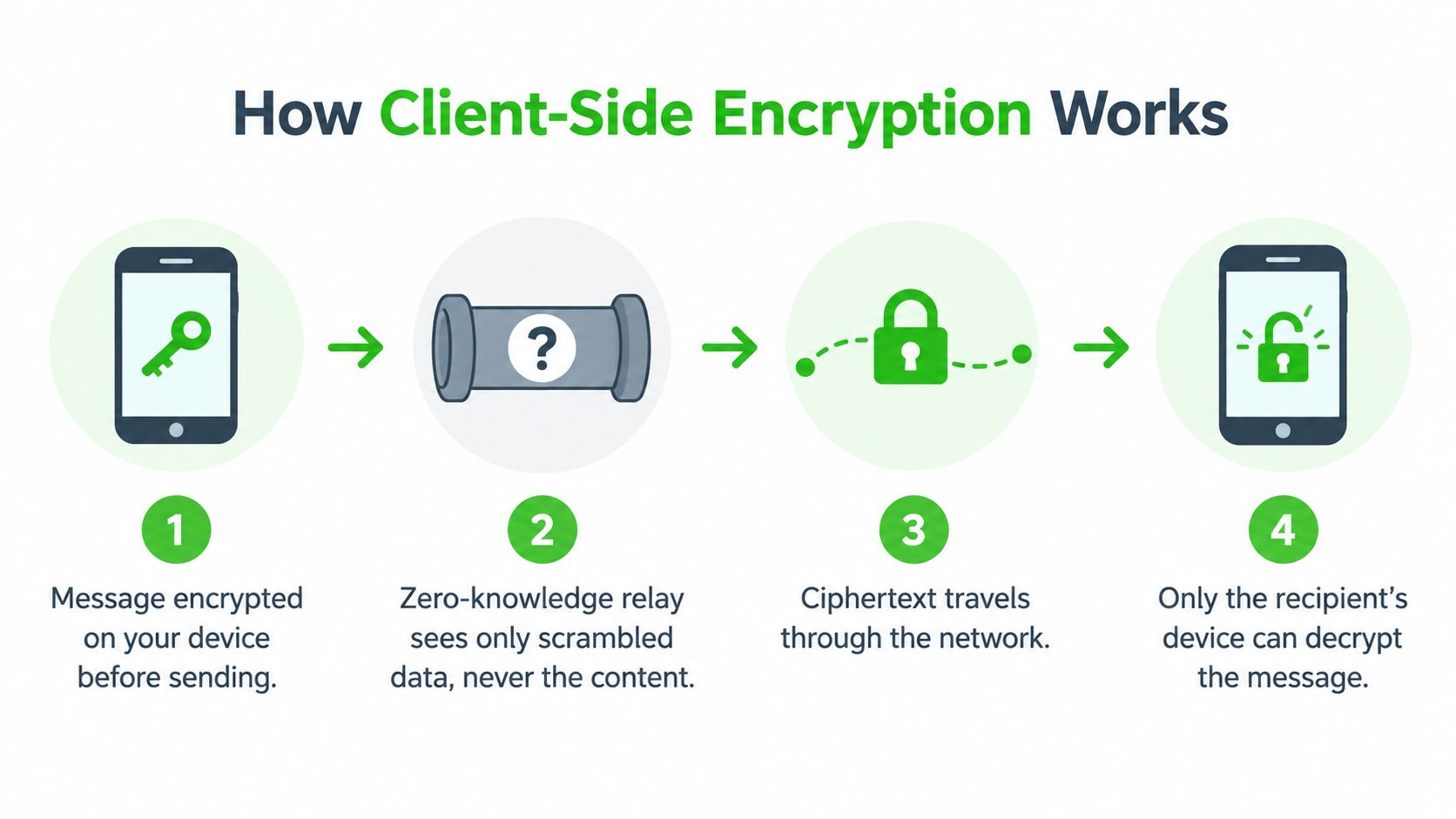
A provider's claim that it “uses encryption” tells you almost nothing until you establish where encryption happens and who controls the keys. Server-side encryption protects data after it reaches the service, but the service may still decrypt it during processing. Client-side E2EE encrypts the content on the sender's device, keeps the decryption material with the participants, and sends the relay only data it can't interpret.
A typical browser-native flow looks like this:
- The browser creates or receives the channel secret locally.
- A key derivation function turns that secret into an encryption key.
- The browser encrypts the plaintext with AES-256-GCM before transmission.
- The relay forwards opaque ciphertext, initialization data, authentication data, and delivery metadata.
- The recipient's browser verifies and decrypts the message locally.
AES-GCM combines confidentiality with integrity. The initialization vector, or IV, ensures that encryption operations use unique context, while the authentication tag lets the receiving device reject altered ciphertext. A relay that sees the ciphertext, IV, and tag still shouldn't be able to recover the plaintext without the key.
Key derivation is part of the security boundary
Human-shareable access credentials are not automatically strong encryption keys. A browser can process a channel secret through PBKDF2, using a per-channel salt and repeated hashing, to derive material suitable for AES-GCM. The salt prevents identical credentials from producing identical derived values across channels, while the work factor makes large-scale guessing more expensive.
That process only helps if the secret never reaches the relay in recoverable form. The browser should retain the usable key locally, encrypt messages before sending them, and discard sensitive state when the channel closes or expires. A system that derives keys on the server, or sends plaintext to an API before “encrypting at rest,” isn't offering the same zero-knowledge boundary.
A relay server can still perform an important delivery function without reading content. It may route encrypted messages, enforce expiry, rate-limit access attempts, and remove expired objects. Those functions don't make the service omniscient, but they also don't make it invisible. Timing, connection information, and service availability remain separate considerations.
Performance depends on message shape
Encryption overhead isn't uniform across workloads. In a 10Gbps Ethernet ping-pong benchmark, AES-GCM showed 5.9% overhead for 256-byte messages and 78.3% overhead for 2MB messages, with BoringSSL outperforming Libsodium and CryptoPP in that test, according to AxioBench's encrypted chat benchmark.
That result has a direct design implication. Text messages and small voice frames fit naturally into a low-latency encrypted pipeline, while large attachments should be chunked, processed asynchronously, and kept out of a single blocking round trip. A product can use a sound cipher and still feel unreliable if it handles every file as one oversized encrypted transaction.
Identity Versus Anonymity in Secure Communications
The hardest design choice usually isn't AES-256 versus another approved primitive. It's whether the service needs to know who the participants are.
Persistent messengers use identifiers to make relationships convenient. Phone numbers, email addresses, usernames, contact discovery, device lists, and synchronized history help people return to the same conversation. That model is appropriate for a trusted team that communicates repeatedly, but it creates a durable graph around the messages. Encryption can hide the contents while leaving the relationship legible to the service, the devices, or an investigator with access to account records.
Identity-free communication removes a different class of risk. A journalist receiving a first tip may not want the source to install an app or reveal a personal number. A lawyer meeting an unfamiliar client may need a confidential intake channel before either party is comfortable joining a persistent contact network. A security researcher coordinating an initial disclosure may want a temporary room that doesn't become a permanent account association.
Browser access changes the first-contact equation
An app-based messenger asks both parties to accept an ecosystem before they can communicate. That may involve an installation, an account, contact permissions, device registration, and notifications that appear in places the user doesn't control. Browser access can reduce that friction to a link and a separately shared access credential.
The trade-off is that a browser isn't magically trusted. The device may be monitored, the browser may be compromised, a participant may capture the screen, and a malicious link may lead to a counterfeit service. Identity-free design reduces account linkage, not every endpoint threat.
The same principle applies to adjacent workflows. Teams handling spoken notes should review the data protection for dictation rather than assume that voice input inherits the privacy properties of an encrypted chat channel. Audio can be exposed before the message is encrypted, especially when transcription, browser permissions, or third-party processing enters the workflow.
Anonymity requires disciplined key sharing
A temporary room only protects first contact if the room link and access key travel through a trustworthy side channel. Sending both in the same exposed email collapses the separation. Participants should verify the channel through an independently known route, confirm the recipient before discussing sensitive facts, and avoid placing names or case details in the room title.
A channel can be identity-free at the application layer while the people using it still identify themselves through careless language, file names, calendar invites, or device notifications.
Comparing Encrypted Chat Apps by Threat Model
A persistent messenger and an ephemeral browser tool shouldn't be ranked on one universal security scale. They solve different operational problems. Signal and WhatsApp are designed for recurring relationships, contact continuity, group communication, and everyday availability. Ciphar is a browser-based option for short, identity-free conversations, with client-side encryption, temporary channels, and no account, phone number, or installation requirement.
| Feature | Mainstream Apps (Signal/WhatsApp) | Ephemeral Browser Tools (Ciphar) |
|---|---|---|
| Account requirement | Persistent account and contact identity are part of the normal workflow | No account, phone number, or email required |
| Default encryption | Signal uses default-on E2EE; WhatsApp protects messages and calls broadly with E2EE | Content is encrypted client-side before relay |
| Identity model | Built for known contacts and durable relationships | Built for first contact without persistent identity exchange |
| Retention model | Conversation history supports ongoing use, delivery, and synchronization | Temporary channel with enforced expiry and no archive |
| Communication pattern | Recurring text, voice, video, and group communication | Short-lived text, files, replies, and voice coordination |
| Metadata exposure | Encryption doesn't remove account, device, contact, and timing considerations | The relay still handles delivery and expiry metadata, while content keys remain client-side |
| Endpoint risks | App, account, backups, notifications, and linked devices require review | Browser, link handling, endpoint integrity, and key sharing require review |
| Best fit | Long-term teams, families, and established professional relationships | Sensitive first contact and sessions that shouldn't become a permanent archive |
The matrix should be read as a threat-modeling tool, not a product scorecard. If a legal team needs durable matter history, administrative controls, retention policy, and recoverability, a temporary room may be the wrong system. Compliance review should cover access controls, audit requirements, contracts, and sector obligations. An Ares HIPAA compliance guide is a useful reference for thinking about access governance, but no chat product becomes compliant merely by displaying an encryption badge.
Select the failure you can tolerate
A persistent service accepts more retained state in exchange for availability and continuity. An ephemeral service accepts less recoverability in exchange for reducing the archive. Losing an expired room may be the intended outcome for a source conversation, but it can be unacceptable for a regulated clinical record or a matter that requires documented preservation.
The encrypted messaging app comparison provides useful background for evaluating default encryption, open implementation details, metadata practices, and disappearing-message behavior. The decision should end with a written answer to one question: if the provider's servers are compelled or breached tomorrow, what information must remain unavailable?
The Policy Tensions of Ephemeral and Zero-Knowledge Chat
Ephemeral encryption creates a real policy conflict. The same architecture that limits exposure for a confidential source can frustrate abuse investigations, evidence preservation, and lawful requests. A service that cannot decrypt content can't search its archive for prohibited material, and a service that promises no archive can't later produce a complete conversation history.
Public concern focuses sharply on this tension. A UK survey from November 2025 found 92% of adults were concerned about child sexual abuse images and videos being shared in end-to-end encrypted spaces, 91% supported company investment in prevention, and 88% supported government requirements for upload prevention, according to the Internet Watch Foundation. These views don't make server-side surveillance compatible with zero-knowledge privacy, but they do explain why encryption claims increasingly need a safety model.
Prevention without reading conversations
A platform can separate content confidentiality from abuse prevention, though every control introduces trade-offs. Possible approaches include client-side safety checks, user reporting, rate limits, access alerts, abuse-resistant account or channel creation, verified safety resources, and strict controls around file handling. Client-side detection is particularly sensitive because it moves inspection onto the endpoint and raises difficult questions about false positives, scope, governance, and who receives the result.
Zero-knowledge relays can still enforce operational controls. They can reject repeated failed access attempts, surface intrusion notices to participants, expire channels, and limit automated guessing without learning the plaintext. Those measures don't identify every abusive actor or resolve legal disputes, but they can reduce opportunistic misuse while preserving the cryptographic boundary.
Legal requests expose architectural honesty
A provider should explain what it can and can't produce under compulsion. “We can't read messages” is narrower than “we retain nothing.” A service may still hold encrypted objects, expiry timestamps, account records, connection data, or abuse signals. Conversely, an enforced deletion design may make recovery impossible, which can protect participants but eliminate legitimate evidentiary options.
Professionals should therefore ask for the security model, retention rules, jurisdictional policy, reporting process, and endpoint assumptions before adoption. Ephemerality is not a moral position or a compliance shortcut. It's a deliberate decision to make future recovery impossible.
Situational Guidance for High-Stakes Professionals
A journalist and a newsroom colleague may need Signal for an established working relationship. A journalist and an unknown source face a different problem. The first conversation may reveal identity before either person has verified the other, and asking the source to install an app can create a trace or expose a phone number. A temporary browser channel is appropriate when the objective is to establish contact, exchange a safe method for follow-up, and let the initial room expire.
A lawyer's recurring client communication usually needs more structure. Matter-specific identity, retention, access control, conflict checks, document governance, and professional obligations can outweigh the advantages of a disposable room. But an intake conversation with a prospective client, whistleblower, or intermediary may call for a short-lived first-contact channel before the firm creates a formal record.
Use the smallest channel that fits
A security researcher coordinating a vulnerability disclosure should distinguish triage from long-term remediation. During first contact, a temporary room can reduce identity exchange and prevent a sensitive description from becoming a durable account conversation. Once the receiving team verifies the report and establishes authorized contacts, a persistent enterprise channel with access controls and an agreed recordkeeping process may be more suitable.
Healthcare professionals need even tighter discipline. A browser room can support limited coordination only when the organization has evaluated its legal, contractual, clinical, and recordkeeping duties. It shouldn't become an informal substitute for an approved regulated-communications system, especially when the conversation must be retained, attributed, or integrated with a patient record.
A practical decision test
Ask three questions before opening a channel:
- Do we need continuity? If participants must return to the same history, use a persistent messenger or approved collaboration system.
- Does first contact create risk? If phone numbers, accounts, or installations would expose a source, client, or researcher, use an identity-minimizing channel.
- Must the record survive? If policy or law requires preservation, don't use enforced ephemerality as the primary record.
The right tool can change during the engagement. Start with the narrowest safe channel, verify identities through a separate route, then move to a durable system only when continuity and accountability matter more than temporary anonymity.
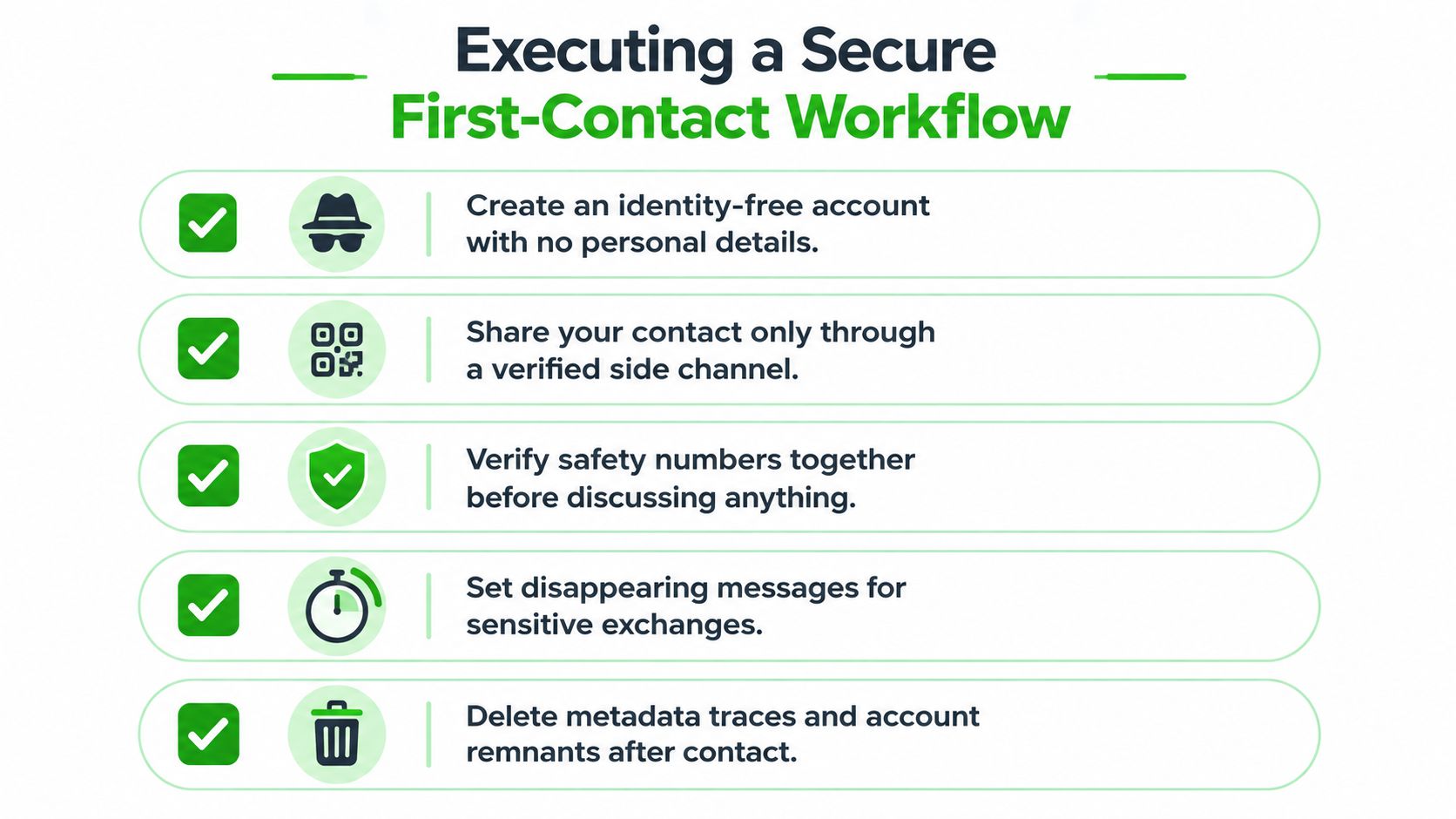
Executing a Secure First-Contact Workflow
Start with the threat model, not the interface. Decide what the other party must know, what must never be retained, how you'll verify the person, and what event should trigger an immediate shutdown.
- Create the channel without personal details. Use a private browser session where appropriate, avoid names or case references in the room title, and generate the access credential locally.
- Separate the link from the key. Send the channel address through one route and the access key through a verified side channel. Don't place both in an untrusted message.
- Perform an access check before disclosing substance. Exchange a harmless test phrase, verify that both participants see the expected security notice, and confirm that failed access attempts are visible.
- Set the retention expectation explicitly. Tell the other participant when the channel expires, what cannot be recovered, and whether either side may copy, photograph, or record the screen.
- Burn early when conditions change. Use the manual termination control if the device, participant, link, or surrounding environment appears compromised. Don't wait for the timer when immediate destruction is safer.
Ciphar offers browser-based, zero-knowledge temporary channels with client-side AES-256-GCM encryption, encrypted voice frames, intrusion alerts, manual burn control, and an enforced sixty-minute lifetime. Visit Ciphar to assess whether that identity-free workflow fits your first-contact threat model, and document the point at which you'll transition to an approved persistent system.