The deal is live, the other side wants to move fast, and the channel you have is wrong.
Maybe it's a retained corporate chat where too many people can scroll back. Maybe it's a phone-number-based app that instantly gives away identity. Maybe it's email, where forwarding is easy and deletion is mostly theater. The failure usually doesn't start with cryptography. It starts with workflow. Someone invites the wrong person, keeps the thread too long, reuses a link, or verifies identity with the same channel an impersonator already controls.
I've seen the same pattern across journalist source handling, privileged legal intake, sensitive healthcare coordination, and executive negotiations. The highest-risk conversations don't fail because people forgot the word “encryption.” They fail because nobody designed the deal communication process from first contact to burn.
Why Deal Communication Fails Under Pressure
A sensitive deal rarely breaks at the moment someone says the wrong thing. It breaks earlier, when the team falls back to whatever inbox, chat app, or assistant-managed thread is already open.
I've seen the same failure pattern with reporters, outside counsel, healthcare operators, and executive teams. The channel gets chosen for speed, not fit. Then the workarounds begin. Someone shares a phone number that did not need to be shared. Someone invites a second participant without checking device hygiene. Someone assumes disappearing messages solve retention, while screenshots, synced notifications, and stale sessions keep copies alive elsewhere.
The failure point is operational control
Under pressure, I apply three filters before opening any channel: how much identity the channel exposes, how many copies it creates, and how I will remove access if the thread turns.
That framing matters because deal communication is an operating procedure, not a feature checklist. The problem is usually poor control over exposure, retention, and recovery.
The breakdown points are predictable:
- Identity exposure: Phone numbers, primary email addresses, profile photos, and account handles can identify a source, reveal a client relationship, or map an executive's internal circle.
- Retention drift: Messages outlive the deal window and remain in inbox rules, cloud backups, notification trays, desktop sync folders, or legal hold systems nobody considered at the start.
- Access confusion: Participants do not know who joined, who still has the invite, whether a link was forwarded, or which device is still logged in.
- No burn procedure: A suspicious login, a misdirected attachment, or an impersonation attempt appears, and the team has no agreed call on whether to freeze, rotate credentials, preserve evidence, or kill the channel.
Generic business deal negotiation tips help with pacing, framing, and influence in the commercial sense. They do not tell you how to run a short-lived conversation where the existence of the thread may be as sensitive as the terms inside it.
A simple rule holds up well: if the channel asks for more identity than the deal requires, the setup is already exposing too much.
Confidentiality also gets confused with survivability. A private chat can still fail fast if one participant is on a shared laptop, one invite link gets reused, or one assistant has mailbox delegation nobody mentioned. The operational discipline from crisis communication planning applies here too. Decide who can initiate contact, who can verify identity out of band, what gets recorded, and what event triggers an immediate burn.
Three controls that hold up under stress
| Control | What it looks like in practice | Common failure mode |
|---|---|---|
| Minimize identity | Use channels that do not require unnecessary phone numbers, personal emails, or visible social graphs for first contact | Teams default to identity-heavy apps because everyone already has them |
| Minimize retention | Set short message lifetimes, limit downloads, avoid broad sync, and define when the thread is destroyed | Copies remain on managed devices, backups, exports, or notification previews |
| Verify access | Confirm the human, the device, and the current session before discussing terms or sharing files | People trust a link, avatar, or reply style instead of a verification check |
These controls are not universal. Some matters need formal records, supervision, or preservation from the first exchange. But when the job is to move quickly with limited exposure, deal communication works best as a managed workflow from threat model to burn procedure, with identity-light channels and verification steps matched to the audience in front of you.
Map Your Threat Model Before You Choose a Channel
Most channel mistakes happen because people choose tools first and think about risk second.
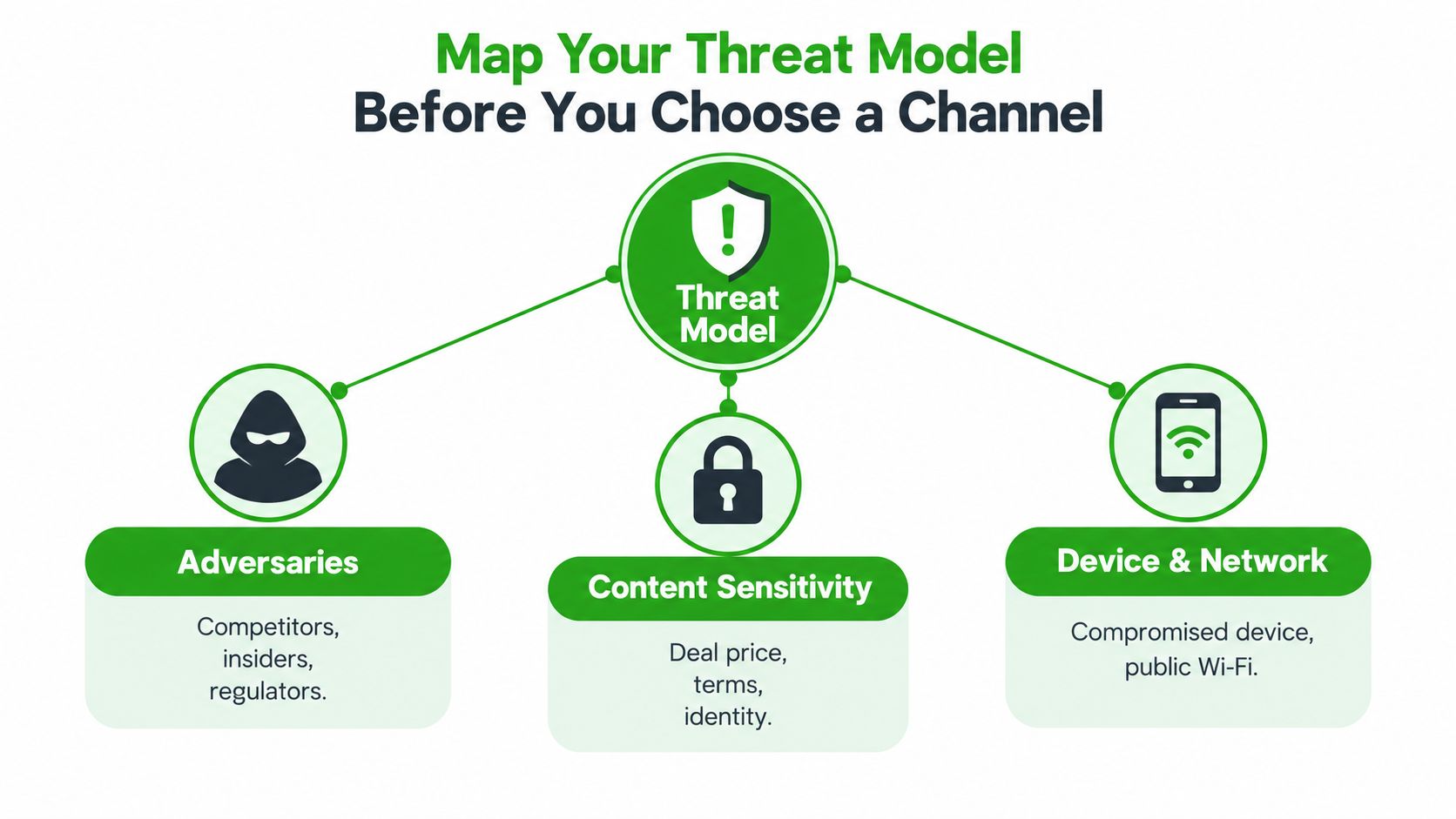
Threat modeling for deal communication doesn't need a workshop or a consultant. It needs ten minutes of honest answers about who could get hurt, what would hurt if exposed, and how long any copy should exist.
Start with who can act against you
Don't start with “hackers” as a vague category. Name actors.
For a journalist, that might be an employer trying to identify a source, an insider monitoring official devices, or an intermediary posing as the source. For counsel, it might be an opposing party, an overbroad internal distribution list, or a client using family devices. For healthcare teams, it may be less about an attacker and more about misdelivery, shared workstations, and uncontrolled forwarding. For executives, think competitors, insiders, assistants with broad mailbox access, and board-level leaks.
A simple classification works well:
- Low exposure: Scheduling, logistics, non-sensitive introductions
- Medium exposure: Early terms, identities not yet public, non-public attachments
- High exposure: privileged matters, source identities, live incidents, health data, acquisition terms, whistleblower contact
Then identify what matters if disclosed
The content isn't just “the message.” It includes:
- The existence of the conversation
- The identities of the participants
- The substance of terms, files, or voice discussion
- The timing and frequency of contact
That distinction matters because a channel can hide content but still leak metadata. In many high-risk deals, who spoke to whom can be nearly as sensitive as what they said.
The web moved toward encryption as a baseline. One industry summary says over 90% of online traffic is encrypted in most nations, and another notes encrypted internet interactions rose from 64% in FY2021 to 79% in FY2024, a 15-point increase over four years, with 82.9% of websites using valid SSL certificates in 2023, up from 18.5% five years earlier (encryption trend summary). That matters because encryption is now table stakes. It doesn't answer the harder workflow questions about identity, metadata, and retention.
Encryption protects transport. It doesn't decide whether the wrong person joins, whether a copy survives, or whether a leaked invite exposes the relationship itself.
Ask how long a copy should exist
Teams either overbuild or underprotect.
If the conversation is only for first contact, a short-lived channel may be exactly right. If the exchange is likely to become a business record, trigger discovery obligations, or fall under regulated retention, disappearing messages don't remove that duty. The operational question isn't whether ephemeral messaging is “secure.” It's whether the communication must later be captured elsewhere.
Use this decision table before you pick a tool:
| Question | If the answer is yes | Implication |
|---|---|---|
| Does identity itself need protection? | Use identity-light onboarding | Avoid phone numbers and account requirements |
| Would a retained transcript create liability? | Prefer short-lived channels | Limit persistence and disable casual archives |
| Must the exchange be preserved as a record? | Plan capture outside the ephemeral room | Preserve according to legal or policy obligations |
| Are unmanaged devices likely involved? | Assume endpoint risk | Keep scope narrow and content minimal |
A final caution matters here. As encrypted traffic became normal, attackers moved into it too. One cybersecurity report states that more than 85% of cyberattacks in 2022 were carried out via encrypted channels, and threats using encrypted communication increased 20% year over year (encrypted-channel threat analysis). The lesson is simple. Encryption alone isn't enough. For high-risk deal communication, short lifetimes, strong access verification, and rapid termination matter just as much.
Choosing and Configuring Ephemeral Encrypted Channels
Once the threat model is clear, channel selection gets easier. You're no longer asking which app is “best.” You're asking which properties fit this exchange.
The wrong habit is picking a familiar messenger and turning on disappearing messages as an afterthought. The better habit is evaluating the channel as a temporary operating environment.
What to evaluate before inviting anyone
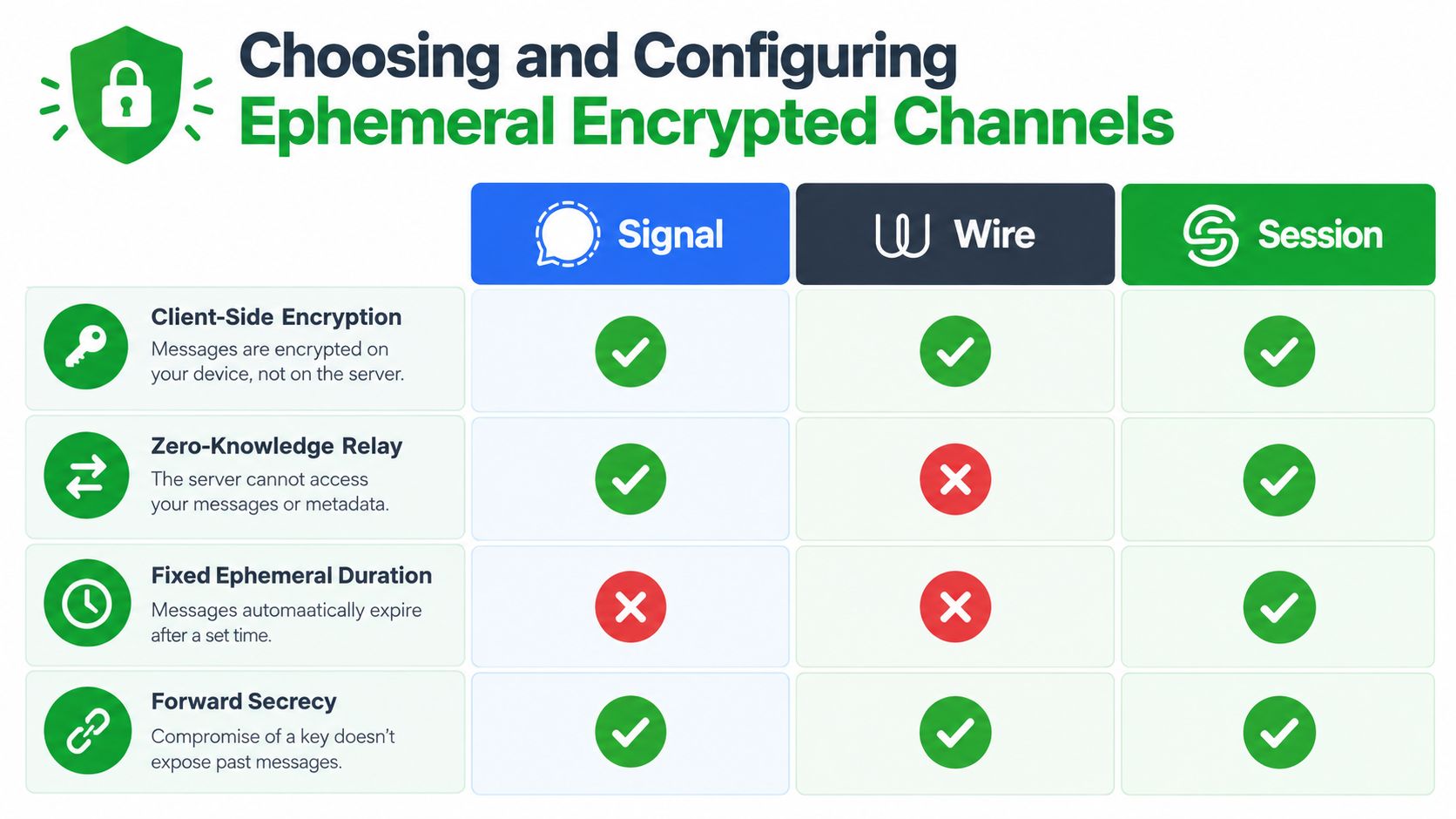
Look for these properties first.
- Client-side encryption: The service should encrypt on the device before relay, not only in transit.
- Zero-knowledge relay: The server should relay opaque ciphertext rather than readable content.
- Fixed lifetime: Expiry should be enforced by the system, not left to user discipline.
- Burn control: You need the option to kill the room immediately if verification fails or an alert appears.
- Verification signals: The channel should give participants a way to test whether the other party has the correct access material.
These criteria matter more than glossy feature lists. A messenger can advertise privacy and still retain identifiers, backups, or recoverable history that don't belong in sensitive deal communication.
One browser-based option in this category is Ciphar, which provides one-time channels with client-side encryption, a server-enforced 60-minute lifetime, manual burn control, and access verification through an encrypted test blob. That makes it a fit for short first-contact conversations where parties need to avoid accounts, phone numbers, and installation.
For broader app ecosystems, people often compare tools such as Signal, Wire, and Session differently depending on whether they prioritize mobile persistence, organizational controls, or identity minimization. The point isn't brand loyalty. It's fit.
A workable 60-minute setup
For a narrow deal window, configure the room as if it will only exist once, because it should.
- Forge the channel just before use. Don't create it hours early and leave the invite sitting in inboxes.
- Share the access key separately. Never send the room link and the key in the same message stream.
- Load a harmless verification artifact first. A short text blob or non-sensitive file confirms both parties can decrypt before terms are discussed.
- Restrict scope. Keep the room to the minimum participants needed to close the immediate question.
- Burn on ambiguity. If the wrong person joins, someone can't verify, or alerts appear, terminate and rebuild.
The setup test matters more than people think. Before inviting a source, client, or counterparty, verify that expiry is enforced server-side, that stored material is ciphertext-only, and that manual burn behaves as expected. Don't assume a disappearing-message toggle equals destruction.
For teams evaluating temporary browser rooms versus installed messengers, the practical trade-offs in temporary chat workflows are worth reviewing. The key distinction is whether the tool was built for ongoing identity-based messaging or for short, self-destructing exchanges.
If a tool can be casually repurposed into long-term storage, people will eventually use it that way.
What to disable or avoid
This list is usually more important than the enablement checklist.
- Avoid synced archives: If desktop and mobile copies linger, the room isn't temporary.
- Avoid account-driven invites: They create a durable relationship graph even when content is encrypted.
- Avoid mixed-purpose channels: Don't use the same thread for small talk, scheduling, documents, and final terms.
- Avoid convenience exports: If someone can save the conversation in one click, assume they eventually will.
Short-lived deal rooms work best when they're intentionally inconvenient for retention and easy for participants to abandon once the immediate decision is made.
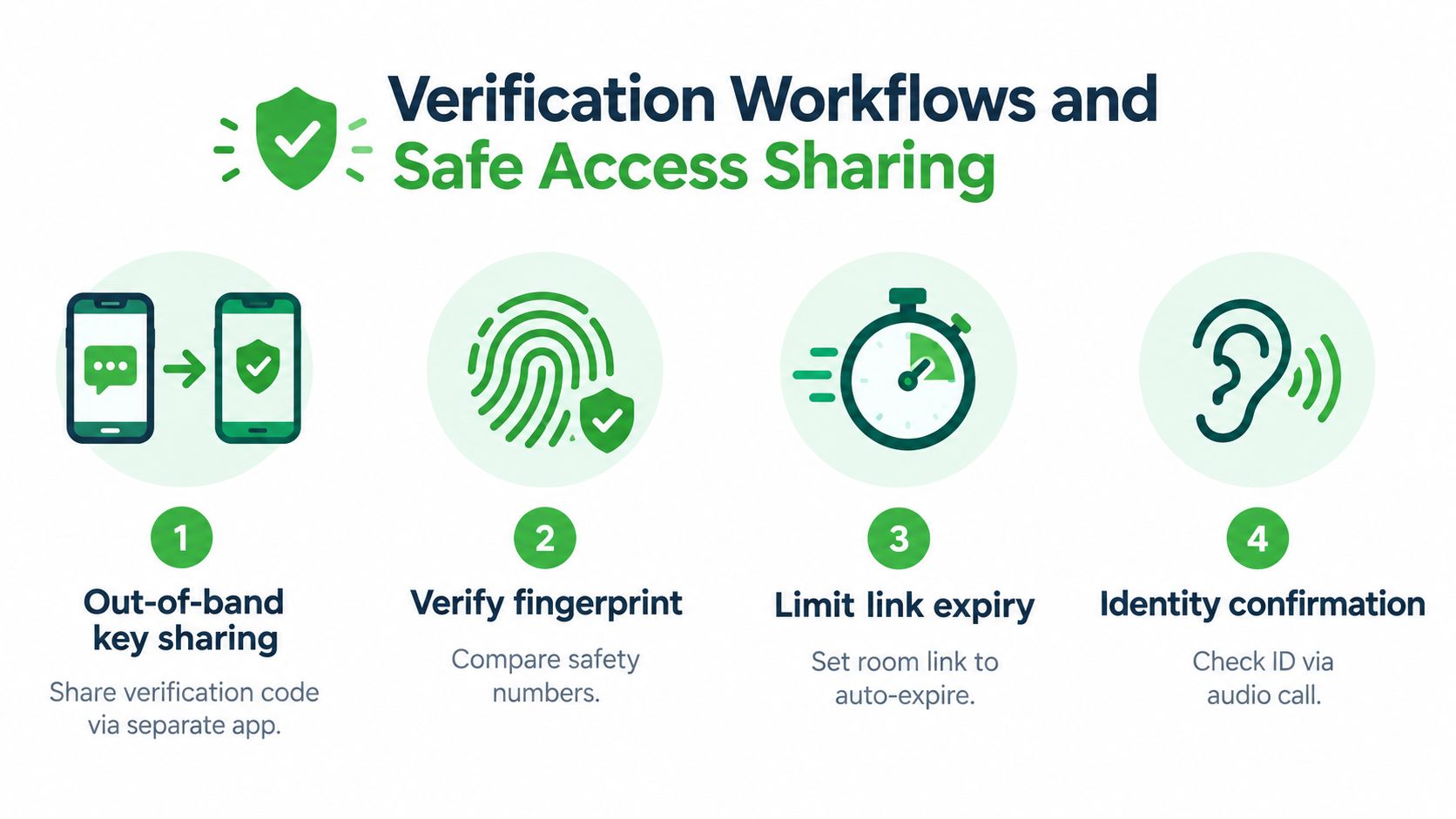
Verification Workflows and Safe Access Sharing
Most failures in sensitive deal communication happen before the first meaningful line of text. The room may be encrypted, but the wrong person still gets in because the invitation path was sloppy.
Verification needs its own workflow. Not a vague “be careful,” but a repeatable sequence that a busy reporter, associate, care coordinator, or chief of staff can run without improvising.
Use split-path access by default
The safest practical pattern is simple. Send the room location one way, and the access material another way.
Examples:
- Link by email, key by voice call
- Link by known work address, key by text relayed through an existing trusted contact
- Link through an assistant, key directly to the principal
- Link in one messenger, verification phrase over a separate channel
That's the same idea behind out-of-band key exchange. You don't trust a single compromised path to deliver everything needed for entry.
For teams that need a model for structured identity checks, some platform verify features show the right direction operationally. The useful lesson isn't the product itself. It's that verification deserves an explicit step, not a hopeful assumption.
A four-step verification sequence
Run this sequence before discussing substance.
Deliver a callsign
Use a pre-agreed phrase, code word, or short identifier known only to the expected participant. Keep it human, not clever. If the counterparty can't repeat it correctly, stop there.
Require decryption of a harmless test blob
Put a non-sensitive encrypted message or file in the room first. If they can open it and report back the expected phrase inside, they have the correct key and basic room access.
Confirm role, not biography
Don't ask for extra personal detail if anonymity matters. Ask only what confirms standing for this conversation. “Are you the person authorized to discuss the draft term sheet?” is better than collecting identity debris you don't need.
Watch for security friction
Failed join attempts, repeated wrong keys, or access from unexpected participants are signals. Treat them as intrusion indicators, not user error until proven otherwise.
Burn and re-forge if any part of first contact feels off. Salvaging a contaminated room is usually a mistake.
Invitation language that works
You don't need elaborate wording. You need clean instructions.
For a journalist:
Use the attached room link in a private browser session. I'll send the access phrase through a separate route. Don't include identifying details until we verify access.
For counsel:
This room is only for first privileged intake. I'll provide the access material separately. Please confirm you're in a private setting before opening documents.
For healthcare coordination:
This temporary channel is for immediate case coordination only. Join with the room link, then verify the code phrase before sharing patient-specific details.
For executives:
Use this room for the live decision window only. Access details will arrive separately. If anyone unexpected appears, exit immediately and wait for a replacement room.
The no-leak checklist
Before any sensitive exchange, check these five items:
- Separate path: Link and key do not travel together
- Short validity: Room is created near the meeting time
- Known counterpart: You have at least one trusted anchor for the other side
- Test before terms: Verification artifact is decrypted successfully
- Clear abort rule: Everyone knows what event triggers an immediate burn
Verification looks fussy until you've had one impersonation scare. After that, it becomes normal.
Audit Trails Incident Response and Retention Rules
Ephemeral communication doesn't remove governance. It changes where governance sits.
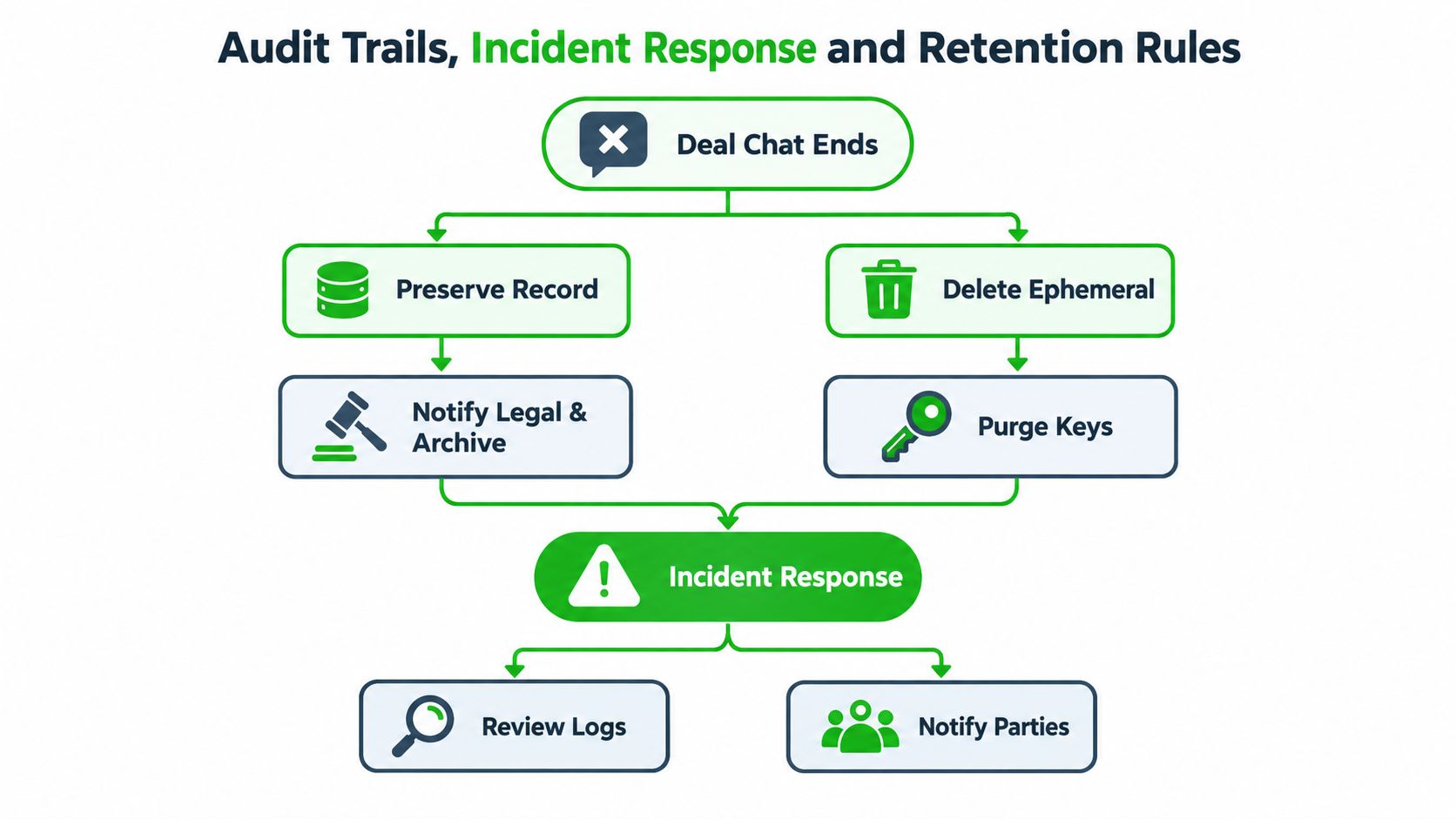
If your team uses short-lived channels, you still need rules for when a conversation becomes a business record, what minimal documentation survives the burn, and what happens if something goes sideways mid-stream. The cleanest setups are the ones that separate conversation content from administrative proof.
When ephemeral still becomes a record
Many teams get careless at this stage. Disappearing messages may still need to be captured and retained, and enterprise guidance notes that regulators such as the SEC and FINRA expect business communications to be preserved even if they occurred on disappearing-message tools. The same guidance also notes that many enterprises now operate across three to five platforms while employees still use personal or ephemeral apps for business despite policy bans (enterprise guidance on ephemeral business records).
That means the control point can't be “we used an ephemeral app, so nothing exists.” The control point has to be a decision rule:
- Was this pure first contact?
- Did legal advice get rendered?
- Did material terms get agreed?
- Did regulated or litigated subject matter arise?
- Did someone issue a preservation instruction?
If the answer moves from exploratory contact into formal business action, the record obligation may begin even if the room itself is temporary.
Keep a minimal deal log
You don't need full transcripts for every sensitive contact. You do need a sparse operational log.
A useful minimal log captures:
| Log field | Keep | Don't keep |
|---|---|---|
| Date and time | Yes | Full content transcript by default |
| Purpose of room | Yes | Unnecessary personal identifiers |
| Participants by role | Yes | Extra metadata that adds exposure |
| Preservation decision | Yes | Screenshots unless required |
| Burn or expiry result | Yes | Casual notes mixed with substantive advice |
This gives compliance teams something to point to without creating a second, sloppier archive of the actual conversation.
Incident response for a compromised room
A burn procedure should be short enough to remember.
- Terminate the room immediately
- Notify active participants through a separate trusted path
- Record what triggered the burn
- Decide whether the event requires preservation, escalation, or both
- Rebuild in a fresh room only after access assumptions are reset
The operational mistake I see most is trying to continue inside a room after suspicious behavior. People tell themselves it was probably a typo, a stale link, or a confused participant. Maybe. But if the conversation matters, uncertainty is enough reason to stop.
A room that may be compromised is already compromised for decision-making purposes.
Retention by audience
The retention rule should match the audience's obligations.
- Journalists: Protect source confidentiality aggressively, but coordinate with editorial and legal standards if notes or evidence must later support publication.
- Lawyers: Privilege and confidentiality don't remove preservation duties when litigation or formal recordkeeping attaches.
- Healthcare teams: Minimize unnecessary patient detail in transient channels and move required documentation into approved record systems promptly.
- Executives: Separate negotiation chatter from formal approvals, board records, and signed deal artifacts.
Good deal communication doesn't end at secure delivery. It ends when the team can explain what was said where, what had to survive, and why the rest was allowed to disappear.
Templates and Checklists for Confident Deal Execution
The teams that handle sensitive deals well don't improvise from scratch. They run habits.
That matters because communication quality affects outcomes. In an empirical bargaining study, the typical bargaining session succeeded 44% of the time, and when parties used messages they were 8 percentage points more likely to transact, which the authors describe as a 14% reduction in bargaining breakdown (bargaining communication study). Another analysis of 40 negotiations found 18 agreements and 22 non-agreements, with apologizing and accepting offers associated with agreement, while personal communication and procedural suggestions correlated with non-agreement (negotiation behavior analysis).
The lesson isn't to script every line. It's to keep deal communication concise, concession-aware, and tightly tied to decisions.
Four audience templates
Journalist to source
“Use the temporary room link I sent. I'll provide the access phrase separately. Once you join, send only the verification words first. Don't send names, employers, or documents until I confirm access.”
Lawyer to new client
“This channel is only for initial confidential intake. I'll send the access material through a separate route. Once verified, give a short summary of the issue and any deadline before sharing attachments.”
Healthcare coordinator to counterpart
“Join the room from a private device if possible. I'll confirm the code phrase separately. After verification, share only the minimum details needed for immediate coordination, then move required documentation into the approved record system.”
Executive to counterparty
“This is a temporary room for the current negotiation window. Access details arrive separately. Once we verify participants, keep messages limited to live decision points, open items, and agreed next moves.”
The pre-flight checklist
Before opening the room, confirm:
- Threat fit: The channel matches the sensitivity of the exchange
- Identity discipline: No unnecessary phone number, account, or profile exposure
- Split delivery: Link and key are traveling separately
- Verification plan: Callsign and test blob are ready
- Burn authority: One person is clearly authorized to terminate on suspicion
The post-burn checklist
After the room expires or is burned:
- Log the event: Record purpose, participants by role, and preservation decision
- Move required records: Transfer formal obligations into approved systems
- Close loose ends: Revoke follow-up links and stop reuse of access material
- Debrief briefly: Note what caused friction, delay, or ambiguity
- Reset the norm: New deal, new room, new key
One more habit matters. Keep language direct. Acknowledge concessions plainly. Don't let the thread drift into relationship theater or process debates when the work is deciding, confirming, or walking away. Under pressure, better deal communication is usually shorter, cleaner, and easier to shut down.
Ciphar offers a browser-based way to run short, identity-free encrypted conversations with one-time channels, client-side encryption, and a fixed self-destruct window. If your team needs a tighter workflow for first contact, verification, and controlled burn procedures, visit Ciphar and review whether that model fits your deal communication requirements.