The most popular advice about digital safety is often the least precise: hide in a crowd, use the biggest platform, and assume anonymity follows scale. That logic can work in limited physical situations, but it fails when the crowd leaves a permanent record of who connected, when, from where, and for how long.
A large encrypted service may protect message content while still retaining identifiers, connection records, account relationships, backups, or searchable archives. If a source, client, patient, or incident response team needs a short conversation rather than a permanent communications history, data minimization matters more than popularity. Safety of numbers isn't a guarantee. It's a risk relationship that depends on exposure, infrastructure, oversight, and what remains after the conversation ends.
Rethinking Digital Anonymity and Scale
A large user base can make an individual less conspicuous, but it can also create a larger and more valuable target. In a physical crowd, other people may reduce an individual's exposure to certain hazards. In a digital service, every participant can contribute to a growing pool of metadata, account links, device records, and retained messages. The crowd may obscure one person while giving an adversary a richer map of everyone.
This distinction matters for journalists, lawyers, researchers, and executives handling sensitive first contact. End-to-end encryption can prevent a relay from reading message content, but it doesn't automatically remove the surrounding evidence. A persistent identifier can connect separate conversations. A long-lived archive can expose old messages after a device, account, or server is compromised. A phone number can turn a private exchange into a relationship that remains discoverable long after the immediate need has ended.
Popularity isn't a threat model
“Use the app everyone else uses” is a convenience recommendation, not a security analysis. It may reduce suspicion because the service is common, but it doesn't answer the operational questions that matter:
- Identity: Does the service require a phone number, email address, account, or profile?
- Metadata: Can an operator identify participants, connection times, or channel relationships?
- Retention: Are messages, files, transcripts, backups, or logs retained?
- Recovery: Can old material be restored after deletion?
- Compulsion: What information could the provider disclose if legally compelled?
- Failure scope: How much history would a breach expose?
Teams working with personal information can use resources such as practical techniques to protect PII with GoReplay to think more carefully about minimization and anonymization. The same discipline applies to chat. Protecting content while retaining unnecessary identity data solves only part of the problem.
A browser-based, identity-free channel changes the starting point. The participants don't need to create a durable account relationship before they speak, and the conversation can be designed to expire rather than become another searchable record. That approach is particularly relevant when phone number privacy affects confidential communication, because exchanging a number can create a persistent identity link that the conversation itself never required.
Operational rule: Treat anonymity as a property of the whole workflow, not a label attached to encryption.
The practical lesson is uncomfortable but useful. Scale can hide a user, or it can scale the evidence around that user. Only a clear retention policy and a deliberately narrow identity model tell you which outcome you're getting.
The Historical Evolution of Safety in Numbers
The phrase “safety in numbers” predates modern security technology by centuries. It was first recorded in English around 1550, while the underlying idea appears in the Latin proverb Defendit numerus. Jane Austen later used the phrase in Emma, published in 1816, showing that it had entered ordinary English usage by the early nineteenth century. These historical details are documented in the history of the phrase and its earlier sources.
The expression began as a broad social observation. A person travelling with others might face less danger than someone alone. A group could attract attention, share responsibilities, or deter an attacker. None of that established a universal law. It described a possibility that depended on the environment and the behaviour of the group.
From proverb to measurable relationship
Modern transport research made the idea more precise. In 2003, Peter Jacobsen examined walking and cycling participation and reported an inverse relationship between the number of people walking or cycling and the risk of collisions with motorists, as described in the historical account linked above. The finding helped turn a proverb into a public-safety hypothesis.
The important qualification is that the relationship wasn't linear. More pedestrians or cyclists could coincide with more total crashes while the risk per person fell as participation increased. That distinction separates individual exposure from aggregate harm. A growing group may reduce the chance that any one member is hit, while still producing more incidents overall because more people are present.
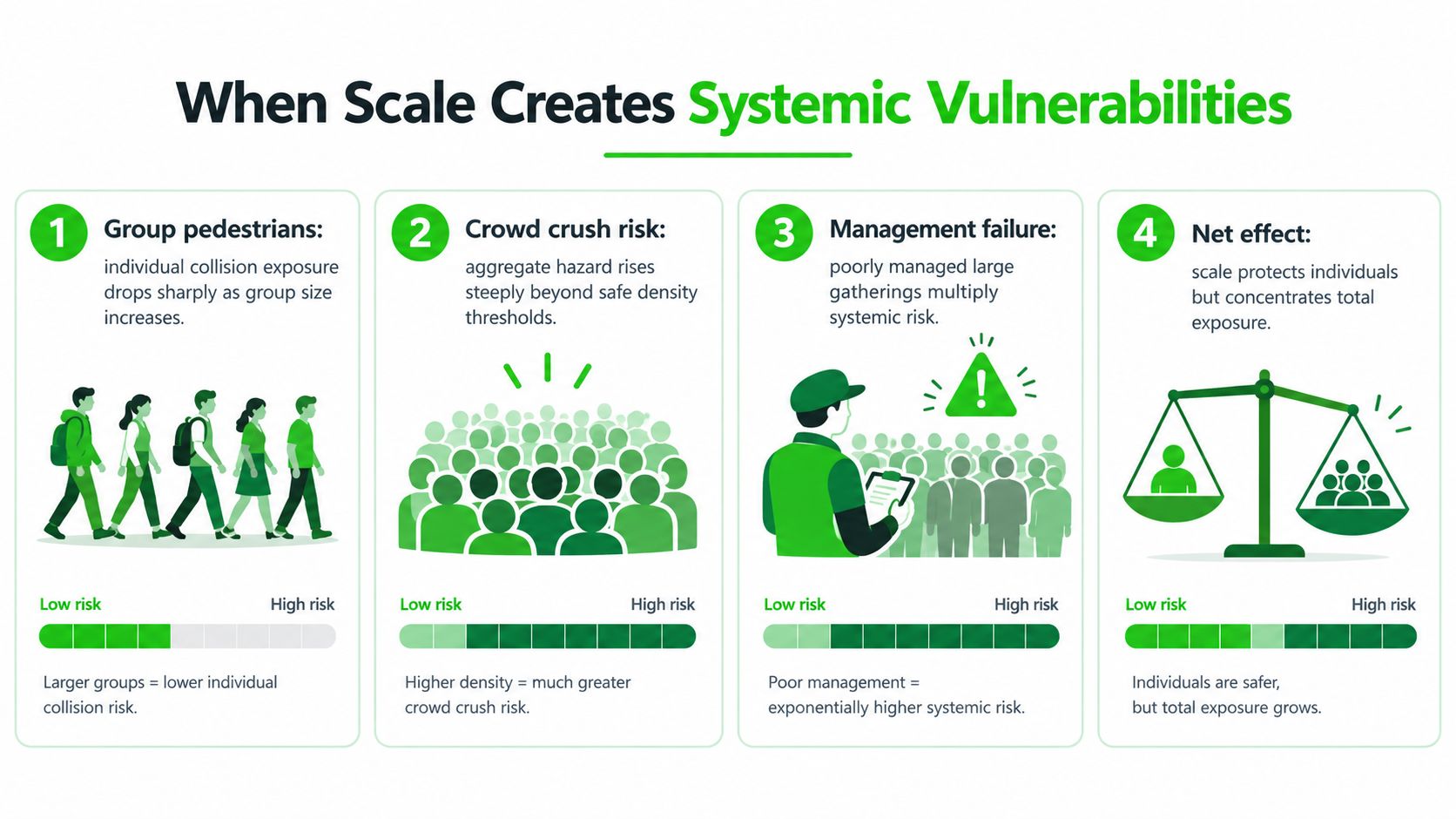
The same distinction is essential in digital privacy. A user may feel less visible among millions of accounts, yet the provider may hold a larger and more connected dataset. Individual obscurity can coexist with systemic exposure.
What the evidence doesn't establish
The phrase also hides a causality problem. A U.S. Department of Transportation literature review states that “the exact cause of the SIN effect is unknown”, while longitudinal work continues to treat the effect as a statistical relationship rather than a proven mechanism. The U.S. DOT review of the safety-in-numbers literature is valuable precisely because it resists turning an observed pattern into a promise.
For privacy practitioners, that caution changes the question. Don't ask whether more users automatically make a service safer. Ask which risk is falling, which risk is rising, and what controls explain the difference. A popular network might reduce the visibility of one account while increasing the consequences of a central database breach. A small temporary channel might look less anonymous in aggregate while retaining far less information about its participants.
Safety of numbers is therefore best understood as a context-dependent relationship. It can inform a design decision, but it can't replace a threat model.
When Scale Creates Systemic Vulnerabilities
Crowd data shows why collective presence can produce contradictory outcomes. A 2023 UNSW analysis reported that serious crowd accidents worldwide rose from an average of about 3 incidents per year during 1990 to 1999 to nearly 12 per year during 2010 to 2019, while estimating that around 8,000 people were killed and more than 15,000 injured in crowd accidents during the preceding 20 years. The figures appear in the UNSW analysis of crowd accident hotspots and risk.
A separate crowd-safety summary estimated that between 1980 and 2022, about 440 crowd-surge incidents caused more than 13,700 deaths and 27,000 injuries, also discussed by UNSW. The point isn't that crowds are naturally dangerous. It's that density, movement, infrastructure, supervision, and emergency control determine whether scale reduces individual exposure or concentrates catastrophic risk.
Translating crowd risk into digital risk
A digital service has its own forms of density. Millions of accounts may share a common identity system. Many conversations may pass through the same relay. Large archives may sit behind one administrative boundary. A single compromise, subpoena, insider error, or misconfigured backup can therefore affect people who never interacted with one another directly.
The physical analogy is not exact, and it shouldn't be overstated. A server breach isn't a crowd surge. The useful comparison is structural: adding participants without adding controls can increase the total blast radius. A service that keeps more history creates more material to steal, disclose, correlate, or misinterpret. A service that binds every conversation to a durable identity makes unrelated events easier to connect.
The failure modes differ, but the management questions are similar:
- Density: How much sensitive information accumulates in one place?
- Flow: Can an attacker observe relationships, timing, or movement between channels?
- Infrastructure: Does the system rely on a central archive, account directory, or recovery layer?
- Control: Can administrators limit access, detect guessing, terminate a session, or remove retained data?
- Consequence: If the system fails, does the incident expose one exchange or years of communications?
More users don't remove aggregate exposure
A common privacy argument says that a larger service gives users plausible deniability. That may help against an observer who sees only a public population, but it doesn't address a provider that can correlate persistent identifiers with connection records. Nor does it protect a confidential exchange if the endpoint stores screenshots, downloads, browser artifacts, or copied notes.
Ephemeral design addresses a different part of the problem. It doesn't make the participants invulnerable, and it can't prevent a recipient from photographing a screen or repeating a message. It can, however, reduce the amount of server-side material available after the operational need has passed. That is a structural reduction in exposure, not an appeal to crowd size.
The trade-off is straightforward. Persistent tools offer continuity, search, recovery, and group coordination. Temporary tools offer less convenience in exchange for a smaller historical footprint. Neither choice is universally safer. The correct choice depends on whether the main threat is interruption and loss of continuity, or discovery and accumulation of sensitive records.
The Mechanics of Ephemeral Risk Reduction
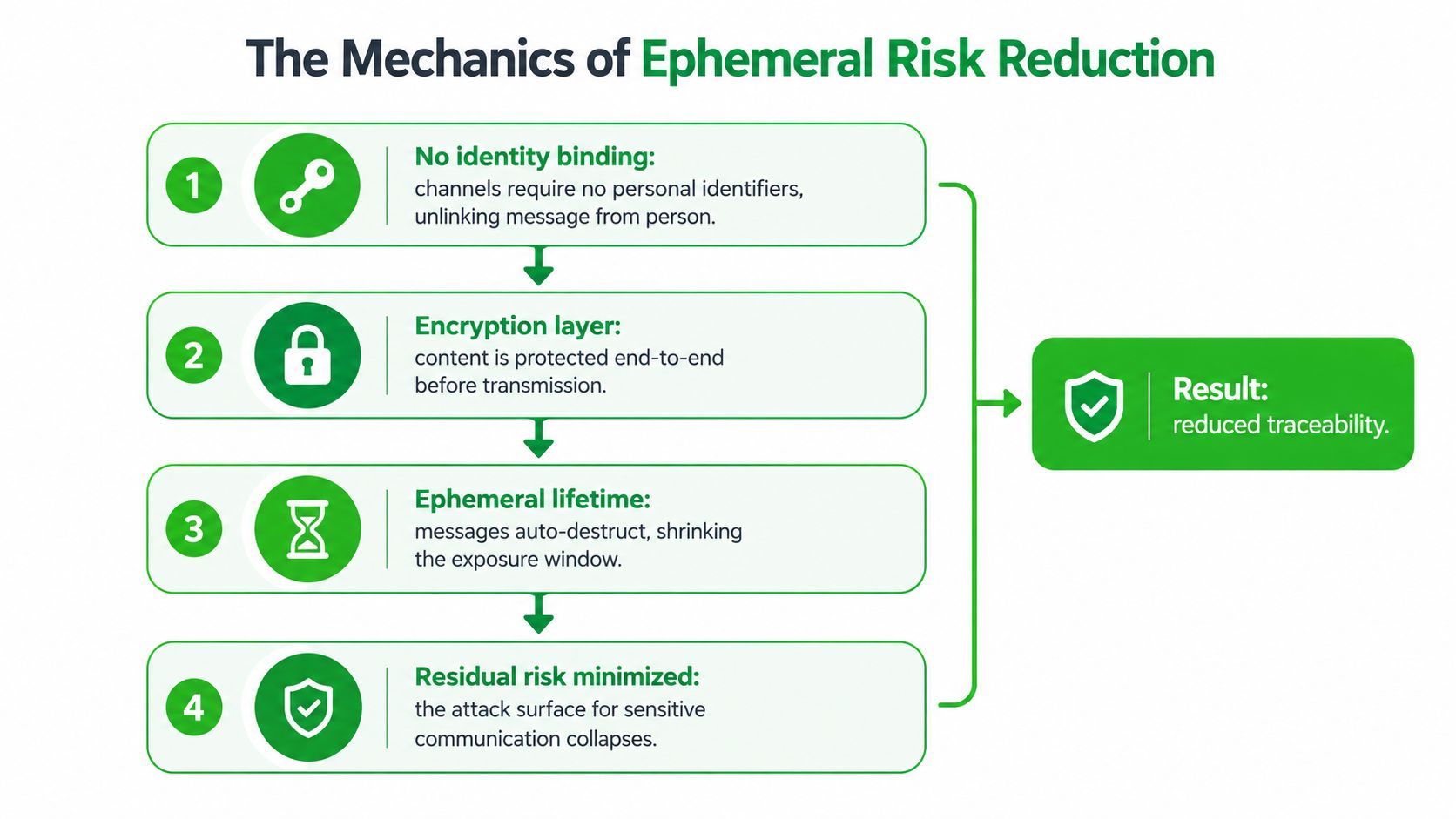
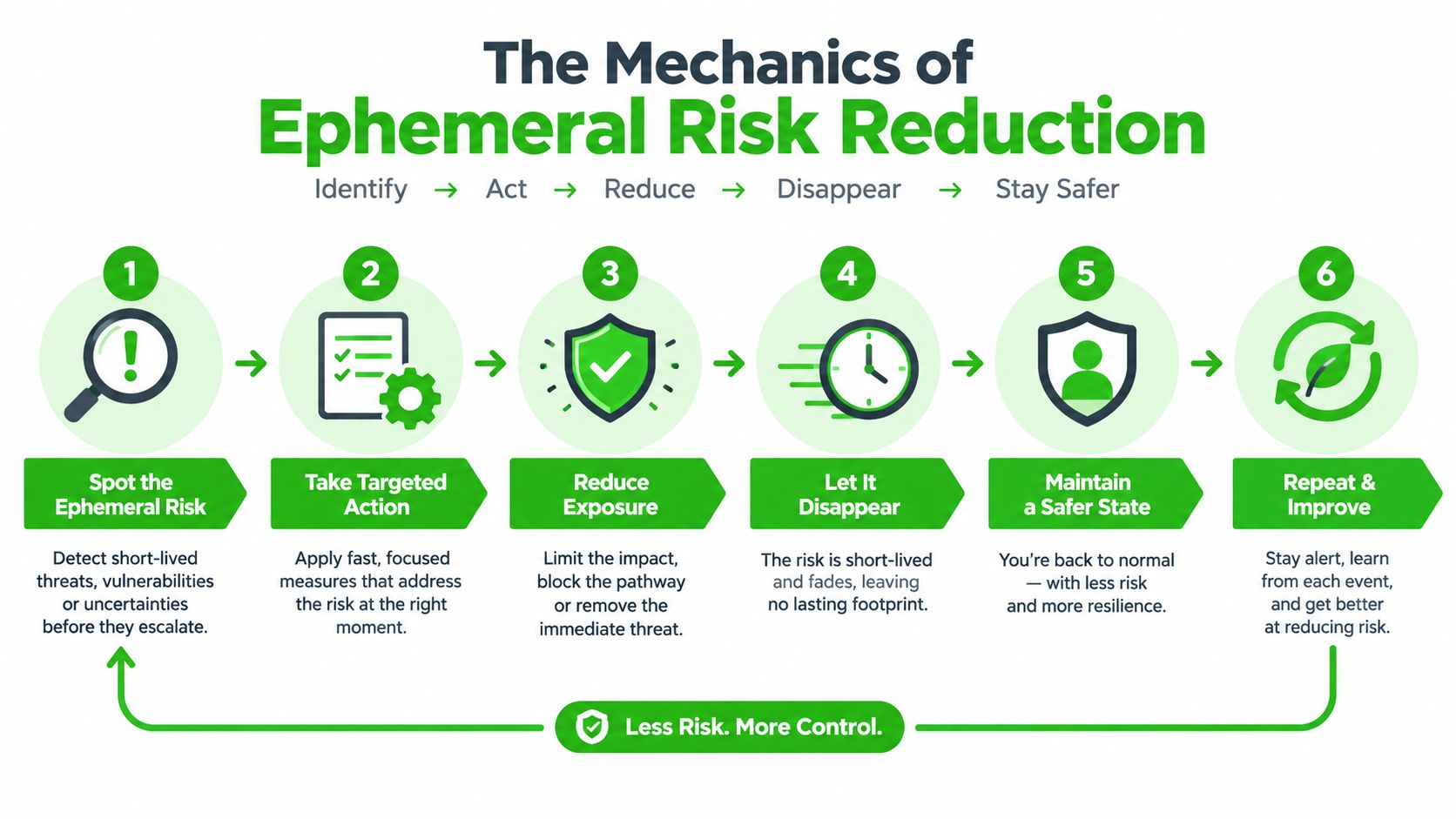
Ephemerality works by imposing a limit that users and administrators can't easily ignore. A temporary channel doesn't merely encourage deletion. It makes the conversation's lifetime part of the system design, which changes the consequences of a later breach or legal request.
For identity-free communication, the sequence matters.
Start with identity minimization
A channel can be created without an account, phone number, email address, or installation. Participants receive a channel name and access key, then share the key through a separate route. That separation prevents the chat service from needing to know the real-world identity of everyone who enters.
Identity minimization doesn't mean participants should trust unknown contacts automatically. It means the application collects less identity data by default. Users still need to verify who they're speaking with through an appropriate out-of-band method, especially when a source, client, or responder faces impersonation risk.
Encrypt before transmission
Client-side encryption means the browser protects messages, files, replies, edits, and voice frames before they reach the relay. Ciphar's documented design uses AES-256-GCM, derives channel keys in the browser with PBKDF2 using 100,000 SHA-256 iterations, and uses a per-channel salt. Those details describe the implementation, not a guarantee that every endpoint is secure.
The relay's role is consequently narrower. It can pass opaque ciphertext and associated material needed for delivery, but it doesn't hold the decryption key. A zero-knowledge relay reduces the value of server compromise because the operator can't directly open the stored conversation and read it.
Enforce expiration, don't just recommend it
The channel has a hard 60-minute lifetime, enforced server-side, with no archive and no recovery. Once the lifetime ends, the system isn't designed to preserve a historical copy for later convenience. A manual burn control can terminate the session earlier when a participant detects compromise, mistaken access, or a change in circumstances.
That constraint changes the threat model. An attacker who gains access to server material later can't retrieve a permanent archive that the system never retained. The control doesn't eliminate endpoint risk, screen capture, malicious recipients, or active interception. It narrows the window and reduces the amount of historical evidence available to a future attacker.
Design principle: Encryption protects what is stored. Expiration limits how much there is to store.
Service operators and legal teams should also examine the broader privacy provisions for service providers, including what policies say about collection, disclosure, and retention. Technical controls and legal documentation should describe the same system. A short-lived channel is undermined if logs, analytics, transcripts, or hidden backups recreate the archive elsewhere.
The practical explanation of these design choices is set out in what ephemeral messaging means in operational use. The key idea is simple: remove persistence as a failure mode instead of asking users to remember perfect deletion after every sensitive exchange.
Comparing Persistent Messengers and Ephemeral Channels
The choice between a persistent messenger and an ephemeral channel should begin with the conversation's purpose. A long-running team needs continuity, search, membership management, and recoverable records. A confidential first contact may need none of those features and may be harmed by them.
The table below is a decision aid, not a claim that one category is always secure.
Threat Model Comparison Matrix
| Feature | Persistent Messengers | Ephemeral Channels |
|---|---|---|
| Identity requirements | Usually built around accounts, phone numbers, email addresses, or stable profiles. | Can operate without a personal account or persistent identifier. |
| Installation friction | Often requires an app, registration, device verification, or participation in a platform ecosystem. | Browser access can reduce onboarding and avoid downloads. |
| Conversation lifetime | Designed for ongoing history, retrieval, synchronization, and backups. | Designed for a defined session that expires rather than becoming an archive. |
| Search and recovery | Useful when teams need to find prior decisions, files, or instructions. | Intentionally limited, which reduces historical exposure but removes convenient recovery. |
| Group coordination | Suited to established teams and recurring communities. | Better suited to a narrow, time-limited exchange with a small participant set. |
| Server-side exposure | The provider may hold a substantial history, even when content is encrypted in transit or at rest. | A ciphertext-only relay with enforced expiry can reduce retained material. |
| Endpoint risk | Users may keep local copies, notifications, exports, screenshots, and synchronized backups. | Users still control endpoints, so temporary server storage doesn't prevent local capture. |
| Failure consequence | A compromise may expose relationships and historical context across many conversations. | A compromise may have a narrower scope if the channel has already expired and no archive exists. |
| Best fit | Projects where continuity, auditability, and recovery are legitimate requirements. | Sensitive first contact, incident coordination, or a one-off conversation where persistence creates unnecessary risk. |
Match the tool to the consequence
A law firm managing a durable case team shouldn't replace its approved document and messaging systems with an ephemeral channel. A newsroom may need a temporary route for an initial source conversation, then move verified material into a controlled editorial workflow. An incident response team may use a short-lived room during a rapidly changing event, while preserving only the decisions that policy requires.
The wrong tool creates two kinds of failure. Persistent software can retain more information than a sensitive exchange needs. Ephemeral software can destroy information that a team has a legal, regulatory, or operational duty to preserve. Decision-makers should identify those duties before choosing convenience.
Decision test: If losing the conversation would be worse than exposing it, persistence may be justified. If retaining it would create the greater danger, don't default to a permanent messenger.
Operational Workflows for High-Stakes Professions
A privacy tool becomes useful only when it fits the work people do. The strongest workflow is usually short, deliberate, and boring. Participants should know how a channel starts, how they verify one another, what they may share, and what happens when the session ends.
Journalists and confidential sources
A reporter can create a temporary channel before requesting sensitive material. The reporter should share the access key through a separate route, such as an already verified contact method, rather than placing the key beside the invitation. The first messages should confirm the source's identity and expectations without asking for unnecessary personal details.
The reporter should also explain limitations. A disappearing channel can't stop a source from saving a copy, and it can't protect a compromised device. The journalist should avoid collecting identifying information before it's needed, disable unnecessary previews and notifications, and use the manual burn control if the source reports an access problem or suspects that someone else received the key.
The operational guidance in journalist source protection practices should sit alongside newsroom policy, source verification, and secure evidence handling. Ephemeral chat is a first-contact control, not a replacement for editorial security.
Lawyers and prospective clients
A law firm often needs to answer an intake question before it knows whether a formal engagement exists. Asking a prospective client to install software or disclose a personal number can create friction and unnecessary records. A temporary browser channel can support an initial exchange without turning the intake route into a permanent social identity link.
Counsel should tell the client what not to send before the channel opens. The first exchange can establish the matter's general nature, conflict-check requirements, urgency, and the approved next step. Once the firm accepts the matter or needs a durable record, it should transfer only the necessary information into its governed case-management system.
This workflow preserves an important distinction. Privacy is not the same as record destruction. Lawyers must follow applicable professional duties and retention policies. A temporary intake conversation may reduce incidental exposure, but it doesn't authorize a firm to discard records that it is required to keep.
Incident responders and security teams
During an active incident, responders need rapid coordination, but a permanent chat history can expose vulnerabilities, credentials, host details, and investigative hypotheses long after containment. A short-lived room can support live voice or text coordination while participants exchange only the minimum operational detail.
The team should establish a separate authoritative record before starting. That record might contain approved findings, timestamps, decisions, and handoff notes. The temporary room then functions as a coordination surface, not the incident archive. Participants should never paste secrets merely because the channel is encrypted, and they should burn the room if an access key is exposed or an unexpected participant appears.
A disciplined workflow looks like this:
- Initialize: Create the channel and confirm the intended participants through a separate route.
- Verify: Use the access test and a known detail to confirm that everyone holds the correct key.
- Limit: Share only what the immediate decision requires.
- Record selectively: Move necessary decisions into the approved system of record.
- Terminate: Burn the session when the risk changes, then allow the remaining channel lifetime to expire.
These controls work because they assign actions to people. No system can compensate for a team that shares keys in public, ignores identity verification, or treats an encrypted room as a substitute for judgment.
Building a Resilient Communication Strategy
The evidence behind safety of numbers doesn't support a simple rule that more participants, more anonymity, or a larger platform automatically creates protection. The mechanism remains context-dependent, and the observed relationship doesn't tell practitioners that scale itself causes safety. A resilient communication strategy therefore starts with risk reduction by design, not confidence in popularity.
Use a layered approach:
- Minimize identity: Don't collect a phone number, email address, or profile when the task doesn't require one.
- Limit retention: Keep sensitive material only for the operational period and approved recordkeeping need.
- Separate channels: Use one route to invite a participant and another to share the access key.
- Control endpoints: Disable unnecessary previews, avoid unmanaged devices, and warn participants about screenshots and local copies.
- Burn deliberately: End a session when the key is exposed, the wrong person joins, or the conversation no longer needs to exist.
- Preserve obligations: Move legally or operationally necessary records into a governed system instead of relying on a disappearing conversation.
A communication protocol should state who may open a channel, how participants verify one another, what information is prohibited, and who can terminate the session. Teams looking to formalize that discipline can consult this communication protocol guide from Reworx Recycling as a useful example of how procedures can define responsibility and handoff.
The central principle is narrower than “safety in numbers.” Reduce the attack surface, reduce the identity trail, and reduce the time sensitive material exists. Scale may help in some environments, but ephemerality gives professionals a control they can test directly: when the conversation ends, the retained exposure should end with it.
Ciphar provides browser-based, zero-knowledge encrypted channels for short, identity-free conversations, with client-side encryption, controlled access, voice support, and enforced expiry. If your work involves confidential first contact or time-sensitive coordination, visit Ciphar and evaluate whether a deliberately temporary channel fits your threat model.