A source needs to speak with a lawyer before dawn. A reporter has a contact who can't install software or create an account. An incident responder is coordinating a live handoff while the team assumes the usual calling app is “secure enough.” The call connects, the voices are clear, and everyone moves on. The difficult question is what the system, the participants, and the relay can still learn after the conversation ends.
Secure voice chat isn't only an encryption feature. It's a trust model covering participant access, key handling, media routing, metadata, retention, and the signals that appear when someone tries to enter without authorization. A call can use encrypted transport and still leave operators unable to verify who joined, where audio was decrypted, or whether the room will remain available after the risk has passed.
Why Standard Calls Are Too Dangerous for Sensitive Work
The problem with a normal phone call usually appears after the call, not during it. A journalist may know the source's phone number, the carrier may retain connection records, the messaging service may associate the conversation with an account, and the participants may have no reliable way to verify that the person on the other end is the intended contact. Even if nobody intercepts the audio, the surrounding information can reveal who communicated, when, and through which service.
A standard messaging app may provide strong protections, but its design often assumes persistent identities, contact lists, account recovery, and conversation history. Those are useful features for everyday communication. They become liabilities when two people need a short-lived conversation without exchanging phone numbers or creating a durable relationship between their identities.
Operational rule: Protect the conversation and the circumstances around it. Confidential audio isn't enough if access, timing, identity, and retention remain exposed.
The weakness is often procedural. A legal team starts a call in an existing group, a participant forwards the meeting link, someone records locally for convenience, or an old room remains available because nobody remembered to close it. None of these failures requires a cryptographic break. They happen because the product's default workflow treats sensitive communication like ordinary collaboration.
The underlying idea behind protected voice isn't new. The U.S. Department of Defense's history of SIGSALY and secure voice coding describes a vocoder-based secure speech system first introduced at the 1939 World's Fair and later used as an encrypted voice capability during World War II. The technology moved from specialized hardware to software, but the requirement stayed consistent: encode speech before transmission and reconstruct it only for authorized recipients.

The missing controls in ordinary calls
For high-risk work, evaluate a calling workflow against these questions:
- Identity minimization: Can the parties communicate without exposing phone numbers, emails, or persistent account identifiers?
- Participant verification: Does the room reject a participant who lacks the correct access material, or does possession of a link count as authorization?
- Expiration: Does the room close automatically, or does someone need to remember to delete it?
- Retention: Are audio, transcripts, files, and event logs stored after the handoff?
- Access visibility: Do participants receive a useful signal when someone guesses a key or repeatedly attempts entry?
A conventional call may answer some of these questions, but it rarely enforces all of them as one coherent workflow. Guidance on preventing eavesdropping is useful for reducing interception risk, but operators also need to control who can enter and what remains after the call.
The practical distinction is simple. An ordinary call protects a communication channel as part of a persistent service. A purpose-built ephemeral room treats the channel itself as disposable, keeps authorization separate from identity, and makes expiration part of the security boundary.
How End-to-End Encryption Actually Works for Real-Time Audio
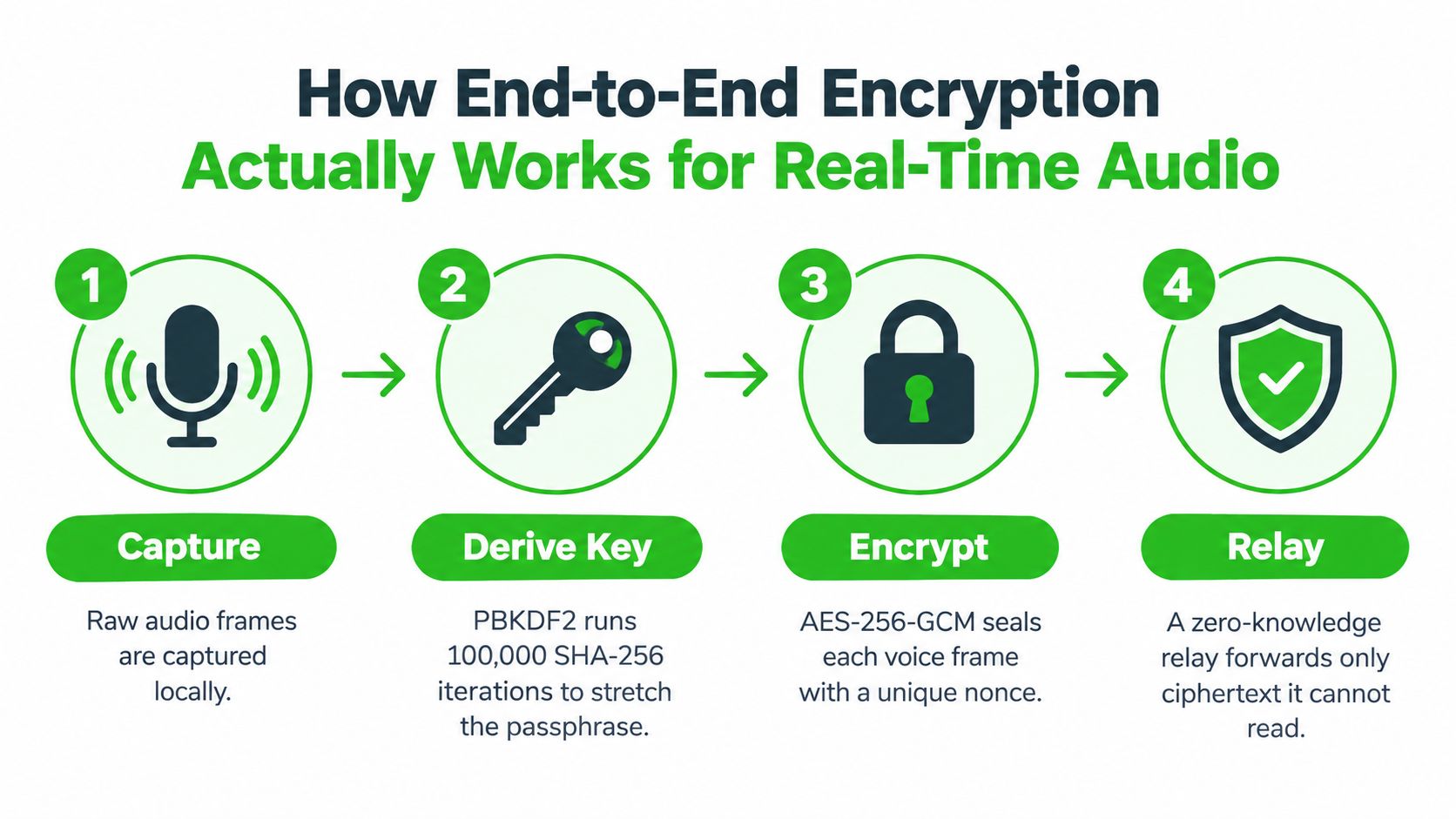
Real-time audio encryption has to happen before voice frames reach the network. The microphone captures short pieces of speech in the browser or application, the client encrypts those frames locally, and the relay forwards ciphertext rather than readable audio. The recipient's client performs the reverse operation after it has demonstrated possession of the right key.
A useful implementation flow looks like this:
- Capture: The client receives raw audio frames from the local microphone. The server doesn't need access to those frames in readable form.
- Derive a key: The browser turns a human-shared access secret into a cryptographic key using PBKDF2 with 100,000 SHA-256 iterations and a per-channel salt. This makes password guessing more expensive than using the passphrase directly.
- Encrypt: AES-256-GCM seals each frame. The authenticated encryption result includes integrity protection, so a modified frame won't be accepted as valid audio.
- Relay: The server passes along encrypted frames and the information required for recipients to process them, but it doesn't hold the decryption key.
The key distinction is client-side encryption, not merely the presence of a padlock in a browser. If the server receives plaintext audio and encrypts it afterward, the server remains a trusted listening point. If the client encrypts before transmission, the relay can route the session without needing to understand the conversation.
Integrity matters as much as secrecy
Confidentiality prevents unauthorized reading. Integrity helps prevent undetected modification. With AES-GCM, a recipient checks the authentication tag while decrypting. If a relay or intermediary changes the ciphertext, the check fails instead of producing corrupted speech.
That property doesn't authenticate the speaker by itself. A valid key can prove that a client has the room secret, but it can't prove that the person holding the secret is the person they claim to be. Operators still need an out-of-band method to share the key and verify the participant when impersonation carries serious consequences.
The WebRTC model illustrates another important boundary. WebRTC media uses DTLS to establish media keys and SRTP to encrypt audio and video before packets leave the device. The commonly cited SRTP profile uses AES-128 with an integrity tag such as HMAC-SHA1-80, while signaling requires separate protection because encrypted media doesn't automatically secure the signaling path, as explained in this WebRTC protocol security reference.
A browser-based voice room using a different relay path may apply its own frame-encryption layer, such as AES-256-GCM over WebSocket transport. That can protect the audio from the relay, but only if the implementation really encrypts every voice frame in the client and does not send a copy to a recording, transcription, or moderation service.
What the relay must never receive
A trustworthy design keeps the decryption key on participant devices. The relay may need opaque ciphertext, initialization vectors, authentication tags, salts, and expiry information, but those values shouldn't let the server reconstruct the audio.
This is also why key derivation parameters deserve inspection. A passphrase that goes straight into encryption is not equivalent to a stretched key derived with a salt and a deliberately expensive password-based function. Encryption protects the data after a key exists. Key derivation determines how difficult it is to recover that key when an attacker guesses access secrets.
Where Voice Media Terminates Changes Everything
Two calls can display the same “encrypted” label while creating different trust relationships.
In a peer-to-peer WebRTC call, media can travel directly between endpoints after the participants negotiate a connection. The endpoint devices hold the media keys, and there may be no central media service that needs to decode the audio. This can reduce server exposure, although connectivity, network conditions, and participant count can make direct routing difficult.
In a system using an SFU or media server, each participant sends media to a central service. The service forwards selected streams to other participants and can improve scalability, bandwidth management, and connection reliability. The trade-off is architectural: if the server terminates media encryption, it may be able to access plaintext audio or sensitive stream metadata.
| Architecture | What it can improve | Trust consequence |
|---|---|---|
| Peer-to-peer media | Direct endpoint communication and a smaller media-service role | Connectivity and group scaling can be harder |
| Server-assisted forwarding | Routing efficiency, participant management, and operational resilience | The server may see metadata or plaintext if media terminates there |
| Blind relay with client-side frame encryption | Central routing without readable audio at the relay | The client must manage keys, verification, and compatibility correctly |
The phrase end-to-end encrypted only has practical meaning when the endpoints are the only places where readable audio exists. A server can transport encrypted packets while still receiving a separate plaintext stream for recording or speech recognition. Operators evaluating those features should distinguish privacy-preserving transport from service-side processing, much as teams compare the pros and cons of cloud speech recognition before sending sensitive audio to an external processor.
Signaling is a separate trust decision
Media encryption doesn't automatically protect signaling. Participants still need to discover a room, negotiate capabilities, exchange session information, and learn whether another client is authorized. If signaling reveals room identifiers, participant details, or access material, an encrypted media stream may coexist with an exposed control plane.
A relay server can therefore be blind to content while still learning useful metadata. It might observe connection timing, room activity, packet volume, or the fact that two clients communicated. A strong design minimizes what the relay stores and avoids treating transport encryption as a promise that no operational information exists.
The role of a relay server in real-time communication should be documented in plain language. Ask whether it forwards ciphertext only, whether it can decrypt frames, whether it stores media, and whether it keeps room activity after expiry. If the provider can't answer those questions, you can't accurately assess the trust boundary.
Scalability isn't a free security upgrade
SFUs and media servers solve real engineering problems. They can make group calls more practical and reduce the need for every participant to send media to every other participant. But moving media through a central service changes who must be trusted.
Layered end-to-end encryption can preserve confidentiality while keeping a server-assisted architecture. The implementation then has to encrypt frames before the SFU sees them, distribute keys safely, handle membership changes, and prevent unauthorized clients from receiving usable key material. A diagram that shows encrypted transport is not enough. Operators need to know where the audio becomes readable.
How Identity-Free Access and Intrusion Alerts Build Trust
An identity-free room removes a familiar signal. There may be no account name, verified phone number, or organizational directory to consult. That doesn't make verification impossible, but it means the protocol must prove possession of a secret and the participants must verify one another through a separate channel.
A defensible workflow starts with a room created in the browser and an access key shared out of band. The key isn't sent to the relay as a decryption credential. Each client derives its local key from the secret and the channel's salt, then attempts an encrypted test operation. A participant who has the wrong key can't produce a valid result, so the room can reject the connection before admitting it to the conversation.
Access proof is not identity proof
This distinction is easy to miss:
- Access proof shows that a client knows the room secret.
- Identity verification gives participants confidence about the human or organization behind that client.
- Conversation security protects voice frames after admission.
- Operational monitoring reveals attempts to bypass the first three controls.
A key can establish authorization without telling you whether the person who received it is genuine. For a journalist meeting a source, the link and key should travel through a channel that does not repeat the same identity assumptions. For a legal team, participants should confirm expected contacts before discussing privileged material. The room's cryptography can't compensate for a key sent to the wrong person.
Brute-force resistance matters because a link-based room may be discoverable by anyone who obtains the URL. The design should use a sufficiently strong access secret, derive keys with a salted password-based function, rate-limit failed attempts, and make guessing visible to the people already inside the room. A failed attempt is not proof of a compromise, but a pattern of attempts is actionable information.
Practical rule: Treat an intrusion alert as a reason to verify the key out of band and burn the room, not as evidence that the attacker has heard the conversation.
Alerts turn invisible attacks into decisions
A useful alert should tell participants that an unauthorized access attempt occurred without disclosing the attempted secret. It should also avoid becoming a source of excessive identifying data. The operator needs enough information to decide whether to terminate the room, not a permanent surveillance log about every visitor.
This model addresses a gap in conventional guidance. Market coverage identifies voice spoofing and deepfake audio as emerging challenges and discusses voice-biometric authentication, while other coverage describes AI and machine learning for threat detection and monitoring. The VoicePrivacy 2026 challenge also shows that privacy-preserving speech remains an active technical problem. None of those developments removes the need for basic admission control.
A room can protect frames from interception and still fail against impersonation, replay, or synthetic voice injection. Participants should agree on a verification phrase, callback method, or known secondary channel before the sensitive handoff. They should also assume that voice alone may not establish identity when an adversary can reproduce or manipulate speech.
Browser-Based Ephemeral Rooms in Practice
Consider a reporter who needs a first conversation with a source. The source doesn't want to install an app, create an account, or share a phone number. The reporter creates a browser room, sends the link and access key through separate channels, confirms the source using a prearranged method, and starts the voice conversation only after the encrypted admission check succeeds.
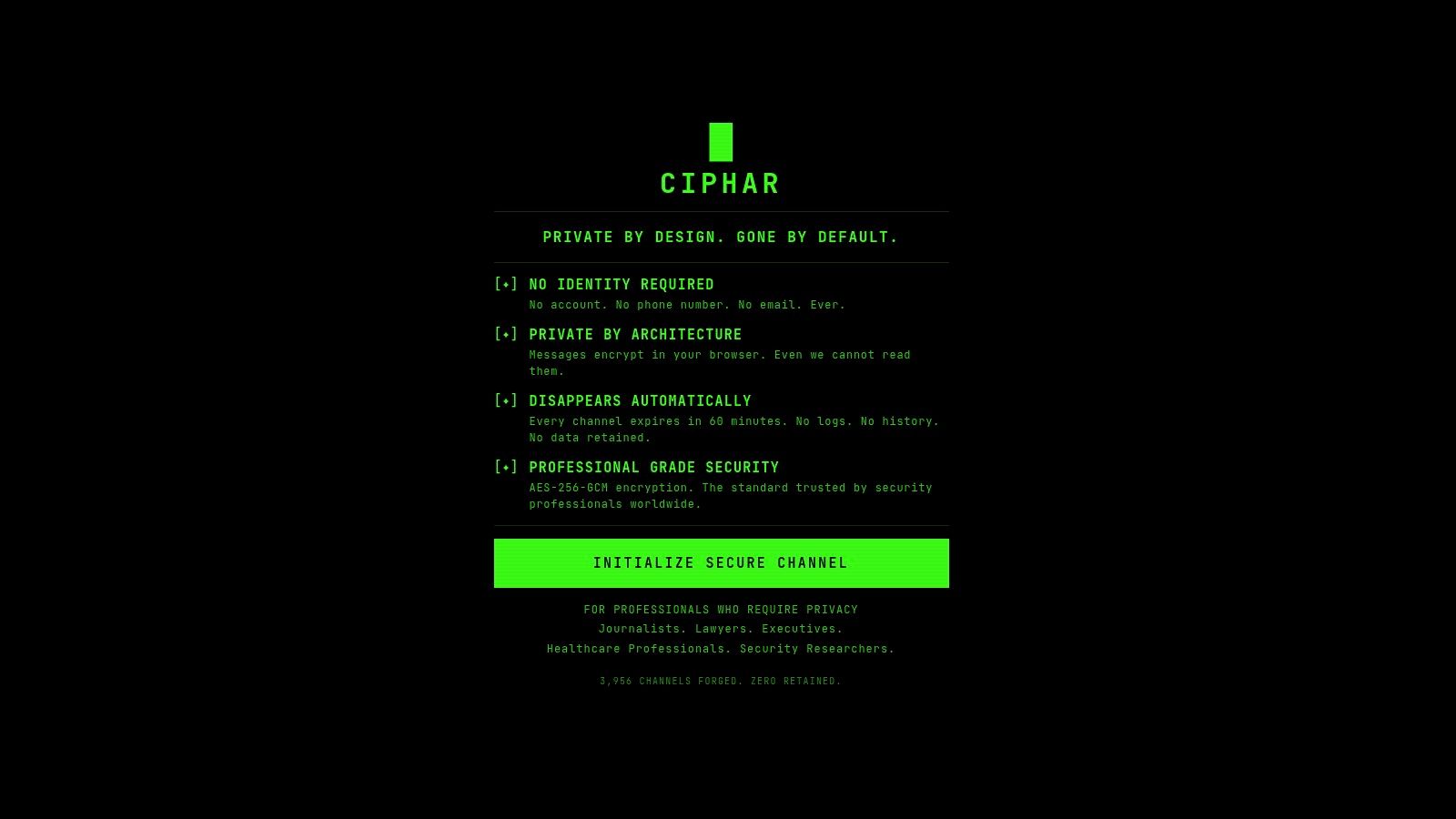
The room's value comes from the combination of controls. It uses client-side encryption for voice frames, a zero-knowledge relay that forwards opaque data, no account or phone-number requirement, and a hard 60-minute lifetime enforced by the service. There is no extension path, archive, or recovery workflow, so the room is unsuitable for conversations that need a persistent record.
A lawyer and client could use the same pattern for a short privileged coordination call, provided their professional and regulatory obligations permit the workflow. An incident-response team could create a temporary channel during an active handoff, verify the participants, share only the necessary details, and burn the room when the immediate risk has passed.
The hard expiry is deliberately inconvenient. It prevents a temporary room from becoming an unreviewed standing channel and forces the team to decide whether a new conversation is justified. If a matter needs long-term collaboration, searchable records, retention controls, or formal discovery, an ephemeral voice room is the wrong tool.
The browser changes the operating procedure
No installation removes one source of friction, but it doesn't remove endpoint risk. A compromised browser, malicious extension, unsafe microphone permissions, screen capture, or local recording can defeat confidentiality after the audio is decrypted for the participant. Encryption protects the path and relay. It doesn't make an endpoint trustworthy.
The product boundary should be explicit. A short-lived room is designed for first contact, sensitive coordination, and temporary handoffs. It isn't a replacement for a regulated communications archive, a case-management system, a permanent team workspace, or a secure evidence repository.
Teams comparing browser-native communication patterns with broader collaboration systems can also review this custom enterprise collaboration case to understand why interoperability and operational consistency create their own design trade-offs.
The browser workflow can remain simple without being casual:
- Initialize the room on a trusted device.
- Share the link and access key through separate paths.
- Verify the participant before discussing sensitive material.
- Watch for failed-access alerts.
- End the session or let the room expire.
- Record nothing unless the participants have a separate, explicit reason and safe storage plan.
The encrypted browser application guide gives operators a way to examine this pattern in more detail. The key question isn't whether a browser room looks like a familiar call. It's whether its defaults enforce the short-lived trust relationship the situation requires.
What Operators Should Check Before Using Secure Voice Chat
Choose a secure voice tool by inspecting its trust boundaries, not by accepting its feature list. The provider should explain what happens to raw audio, encrypted frames, keys, signaling data, access attempts, and expired rooms. If the explanation stops at “we use encryption,” the review hasn't reached the important questions.
Start with the client and key path
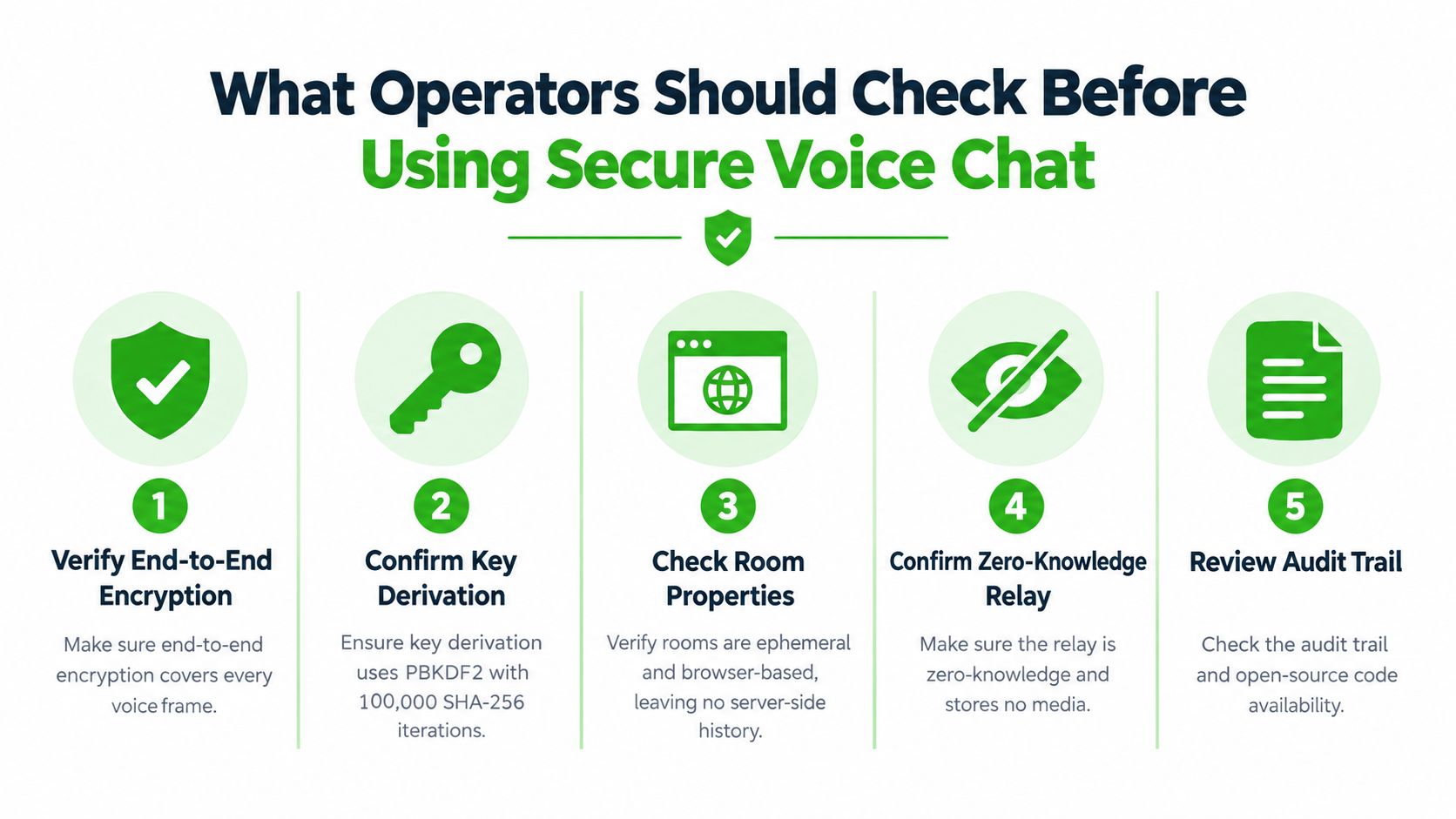
Verify that encryption begins on the participant's device and covers every voice frame. Ask whether the server can decrypt media, whether recordings or transcripts are generated, and whether a third-party speech service receives audio.
Then inspect key derivation. The documented design for the browser workflow uses PBKDF2 with 100,000 SHA-256 iterations, a per-channel salt, and keys that remain on the device. Operators should confirm that the access secret isn't transmitted to the relay as plaintext and that a wrong key fails an authenticated test instead of receiving partial room access.
Examine the relay and retention model
A zero-knowledge relay should have a narrow purpose. It forwards ciphertext and connection data, but it shouldn't store readable media, maintain an archive, or retain more room history than the security model requires. Ask whether the service can replay old frames, recover an expired room, or provide content after a legal or administrative request.
Ephemerality must be enforced, not merely suggested in user guidance. A hard 60-minute lifetime with no extensions creates a clear boundary for a short-lived room. Manual burn controls are useful as well, but they shouldn't be the only way to end a session because operators forget and emergencies interrupt procedures.
Test the human workflow
Before using a room for a sensitive handoff, run a controlled test with the actual browsers, microphones, network conditions, and participant process. Confirm that:
- Frame protection: Every voice frame is encrypted before it reaches the relay.
- Key handling: PBKDF2, salted derivation, and local key storage work as documented.
- Room expiry: The channel closes at its enforced lifetime and has no archive or recovery path.
- Relay limitations: The server stores opaque data only and doesn't retain media.
- Auditability: Security documentation, implementation details, and available source code let an informed reviewer validate the claims.
Don't confuse an encrypted room with an authenticated person. Verify participants separately, share access keys out of band, keep endpoint devices clean, and treat alerts as reasons to reassess the room. Don't use an ephemeral channel as a substitute for an approved retention system when law, policy, or professional duty requires a record.
Secure voice chat works when cryptography, architecture, and operator behavior agree. If any one of those layers contradicts the others, the interface may look private while the workflow remains exposed.
Ciphar provides browser-based, identity-free encrypted chat and voice rooms with client-side AES-256-GCM protection, a zero-knowledge relay, and enforced one-hour expiry. Visit Ciphar to evaluate whether its short-lived room model fits your next sensitive handoff.