You need to send a sensitive message tonight. The recipient won't install an app, you don't want their phone number in your address book, and a permanent chat history would create more risk than value. Choosing the right encrypted text message app isn't about collecting the longest feature list. It's about matching the communication tool to the job, the person you're protecting, and what must disappear afterward.
An ongoing conversation with a trusted contact calls for a different product than a one-time disclosure. A clinician coordinating a case has different obligations from a security researcher receiving a vulnerability report. The recommendations below separate those situations instead of pretending that one messenger can handle them all.
Who This Guide Is For and What You'll Walk Away With
A freelance investigator may need a private channel with a source who has never used a secure messenger. The source might be unwilling to install software, create an account, or exchange a phone number. In that situation, the requirement is not a polished permanent inbox. It's a short-lived, identity-free channel that can carry a conversation and then expire.
That distinction matters for anyone handling sensitive information outside corporate IT. Journalists protect sources, lawyers exchange privileged material, clinicians coordinate patient-related work, and security researchers arrange disclosures. Each role involves a different balance of confidentiality, persistence, identity verification, collaboration, and operational convenience.
Start with the job, not the brand
Most messaging comparisons begin with features. That approach produces weak recommendations because it treats a family chat, a source introduction, and an incident-response room as the same problem.
Use these questions instead:
- Is this an ongoing relationship? If you'll speak with the person regularly, a persistent messenger may be appropriate.
- Do you need to avoid identity exchange? A phone-number account creates a durable connection between people, even when message content is encrypted.
- Should the conversation survive? Some work requires history, search, and recovery. Other work becomes riskier when records remain.
- Can both people verify each other? High-risk communication needs a way to confirm that the intended person holds the relevant keys.
- What happens after the message is read? Encryption protects content in transit and storage, but it can't control what a recipient copies, photographs, or remembers.
Practical rule: Choose the shortest-lived tool that still supports the work. Persistence is useful, but it also expands the consequences of compromise.
A useful primer on designing a broader secure communication system can help teams think beyond the chat window. By the end of this guide, you should be able to identify your threat model, select the right category, and configure the app without confusing encrypted content with complete anonymity.
How Encrypted Messaging Actually Works
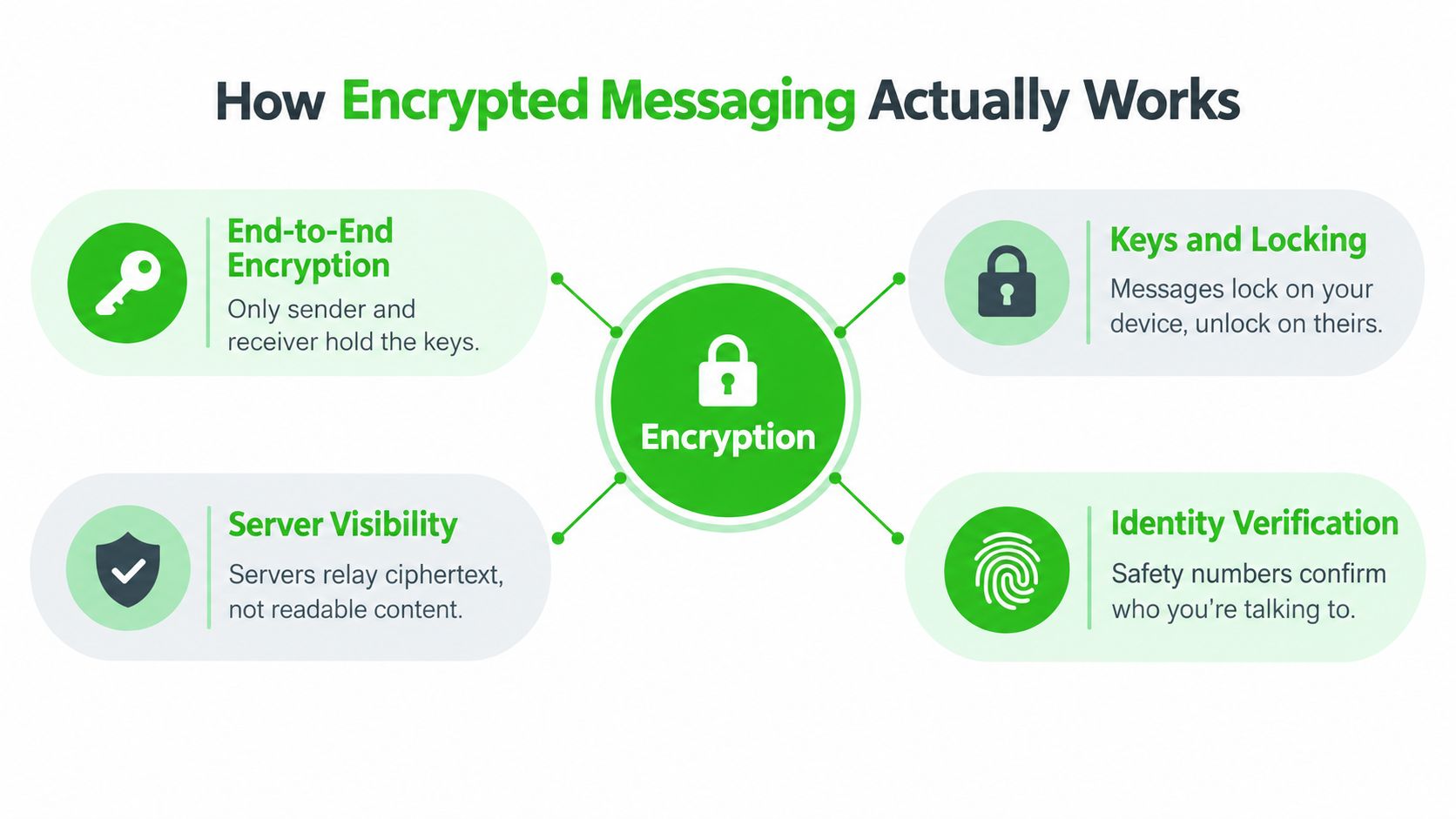
Encryption turns readable plaintext into ciphertext. A key allows the intended device to transform that ciphertext back into readable content. The important question isn't whether an app uses the word “encrypted.” It's where the keys exist, who can access them, and what the service retains around the message.
End-to-end encryption, or E2EE, means the sender's and recipient's devices perform the meaningful encryption and decryption. The relay passes encrypted data between them. If an attacker compromises the relay, the attacker should receive ciphertext rather than readable message bodies. That protection depends on correct implementation, trustworthy clients, secure key handling, and users verifying the identity of the person on the other end.
Four concepts determine the real boundary
A zero-knowledge relay takes the model further. The server holds opaque encrypted material and lacks the decryption key. A properly designed relay also minimizes information that could connect a person to a particular conversation. That doesn't automatically make the user anonymous, but it reduces what the operator can read or reconstruct.
Ephemerality limits the time available for later exposure. A disappearing message timer may remove content from supported devices, while an expiring room can eliminate the channel itself. The distinction matters. A timer is a setting. A hard expiry enforced by the service is a stronger operational constraint, although neither can erase screenshots or independent copies.
Metadata describes the surrounding facts, such as who contacted whom, when communication occurred, how long it lasted, and which devices participated. E2EE normally protects the body, not every surrounding record. Mainstream services can therefore protect message content while retaining information about accounts, contacts, delivery, and timing.
Identity verification answers a separate question: are you communicating with the intended person? Safety numbers, QR comparisons, fingerprints, or an out-of-band confirmation can expose a changed identity key. Without verification, an encrypted channel may still connect you to the wrong endpoint.
Browser-native tools use a different identity assumption. Instead of a permanent account, they can use a single-use channel link and a separate access secret. That reduces onboarding and persistent identifiers, but it shifts responsibility to the participants. They must share the access information safely and protect the browser and device.
For practical guidance on secure texting apps and settings, focus on the settings that determine retention, backups, device access, and contact verification. The cryptography matters, but the surrounding workflow often decides whether the protection survives real use. A deeper explanation of end-to-end encryption is useful if terms such as relay, key derivation, and forward secrecy still feel abstract.
The Main Categories of Encrypted Messaging Tools
Encrypted messaging products fall into four practical categories. They differ less by the presence of encryption than by their assumptions about identity, persistence, access, and administration.
Mainstream E2EE messengers
Signal, WhatsApp, and iMessage are designed for continuing relationships. They support contact discovery, regular conversations, media, calls, and message history. That makes them the sensible choice for friends, family, established colleagues, and recurring professional contacts who can verify each other.
Their weakness is persistence. Accounts, phone numbers, address books, backups, device registrations, and social connections create a durable footprint. Disappearing messages reduce retained content, but they don't turn a permanent identity into an anonymous one.
Ephemeral identity-free rooms
Temporary browser rooms solve the opposite problem. The participants need a conversation now, but they don't need a long-term relationship inside the service. A browser link avoids installation and account creation, while a fixed expiry can prevent a temporary exchange from becoming an accidental archive.
This category fits first contact, confidential intake, and one-off coordination. It's a poor choice for searchable institutional history, recurring group work, or situations requiring formal retention and audit controls. The person who creates the room must also protect the link and access key.
The practical distinctions are covered in this guide to ephemeral messaging, especially the difference between deleting individual messages and destroying a short-lived communication channel.
One-time notes and secret links
Privnote and OneTimeSecret are narrower tools. They're built for a single payload, such as a password, token, or short instruction, that the recipient retrieves once. They're useful when a reply channel would create unnecessary exposure.
They don't replace a conversational messenger. If the recipient needs to ask questions, exchange context, or send a file back, you'll need another protected channel, which can undermine the simplicity of the original handoff.
Enterprise secure messaging
Wickr, Wire for Teams, and Matrix or Element deployments address organizations that need administration as well as encryption. Directory integration, access controls, deployment choices, retention policies, and audit functions may matter more than consumer convenience.
Enterprise controls can also conflict with strict ephemerality. A compliance team may need records, legal holds, and controlled discovery. A source-protection workflow may need the opposite. Don't choose an enterprise platform just because it has more controls. Choose it when the organization must govern communication at scale.
| Category | Identity assumption | Persistence | Strongest fit | Main weakness |
|---|---|---|---|---|
| Mainstream E2EE messenger | Known, recurring contact | Ongoing history with optional deletion | Personal and continuing professional relationships | Account and metadata footprint |
| Ephemeral identity-free room | Temporary or unknown contact | Short, enforced lifetime | One-time disclosure and confidential intake | Limited continuity and recovery |
| One-time secret link | Recipient needs one payload | Single retrieval | Credentials and short secrets | No real conversation |
| Enterprise secure messaging | Managed organizational identity | Policy-controlled | Regulated teams and administration | Can preserve more data than privacy-sensitive work allows |
Ciphar, Signal, WhatsApp, Telegram, and Privnote Compared
These tools shouldn't be ranked on one universal security score. Compare them on five questions: what protects the content, how long the content persists, what identity is required, where the tool runs, and whether the workflow needs collaboration.
| App | Security Model | Ephemerality | Identity Required | Platform | Best For |
|---|---|---|---|---|---|
| Ciphar | Client-side encrypted browser rooms with a ciphertext-only relay | Hard 60-minute channel expiry and manual burn | No account, phone number, or email | Browser | Short, identity-free conversations |
| Signal | E2EE by default, with established key-verification features | Disappearing messages available | Phone number account | Mobile and desktop apps | Ongoing high-sensitivity contact |
| E2EE based on the Signal protocol for message content | Disappearing messages available | Phone number account | Mobile, desktop, and web experiences | Mainstream contact reach | |
| Telegram | E2EE only in Secret Chats, not ordinary cloud chats | Secret Chat timers available | Account and phone number | Mobile, desktop, and web experiences | Broad cloud messaging, not default E2EE |
| Privnote | Encrypted one-time note delivery | One-time retrieval | Usually no persistent chat identity | Browser | One-way secrets and short messages |
Signal is the strongest default for an ongoing sensitive relationship in this group. Its cryptographic design and safety-verification workflow suit contacts who need to remain reachable. The trade-off is clear: the account is persistent, and phone-number identity remains part of the operating model.
WhatsApp brought the Signal protocol to a mass audience. The 2016 partnership between Signal and WhatsApp helped bring E2EE to WhatsApp's billion-plus user base, and by 2025 WhatsApp was described as the most widely used E2EE messaging service, with over 3 billion users, while Signal was estimated at roughly 70 million users. Those figures come from this analysis of E2EE messaging interoperability. Scale makes WhatsApp easy to use with existing contacts, but it doesn't remove the phone-number and metadata trade-off.
Where the other three fall short
Telegram fails a strict “encrypted by default” requirement. Ordinary chats use cloud-based protection rather than E2EE, so users must deliberately open a Secret Chat, and that mode doesn't provide the same broad cloud workflow. If the requirement is that every ordinary message must be end-to-end encrypted, Telegram is the wrong recommendation.
Privnote handles a different task. It's useful when you need to deliver a single secret and don't want a reply thread. It becomes awkward for a source interview, legal intake, or technical coordination because the recipient needs another channel to respond.
Ciphar is a separate category rather than a smaller Signal clone. It provides browser-based rooms without an account, phone number, or installation, uses client-side AES-256-GCM encryption, derives channel keys in the browser with PBKDF2 using 100,000 SHA-256 iterations, and enforces a 60-minute channel lifetime. The key-derivation setting and browser performance context are documented in this web messenger paper. That design suits a one-time exchange. It isn't a replacement for a durable contact directory, searchable archive, or regulated records system.
Matching the Right Tool to Real Professional Use Cases
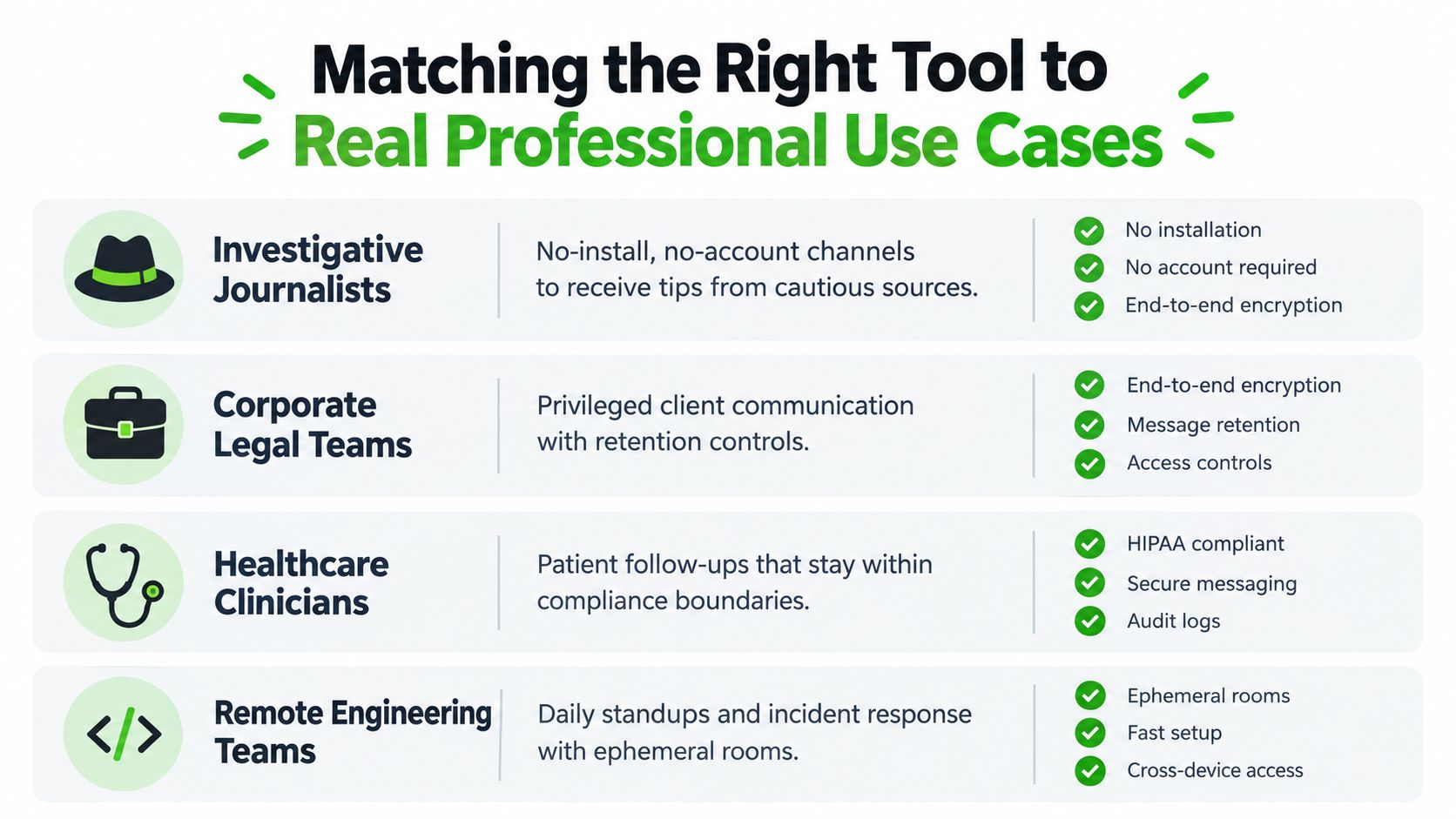
The right choice becomes obvious when you follow the workflow instead of the label. A journalist, lawyer, clinician, and security researcher may all say “send an encrypted message,” but they don't need the same channel.
Investigative journalists and confidential sources
A source may have a browser but no secure-messaging habit. Requiring an app download, account registration, or phone-number exchange can end the conversation before it starts. An ephemeral identity-free room is a better fit for a first contact when the journalist needs to receive text, context, or a file without creating a permanent contact record.
Signal remains appropriate when the source relationship is ongoing and both parties can verify device identities. It gives the journalist a reusable channel, but that persistence creates a record of association that a one-time room avoids.
Lawyers and client intake
A lawyer handling a first confidential inquiry needs to separate confidentiality from retention. A long-lived messenger may protect message content while still leaving accounts, contact records, backups, and device copies. An expiring room can reduce the amount of material left behind after a preliminary consultation.
That doesn't make a disposable room a complete legal communications system. Matters requiring document management, formal retention, access logging, or discovery controls belong in an approved enterprise platform. Use ephemeral communication for a narrowly defined intake or handoff, not as a way to bypass the firm's obligations.
Healthcare clinicians
Secure messaging is already embedded in clinical workflows. A 2023 healthcare study recorded 32,881 users, 9,639,149 messages, and 1,547,879 conversations. Median daily volume rose from 53,951 in the first two weeks to 69,526 in the last two weeks, a 29% increase. Nurses sent 40% of messages, physicians 25%, and medical assistants 12%, according to the Journal of Medical Internet Research study.
Those figures show why healthcare teams need more than consumer privacy features. A browser room can help with a short-lived coordination task, but it doesn't automatically establish regulatory compliance, a business agreement, access governance, or an approved patient record. Clinicians must use a platform their organization has authorized for the data involved.
Security researchers and incident responders
Vulnerability disclosure often begins asymmetrically. The researcher needs to reach a vendor or recipient without building a public profile, while the recipient needs a way to reply and exchange technical context. A short-lived browser room handles that first exchange more cleanly than a permanent consumer account.
For recurring incident response, use an enterprise system or hardened E2EE messenger with verified participants, defined roles, and documented procedures. Don't treat ephemerality as a substitute for evidence handling. If the team must reconstruct events later, destroying every message may create a different operational failure.
Choosing an Encrypted Text Message App for Your Threat Model
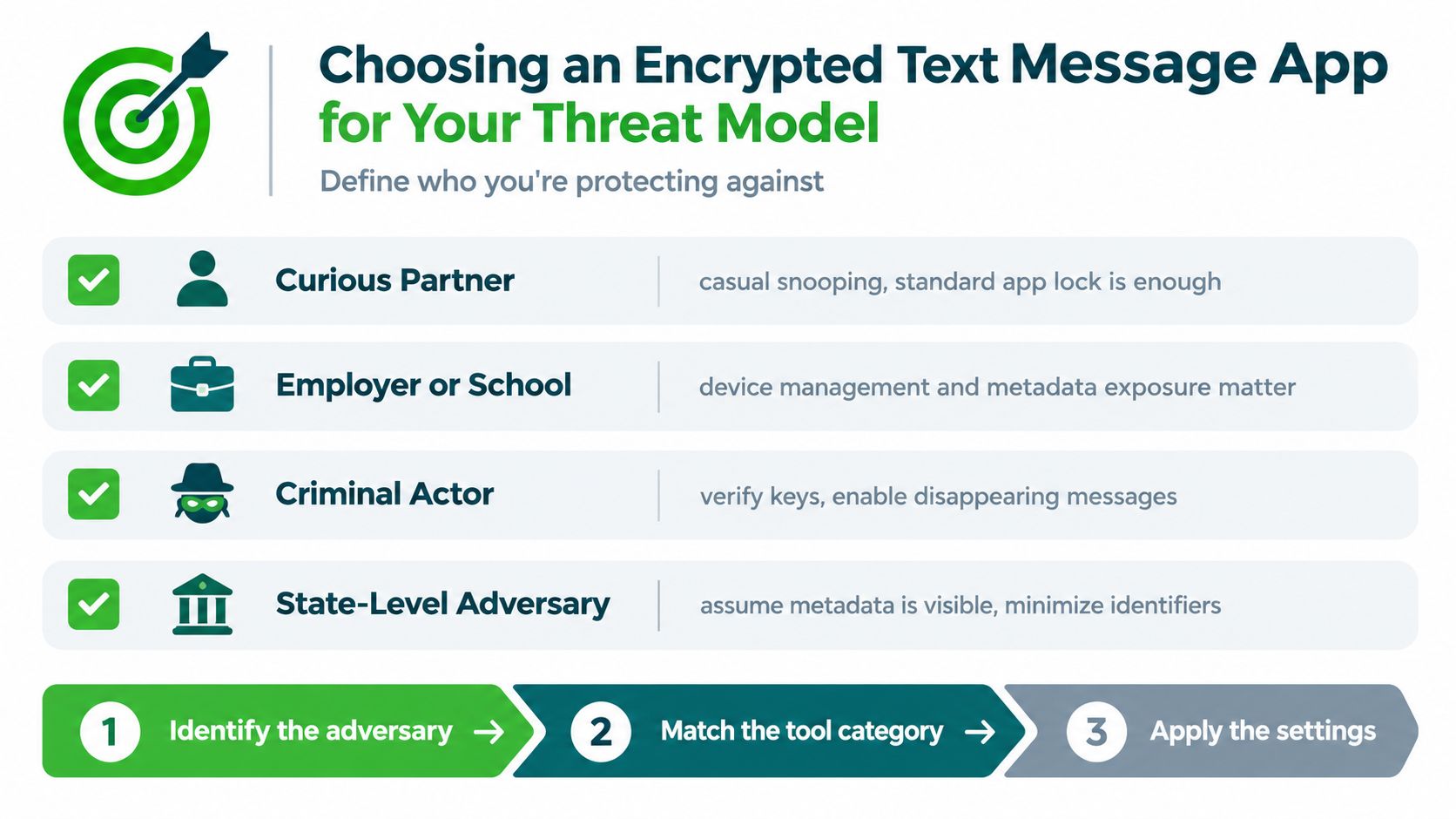
Start by naming the adversary. “Privacy” is too broad to guide a purchase. A curious partner, employer, criminal actor, state-level adversary, and legal subpoena create different risks, and the same app can be sensible for one threat while inadequate for another.
Match the tool to the exposure
For ordinary private conversations, choose a mainstream messenger with E2EE enabled by default. Signal is the direct recommendation when you need an ongoing high-sensitivity relationship and can accept a phone-number-based identity. WhatsApp is the practical choice when reach matters and the recipient already uses it, but its account and metadata model deserves explicit acceptance.
For a one-time disclosure, choose an ephemeral identity-free room. The absence of an account reduces onboarding and persistent identity, while enforced expiry limits how long the channel exists. Share the access key through a separate channel, verify the recipient, and avoid opening the room on a compromised device.
For a one-way handoff, use a self-destructing note. Don't create a full chat account merely to send a credential or short secret. For regulated team communication, choose enterprise secure messaging with the controls your organization requires, including access management, retention, auditability, and approved hosting.
Encryption protects the channel. It doesn't make an unsafe endpoint safe.
Apply the limits that apps can't remove
A recipient can screenshot a message, photograph the screen, forward plaintext, or copy a file before deletion. An open device can expose content after delivery. Cloud backups can create another route to disclosure. Metadata can still reveal a relationship and timing even when message bodies remain unreadable to the relay.
Device disposal deserves the same attention as app selection. When a company retires phones used for sensitive communications, follow a documented mobile device retirement process that addresses data removal and chain of custody. Deleting a conversation doesn't securely retire every copy on a device.
Run this checklist before sending:
- Identify the other end. Do you know who controls the recipient account, browser, or device?
- Define the retention requirement. Must the message remain available, or should the channel expire?
- Inspect the identity cost. Does the app require a phone number, email, account, or directory entry?
- Verify the keys or access secret. Use an established verification method or a separate trusted channel.
- Check the endpoints. Assume encryption can't help if either device is compromised or left open.
- Review the surrounding records. Consider backups, notifications, screenshots, contact lists, timestamps, and server metadata.
A credible encrypted text message app fits the threat model without pretending to solve every operational problem. For recurring contact, use Signal or an approved enterprise platform. For a single, browser-native conversation without account exchange, use an ephemeral room. For a one-time secret, use a single-use note.
Ciphar offers browser-based, zero-knowledge encrypted rooms for short conversations that don't need a permanent account, phone number, installation, or archive. Create a temporary channel, share its access details through a separate trusted route, and visit Ciphar when your next sensitive exchange needs a short-lived communication path.