The usual advice for when someone blocks you is to interpret the silence as a social verdict, guess what you did wrong, and find another way to reach the person. That advice doesn't fit Ciphar. It has no account, contact list, or persistent block feature, so the familiar signal of a user blocking you isn't available.
In Ciphar, access can disappear for practical reasons. A channel may have reached its 60-minute lifetime, a participant may have used manual burn control, or the channel may remain closed because you don't have the correct access key. The result looks similar from the outside, but the cause matters less than your response.
Use the seven rules below to recognize those outcomes, verify what you reasonably can, and act without probing someone else's privacy. In an identity-free, ephemeral channel, discipline is more useful than speculation.
1. Understand Why Blocking Occurs in Encrypted Channels
Silence in Ciphar is usually a channel state, not a social signal. The room may have expired, someone may have used burn control, or the access key may never have been shared with you. In an identity-free system, those causes look similar from the outside, so guessing motive is usually wasted effort.
The practical question is narrower. Did the room hit its 60-minute lifetime, was it intentionally terminated, or are you missing the one thing that still grants entry?
That distinction changes how you respond. A journalist can burn a room after a source gets nervous about surveillance. A lawyer and client can let a room die after the consultation ends. A healthcare team can see an unauthorized join attempt, alert everyone, and shut the session down rather than continue with uncertainty. None of those cases says much about the relationship between participants. They say a lot about risk, timing, and access control.
Ciphar's design fits a broader history of online boundary-setting. Blocking started as a technical way to set limits online, and Facebook introduced a stricter interaction-blocking feature in 2005, a milestone discussed in research on online tie breaking (the historical study of blocking and digital relationship boundaries). Modern platforms treat blocking as a safety control, and tools like the Horus Intelligence platform examine how these signals appear across messaging services. Ciphar reaches a similar result through session control instead of identity management.
Practical rule: Treat “session unavailable” as an access state, not a verdict about your character or your last message.
Use a simple verification order. Check whether the room may have expired. Confirm whether the key you have is current and complete. Then stop. If the channel is gone, do not route around that loss unless everyone already agreed on an out-of-band re-contact method. In ephemeral encrypted channels, restraint is part of etiquette.
2. Use Out-of-Band Key Sharing to Control Access
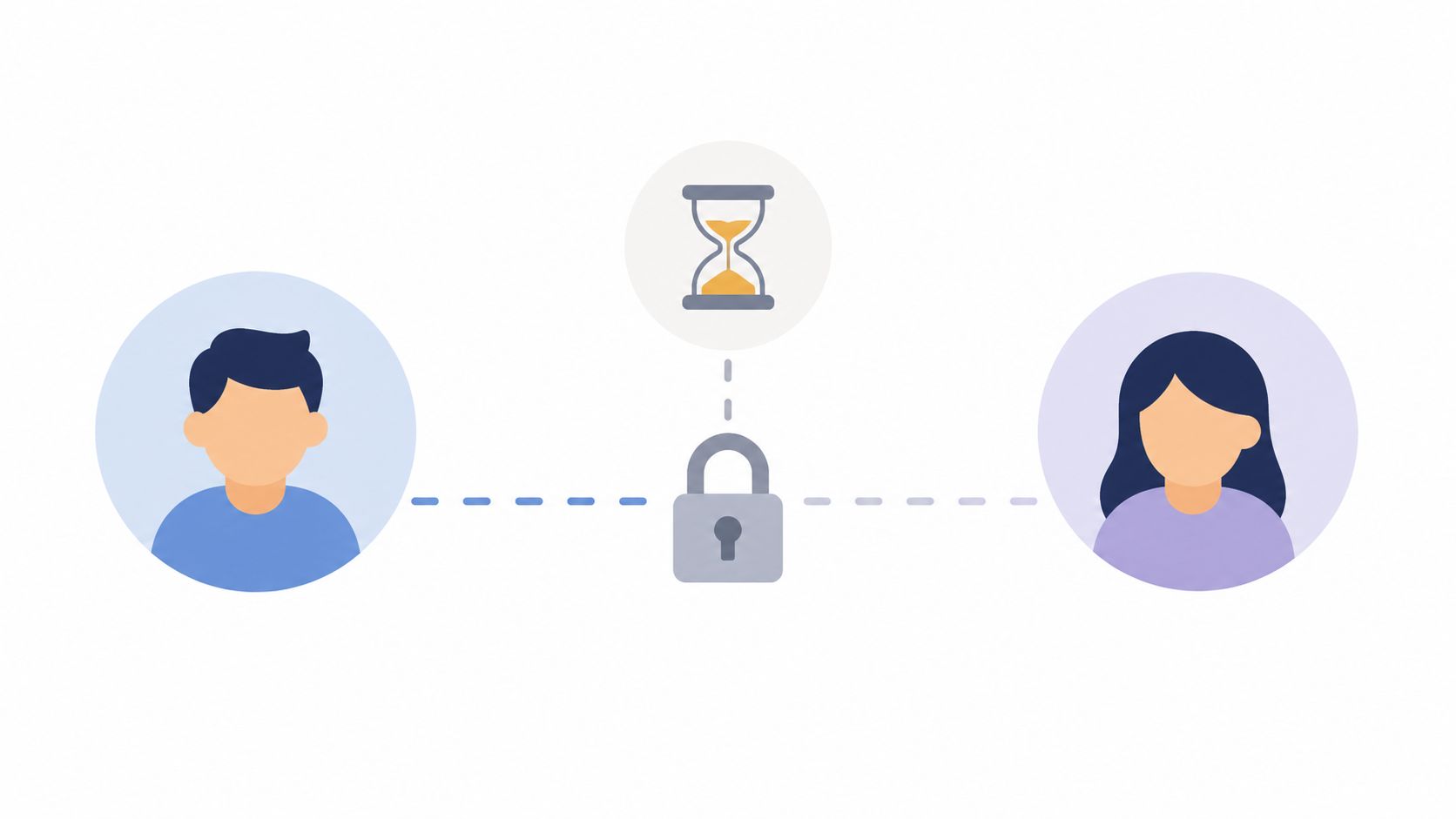
A Ciphar invitation has two parts, a channel link and an access key. Treat them as separate controls. If one path leaks, the other can still hold the room closed, which matters in a system built around short-lived access rather than persistent identity.
The split is practical, not ceremonial. A journalist might receive a Ciphar link in a social-media direct message, then get the key during a phone call. A lawyer could email the link and provide the key in person. A healthcare crisis team might publish the room link in a restricted group while sending the key only to verified professionals through a separate secure channel.
That approach also gives participants a simple verification step before anyone says anything sensitive. In an identity-free room, the key does more than open the door. It acts as the access check that an account system would normally handle.
Keep the link and key on separate paths
Do not place both pieces in one email, direct message, or calendar invite. If that message is forwarded, exposed, or read on the wrong device, the room is already burned. Use a strong, random key rather than a guessable phrase. For the underlying practice of distributing pre-shared keys safely, see these enterprise PSK setup tips. Then confirm that every participant has the same key before the meeting starts.
For higher-risk conversations, verify the invitation through more than one trusted method. A phone call can confirm the person and deliver the key, while the link arrives elsewhere. That adds friction. In this setting, some friction is the control. It reduces the chance that silence later gets misread as a personal block when the actual issue was a bad handoff, an expired room, or a key that was never shared.
Set expectations early. Tell participants about the 60-minute lifetime before they join. Agree on the follow-up route at the same time, because a new conversation requires a new invitation and key, and withheld access should be interpreted carefully until you've ruled out expiry or distribution failure.
“If the key wasn't shared with you, don't try to work around the missing access.”
3. Use Intrusion Alerts to Detect Unauthorized Access Attempts
In a room with no stable identity layer, a failed entry attempt is not social drama. It is an access event. Ciphar's intrusion alerts make that event visible. If someone enters the wrong key, participants can see a system notice, and the room can slow repeated guessing. That still does not tell you who tried. It does tell you the access path may no longer be clean.
That distinction matters when a room goes quiet. Silence after an alert can mean several different things. The room may have expired. Someone may have burned it. A participant may never have had the right key in the first place. Treating every interruption as a personal block creates confusion and wastes time.
A journalist speaking with a source has to make that call quickly. Repeated failed attempts during the conversation are enough to stop, check who should be present, and decide whether the invitation path was exposed. The same applies in a legal consultation or an incident-response call. An outdated key is plausible. So is deliberate guessing. You usually cannot prove which one happened in the moment, so the safest response is verification and containment.
Ciphar's guide to intrusion detection gives the broader security context. In practice, the useful question is simpler. What do participants do the minute an alert appears?
Make alerts operational
- Assign an owner: Decide who watches system notices during a sensitive meeting, especially when several people are speaking.
- Record timing: Note when the alert appeared and what was happening in the room.
- Confirm expected access: Check who was supposed to join and whether anyone is missing because the key was withheld, mistyped, or shared late.
- Review distribution: Ask whether the link and key may have traveled together or been forwarded outside the intended group.
- Restart when necessary: In a higher-risk situation, open a fresh room and re-verify each participant instead of arguing about motive.
Repeated failures do not prove a specific person is targeting the room. They do show that the current setup deserves scrutiny. If contact stops after an alert, verify expiry, burn status, and key access before you read the silence as a block.
4. Implement the Manual Burn Control for Immediate Session Termination
Automatic expiry is useful, but it isn't an incident-response plan. Ciphar's manual burn control lets a participant end a channel immediately when the conversation may be compromised or the situation has become unsafe. Burning is irreversible. It removes the session rather than merely hiding it from view.
A breach responder might burn a room after realizing that an unauthorized person could have received the invitation. A lawyer may terminate a consultation after a client shares information that shouldn't remain in the session. A journalist may burn a source conversation after learning that the source is being monitored, then move to a safer, pre-agreed contact method.
The correct moment to burn depends on the situation. Waiting for the sixty-minute timer can preserve a channel that participants no longer trust. Burning too quickly can interrupt useful work and leave people without a record of what they decided. That trade-off should be handled through a policy agreed before pressure arrives.
Use burn as a practiced procedure
Train participants to recognize the control and understand that it can't be undone. Teams can establish a simple burn signal for unsafe conditions, but the signal itself shouldn't reveal sensitive details to anyone watching the room. Afterward, notify affected participants through a separate secure channel when it's safe to explain why the conversation ended.
Ciphar's guide to deleting a chat is useful for understanding the difference between ordinary deletion expectations and immediate session destruction. Don't rely on memory during a high-pressure event. Practice the sequence before using the service for confidential coordination.
A burn doesn't tell you who caused the risk. It also doesn't authorize you to chase a participant for an explanation. Preserve only the incident information your organization legitimately needs, then rebuild access with a fresh link, a fresh key, and a smaller participant set if appropriate.
5. Accept the 60-Minute Ephemerality as a Feature, Not a Limitation
A Ciphar channel isn't a delayed inbox or a permanent project room. Its server-enforced 60-minute lifetime ends the session without extensions, archive access, or recovery. That constraint changes how you work. You use the room for live coordination, then move any necessary outcome into an appropriate secure record before the timer runs out.
A journalist can use the channel for an initial source interview and transfer essential facts to an offline notebook before expiry. A legal team can discuss a time-sensitive brief, then capture agreed actions in a privileged memo. A healthcare crisis team can coordinate an urgent case in real time and document clinical decisions in the authorized medical record.
The hard limit is valuable because it prevents casual accumulation. It also creates a predictable failure mode. If participants don't plan, they may mistake the disappearance of the room for a personal rejection or lose information they assumed would remain available.
Build the timer into the meeting
Set a reminder before the channel closes. Use the final part of the session to confirm decisions, identify unresolved questions, and agree on the next contact method. Don't wait until the last moments to discover that someone needs a file, a name, or a precise instruction that nobody recorded.
Use Ciphar for synchronous work, not for persistent storage. Its encrypted relay and short retention reduce what remains on the service, but they don't protect information that a participant copies, photographs, records elsewhere, or exposes through a compromised device. Ephemerality limits server-side persistence. It doesn't erase every endpoint risk.
The timer is part of the security model, so treat it like a deadline, not a background setting.
Explain the limit at the start of every session, especially with first-time users. If the channel closes, check the clock and the agreed protocol before concluding that someone blocked you.
6. Establish Clear Protocols for Out-of-Band Re-Contact After Channel Expiry
A short-lived room needs an exit route. Before sharing sensitive information, participants should agree on how they will reconnect if the discussion must continue. Without that arrangement, a person who loses access may be tempted to search for another route, send repeated messages, or interpret silence as an intentional block.
The route can be different for each use case. A journalist and source might agree that follow-up will happen through a newsroom tip line, with a new Ciphar link and key provided during the next call. A lawyer and client may arrange future appointments through an existing email process while keeping substantive discussions inside new, time-limited rooms. A healthcare provider and patient may reserve Ciphar for urgent coordination and use the patient portal for routine follow-up.
Agree before the room closes
At the beginning, define the channel for routine questions and the channel for urgent issues. Decide who initiates contact, when a follow-up should happen, and how the next access key will be delivered. In some relationships, asymmetric contact is safer. One party can hold the other's contact route without requiring both sides to exchange unnecessary identity details.
Use a clear phrase such as, “If we need to continue, contact the tip line and ask for a new invitation.” Avoid vague promises like “we'll find each other later.” The more sensitive the conversation, the more specific the procedure should be.
If the room expires and you have no agreed route, don't improvise with alternate accounts or mutual acquaintances. A block on a conventional platform generally means stop contacting the person. The same etiquette applies here when access has been withdrawn, even though Ciphar doesn't expose a named block state.
One brief clarification may be reasonable through an already appropriate channel if you suspect a technical mistake. If there's no response, stop. The absence of closure is difficult, but it doesn't create permission to bypass the boundary.
7. Operate Transparently About Ciphar's Scope and Limitations Before Relying on It
Ciphar is built for first contact, identity-free communication, and short real-time coordination. It isn't a long-term messenger, a permanent file store, or a regulated-communications platform. Teams get into trouble when they treat the lack of retained data as a universal answer to retention, audit, discovery, or clinical-record obligations.
A newsroom might approve Ciphar for source interviews while forbidding reporters from using it as a story archive. A law firm may tell clients that the conversation won't remain available and require them to keep their own authorized notes. A healthcare organization may restrict the tool to urgent coordination and use systems designed for the records it must retain.
Read Ciphar's zero-knowledge encryption explanation before deployment, then write down what the service does and doesn't protect. Client-side AES-256-GCM encryption, keys that remain on participant devices, and opaque ciphertext relayed by the server address important confidentiality risks. They don't solve endpoint compromise, screenshots, social engineering, impersonation, or a participant sharing credentials.
Set expectations in plain language
Tell users: “Ciphar is for real-time coordination. It isn't a permanent archive.” Make the same statement in onboarding material, internal policy, and the invitation process. If a use case requires an audit trail, persistent storage, formal retention controls, or regulated workflow support, choose a platform designed for that requirement.
Review actual usage after deployment. If people depend on expired rooms for records, use the wrong channel for ongoing work, or assume encryption removes every operational risk, the problem is policy, not a missing button. Clear limits protect users from the most misleading interpretation of silence, that a closed Ciphar room proves another person chose to reject them.
7-Point Comparison: Handling Blocks in Encrypted Channels
| Item | 🔄 Implementation Complexity | ⚡ Resource Requirements | ⭐ Expected Outcomes | 💡 Ideal Use Cases | 📊 Key Advantages |
|---|---|---|---|---|---|
| Understand Why Blocking Occurs in Encrypted Channels | Low, behavior is architectural (expiry/manual burn) | Minimal, no accounts; manage access key sharing | Implicit blocking via expiry or manual burn; preserves anonymity | Journalist interviews, legal consultations, incident coordination | Automatic expiry, identity-free, low operational friction |
| Use Out-of-Band Key Sharing to Control Access | Medium, requires coordination across channels | Moderate, trusted secondary channel and user discipline | Strong access control; reduces casual interception risk | Whistleblower contact, in-person lawyer handoff, healthcare teams | Granular access, second-layer auth without identities |
| Leverage Intrusion Alerts to Detect Unauthorized Access Attempts | Low, automatic notifications, no setup | Low, only attention and monitoring required | Early detection of failed attempts; enables rapid response | First-contact scenarios, sensitive live sessions | Visibility into attempts, deterrent, supports containment |
| Implement the Manual Burn Control for Immediate Session Termination | Low, single user action but irreversible | Low, UI action; no extra infrastructure | Immediate, irreversible deletion of session data | Compromise response, emergency containment, high-risk talks | Total data destruction, decisive control for participants |
| Accept the 60-Minute Ephemerality as a Feature, Not a Limitation | Low, enforced server-side; no extensions | Low, requires planning and documentation | Time-limited conversations; strong data minimization | Real-time coordination, source interviews, urgent cases | Reduces liability, enforces efficient communication, no archives |
| Establish Clear Protocols for Out-of-Band Re-Contact After Channel Expiry | Medium, policy and coordination required | Moderate, maintain secure secondary contact methods | Predictable, secure follow-ups; prevents being stranded | Follow-ups after interviews, recurring anonymous contacts | Explicit consent for re-contact; avoids accidental linkage |
| Operate Transparently About Ciphar's Scope and Limitations Before Relying on It | Low, produce docs and training | Low–Moderate, documentation, training, policy adoption | Appropriate tool selection; fewer misuses and surprises | Organizational adoption, compliance reviews, training | Builds trust, prevents over-reliance, aligns expectations |
From Silence to Next Step
When a Ciphar room goes quiet, start with the mechanics. Check whether the 60-minute lifetime has passed, whether a participant burned the channel, or whether you never received the correct access key. A closed session doesn't provide enough evidence to infer motive, conflict, or wrongdoing.
Use a short operating routine:
- Agree on re-contact first: Decide how participants will reconnect before the conversation becomes sensitive.
- Separate the invitation paths: Send the channel link and access key through different trusted channels.
- Watch for intrusion alerts: Treat failed access attempts as a reason to verify participants and review key distribution.
- Record decisions before expiry: Move essential outcomes into the appropriate secure record while the room is still open.
- Burn when trust is lost: End a compromised session proactively instead of waiting for automatic expiry.
- Respect missing access: Don't create alternate accounts, use mutual contacts, or repeatedly test a closed room.
The broader lesson behind when someone blocks you is simple. A boundary doesn't need to reveal its motive before you respect it. In conventional social platforms, blocking may be preventative, interpersonal, or safety-related, and research shows it often occurs without a recent direct exchange. A Bluesky analysis of more than 100 million actions involving nearly 2 million users found that only about 5% of blocks followed a recent direct interaction (the study of blocking behavior on Bluesky). That finding reinforces a useful rule for Ciphar: don't treat a closed channel as proof of a specific message or event.
If you have an agreed secondary channel, use it once to ask what happened. If the other person doesn't respond, stop contacting them. If repeated unwanted contact, threats, stalking, coercion, or impersonation are involved, save relevant timestamps and screenshots, report the behavior through the appropriate service, tell trusted people, and contact local specialist or emergency services when danger is credible. Blocking or burning can contain one channel, but it can't guarantee that an aggressor won't switch accounts or platforms, so safety planning must extend beyond the room.
Ciphar offers browser-based, zero-knowledge encrypted rooms for short, identity-free conversations, with access keys, intrusion alerts, manual burn control, and enforced sixty-minute expiry. Use it when you need a clear way to end access without building a persistent contact graph, then visit Ciphar to assess whether its limits fit your communication protocol.