If an app says you're anonymous, anonymous from whom? From the person you're talking to, from the company running the server, from someone watching the network, or from anyone who finds your phone tomorrow? Those are different promises, and confusing them is how people end up trusting a tool for a job it was never built to do. An anonymous chat app can be useful, but only once you separate identity, content, metadata, and time.
What Anonymous Chat Apps Are and Why They Matter
A reporter gets an email from someone inside a city agency. The source will share a document, but won't give a phone number, won't create an account under a work email, and doesn't want a chat history sitting in an app for months. The reporter has the mirror problem. Sharing a personal number links every future call and message to a real identity, and asking a nervous source to install and register for something new may end the conversation before it starts.
That gap is what an anonymous chat app fills. At its simplest, it's a service that lets people talk without a persistent identity, without account registration, and without a permanent archive of what was said. You open a channel, share a way in, talk, and the channel disappears. There's no profile to browse, no contact list to sync, and no username that follows you into the next conversation.
Anonymous is not one thing
People use the word to mean several different protections. Hiding your name from the other participant is one. Keeping the platform from reading your messages is another. Preventing a third party from learning that you two talked at all is a third, and it's much harder. Avoiding a stored record after the conversation ends is a fourth. A given tool might do two of these well and the others barely at all, which is why a 2025 vignette study on how users interpret untraceability is useful reading. In that study of 189 participants, people often understood anonymity as concealing identity from the person they were chatting with, not only from platforms or authorities.
The question to keep asking: Anonymous from whom, under which threat model, and for how long?
The demand behind these tools isn't new or fringe. In Pew Research Center's 2013 survey on anonymity online, 86% of internet users had taken at least one step to remove or mask their digital footprints, 25% had posted comments without revealing their identity, and 55% had acted to avoid observation by particular people, organizations, or government agencies. At the same time, 59% said complete anonymity online was impossible, while 59% believed people should be able to use the internet completely anonymously. That pairing is the honest starting point. People want less identity attached to a conversation, and most already suspect that total invisibility is a fantasy.
So treat an anonymous chat app as a tool for a specific job. It's a good fit for first contact, a short exchange, or coordination that shouldn't leave an archive. It's a poor fit for an ongoing relationship where you need continuity, accountability, searchable history, or a record you're required to keep. Choosing between it and a regular messenger isn't about which is better in general. It's about which exposure you're trying to reduce in this particular conversation.
How Anonymous Chat Apps Work Under the Hood
Start with a locked box. You write a note, put it in the box, and lock it before handing it to a courier. The courier carries the box across town but never has the key, so the courier can confirm a delivery happened without reading the note. Your recipient, who has a matching key, opens it at the other end. That is the basic shape of end-to-end encryption, and it's the mechanism that matters most here.
Locking the message on your device
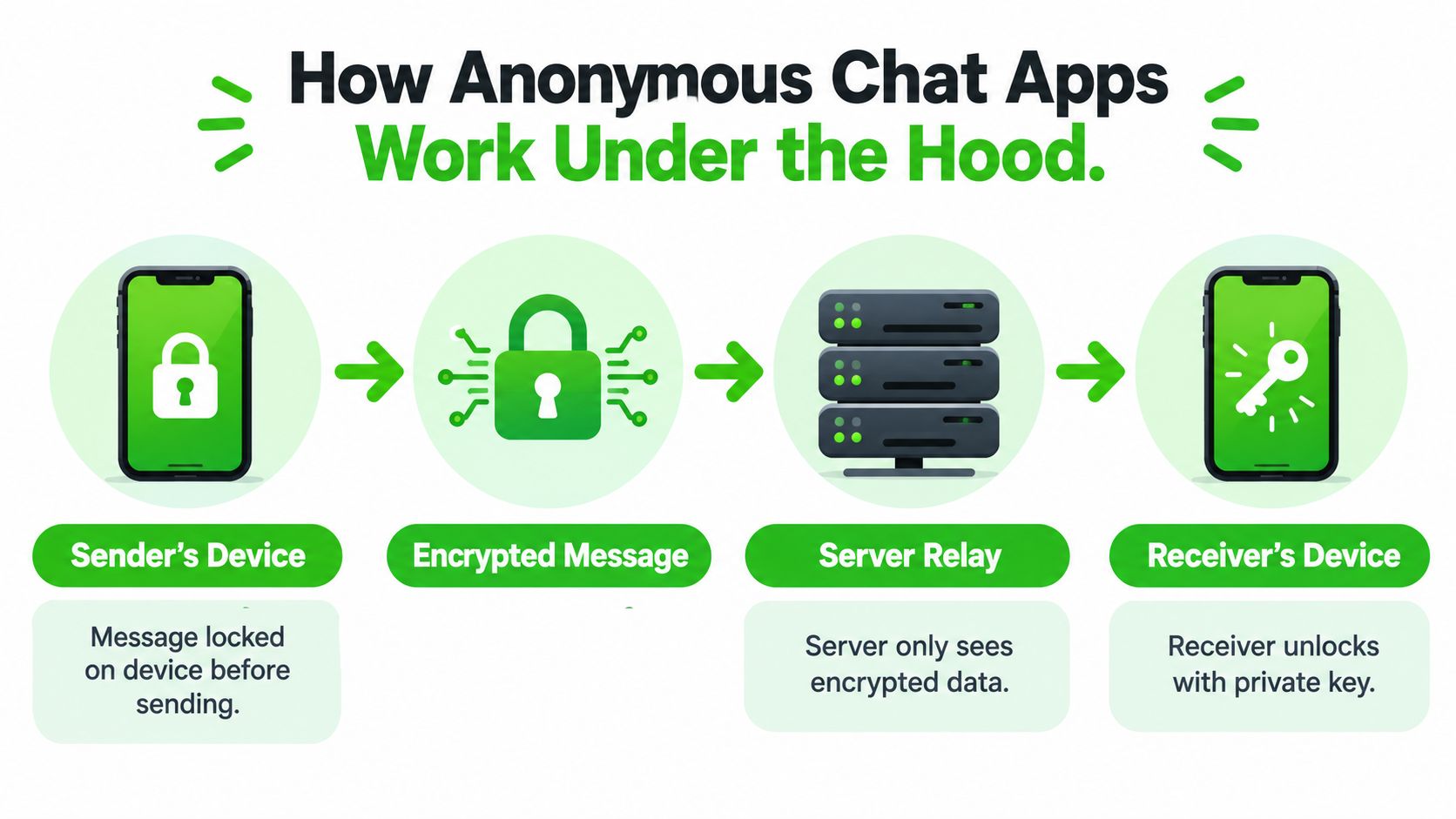
In a well-built anonymous chat app, your browser or app encrypts each message locally before anything leaves your device. What travels to the server is ciphertext, meaning scrambled data that's unreadable without the key. The server acts as a relay. It stores or forwards the scrambled data, along with technical material such as a salt, initialization vectors, and authentication tags, but it doesn't hold the key that turns ciphertext back into words. The recipient's device decrypts the message locally.
The diagram below shows that flow from sender to relay to receiver.
It's worth separating three terms people blur together. Encryption in transit protects data while it moves across a network, but the service at the other end may still read it. Encryption at rest protects stored data on a disk, but the service usually holds those keys too. End-to-end encryption is different because only the endpoints hold the key. If a service advertises encryption but can reset your password and show you your old messages, it probably holds a way in, and that's not the same guarantee.
Turning a shared secret into a key
Both sides need the same key, but you can't just send the key through the channel you're trying to protect. Instead, the devices derive it locally from a shared secret, such as an access key you exchange some other way. A process called key derivation stretches that secret into a strong encryption key, using a unique salt so identical secrets in different channels don't produce identical keys. If you want the mechanics in more depth, read this explanation of how encryption keys work before you rely on any tool for sensitive work.
That design has a practical consequence. If the relay's storage is stolen or handed over under legal pressure, the attacker gets ciphertext rather than readable conversations. They would still need to guess the shared secret. Rate limiting and intrusion alerts slow down online guessing, but they can't rescue a short or predictable secret, so the strength of what you share out-of-band does most of the work.
Ephemerality and the limits of the relay
The second core idea is ephemerality. Rather than keeping messages indefinitely, the service enforces a lifetime, after which the channel and its server-side ciphertext are deleted. This shrinks the window in which a breach, a subpoena, or an insider could expose anything, and it means there's no archive to recover later. Deletion here needs precise language, though. It covers what the server held. It doesn't reach a screenshot the other person took, a file they downloaded, or a copy sitting in a browser cache.
Networking details sit outside the locked box entirely. Your connection still has an IP address, and the relay may see connection timing even when it can't read content. If you're assessing what your own network exposes, you can check your IP details to see the kind of information a connection presents before any chat begins. Encryption protects content. It doesn't make the act of connecting invisible, and it can't protect a device that's already compromised.
Anonymous Chat Apps vs Traditional Messengers
Signal, WhatsApp, and Telegram are good at what they're built for, which is ongoing communication between people who know each other. The comparison only becomes useful when you ask what each design assumes. A mainstream messenger assumes you have an identity worth keeping, contacts worth reconnecting with, and a history worth preserving. An anonymous chat app assumes the opposite for one conversation. Neither assumption is wrong. They just serve different situations, and picking the wrong one creates exposure you didn't need or friction you can't afford.
| Feature | Anonymous Chat Apps | Traditional Messengers |
|---|---|---|
| Account required | Typically none | Yes, tied to a phone number or username |
| Phone number | Not required | Usually required or strongly encouraged |
| Identity shown to contacts | None by default, or a temporary label | Profile name, photo, and number |
| Encryption | Client-side and end-to-end by design | Varies by app and chat type, sometimes optional |
| Message retention | Short, enforced lifetime, then deletion | Kept until you delete, often backed up |
| Self-destruction | Core feature, automatic | Optional timers in some apps |
| Server knowledge | Ciphertext only in a zero-knowledge design | Often metadata, sometimes content access |
| Best fit | Brief, sensitive, first-contact conversations | Ongoing relationships and group coordination |
Encrypted does not mean anonymous
This is the misconception that causes the most trouble. Encryption protects content. Anonymity protects identity. A messenger can encrypt your messages beautifully while still knowing your phone number, your contact graph, when you're online, and who you talk to most. That metadata can be revealing on its own. Knowing that a journalist exchanged messages with a particular number every night for a week tells a story even if nobody reads a single word.
Conversely, a service could hide your name from other users while storing your messages in readable form on its servers. You'd feel anonymous in the conversation while the operator, or anyone who breaches the operator, could read everything. That's why you should evaluate the two properties separately and ask which one a given claim covers.
What you give up for identity-free chat
The trade-offs are real and worth naming plainly. Without accounts, there's no easy way to recover a conversation, prove you are the same person as last time, or reconnect if a link is lost. Without archives, you can't search last month's discussion. Without persistent identity, blocking a bad actor is harder because they can return under nothing in particular. For a team planning a project over six months, those losses make the tool unusable.
For a single conversation where the record itself is the risk, those same properties are the point. The skill isn't finding a universally superior app. It's matching the tool to the threat. Ask whether you need continuity or deniability, whether a phone number exchange is acceptable, and whether a stored history helps you or endangers someone. Your answers point to the right category quickly.
Real-World Use Cases for Anonymous Chat
Abstract privacy arguments get clearer when you attach them to a person's afternoon. The scenarios below share a pattern. Someone needs to talk now, the relationship is new or fragile, and the ordinary requirement to swap accounts or numbers creates risk or friction that has nothing to do with the conversation itself. In each case, removing identity and shortening the record changes whether the conversation happens at all.
Journalism and security research
A source who fears losing a job will often talk before they'll identify themselves. A browser-based anonymous chat app lets a reporter send a link and an access key through whatever channel already exists, then hold a first conversation with no numbers exchanged and no archive created. If the source decides not to proceed, nothing persists to be discovered later. This guide to journalist source protection goes deeper on handling that first contact without overpromising what any tool can guarantee.
Security researchers face a similar shape of problem during vulnerability disclosure. A researcher who finds a flaw in a company's product may want to share technical details and negotiate a timeline without attaching a personal identity to an early, possibly tense exchange. A disposable encrypted channel supports that conversation, and an immediate burn option matters if a session needs to end abruptly. Incident responders use the same property when coordinating quickly during an event they don't want preserved in a general-purpose chat log.
Legal and healthcare conversations
A lawyer taking a first call from a potential client sometimes needs to discuss the outline of a privileged matter before any engagement exists. Doing that inside a permanent, account-based thread creates a record neither side has decided they want. A short-lived channel keeps that exploratory conversation contained. It doesn't replace proper client systems once a relationship is formal, and it shouldn't be used where regulations require retention. It fits the narrow window before those obligations attach.
Healthcare professionals coordinating a sensitive case can have comparable needs, particularly when a quick consultation shouldn't be threaded through personal messaging accounts. Again, the boundary matters. Anonymous chat can suit brief coordination that must not linger, but it is not a medical record system and can't provide the audit trail that clinical care often requires.
A disposable channel earns its place when the record is the risk, not when the record is the deliverable.
Notice what these cases have in common and what they exclude. They're short, bounded, and involve people who may never speak again. They're not team collaboration, long-term client management, or regulated recordkeeping. Recognizing your own situation in one column or the other is most of the decision, and it's a decision about your circumstances rather than about which app has the longest feature list.
Where Anonymous Chat Actually Breaks Down
Any honest account has to start with the endpoint, because that is where most failures happen. Encryption protects data between two devices. It does nothing about what happens on them. A browser with a malicious extension, a compromised phone, an unattended laptop on a desk, or a participant who screenshots the conversation all sit outside the relay's protection. If the person you are talking to copies a file, no amount of server-side deletion retrieves it. That is a boundary you plan around, not a flaw in the encryption.
A useful way to frame this is the question anonymity tools rarely answer: anonymous from whom, under which threat model, and for how long? A relay that never sees your name still leaves your device, your counterpart, and your network untouched. Each of those is a separate surface, and each fails differently.
Why these risks are not hypothetical
The harms that push people toward privacy tools are common rather than exotic. In Pew Research Center's 2013 findings on privacy and security online, 21% of internet users said an email or social networking account had been compromised without permission, 11% said important personal information such as a Social Security number or bank details had been stolen, and 12% reported being stalked or harassed online. Motivations for hiding activity included 33% who wanted concealment from hackers or criminals, 28% from advertisers, and 17% from potential critics or harassers.
Account-based systems concentrate exactly the material those attackers want, which is part of why avoiding an account can reduce exposure. Reduced exposure is not safety, and confusing the two is how people end up protected against the wrong threat.
The disclosure and safety trade-off
Anonymity lowers the cost of speaking, and that cuts both ways. In a 2025 realist evaluation of an anonymous mental health community, 59.3% of surveyed participants agreed or strongly agreed that anonymity made them feel safe to post, while 22.4% agreed and 3.4% strongly agreed that discussing mental health online could make them feel worse. The researchers also described how poor moderation can expose people to distressing posts, misinformation, and toxic discussion, and how complete anonymity limits the ability to support someone or assess their safety.
That creates a design question with no clean answer. A service that cannot identify participants also cannot follow up, verify claims, or intervene in a crisis. Privacy-preserving safeguards still exist, including clear scope limits, intrusion alerts, rate limits, pre-session warnings, and emergency guidance. They work differently from identity verification or reading people's messages, and they should. If your situation needs continuity of care or accountable follow-up, a disposable anonymous channel is the wrong tool, and using it anyway trades one risk for a worse one.
What "untraceable" actually means in practice
Discard the word untraceable entirely. Network observers may see that a connection occurred even when they cannot read it. A participant may reveal themselves through what they say, and writing style or shared details can identify someone faster than any technical leak. Duration matters too: a channel that exists for an hour gives an adversary an hour of exposure, while a permanent thread gives them years.
Organizations thinking about these layers together will find the 2026 startup data protection guide useful for framing endpoint and policy controls that a chat tool alone cannot supply. An anonymous chat app reduces specific risks around identity, retention, and server exposure. Risk stays in the conversation regardless, and believing otherwise is itself a risk.
How to Choose and Use an Anonymous Chat App Safely
Evaluating one of these services is easier when you turn marketing claims into questions with verifiable answers. You're not looking for the word private on a homepage. You're looking for a design that makes certain exposures structurally impossible rather than merely promised against. The infographic below condenses the checks into a quick reference you can reuse.
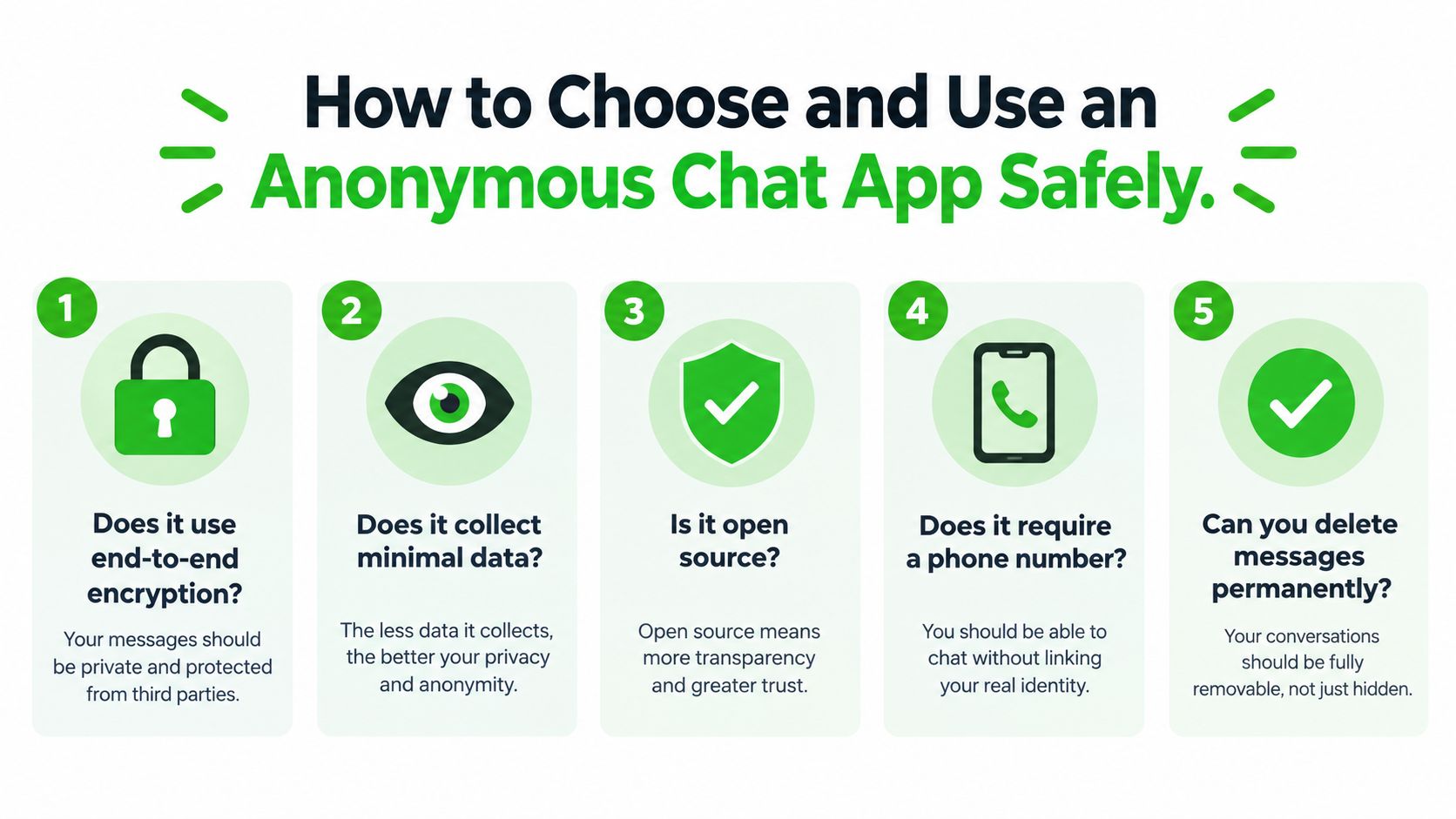
Work through these questions before trusting a service with anything sensitive:
- Does it require an account, email, or phone number? If yes, your identity is attached before you type anything, whatever the branding says.
- Where does encryption happen? Client-side, end-to-end encryption by default is the meaningful standard. Optional secret modes mean most conversations aren't protected that way.
- What does the server store? A zero-knowledge relay should hold only ciphertext and expiry information, with no decryption key available to the operator.
- How long does anything live? Look for a fixed, enforced lifetime and a manual option to end a session immediately, not a vague deletion policy.
- What happens on a breach? If the honest answer is that attackers would get unreadable ciphertext for a short window, the design is doing its job.
How you use the tool matters as much as which one you pick. Share access keys out-of-band, meaning through a different channel than the link itself, so one intercepted message doesn't hand over both. Use a long, randomly generated key rather than a word or a familiar name, because a channel name is a label and shouldn't double as the secret. Assume anything you type can be captured by the person receiving it, and keep identifying details out of the conversation unless they're necessary. This primer on what a threat model is helps you turn those habits into decisions matched to your own situation rather than generic caution.
The short video below walks through related security thinking you can apply while comparing services.
Regulated fields add another layer, since retention and audit requirements may rule out disposable channels for some conversations entirely. For that angle, MedQAIR regulatory security insights offers useful context on how privacy expectations interact with compliance duties. Treat the checklist as a repeatable filter. Any anonymous chat app that can't answer these questions plainly is asking for trust it hasn't earned.
How Ciphar Addresses These Privacy Needs
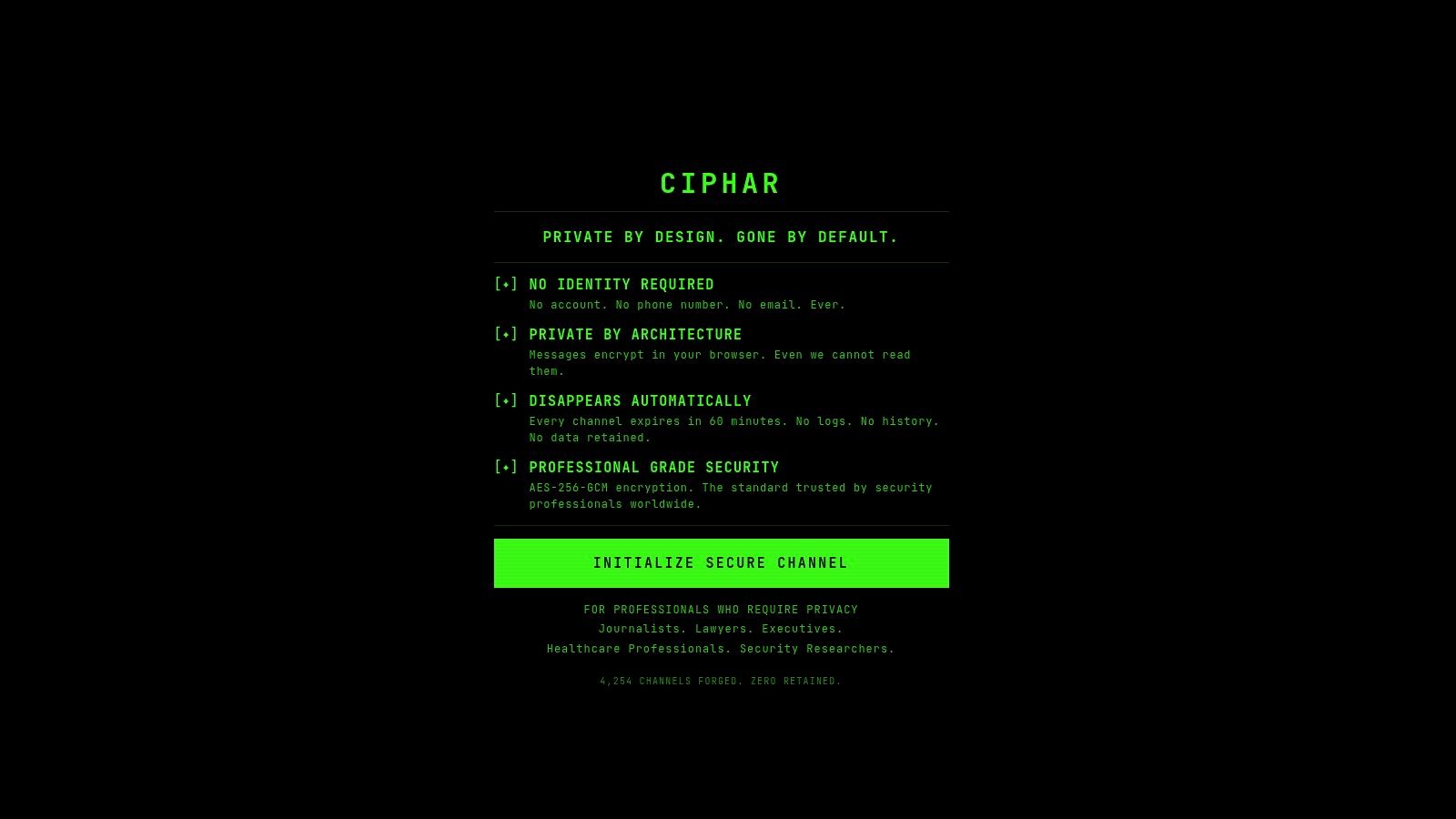
Ciphar is a concrete example of the design pattern described above, so it's a useful test of whether the concepts hold up in a real product. It's browser-based, which means there's nothing to install and no app store account involved. You create a channel, share a link plus an access key through another channel, talk, and let the session expire or end it yourself. No account, phone number, or email is collected, so there's no persistent identity to breach or to link across conversations.
The screenshot below shows the interface a participant sees when opening a channel.
How the pieces fit together
Messages, files, and voice frames are encrypted on the device with AES-256-GCM, which provides confidentiality plus authenticated integrity, so tampered ciphertext fails authentication instead of decrypting into altered text. Correct handling depends on using a unique nonce for every encryption under the same key, since reusing one in this mode can expose relationships between messages and weaken authentication. Keys are derived in the browser and never leave the device, while the server relay stores only opaque ciphertext, IVs, authentication tags, salt, and expiry timestamps.
Honesty about parameters matters here. Ciphar derives keys with PBKDF2-HMAC-SHA-256 at 100,000 iterations and a per-channel salt, whereas OWASP's password storage guidance lists 600,000 iterations for PBKDF2-HMAC-SHA-256 when PBKDF2 is required and recommends unique salts for each password-derived secret. The practical reading is that the current iteration count is a performance and compatibility baseline, so the entropy of your access key carries more weight than the derivation step alone. A long random key shared out-of-band isn't optional advice. It's the load-bearing control, supported by rate limiting and in-channel intrusion notices when someone fails an access attempt.
Channels have a hard 60-minute lifetime enforced by the server, with no archive, no recovery, and a manual burn control to wipe a session immediately. There's no telemetry, analytics, or profiling, and the stated scope is narrow on purpose. Ciphar isn't positioned as a long-term messenger, a file store, or a regulated communications tool, and it doesn't solve endpoint problems such as screenshots, compromised browsers, or an unsecured device. Judged against the earlier checklist, its claim is specific rather than sweeping. For a short, identity-free conversation where the record itself is the liability, that narrowness is the feature.
If you need a short conversation that doesn't require exchanging phone numbers or creating accounts, open a disposable encrypted channel with Ciphar, share the access key through a separate channel, and let the session expire when you're done. Try it on your next first contact with a source, client, or researcher, and judge it against the threat model you've just built.