The most popular advice about business continuity is also the least useful: “Restore everything as quickly as possible.” That sounds decisive, but it gives a team no answer when full restoration is impossible, unsafe, or less important than keeping one critical service available.
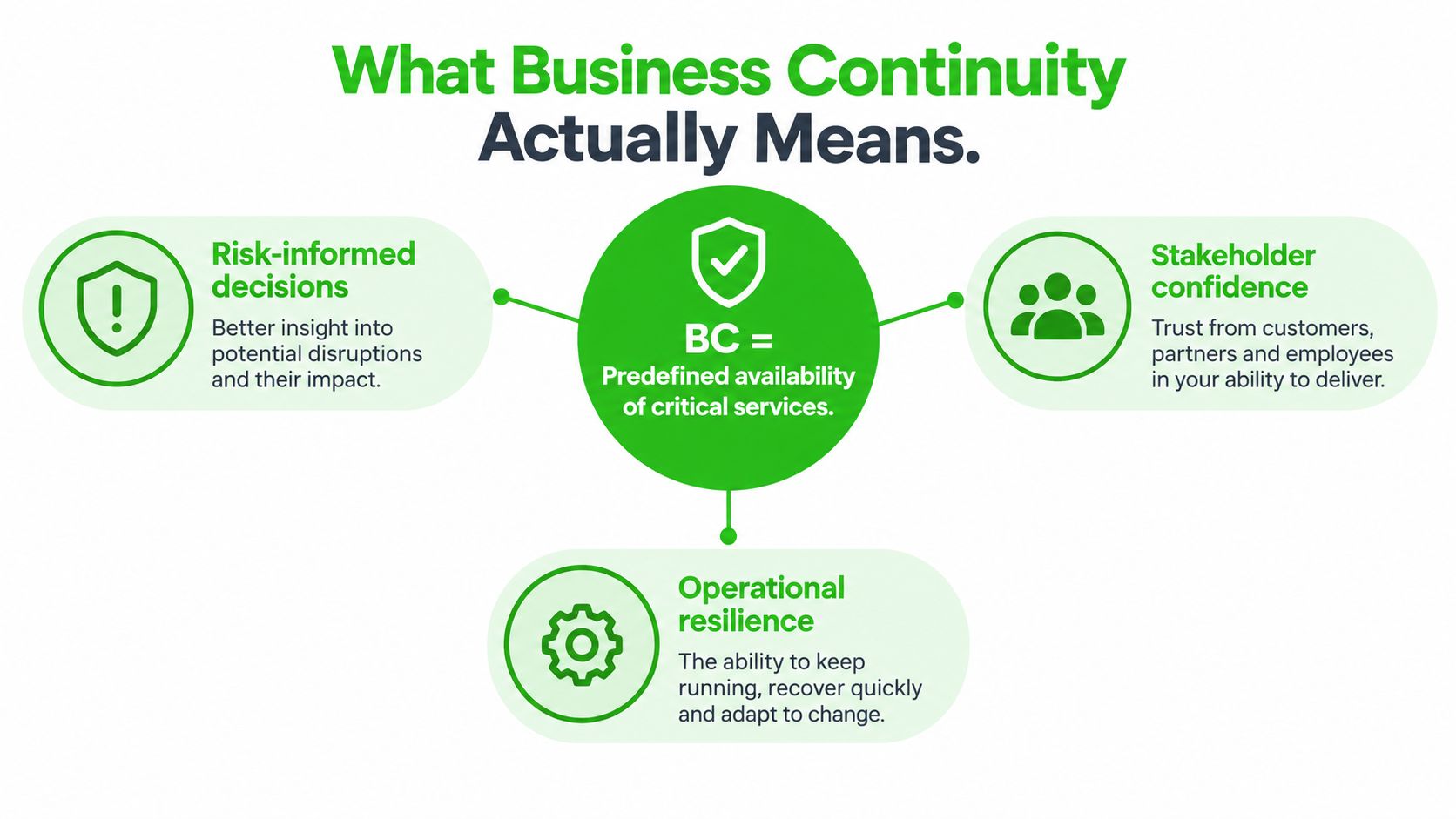
Business continuity means deciding in advance what must continue, at what minimum capacity, and within which acceptable timeframe while disruption is still happening. It isn't a promise that every system will remain online. It isn't a guarantee that normal operations will return immediately. It is a reasoned agreement about what the organization will protect first, what it can temporarily reduce, and who has authority to make those trade-offs.
That distinction changes how you prepare. A hospital that keeps its emergency room operating while elective procedures pause is practicing continuity. It hasn't preserved every service, but it has protected the function where interruption would cause the greatest harm. The same principle applies to a newsroom, law firm, clinic, software company, or incident-response team.
What Business Continuity Actually Means
The clearest definition comes from ISO guidance on business continuity: maintaining delivery of critical products or services at a predefined minimum capacity and within acceptable timeframes while a disruption is occurring, rather than merely restoring normal operations afterward.
That definition contains three decisions. First, identify the critical product or service. Second, define the minimum acceptable capacity. Third, decide how long that reduced service can continue before the consequences become unacceptable. Without those decisions, an incident team tends to protect whatever is easiest to restore, not whatever the organization actually needs.
A payment operation might preserve transaction authorization while postponing reporting. A legal team might keep privileged communication available while suspending document collaboration. A publisher might maintain editorial approval while delaying nonessential production work. These are continuity choices because they accept degraded service on purpose.
What continuity doesn't promise
Continuity is often confused with several neighboring disciplines:
- Uptime describes availability under normal operating conditions. Continuity addresses how critical work continues during abnormal conditions.
- Disaster recovery focuses mainly on restoring technology, infrastructure, and data. Continuity asks how the organization keeps functioning while restoration is incomplete.
- Crisis communication governs messages to employees, customers, regulators, and other stakeholders. It doesn't automatically provide a confidential operational channel for the response team.
- Resilience is the broader ability to absorb disruption, adapt, and continue. Business continuity gives that ambition concrete service priorities and decision rules.
A useful continuity plan therefore names both the protected service and the permitted reduction. A team may preserve secure coordination while pausing voice, reporting, or documentation updates. If confidentiality matters, the plan should also explain how people will convene without exposing unnecessary identities or creating records that the business never intended to retain. For a practical example of privacy-aware planning, see confidential planning for sensitive coordination.
Practical rule: If your plan says “keep the business running,” rewrite it as a specific service, capacity, timeframe, and decision owner.
Continuity also has a financial dimension, but financial protection isn't the same as operational capability. Organizations comparing risk transfer with operational preparation may benefit from understanding how BI insurance works. Insurance can address some consequences of interruption, while a continuity plan determines what people will do when systems, suppliers, facilities, or communications are impaired.
The Measurable Targets Behind Every Continuity Plan
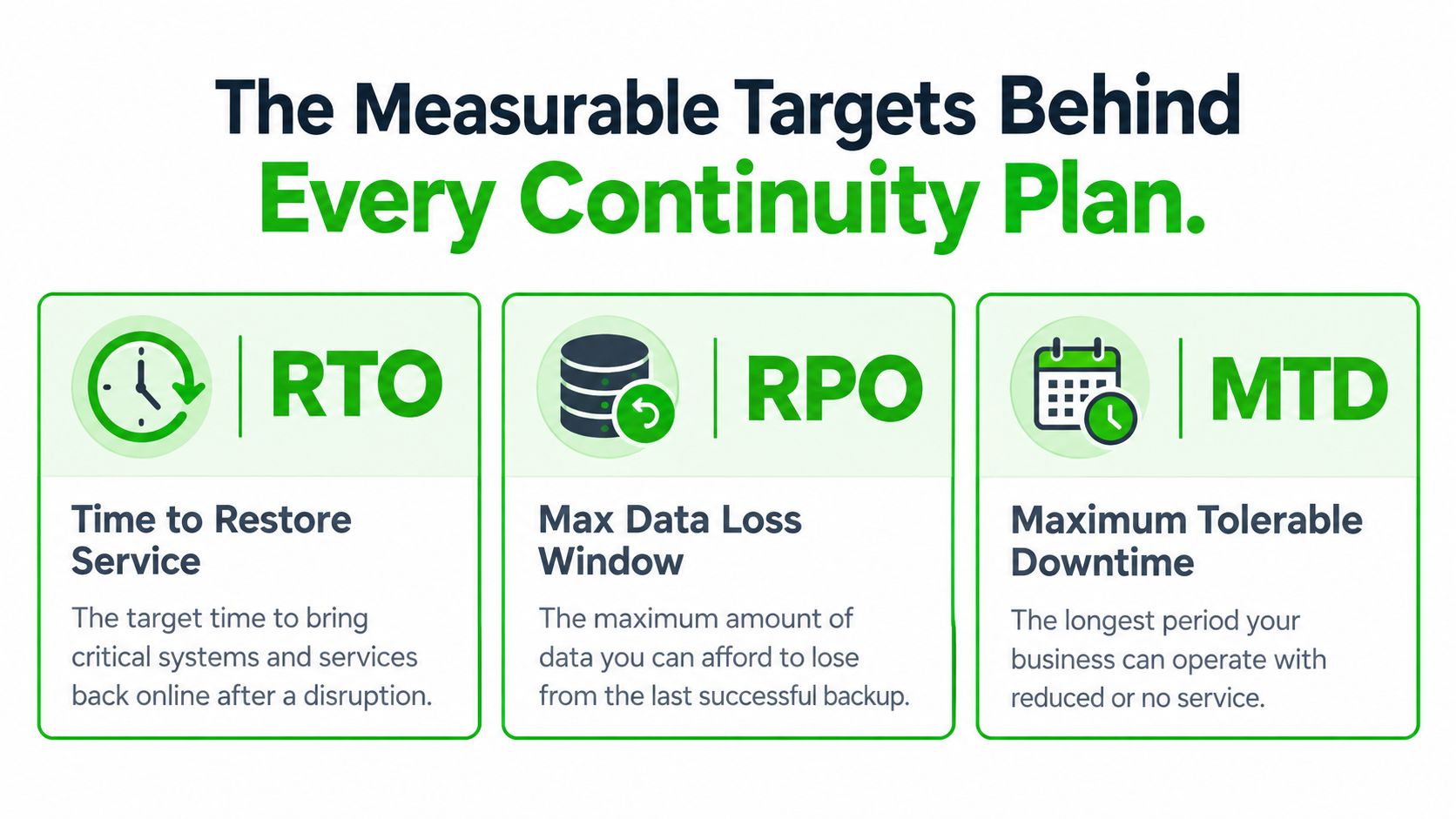
A continuity statement becomes useful only when it turns into measurable limits. The main terms are recovery time objective, recovery point objective, and maximum tolerable downtime. They answer different questions, so combining them into one vague recovery promise creates confusion.
According to NIST's contingency planning guidance, the recovery time objective, or RTO, is the maximum period a system resource can remain unavailable before the impact becomes unacceptable. Think of it as the service's recovery clock.
The recovery point objective, or RPO, asks how far back data must be recoverable after an outage. It reflects tolerable data loss, not the time needed to restore a system. A service might require strong protection for access controls and expiry metadata while deliberately offering no restoration of transient message content.
Maximum tolerable downtime, or MTD, is the outer boundary. It represents the point at which continued unavailability creates an unacceptable business impact. RTO normally needs to be shorter than MTD because recovery must finish before the organization crosses that boundary.
Different services deserve different targets
Treating an application as one indivisible system is a common planning error. A more useful design assigns targets to individual capabilities:
| Capability | Continuity question |
|---|---|
| Channel creation | Can authorized people establish a temporary channel? |
| Encrypted relay | Can essential messages move confidentially? |
| Access-attempt controls | Can the service limit guessing and surface suspicious access? |
| Expiry enforcement | Can security and retention rules remain trustworthy? |
| Voice transport | Is real-time voice essential, or can it pause during degradation? |
For an ephemeral communication service, message recovery may be intentionally unavailable. Restoring old content from a backup could undermine the very retention boundary the service is supposed to enforce. The continuity priority may instead be availability plus security-state integrity, with lower-priority features disabled until the platform stabilizes.
That is why backups aren't a substitute for continuity design. A backup answers, “What data can we restore?” It doesn't answer, “Which function must remain available now, who activates the fallback, or what data must never be recreated?” Those answers come from business-impact analysis and risk tolerance.
The practical exercise is straightforward. For each critical capability, write the business consequence of unavailability, the latest acceptable recovery point, the data that must not be recovered, and the person authorized to accept degraded service. Then test whether the technical architecture can meet those limits under realistic failure conditions.
This short explainer provides another way to frame the relationship between recovery limits and operational priorities:
Business Continuity Planning Versus Disaster Recovery
A business continuity plan and a disaster recovery plan overlap, but they don't answer the same question.
A business continuity plan asks, “How will people deliver critical services during disruption?” It covers staff responsibilities, alternate processes, facilities, suppliers, technology dependencies, decision rights, and communications. A disaster recovery plan asks, “How will we restore affected systems, infrastructure, and data?” It usually belongs within the broader continuity approach, but it can't replace it.
| Planning layer | Primary question | Typical concern |
|---|---|---|
| Incident response | What happened, and how do we contain it? | Investigation, escalation, and immediate controls |
| Business continuity | What critical work must continue now? | People, processes, priorities, and fallback methods |
| Disaster recovery | How do we restore technology? | Systems, infrastructure, applications, and data |
| Crisis communication | What should each audience be told? | Accurate, approved, and timely messages |
Consider a collaboration platform outage during a security incident. The recovery team may be rebuilding servers and validating backups, while legal, security, and leadership still need to coordinate. A technically excellent recovery process won't tell those people how to share sensitive information, approve an action, or reach one another if their normal identity and messaging systems are unavailable.
The order of questions matters. Start with the business function, not the server. Identify what must continue, define acceptable degradation, and then ask which technical restoration activities support that outcome. Teams that begin with infrastructure often restore the most visible system rather than the service with the highest consequence of interruption.
For readers who want a more detailed comparison of the two planning disciplines, F1Group's disaster recovery planning resource offers useful context. The essential distinction remains simple: continuity keeps priority work moving, while disaster recovery restores the machinery that supports it.
A complete resilience stack needs all four layers. Incident response controls the event. Continuity protects critical operations. Disaster recovery brings systems back. Crisis communication maintains trust and alignment across affected audiences. Omitting any one of them leaves a predictable gap, especially when technology returns before people can safely coordinate.
How ISO 22301 Frames the Work
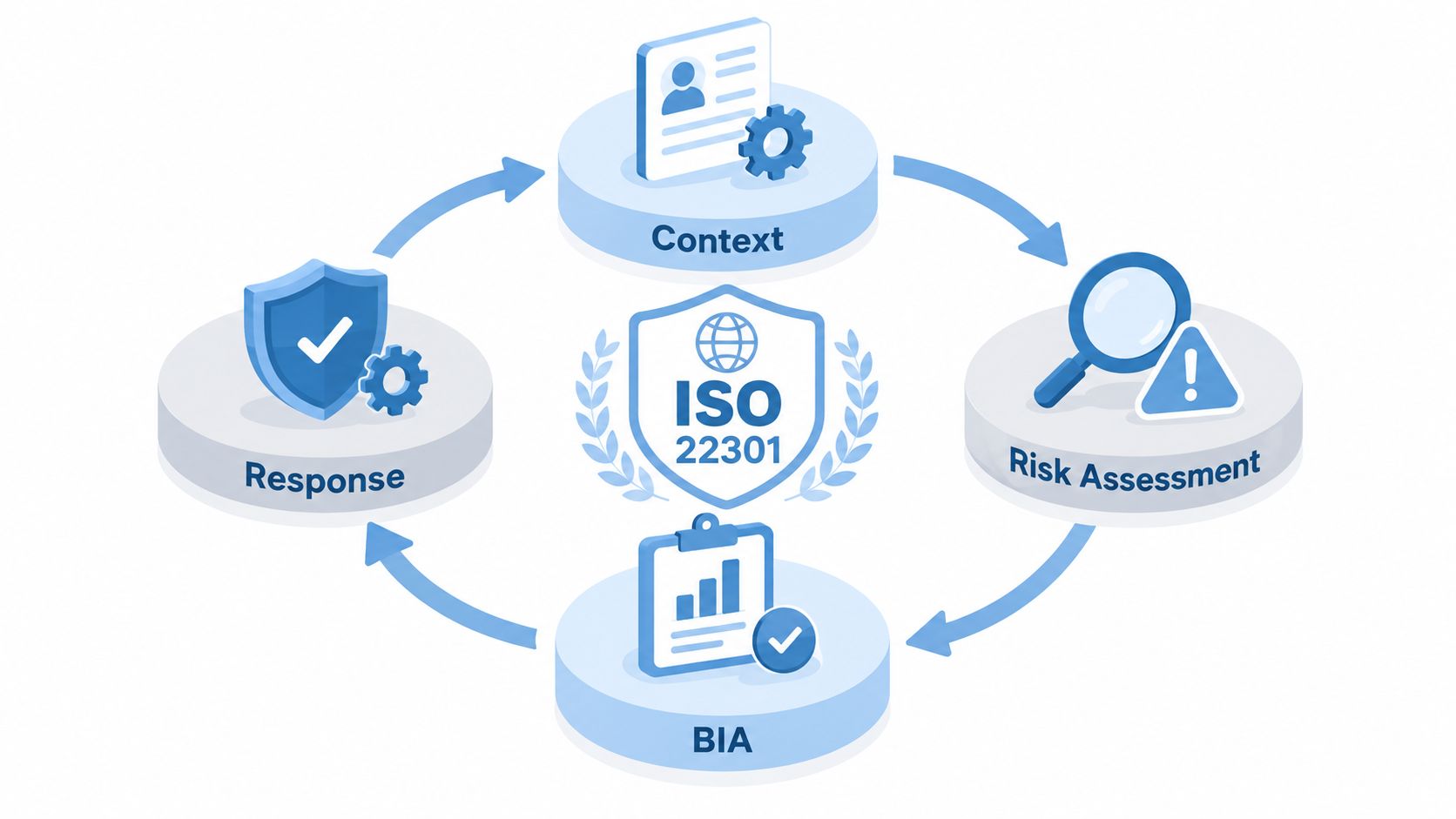
ISO 22301 treats continuity as a business continuity management system, or BCMS, rather than a document that someone writes and stores. The system identifies threats, assesses impacts, assigns responsibilities, defines measurable objectives, and improves through testing and review.
The work usually follows a loop:
- Set the context. Define the organization, its services, stakeholders, obligations, and operating assumptions.
- Assess risk. Identify events that could interrupt critical work and examine the conditions that make those events more damaging.
- Conduct business-impact analysis. Determine which activities matter most, what dependencies they require, and how disruption affects the organization over time.
- Choose strategies. Select practical ways to maintain or restore priority services, including alternate processes, people, suppliers, infrastructure, and communications.
- Develop response arrangements. Document roles, escalation paths, activation criteria, procedures, and minimum service objectives.
- Exercise and improve. Test the arrangements, capture evidence, correct weaknesses, and update the system as the organization changes.
Why copied recovery targets fail
ISO 22301 guidance doesn't prescribe universal recovery times. Each organization must set its own targets through business-impact analysis, risk tolerance, and testing. A plan can therefore align with the framework while permitting a very different outage duration from another organization's plan.
That flexibility is necessary. A public emergency service, a small consultancy, and a research team don't face identical consequences when a system becomes unavailable. Copying another organization's RTO or MBCO creates false precision because the number may reflect its staffing, contracts, customer expectations, legal obligations, and architecture, not yours.
A minimum business continuity objective, or MBCO, makes the choice visible. For a secure, short-lived communication service, an MBCO might preserve channel admission, key exchange, encrypted messaging, expiry enforcement, and emergency burn capability while temporarily suspending voice rooms or documentation changes. The important point isn't the feature list. It's the explicit decision that lets responders degrade service without improvising.
Dependency mapping adds another layer of discipline. Trace the chain from the browser client through relay infrastructure, real-time services, access controls, expiry enforcement, rate limiting, monitoring, and third-party providers. A service that appears independent may rely on an identity system or monitoring path that fails in the same incident.
Security certification follows a different framework, but teams often need to coordinate the evidence and responsibilities. A guide to how to get ISO 27001 certified can help distinguish information-security management activities from the continuity decisions made under ISO 22301.
Why Written Plans Fail Under Pressure
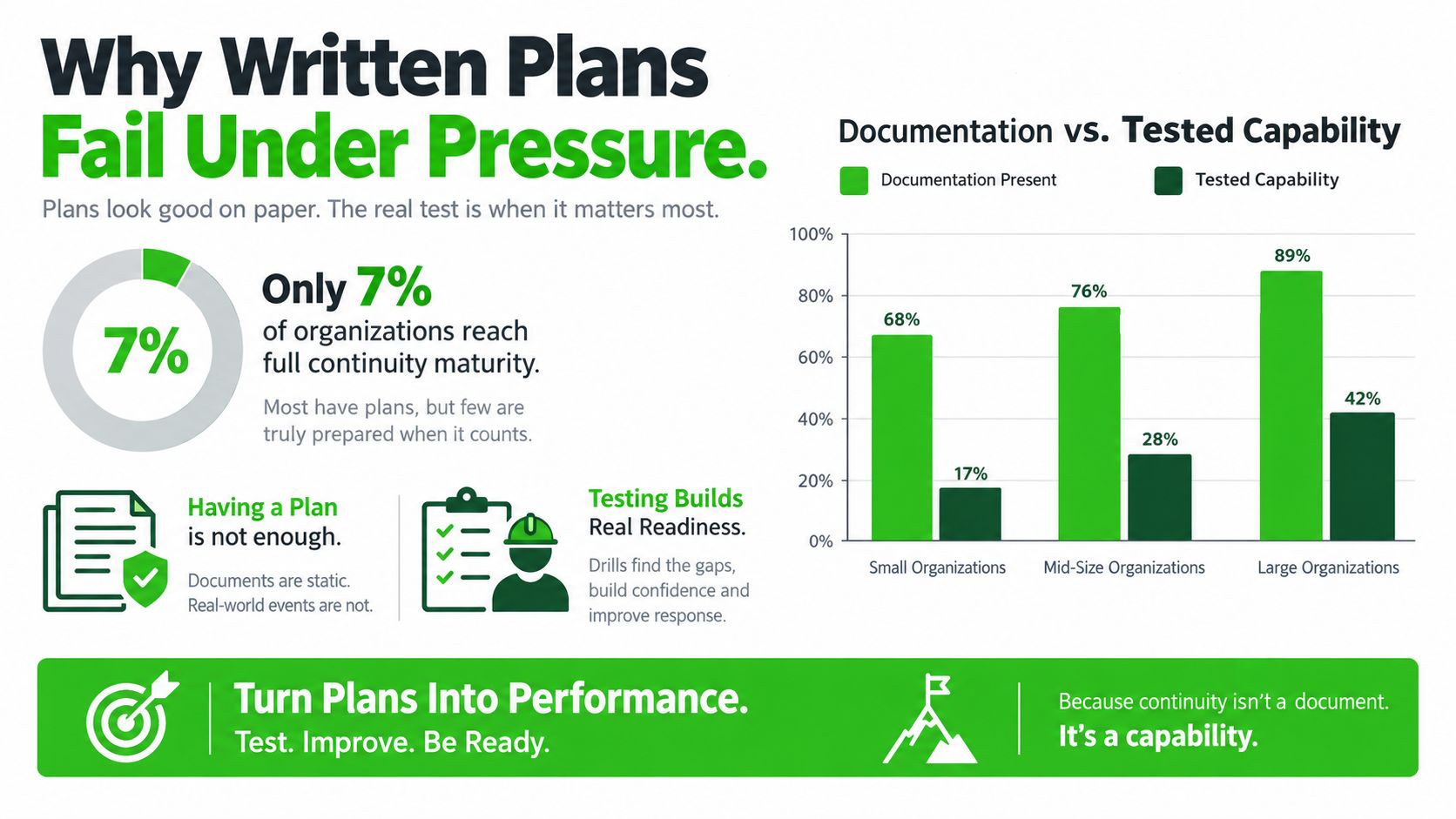
A document can describe a response without proving that anyone can execute it. That distinction matters because pressure changes behavior. People forget rarely used procedures, contact lists become stale, authority becomes unclear, and a supposedly available fallback depends on a system that failed alongside the primary service.
A 2025 report cited in the available findings found that only 4.6% of organizations reached its highest maturity level for IT business-continuity plans, while nearly 19% scored at the lowest levels (source report). The figures don't prove that every plan is weak, but they do challenge the assumption that documentation equals readiness.
The gap is usually operational
Resource constraints, siloed systems or data, and competing priorities make continuity difficult to integrate into daily work. A plan may name a fallback process, but no one has checked whether the people responsible can access it, whether permissions still work, or whether the alternative creates a new confidentiality risk.
Testing doesn't need to begin with a complex full-scale exercise. Start with a tabletop scenario and ask participants to perform the first actions rather than merely discuss them:
- Trigger the decision: Who declares the disruption, and what evidence do they need?
- Reach the responders: Can the incident lead contact the right people without relying on the failed platform?
- Protect sensitive information: Where can authorized participants coordinate without spreading unnecessary copies?
- Measure the clock: Does the team meet the relevant RTO for each priority capability?
- Check the handoff: Can the response move back to normal operations without losing security controls or expiry rules?
A useful exercise exposes friction early. The team may discover that the backup channel requires an account nobody can create during an outage, that the emergency contact list contains personal numbers people shouldn't share, or that the recovery process restores data that policy says should remain unavailable.
A successful exercise doesn't prove that disruption is harmless. It proves that the team has found and reduced specific uncertainty.
The human layer deserves the same attention as backups and failover. Authorized people need a way to establish trust, exchange the minimum necessary information, and coordinate decisions when ordinary collaboration, identity, or document systems can't be relied on. If that path hasn't been tested, it belongs on the continuity risk register.
The Communications Layer Most Plans Miss
A security incident can leave the core systems partly available while making the usual communication environment unsafe or inaccessible. The team still needs to coordinate, but its normal workspace may expose identities, preserve sensitive messages, depend on the same login provider, or create a permanent archive that isn't appropriate for the emergency.
Suppose an incident-response lead loses access to the primary collaboration platform during an investigation. The lead contacts the authorized participants through an out-of-band method, shares a temporary channel address and access key separately, and asks everyone to verify access before discussing the incident. The group uses the channel for concise decisions, exchanges only the necessary files, and ends the session when coordination is complete.
That workflow is deliberately narrower than ordinary collaboration. It doesn't attempt to replace project management, records management, or a long-term team messenger. It creates a controlled bridge for a specific continuity objective: confidential coordination while the primary environment is impaired.
Designing the fallback channel
A communications fallback should be judged against the same questions used for any critical service:
- Availability: Can participants reach it from a browser or alternate network path?
- Admission: Can the team establish a channel without depending on the failed identity provider?
- Confidentiality: Are messages protected before they reach the relay or intermediary?
- Retention: Does the tool preserve only what the continuity policy allows?
- Control: Can an authorized person terminate the session when the risk changes?
- Recovery: Does restoring the primary platform require recreating sensitive temporary content?
For incident responders, journalists, lawyers, healthcare professionals, and privacy-sensitive decision-makers, an identity-free, browser-based option can reduce onboarding friction. Ciphar provides one-time browser channels with client-side encrypted messages, files, and voice frames, server-enforced 60-minute expiry, no account or phone-number requirement, and a manual burn control. Those properties fit a narrowly defined MBCO for short-lived confidential coordination, but they don't make it a long-term archive or a regulated-communications system.
The trade-off is intentional. Ephemeral communication reduces retained material, but it also removes historical recovery. Participants must preserve any information that policy or law requires through an approved system, and they must share access keys through a separate trusted route. The fallback therefore complements primary communications and formal records systems. It doesn't replace either one.
Teams building the wider response model can use this crisis communication guidance to separate stakeholder messaging from confidential operational coordination. Those are related functions, but they need different controls and audiences.
Starting Your Continuity Plan This Week
You don't need a polished manual to begin. You need a defensible set of decisions that people can understand and test. Start with the services that create the greatest operational consequence if they stop, then describe the minimum capacity that keeps each one viable.
Use an afternoon workshop with the people who perform the work, own the systems, manage risk, and coordinate incidents. Record decisions in plain language, including disagreements. A plan built only by infrastructure specialists will often miss customer commitments, legal constraints, staffing realities, and communication dependencies.
The first decisions to record
- Name the critical functions. Write the service or activity, not just the application that supports it.
- Define minimum capacity. State what must remain possible and which features may be paused.
- Set recovery boundaries. Assign an RTO, RPO, and MTD based on business impact, not a copied template.
- Map dependencies. Include people, suppliers, browsers, networks, identity services, relay components, monitoring, and access controls.
- Assign authority. Identify who declares disruption, approves degradation, changes priorities, and ends the emergency mode.
- Choose alternate communication. Confirm how authorized participants will coordinate if the primary platform or identity system is unavailable.
- Run a small exercise. Test the first decisions, access paths, timing, and handoffs before expanding the documentation.
Avoid three traps. Don't treat the document as finished after publication. Don't confuse compliance evidence with demonstrated capability. And don't test only the technology while leaving the people and communications layer untouched.
Review the plan whenever services, suppliers, staffing, or data-retention rules change. After each exercise, remove one source of friction, clarify one decision, and retest the control that matters most. That habit turns business continuity from a binder into an operating capability.
Ciphar provides browser-based, zero-knowledge encrypted channels for short-lived coordination when normal collaboration tools aren't available or appropriate. Visit Ciphar to evaluate whether temporary, identity-free communication belongs in your continuity kit.