Secure anonymous chat is an encrypted conversation that also avoids accounts, phone numbers, and a lasting archive, but encryption alone is not anonymity.
The popular advice to pick an encrypted messenger answers only part of the privacy question. A service might be unable to read your words while an employer can see your visit, an account identifies you, or the other person saves the conversation.
The useful question is anonymous from whom? Start with the person or organization you're worried about, then choose protections that address what they can observe.
What Secure Anonymous Chat Actually Hides
A secure anonymous chat is a short conversation encrypted on participants' devices, entered without an account, phone number, or email, and designed not to become a lasting archive. That describes a design goal, not a guarantee that nobody can identify either participant.
Think of a sealed envelope. Someone carrying it might be unable to read the letter, yet still see where it goes and when it moves. Content confidentiality protects the letter. Anonymity and metadata privacy concern the information around it.
Anonymous from whom
The distinction becomes clearer when you separate the protections instead of treating privacy as a single switch.
| Layer | What a strong design hides | What can still leak | User control |
|---|---|---|---|
| Content confidentiality | Message text, files, and voice as ciphertext | Screenshots, copies, and malware on the device | Use real end-to-end encryption and don't capture locally |
| Identity anonymity | The need for an account, phone number, email, or persistent profile | IP address and browser fingerprint | Skip accounts and consider private browsing or Tor |
| Metadata privacy | An in-app contact graph and stored participant list, when the design avoids keeping them | Timing, destination, and the fact someone visited | Keep sessions short and avoid identifiable links |
| Endpoint security | Nothing the chat product can fully guarantee | Compromised operating systems, notifications, and shared devices | Use a device you control and disable previews |
| Retention and deniability | Readable service-side history after expiry, if none is kept | Recordings and records kept outside the room | Prefer a hard expiry and don't treat the chat as a file store |
A 2025 paper on anonymous chatbot access cautions that encrypted content can coexist with traffic analysis that exposes relationships, timing, destinations, or behavior, and that Tor remains vulnerable to a sufficiently powerful global observer. Tor can address some network exposure, but it isn't a promise of invisibility.
Private browsing has a narrower role. It can reduce history left in the browser, but it doesn't hide your visit from a network administrator or make a compromised laptop safe.
Identify the observer before choosing the room
Say a source wants to contact a reporter without giving the reporter a personal phone number. Identity-free entry addresses that concern. If the source instead fears monitoring on an employer-owned computer, removing the phone-number requirement doesn't solve the main problem.
For a practical explanation of information surrounding a conversation, our guide to what metadata means helps distinguish words from connection records. For the broader context of who might observe ordinary digital activity, Vigil Security on everyday surveillance is a useful companion.
Practical rule: Name the observer and the information you need to hide before choosing a privacy tool.
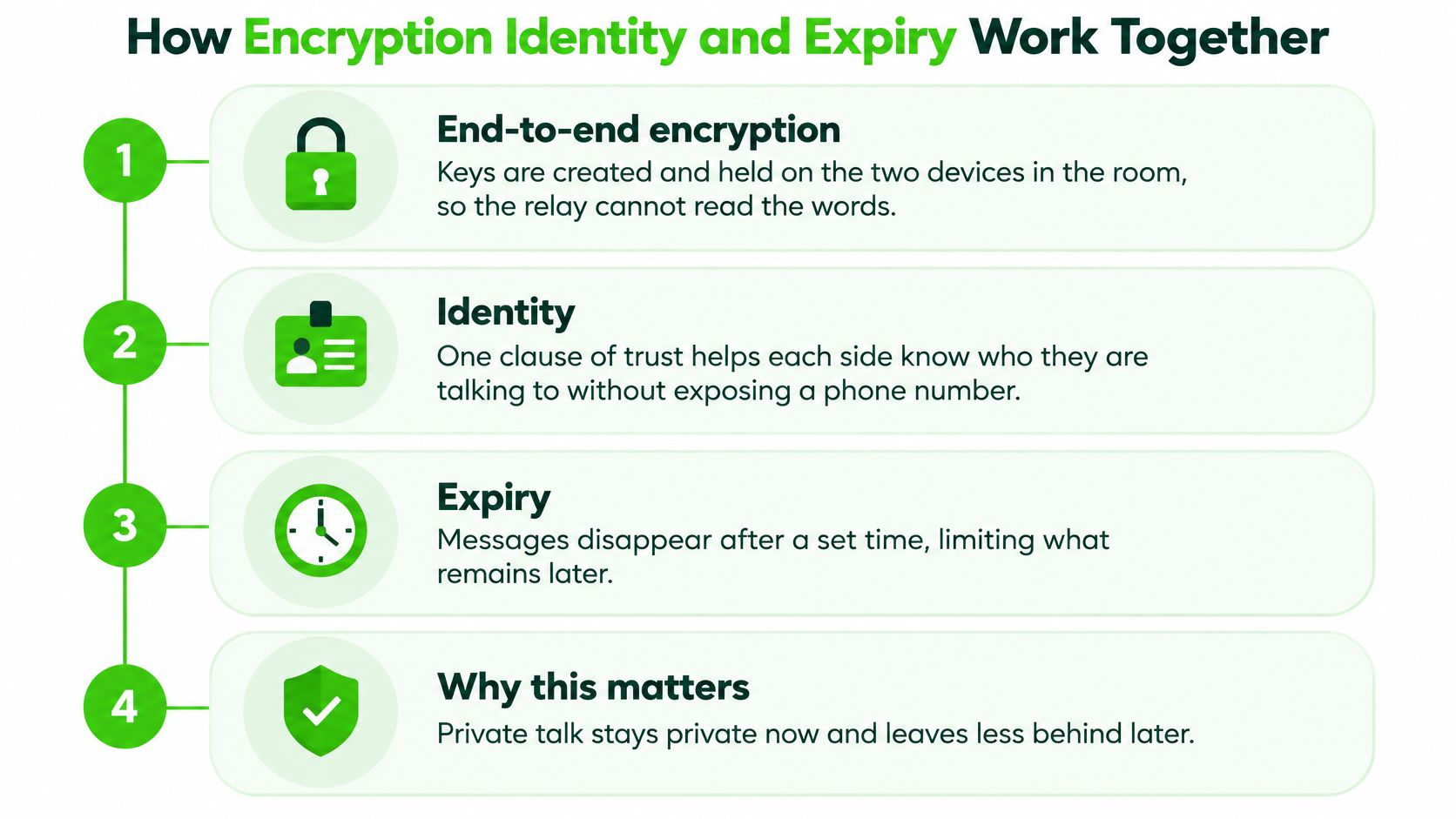
How Encryption Identity and Expiry Work Together
Suppose a reporter and a source agree to speak briefly without exchanging personal contact details. Their browsers need a way to protect the conversation, recognize possession of the shared secret, and end the session without creating a permanent inbox.
The protections fit together, but each has a different job.
Encryption protects the contents
With end-to-end encryption, the participants' devices encrypt and decrypt the conversation, rather than entrusting readable messages to the relay. In our browser flow, each participant derives the encryption key locally. The derived key stays in browser memory and is never sent to the server.
The principle became a mainstream expectation when WhatsApp announced completed default end-to-end encryption on April 5, 2016, protecting communications across a service used by more than 1 billion people. That milestone established an important boundary: the provider shouldn't possess the keys needed to read users' communications.
It didn't make account-based messaging anonymous. For another plain-language explanation of that cryptographic boundary, see end-to-end encryption explained by AONMeetings.
The relay carries a locked box
A zero-knowledge relay resembles a courier carrying a locked box without receiving its key. Our relay holds opaque ciphertext and the supporting encryption and expiry fields, including initialization vectors, authentication tags, and a channel salt. It can deliver encrypted material without reading it or handing cleartext to an employee, attacker, or court.
That promise requires correct cryptography. The Apache Iceberg GCM stream specification describes the importance of unique nonces for GCM encryption: reusing a nonce under the same key can undermine confidentiality and authentication. For a chat implementation, uniqueness must hold across messages, file chunks, replies, edits, and voice frames, including reconnects and concurrent browser tabs.
An algorithm name isn't evidence that every implementation detail is correct. Developers must test nonce handling and authenticate relevant record context, rather than relying on a deletion timer to compensate for encryption mistakes.
The video below provides another way to approach the encryption concept.
Identity and expiry answer different questions
Identity-free entry replaces a user profile with a channel link and a secret. It avoids requiring a phone number or email, but possession of the secret doesn't prove someone's real-world identity. Participants still need an appropriate way to recognize each other.
Ephemerality limits how long the relay retains the session. Our channels expire 60 minutes after creation, with no archive or recovery. This is a channel lifetime, not a fresh countdown attached to every new message.
Together, these properties restrict reading, identification, and retention. None substitutes for the others, and none gives the relay control over a recipient's independent copies.
Criteria for Choosing a Secure Anonymous Chat
| Check | Phone-number messenger | Opt-in secret chat | One-time note | Browser ephemeral room |
|---|---|---|---|---|
| Account required | Yes | Yes | No | No |
| Phone number required | Yes | Often yes | No | No |
| App install required | Yes in this pattern | Yes in this pattern | No | No |
| End-to-end encryption by default | Often yes | No, only the secret mode | Yes in the encrypted pattern | Yes in the encrypted pattern |
| Real-time back-and-forth | Yes | Yes | No, one note | Yes |
| Destruction | Optional disappearing messages | Optional | After one read | Hard expiry, about 60 minutes in our design |
| Server can read content | No, if keys stay on devices | Outside secret mode, potentially | No, if encrypted locally | No, ciphertext only |
These are design patterns, not universal claims about every app. A particular messenger might offer browser access, and a note service might implement encryption differently. Score the actual design rather than assuming the category name guarantees its behavior.
The easiest row to misread is destruction. Optional disappearing messages, deletion after a note is opened, and a channel's fixed expiry are different mechanisms. Ask what starts the clock, whether participants can change it, and what happens to attachments.
Score the design, not the word encrypted
Use this checklist to keep the practical requirements visible.
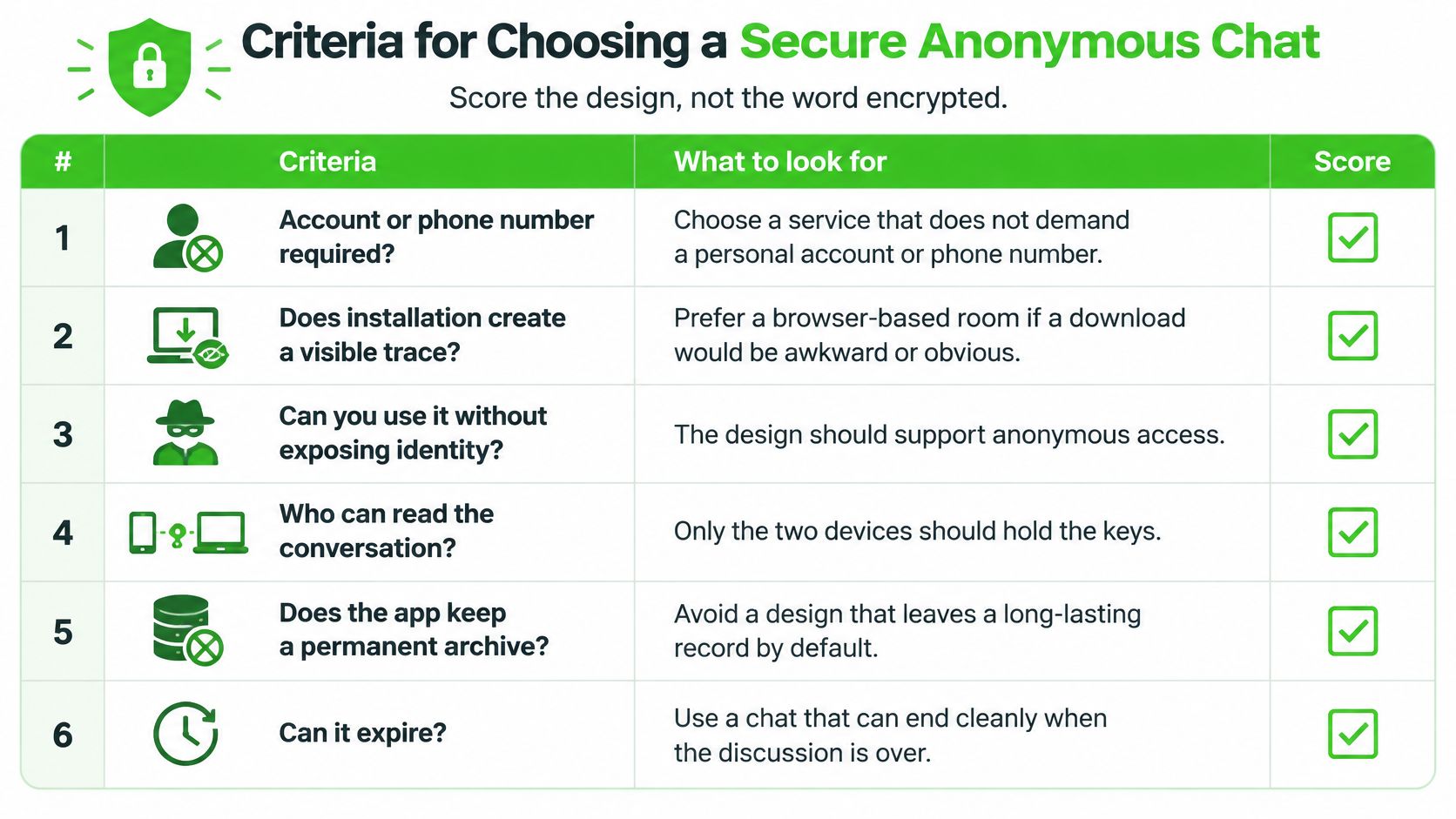
Begin with identity and installation. An account can connect a sensitive conversation to an established profile. An installed app can create a visible trace on a device, although browser access can also leave traces through history, downloads, or monitoring.
Next, distinguish default encryption from a special mode. If protection requires remembering to start a secret conversation, an ordinary thread may have different server-access rules. Then test whether you need live discussion: a note that disappears after reading can deliver a secret, but it can't replace questions and answers.
Finally, evaluate server access and retention separately. TechCrunch's coverage of WhatsApp's encryption rollout explained that the company didn't hold the keys needed to decrypt users' communications. That illustrates content protection, not proof that a service keeps no participant information, timestamps, connection records, or delivery data.
Choose the category that fits the conversation
- Daily messenger: Appropriate when participants already share contact details and need continuity.
- Opt-in secret chat: Useful for a protected thread within an existing account, provided participants select the correct mode.
- One-time note: Suitable for delivering information that doesn't require live discussion.
- Browser ephemeral room: A fit for immediate first contact without account exchange or an intended archive.
A vanishing room is the wrong category if the task requires a persistent identity, a recoverable history, or a regulated record. Don't try to turn a deliberately temporary channel into a records system through habit or screenshots.
When Journalists Lawyers and Responders Need It
Sensitive first contact often creates a practical mismatch. People need to talk now, don't want to exchange personal numbers, and can't comfortably install another app. Yet the same people may later need an accountable record of what happened.
The right distinction is temporary coordination versus information that must be preserved, not private work versus ordinary work.
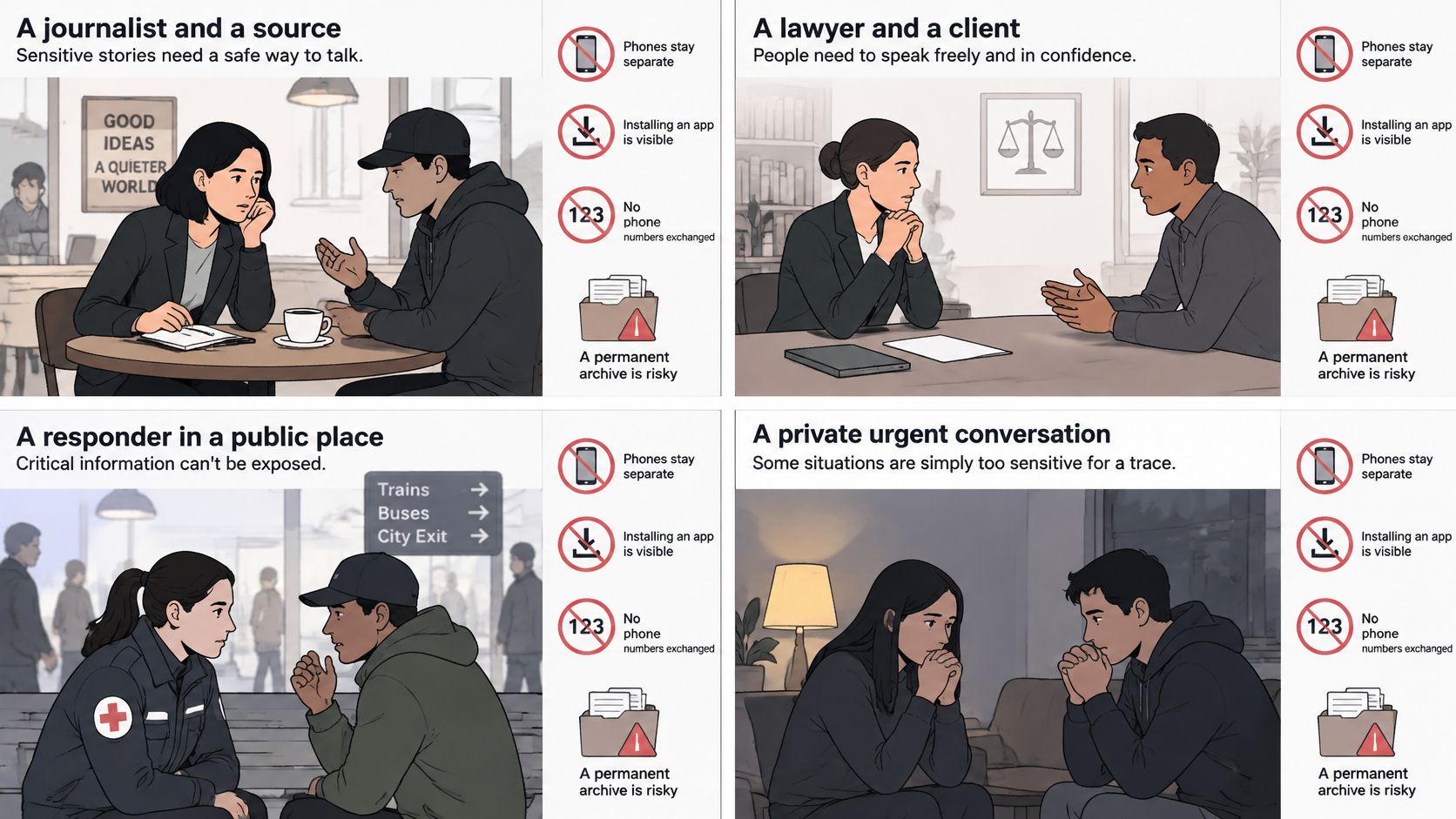
First contact without unnecessary identity exchange
A journalist receives a tip from someone who won't supply a personal number. A temporary room can support initial questions, establish what the person is offering, and agree on a safer process for any further contact. It shouldn't become the only location of material the newsroom is authorized and required to retain.
Usability matters here. A 2025 journalism survey published by the Center for News, Technology & Innovation found that only 15% of journalists used encrypted peer-to-peer messaging as their primary way to communicate with sources, despite describing it as the most secure available option. A theoretically strong tool is a poor operational choice if a source can't safely access or use it.
Our journalist source-protection guidance places the contact method within that wider safety decision. We design short exchanges for sources, anonymous tipsters, and one-off contacts who don't want to give out a phone number.
A lawyer might use a temporary conversation to assess a sensitive initial inquiry when ordinary contact channels are unsuitable. The technology doesn't itself establish privilege, verify the prospective client, or determine what the lawyer must record. Those professional decisions remain outside the room.
Coordination without losing accountability
For healthcare professionals, consider a sensitive handoff between authorized colleagues. Even when temporary coordination is permitted, essential clinical information must reach the approved clinical record. Don't use a vanishing conversation to avoid documenting care, consent, or decisions.
For security researchers and incident responders, a short channel can support a disclosure discussion or an immediate working session. But attack evidence, incident chronology, and decisions needed for later review belong in an authorized evidence or incident-management system.
Disappear the temporary coordination only when doing so won't destroy information someone has a duty to preserve.
Before starting, agree on the boundary:
- What can disappear: Initial questions, availability, and immediate coordination that need no retained record.
- What must be preserved: Required consent, clinical documentation, case information, incident evidence, and investigative chronology.
- Who may preserve it: An authorized person using an approved system, with participant knowledge and consent where appropriate.
- Where it belongs: A system governed by the relevant access controls and retention policy, not an improvised personal export.
Our service isn't a long-term messenger, group chat, file storage service, or collaboration tool. A short anonymous conversation can reduce unnecessary exposure, but it isn't a substitute for professional records management.
How to Run a Short Anonymous Conversation Safely
Choose the key rule before opening the room: use a high-entropy randomly generated access key, and keep the readable channel name separate from the secret. A memorable room name is a navigation aid, not a password.
Also prepare the device. Use one you control, disable notification and link previews where possible, and avoid copying secrets into synced notes. Agree not to screenshot the thread or create an unnecessary transcript.
The visual below summarizes the workflow. Keep the access key separate from the room link when distributing them.
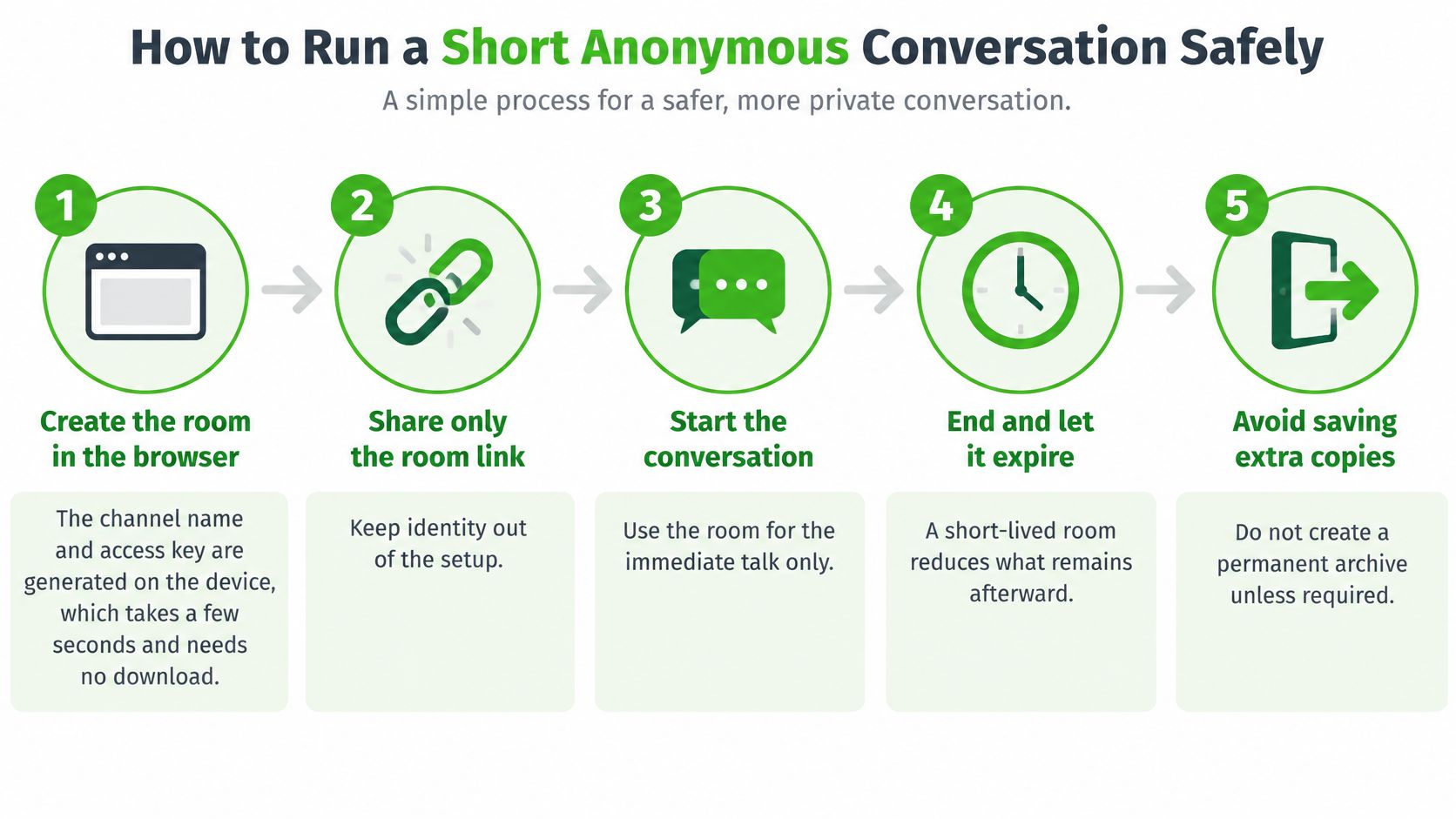
Create, verify, converse, and leave
Create the room in the browser. Click Initialize Secure Channel. The browser generates the channel name and random access key locally, without a download or account. Keep the generated secret rather than replacing it with a familiar password.
Deliver the credentials carefully. Share the link and access key over a separate trusted medium, preferably keeping the secret off the route used for the link. Don't put both into a public post or identifiable email thread. Our guide to out-of-band key exchange explains how to separate delivery routes without mistaking separation for trust.
Have the recipient open the link and paste the key. They don't need an account. Admission requires their browser to derive the same key and successfully decrypt the channel's test blob; a failed decryption means they don't enter. This checks secret possession, not personal identity.
Confirm who's present. Use a pre-agreed detail through an appropriate verification method. Don't use the access key itself as the identity check, because someone who intercepted it could repeat it.
Send only what the immediate conversation needs. Remove unnecessary identifiers from what you type and inspect attachments before sending. Treat files as part of the temporary session, not as documents you can retrieve later.
Burn the room when the conversation ends or something looks wrong. A stranger, an unexpected access alert, or suspected credential exposure is a reason to stop. Otherwise, allow the hard expiry to end the session.
An alert is a cue to act, not proof that an attacker has been contained.
Our access controls rate-limit failed guesses and surface failed attempts through in-channel notices. They don't make a weak secret strong or prove that every successful entrant is the intended person.
Keep the ritual short and deliberate. The room is for completing an immediate exchange, not gradually growing into an ongoing relationship.
Limits a Self Destruct Timer Cannot Fix
A correctly implemented room can prevent the relay from reading the conversation and remove its session data at expiry. That's a narrower promise than total anonymity, and a deletion clock doesn't strengthen a weak access key.
The important distinction is between online guessing, which a server can limit, and offline guessing, which happens against captured encrypted material. An attacker with the channel salt and ciphertext may be able to test candidate secrets without contacting the service.
Key stretching slows guesses but doesn't create entropy
Our browser-side key derivation uses PBKDF2-HMAC-SHA-256 at 100,000 iterations, with a per-channel salt. The salt prevents reusable precomputed rainbow-table attacks and requires attackers to process channels independently. The iteration cost makes each candidate key more expensive to test.
For comparison, the OWASP Password Storage Cheat Sheet recommends 600,000 iterations for PBKDF2-HMAC-SHA-256 when PBKDF2 is required for FIPS-oriented deployments. Our setting is below that benchmark and should be understood as a compatibility and performance trade-off, not a high-cost password-hardening profile.
The practical consequence is straightforward: keep the generated random secret. A long, unpredictable access key can resist guessing despite a lower work factor; a short human phrase or reused password gives an attacker a much smaller search space.
- For participants: Don't substitute a familiar password or derive the secret from the room name.
- For operators: Rate-limit online attempts, while recognizing that those controls don't constrain offline attacks.
- For implementers: Evaluate a higher work factor after measuring worst-case mobile-browser latency, rather than choosing an iteration count without usability testing.
Expiry limits disclosure, not every source of evidence
In response to lawful process, our operator can provide only encrypted blobs that expire on the session's clock, because we hold no plaintext, keys, or message history. That describes what the operator possesses, not what another participant, a device owner, or a separate communication service might possess.
Don't infer that deletion creates legal deniability or that encrypted storage makes an investigation impossible. Our published security model and privacy policy document weaknesses; use them to evaluate assumptions before handling a sensitive exchange.
The honest promise is limited server knowledge and limited retention. It isn't control over every person or device involved.
Open a Channel Only for the Hour You Need
Yes, use a temporary room when participants don't want to exchange phone numbers, need live discussion, and have no reason to keep a conversation archive. That combination calls for a different tool from the messenger you use for everyday relationships.
No, don't use it as a team workspace, long-term file store, or the sole home of a record a lawyer, clinician, journalist, or investigator must preserve. If continuity matters more than disappearance, choose an approved system built for continuity.
Make the final check concrete
Before opening the room, confirm that both people can use suitable devices, receive the secret safely, and agree on what may disappear. If your primary concern is employer monitoring or a compromised endpoint, address that condition first rather than assuming another chat interface will solve it.
Ciphar runs entirely in the browser as a zero-knowledge encrypted chat application. Every message, file, reply, and voice frame is encrypted locally with AES-256-GCM before reaching the network; optional voice uses an end-to-end encrypted WebSocket relay keyed from the channel secret, without service recordings or transcripts.
Starting with Initialize Secure Channel takes about three seconds. Read the public security model and use-case guidance before relying on the room for a high-risk exchange, then deliver the credentials through your agreed trusted route.
Burning the channel or letting it expire ends the relay's session, not copies somebody already made. Open it for the conversation that should finish today, with a clear agreement about what, if anything, must survive elsewhere.
Ciphar offers browser-based encrypted conversations without an account, phone number, or installation, with a fixed expiry rather than a permanent inbox. Visit Ciphar, review the security model, and initialize a channel when you need a short, identity-free exchange rather than a lasting archive.