What can an anonymous voice chat app protect, and what can't it protect? Client-side AES-256-GCM encryption can hide conversation content from the relay, but your voice, the recipient, and the endpoint remain inside the threat boundary.
You're preparing to speak with someone who shouldn't need your phone number: a confidential source, a prospective client, or a researcher coordinating a sensitive disclosure. A temporary browser room looks convenient, but the decision isn't merely whether the app says it's anonymous. You need to know which party could identify you, access the conversation, or preserve it after you leave.
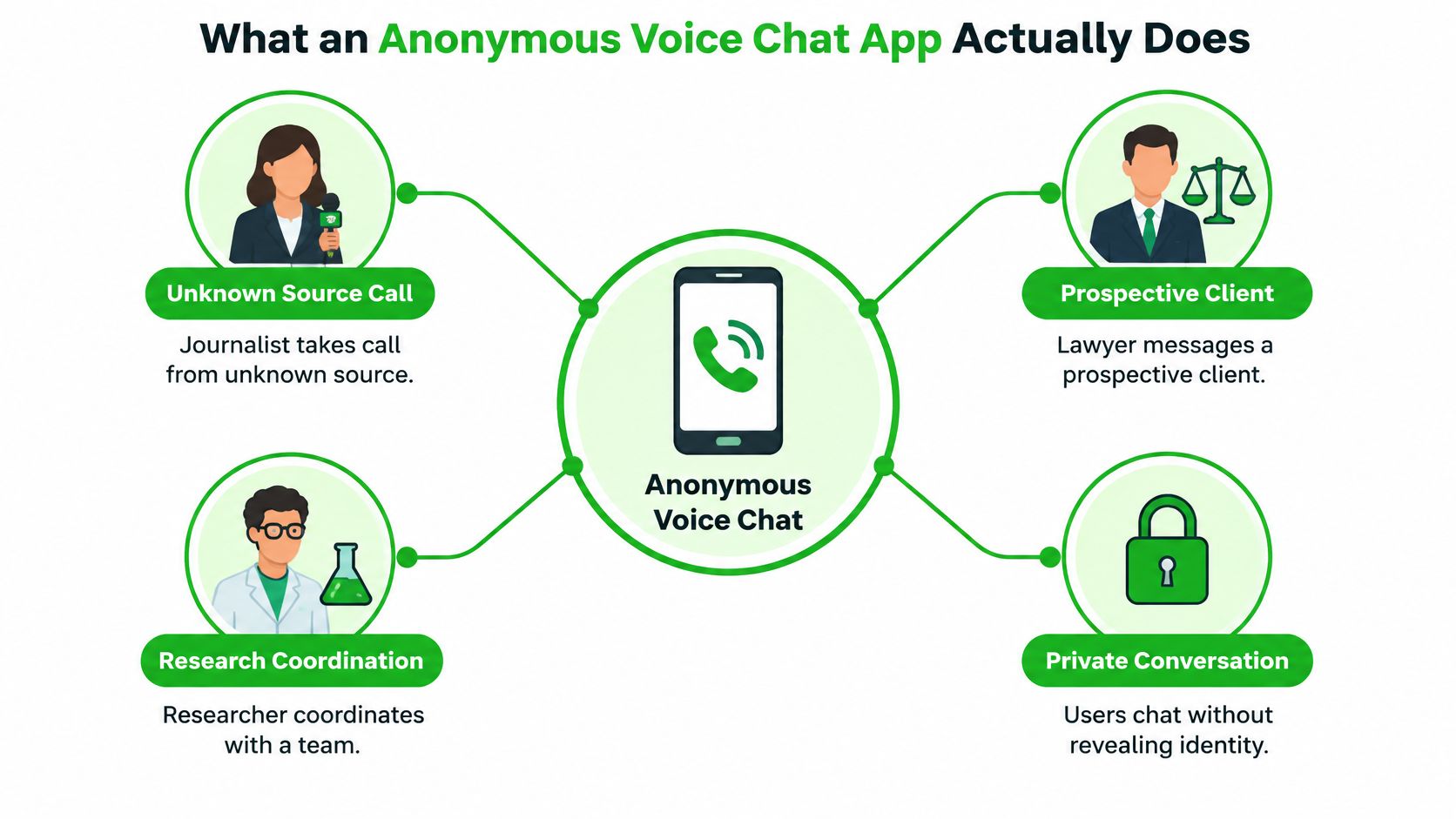
What an Anonymous Voice Chat App Actually Does
A journalist sends a prospective source a temporary channel invitation. The source opens it without registering, enters an access key, and starts speaking. Neither person has exchanged a phone number, but that alone doesn't establish that the conversation is anonymous.
Treat this as a hypothetical first-contact workflow, not a guarantee. The app may avoid collecting account identity while the source mentions a distinctive job responsibility or speaks within earshot of an identifiable announcement. The journalist might recognize the voice, and either participant could preserve the conversation independently.
The same access pattern can serve several professional situations.
Start with the adversary
For the journalist, the concern might be an operator retaining recoverable audio. For the source, it might be the journalist learning their identity. Those are different problems, and a single privacy label can obscure the difference.
Before choosing a room, identify what you're trying to prevent:
- Identity exchange: Must participants avoid providing account details to the service or each other?
- Content disclosure: Must the infrastructure remain unable to understand the conversation?
- Association disclosure: Would evidence that the devices connected be sensitive?
- Recipient misuse: What happens if the person listening isn't trustworthy?
Practical rule: Evaluate anonymity against a named observer, not against an adjective on a product page.
Define the job narrowly
An anonymous voice chat app is most useful as a way to reduce unnecessary identity exchange and retained conversation data. It isn't a substitute for deciding whom to trust, what to disclose, or whether speaking is appropriate.
For lawyers and healthcare professionals, that distinction also prevents a category error: a private room doesn't automatically satisfy professional recordkeeping or regulated-communications requirements. Choose the workflow around those obligations rather than assuming encryption resolves them.
The useful promise is limited exposure with explicit trust boundaries. Anything broader needs an explanation of how the system handles identity, transport, servers, and devices independently.
The Four Layers Behind Anonymous Voice Chat
Consider a channel invitation sent through an existing contact route, with its access key verified separately. The invitation locates the room; the key authorizes access to its content. Neither tells you what the service records or what happens after the listener's browser decrypts audio.
Evaluate those properties separately.
The Four Layers of Anonymous Voice Chat
| Layer | Core question | What it protects | Evaluation cue |
|---|---|---|---|
| Identity | What must I disclose to join? | Limits account-linked identity exposure | Account, email, phone number, and persistent-handle requirements |
| Transport | Where does content become readable? | Protects audio between participant devices | Client-side encryption and documented key handling |
| Server | What can the operator observe or retain? | Limits infrastructure-side disclosure | Ciphertext storage, connection logging, retention, and telemetry policies |
| Endpoint | Who can access decrypted audio? | Depends on device and participant controls | Browser integrity, microphone permissions, local capture, and device trust |
Identity-free access means the joining process doesn't require identifying credentials. It says nothing by itself about whether audio reaches a server in readable form. Conversely, strong content encryption doesn't remove the identifying information a registration process already collected.
The transport layer answers another question: does encryption end at the operator's infrastructure or at the intended listener's device? A product advertising an encrypted connection needs to make that boundary explicit. Don't infer end-to-end confidentiality from a lock icon.
Separate observation from retention
At the server layer, distinguish what infrastructure must process to route traffic from what the operator chooses to retain. A ciphertext-only relay can still observe connections while they occur. A no-telemetry claim should therefore be checked alongside operational logging and retention policies, not treated as proof that infrastructure observes nothing.
At the endpoint layer, the listener must eventually receive usable audio. That is an intentional disclosure to the participant, not a cryptographic failure.
Use a separate assessment for each layer:
- Pass the identity requirement only if joining avoids the identifiers your threat model excludes.
- Pass the content requirement only if key handling keeps the relay outside the decryption boundary.
- Pass the server requirement only if the metadata policy matches your exposure tolerance.
- Pass the endpoint requirement only if the devices and participants are suitable for the conversation.
A strong result in one row doesn't cancel a failure in another. That's why a meaningful assessment needs more than a list of privacy features.
How Encrypted Voice Frames Actually Travel
Follow a spoken sentence through a proposed browser implementation. The microphone captures audio, the client encodes it, and the application encrypts each encoded frame before handing it to the relay. The receiver authenticates and decrypts accepted frames before decoding them for playback.
The important boundary is encryption before relay access, as illustrated below.
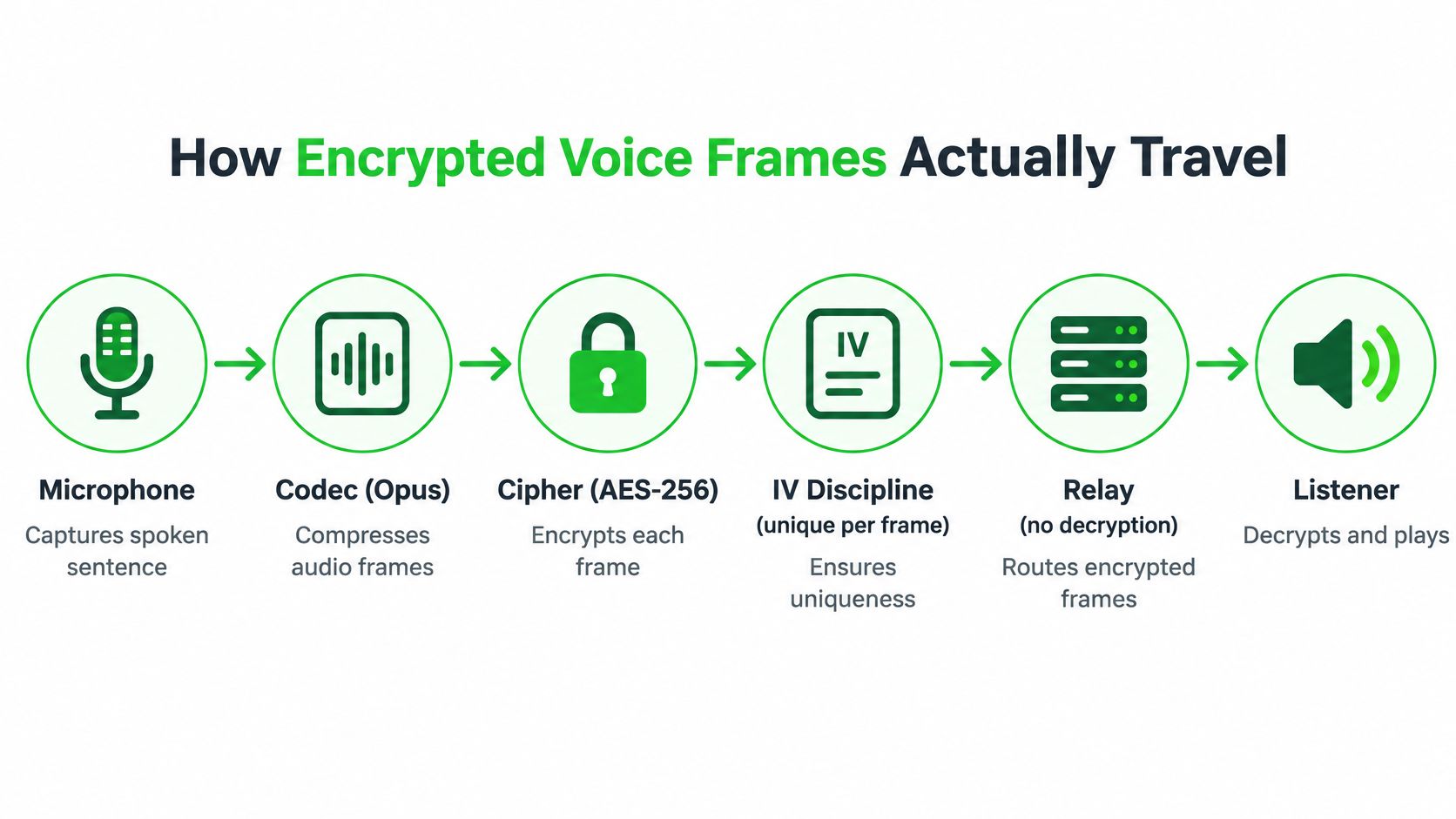
Encoding and encryption solve different problems
Opus is suitable for interactive browser audio: its codec latency can range from approximately 5 ms to 66.5 ms, compared with at least 100 ms for several alternative general-purpose codecs, as detailed in MDN's audio codec guidance. These are codec figures, not promises about microphone-to-speaker delay. Network conditions, buffering, and application scheduling still matter.
The cipher has a separate job. AES-GCM produces ciphertext plus an authentication tag, allowing the receiver to detect tampering as well as conceal content. Selected non-secret fields, such as the channel identifier and frame sequence, should be authenticated as additional data.
The implementation must enforce unique key/IV pairs. A sequence-based nonce construction needs to account for reconnects, restarts, and multiple senders sharing a channel; a counter that resets isn't sufficient.
- Authenticate routing context: Bind frames to their intended channel and sequence.
- Define replay handling: Reject duplicates and handle reordered frames according to an explicit policy.
- Fail without detail leakage: Discard invalid frames without exposing useful decryption-oracle responses.
Keep the relay's role precise
In a ciphertext-only design, the relay forwards opaque frames and may retain ciphertext, IVs, authentication tags, channel salt, and expiry information. Without the key, it can't decrypt or transcribe the conversation. It can attempt to resend captured frames, however, so replay rejection belongs at the receiver, not in a promise that the server won't replay them.
The encrypted voice chat implementation discussion provides additional context for this browser-side boundary.
Use the accompanying video as a visual supplement to that frame-processing model.
This design doesn't cover browser memory, compromised JavaScript delivery, a compromised endpoint, or traffic metadata. Those exclusions belong in the security model, not hidden behind the cipher's name.
The Safety Trade-Off That Privacy Guides Skip
No recording is a retention policy, not a complete safety strategy. Removing stored audio limits what someone can later recover from the service, but it also removes evidence that could help investigate harassment, impersonation, or threats.
The problem is especially difficult in live conversation. ADL's discussion of voice-chat moderation describes limitations in voice moderation and the difficulty of acquiring evidence from ephemeral exchanges. Without reviewable material, moderators may have to weigh conflicting accounts with little context.
The privacy benefit is real, but the visual contrast below shouldn't be read as proof that ephemeral conversations are always safer.
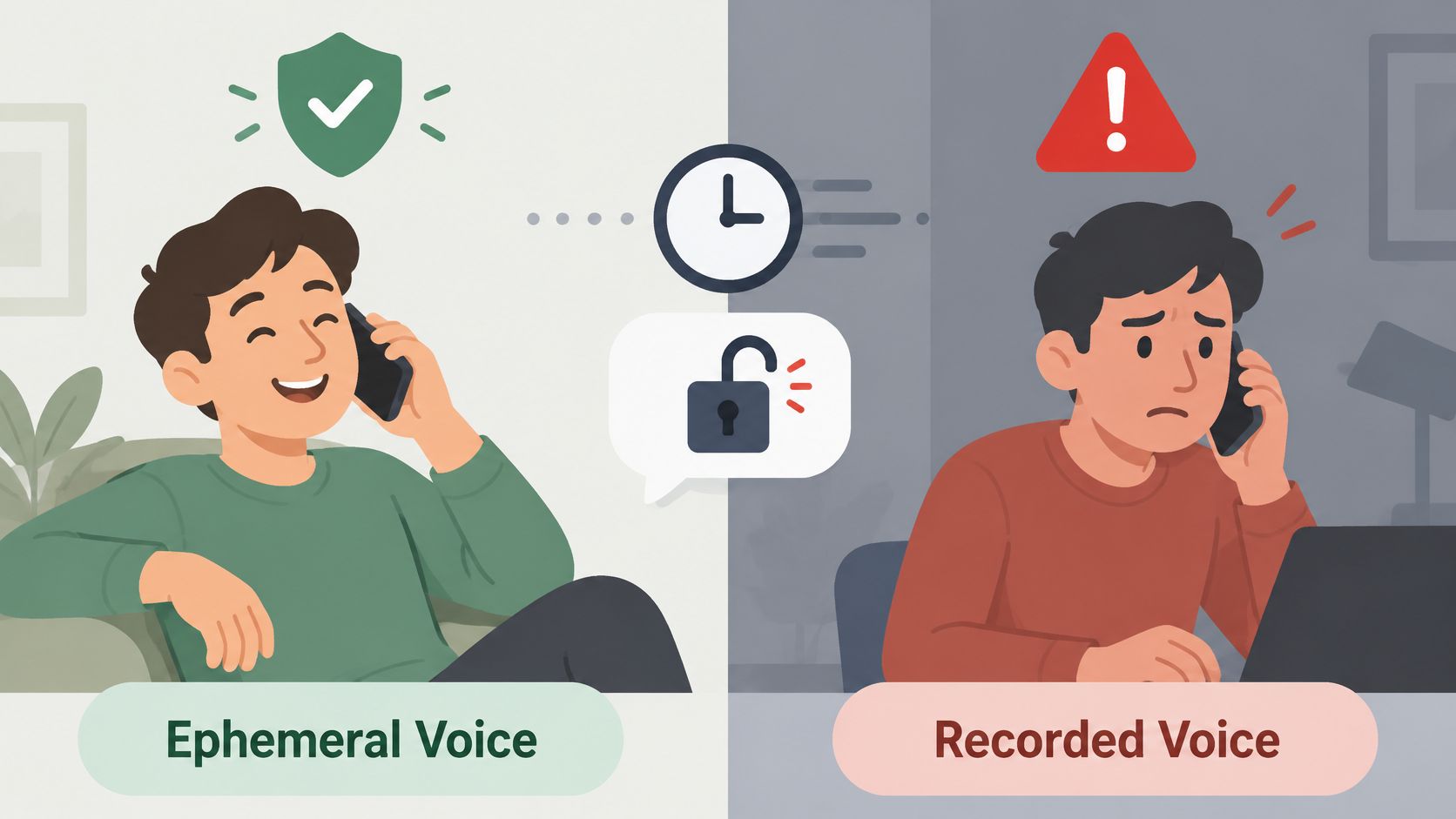
Decide what happens during an incident
A privacy-first service should explain what participants can do while harm is happening, not merely promise that nothing remains afterward. Controls should match the audience and disclose any additional data they create.
Possible designs include:
- Immediate channel burn: Give participants a clear exit and termination control, while explaining its limits outside the service.
- Visible access-failure alerts: Surface attempted unauthorized entry without claiming that every failed attempt proves an intrusion.
- Rate limits: Constrain repeated access attempts without treating throttling as a replacement for strong keys.
- Participant-generated incident reports: Permit a structured account of events, with signatures establishing authorship rather than proving the allegation.
- Emergency capture: Where appropriate, offer explicit participant-controlled preservation with clear consent, access, and retention rules.
These are design choices, not features every private room necessarily provides. Emergency capture, in particular, changes the retention promise and needs careful treatment.
Accountability has a privacy cost
Server-side analysis of intelligible live audio conflicts with a design that excludes the server from content access. A vendor claiming both needs to explain where analysis happens and who can inspect its output.
Maximum ephemerality is not maximum safety. It reduces retained evidence for attackers and investigators alike.
For sensitive professional conversations, agree on an incident response before joining. Decide whether to terminate, preserve an authorized report, or escalate through an established organizational process. Don't discover the evidence policy after something goes wrong.
Relay, Peer-to-Peer, and Hybrid Voice Architectures
Where media travels determines which parties become network observers. It doesn't determine whether content encryption is end-to-end: direct and relayed designs both need a separate answer to that question.
Compare candidate architectures as engineering choices, not as privacy rankings. In particular, don't accept claims that a direct path is automatically faster or that a relay is automatically anonymous. Actual routing and configuration matter.
Voice Transport Architectures Compared
| Architecture | Typical latency | Server metadata exposure | NAT friendliness | Fit for anonymity |
|---|---|---|---|---|
| Relay | Depends on relay placement and buffering | Relay observes media connections | Often simpler through an outbound connection | Useful when avoiding direct peer address exposure |
| Peer-to-peer | Potentially shorter path, not guaranteed | Media can bypass the application relay | Direct connectivity may require traversal or fallback | Requires scrutiny of peer-visible network details |
| Hybrid | Depends on the negotiated media path | Signaling remains server-visible | Depends on traversal and relay fallback | Conditional on actual routing and endpoint trust |
These are qualitative design expectations, not measured performance claims. Ask a provider which path its browser client uses, including what happens when a direct connection fails.
Choose by observer, not topology
A relay gives the operator a routing role. With client-side content encryption, that role needn't include access to intelligible audio, but connection metadata remains a separate concern. The explanation of a relay server is useful background when examining that distinction.
A direct media design removes the application relay from the media path, but it can expose network addressing information between peers. If protecting participants from each other is a requirement, demand an explanation of address exposure rather than accepting “serverless” as sufficient.
A hybrid design commonly separates signaling from the eventual media path. Its privacy properties depend on which route is selected, not the hybrid label. A fallback can also change the set of parties observing traffic.
Architecture decision: Prefer the route that excludes the observer you're concerned about, then inspect the observers it leaves behind.
For confidential first contact, a documented relay-only policy can be easier to reason about than opportunistic direct media. For established collaborators who already trust each other's network visibility, a direct path may be acceptable. Neither choice removes the need to inspect encryption, retention, and endpoint behavior.
How to Evaluate an Anonymous Voice Chat App
Start with a written acceptance condition: what information must remain unavailable, to whom, and after what event? A practical threat-model explanation helps turn “I want privacy” into requirements you can test.
Use the checklist below to organize the review, but require evidence behind each checkbox.
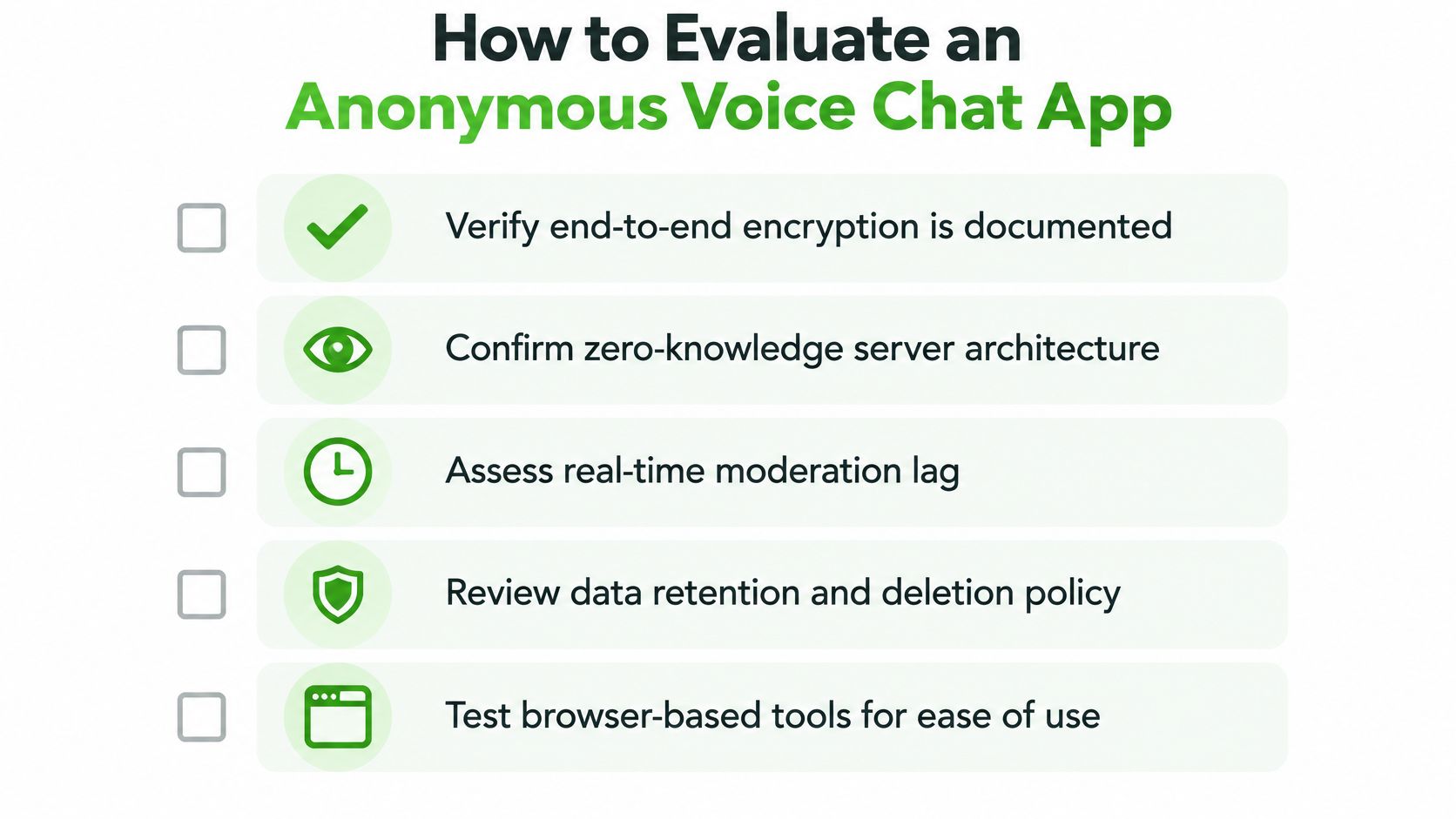
Inspect key derivation rather than cipher branding
A memorable access key can undermine an otherwise sound cipher. OWASP lists 600,000 or more PBKDF2-HMAC-SHA-256 iterations for its FIPS-oriented PBKDF2 guidance, making 100,000 iterations a comparatively lower work factor, according to its password storage recommendations.
A unique per-channel salt prevents identical passwords from producing identical derived keys, but it doesn't add entropy to a weak password. Online throttling and encrypted test-blob verification don't solve offline guessing if an attacker obtains the necessary salt and ciphertext. Prefer generated high-entropy access keys, and benchmark derivation on the browsers participants will use.
Ask for operational evidence
A decision-grade review should include:
- Joining requirements: Test whether account, email, phone, or installation requirements appear anywhere in the flow.
- Cryptographic documentation: Inspect codec choice, key derivation, salt generation, nonce allocation, and authenticated failure handling.
- Server inventory: Request a precise description of stored application data, operational logs, backups, and deletion behavior.
- Device behavior: Check microphone permissions, reconnect handling, decrypted-frame processing, and what persists after closing the room.
- Abuse response: Test alerts and exit controls without assuming they provide moderation or incident evidence.
Test on representative mobile and desktop devices rather than a developer's preferred machine alone. If you're choosing handsets for that exercise, you can find phone comparisons through NeoTeo, then validate the actual browser workflow yourself; hardware comparisons aren't security assessments.
Finally, require a deletion scope. Expiry should specify what the service removes and when, without implying it can erase participant-controlled devices. Reject vague answers where a requirement is essential.
Running an Anonymous Voice Chat Session Safely
Prepare the room before sharing sensitive information. Open it on a device you trust, check microphone permissions, and confirm the application's expiry and termination controls. Use a separate, already trusted route to deliver or verify the access key.
Agree on a simple session procedure:
- Initialize deliberately: Confirm the intended participant has joined before discussing sensitive material.
- Watch access signals: Treat unexpected failures or joins as reasons to pause and verify.
- Limit disclosure: Share what the task requires, not a complete personal or organizational history.
- Terminate decisively: Use manual burn when access looks wrong, rather than continuing while investigating.
Treat speech as identifying material
Your voice can disclose more than the words you intend to share. Vocal characteristics, accent, background sounds, and personal anecdotes can identify a speaker, and a participant can capture audio using a separate device despite an app's no-recording policy, as discussed in this anonymous voice privacy analysis.
Choose a quiet setting without distinctive announcements or nearby conversations. Avoid unnecessary identifying stories, and don't assume a pseudonym prevents recognition.
At the end, terminate the channel or allow its documented expiry to run. Check that termination prevents further access, while remembering that service-side deletion applies only within the service's control. The defensible outcome is a conversation with deliberately limited exposure, not a claim that no trace can exist.
Ciphar offers browser-based, identity-free conversations with client-side encrypted voice rooms and temporary channels, without requiring an account or installation. Visit Ciphar to review its security model and test the joining, access-alert, and burn workflow with nonsensitive material before using it for confidential first contact.