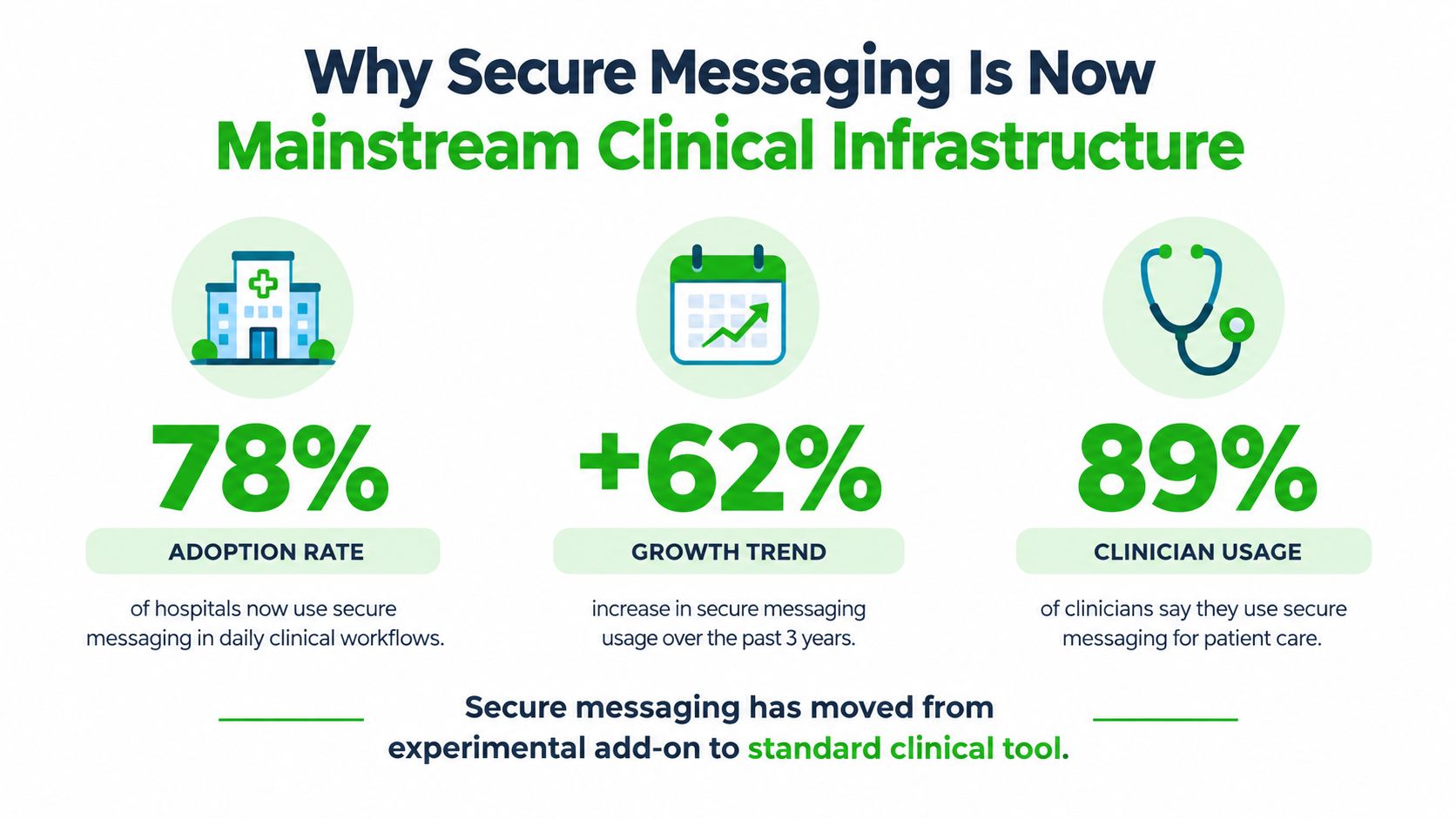
Secure messaging for healthcare is now mainstream clinical infrastructure, not a niche tool. A 2024 study of 33,195 healthcare professionals across 14 hospitals found 62% actively used secure messaging, with 66% adoption among inpatient staff.
That scale changes the job. A tool used by most of a unit isn't an optional add-on you evaluate on encryption features alone. It's infrastructure for handoffs, consults, escalation, and accountability, and it fails in the same places other infrastructure fails, through overload, unclear ownership, and records that don't survive the shift.
Why Secure Messaging Is Now Mainstream Clinical Infrastructure
On a busy inpatient unit, the phone doesn't stop. A nurse needs a dose clarified, a consultant needs context that isn't in the chart, a bed manager needs a discharge decision, and none of them can wait for a callback chain through a switchboard. That's the gap secure messaging filled, not by replacing the EHR, but by giving clinicians a fast, documented way to coordinate around it.
The adoption data confirms that shift, in a 2024 study of 33,195 professionals across 14 hospitals, 800 inpatient units, 263 outpatient locations, and 1,055 outpatient clinical units. Overall 20,576 professionals, or 62%, used secure messaging. Inpatient adoption reached 66% (13,688 of 20,795), compared with 56% (6,888 of 12,400) among outpatient professionals.
What the Variation Tells You
Usage wasn't confined to a few enthusiastic units. 65% of inpatient units and 62% of outpatient units had more than half their professionals using the channel, per the same study. Clinical unit characteristics explained 25.3% of variation in use, while hospital or clinic location explained another 30.5%.
Read that as an implementation signal. Local workflow, staffing patterns, and rollout choices shape adoption more than a feature checklist does. A unit that routes consults through messaging will live in it. A clinic that still expects phone callbacks won't, no matter how strong the cryptography is.
The inpatient and outpatient gap matters for design, too. Inpatient work is interrupt-driven and time-critical. Outpatient work is scheduled, queue-based, and often asynchronous. One inbox model doesn't serve both well, so routing, urgency labels, and expectations for response time have to differ by setting.
If you're building a procurement case, frame it in those operational terms. Teams comparing options will find practical selection criteria in this secure messaging platform guide, which is useful background alongside your own workflow mapping. You're not buying privacy in the abstract. You're buying a coordination layer that most of your staff will treat as authoritative, so it has to carry the same reliability expectations as paging and the chart itself.
The Regulatory Floor HIPAA HITECH GDPR and PDPA Actually Require
Regulatory language sounds abstract until you translate it into controls. HIPAA asks for safeguards around protected health information, HITECH sharpens breach notification consequences, GDPR treats health data as a special category requiring heightened protection, and PDPA-style regimes impose comparable duties around consent, purpose, and security. Different statutes, same operational floor.
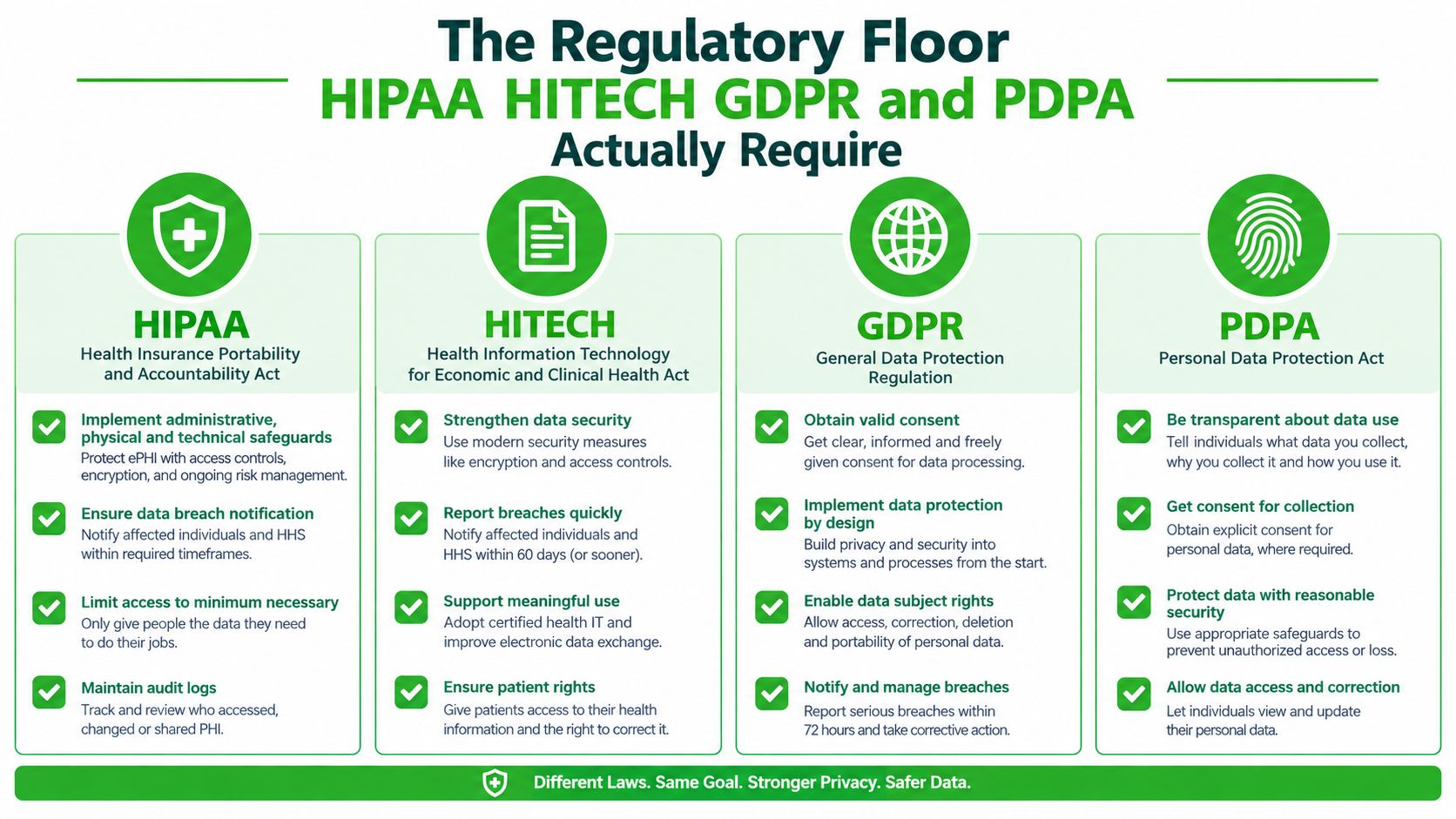
Start with what the technical guidance specifies. NIST identifies TLS as the primary protocol for protecting information traversing the Internet and states that encryption can render protected health information unusable, unreadable, or indecipherable to unauthorized individuals. NIST healthcare guidance also recommends encrypting stored patient information and using strong authentication whenever a patient, clinician, administrator, device, or health-record system accesses the data.
The Control Set That Satisfies the Floor
Translate that into procurement language and you get a short, testable list.
- Encryption in transit and at rest: Transport protection alone doesn't cover cached messages, attachments, backups, or server disks. Require both, and ask where keys live.
- Minimum-necessary access: Role-based permissions should limit who can read, search, and export conversations, not just who can log in.
- Audit logging: You need a record of access and administrative actions that survives long enough to support an investigation.
- Retention limits: Define how long messages persist, where record-worthy content goes, and how deletion is enforced.
- Breach response path: Document who is notified, how exposure is scoped, and what evidence the vendor can produce.
A deeper primer on these duties is available in our overview of healthcare data protection obligations and controls. Use it as a translation layer for compliance counsel, not as legal advice. Counsel decides how the rules apply to your jurisdiction and contracts. IT decides whether the product can enforce them.
The following walkthrough illustrates how those safeguards fit together in a clinical deployment.
One caution matters more than vendors admit. Encryption reduces breach impact, but it doesn't by itself establish compliance. Access governance, risk analysis, auditability, retention, and contractual obligations, including a business associate agreement where required, still determine whether your program holds up.
Practical rule: If a vendor can't show you where keys are stored, who can export logs, and how retention is enforced, you don't have a compliance story. You have a marketing claim.
Encryption Choices Compared End-to-End Client-Side and Transport Only
Encryption isn't one control. It's three different trust models, and picking the wrong one creates either unnecessary friction or a false sense of safety. The question isn't whether a product encrypts. It's who holds the key, and what that means when a server, device, or account is compromised.
Transport-only encryption protects data between device and server, typically with TLS. Once the message lands, the server can read it. Server-managed encryption at rest protects stored disks, but the operator still controls the keys. Client-side encryption encrypts content on the device before transmission, so the relay stores only ciphertext and can't inspect message content.
Encryption Models for Healthcare Messaging Compared
| Model | Keys held by | Protects at-rest content | Fits retained clinical record | Fits ephemeral coordination |
|---|---|---|---|---|
| Transport only | Server operator | No, server reads plaintext | Yes, with access controls | Weakly |
| Server-managed at rest | Server operator | Against disk theft only | Yes | Weakly |
| Client-side end-to-end | Participants' devices | Yes, relay stores ciphertext | Only with governed export | Yes |
For browser-based channels, the defensible pattern pairs modern TLS for the relay connection with client-side authenticated encryption such as AES-GCM, keeping key material outside the server's data path. Otherwise a database compromise can expose both the encrypted records and the means to decrypt them. Our explainer on how end-to-end encryption works in practice covers the mechanics behind that separation.
Key exchange is a separate problem from message encryption, and teams routinely conflate them. HHS 405(d) guidance recommends a separate secured communication channel for exchanging a public key or decryption password, and configuring systems to accept TLS 1.2 or higher. Don't send a channel password or recovery secret in the same channel that carries the protected information.
Where Each Model Fails
Transport-only fails at rest. Server-managed encryption fails if the operator's credentials or key store are compromised. Client-side encryption fails at the endpoint, because a compromised browser or device can defeat strong cryptography, and it complicates search, retention, and recovery.
That's why browser-based client-side tools need compensating controls, including high-entropy access keys, rate limiting on join attempts, and visible alerts on failed access so participants can terminate a compromised session. Predictable, human-readable identifiers alone make online guessing too easy.
Use a simple rule. If the conversation must be retained, searched, and integrated with the record, server-managed encryption with strong access governance is usually the workable choice. If it's sensitive, short-lived, and shouldn't persist, client-side encryption is the conservative choice, provided you accept that recovery may be impossible by design.
Volume Governance and Workflow Safeguards Beyond Encryption
Encryption can be sound while the workflow is already failing. In a six-month study from July 2022 through January 2023, 32,881 healthcare users across 14 hospitals and 263 outpatient clinics sent 9,639,149 messages, median daily volume rose from 53,951 messages in the first two weeks to 69,526 in the final two, a 29% increase, and nurses, physicians, and medical assistants produced 40%, 25%, and 12% of traffic across 74 healthcare professional types.
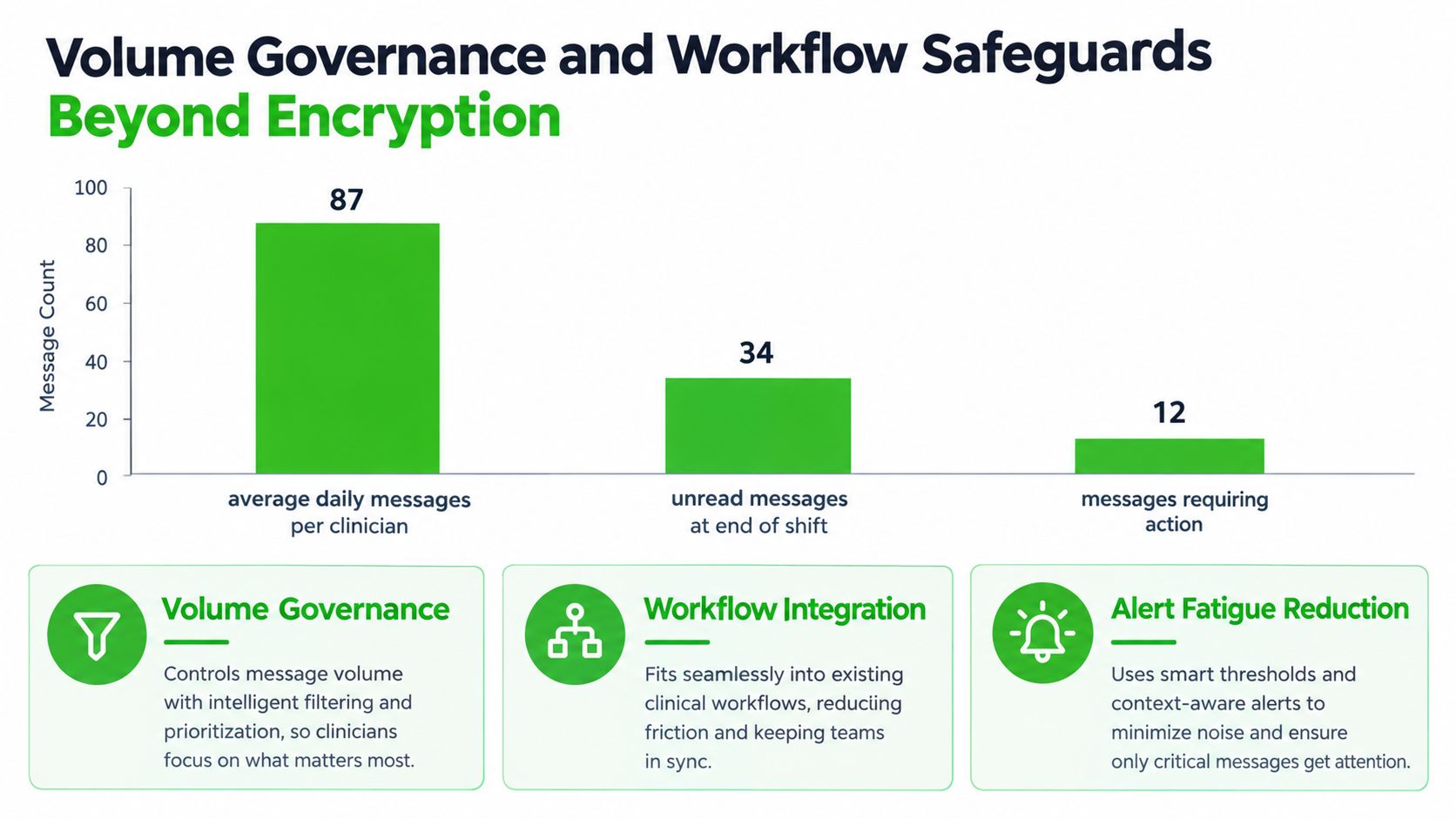
That mix is the design problem. A bedside coordinator, a consulting physician, and a logistics router should not see the same queue, hear the same alert tone, or inherit the same escalation path. The platform had been running since 2019, so this was embedded clinical work still compounding.
Evaluate products on the failure each control prevents:
| Safeguard | Failure it prevents | Practical test |
|---|---|---|
| Structured urgency tags | Routine traffic drowning stat work | Routine, urgent, and stat trigger different notification behavior |
| Role and coverage routing | Messages parked with off-shift staff | A covering clinician or team pool receives the item |
| Closed-loop acknowledgment | Assumed handoffs | The sender sees who accepted responsibility; delivery alone is insufficient |
| Patient and context confirmation | Wrong-patient action | The thread forces patient and task identification |
| Recipient verification | Sensitive content sent to the wrong party | Identity is clear before disclosure across units or organizations |
Make volume a reviewed workload metric, like paging load. When traffic climbs, the useful response is sharper triage and clearer ownership; then ask whether the item is fleeting coordination or a clinical fact that belongs in the record. More notifications only make the failure confidential and faster.
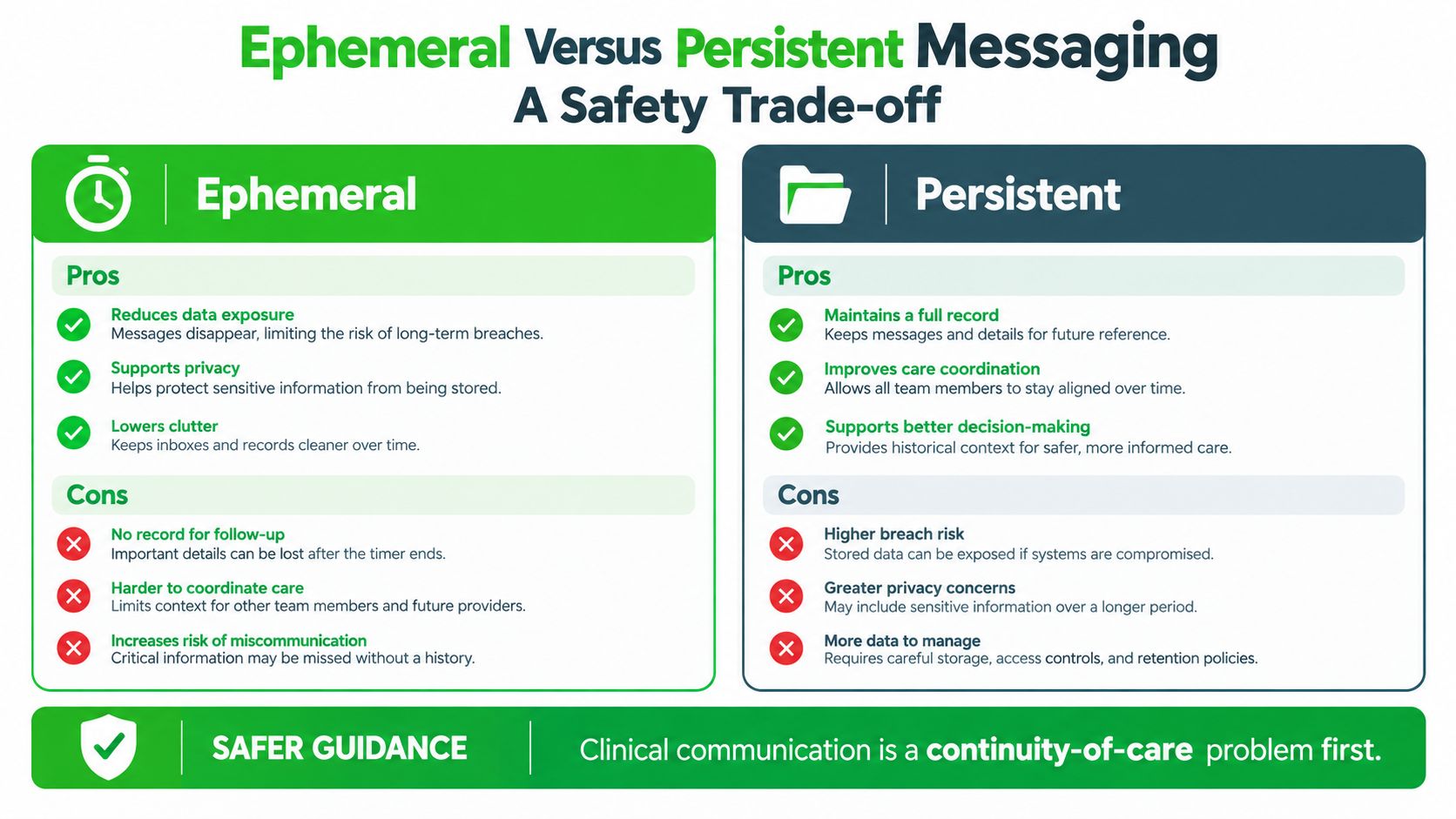
Ephemeral Versus Persistent Messaging A Safety Trade-off
Auto-delete sounds unambiguously safer. Less stored data, less breach exposure, less to subpoena. That logic holds for confidentiality, but clinical communication isn't only a confidentiality problem. It's also how the next clinician learns what happened, why a decision was made, and who agreed to act.
The workload evidence sharpens the point. A 2025 study of 3,232 clinicians covering 3.56 million secure messages found a median of 37 messages and 203 minutes of messaging per clinician per day, and handling four or more concurrent conversations was associated with 54.8 additional minutes of daily EHR time. A separate 2025 hospital survey described in the same research context found clinicians struggling with interruptions, prioritizing urgency, delayed responses, unidentified patients, and absent closed-loop communication.
When Disappearing Messages Help and When They Harm
Ephemerality helps in narrow cases. First contact with an outside party, sensitive coordination that doesn't belong in the record, and conversations where retention itself creates risk all benefit from a short-lived channel. Removing residual copies reduces the blast radius if a device or account is later compromised.
It harms when the content is record-worthy. Clinical orders, dosing decisions, consent discussions, referrals, and handoffs need attribution, recovery, and retrospective review. If that evidence vanishes, the incoming team works from memory, incident reviews stall, and accountability blurs. Stronger confidentiality paired with weaker workflow boundaries doesn't improve safety. It trades one risk for another.
The 2025 SAFER guidance on clinical communication across EHR messaging, secure text, SMS, referrals, discharges, and patient portals frames this correctly, treating electronic communication as a safety and continuity issue rather than a confidentiality checkbox. That framing should drive your policy. Reliability across clinicians, care teams, patients, and proxies comes first, and privacy controls serve that goal.
There's also a governance tension vendors rarely raise. Automatic deletion must align with legal, clinical, and retention duties. It can't replace required documentation or an approved records-management process, and it must account for discoverability, staff turnover, and accommodations for disability or language needs.
Draw the boundary in writing. Coordination channels move people toward a decision. Record channels preserve the decision and its rationale. An ephemeral tool may host the first, but anything clinically material must be transferred into the governed record before the channel expires, with a named person responsible for that transfer.
Implementation Playbook for IT and Clinical Informatics Teams
At one rollout I reviewed, the gaps showed up three months after go-live, and none of them involved cryptography. Night nurses were screenshotting threads because nobody had told them whether messages persisted, and legal could not answer a discovery question about the audit trail. The cause was sequencing: decisions that should have preceded procurement got deferred until after it.
Five moves, taken in order, prevent that pattern. Each carries a verification test, because a control nobody checks is a hope.
| Move | What it settles | How you verify |
|---|---|---|
| Write the threat model first | Who you are protecting messages from: curious insiders, lost devices, breached vendors, subpoenas, external attackers | Every stakeholder can state the top two threats in one sentence |
| Standardize out-of-band key exchange | Passwords, recovery secrets, and decryption keys travel on an independently verified channel, never beside the protected content | Join a pilot channel with a wrong key and confirm participants see the alert |
| Decide logging scope | Who can search audit trails, who can export them, how long they persist | An auditor asks who last exported a log, and you can answer |
| Map retention by message class | Which conversations are record-worthy, where the authoritative copy lives, who owns the transfer | Pull one thread at random and trace where its record copy would land |
| Train on workflow | Closed-loop acknowledgment, urgency tags, patient confirmation, the rule for moving decisions into the governed record | Drill a stat consult, a routine callback, and a wrong-recipient catch; measure whether acknowledgment happens |
Two of these deserve extra attention because they get under-specified most often. Logging scope is a real trade-off: retaining everything forever builds a liability archive, while retaining too little leaves you blind mid-incident. Our guide to governance decisions in enterprise communications walks through how to structure that choice. Retention mapping has its own trap: a channel only one employee can reach is a continuity risk, so account for turnover and discoverability, and keep the standing rule that orders, consent, handoffs, and referrals always land in a governed system before the thread expires.
Then pilot small. One unit, a named clinical owner, weekly review of volume and acknowledgment behavior. Fix routing problems there, where they are cheap, before you expand. Clinicians adopt what fits their shift, and no feature list overrides that.
Matching Scenarios to the Right Channel Type
A patient update sent over a self-destructing channel at the end of a shift looks tidy when it leaves the sender's screen and is invisible by morning rounds. Most messaging failures are matching failures: the tool behaves exactly as designed, and the job needed a different design. Map the scenario first, choose the channel posture second, and evaluate products last.
Two questions sort nearly every case. Will anyone after this conversation need the content, and does exposing who talked create more risk than the content itself? The answers split scenarios into two postures.
Persist by default. Inpatient handoff needs messaging that integrates with the EHR and survives the shift change. The incoming clinician has to recover context hours later, attribute decisions, and act without hunting through an expired thread; anything short-lived there is a safety defect rather than a privacy feature. Cross-organization second opinions belong in the same posture, with verified identities on both sides and appropriate agreements, because the exchange may influence treatment and the opinion has to reach the chart through standard workflows rather than sit in a silo. Incident response rounds out the group. During an outage or breach you want speed, but next week's post-incident review needs a reconstructable timeline, named ownership, and preserved evidence, which means ticketing-integrated chat with durable logs.
Go ephemeral only where exposure is the risk. Sensitive coordination with outside counsel or compliance is the clearest case for an identity-minimized, short-lived channel. Ciphar is one example of that posture, a browser-based channel with client-side AES-256-GCM encryption, no account or installation, and a 60-minute self-destruct window. That fits confidential first contact and source-sensitive coordination where retention itself creates risk. Orders, prescriptions, consent, and handoffs never belong there.
Patient callback sits between the two. A routine result or scheduling matter belongs in the portal or another documented channel. A sensitive first conversation where identity exposure is itself the concern can justify a more private route, provided clinically material outcomes are documented afterward.
Whatever the channel, the working discipline stays the same. State the patient, task, and urgency at the top of any thread, especially outside the EHR. One named person accepts follow-up before the conversation ends. Anything clinically significant moves into the governed record every time. Policy should state plainly that orders never ride ephemeral channels, and training should reinforce it.
Keep the portfolio small. Each additional secure-texting platform adds a routing decision clinicians have to make mid-shift, and ambiguity about where a conversation belongs pushes traffic toward personal tools. A small set of channels with clear ownership rules beats a sprawling stack.
A Five-Point Decision Checklist Before You Choose a Channel
Compress the decision into five fits. If a channel fails any one of them for the job at hand, pick a different channel, no matter how strong its encryption marketing sounds.
- Confidentiality fit: Does the encryption model match your threat model? Default, client-side encryption for sensitive short-lived coordination, governed server-side controls for retained clinical content.
- Retention fit: Does storage duration match legal and clinical duties? Default, if the next shift might need it, it isn't ephemeral.
- Identity fit: Who needs to know who's speaking? Default, verified identity for anything attributable, minimized identity only for first contact where exposure is the risk.
- Interoperability fit: Will the message reach the EHR, the portal, and the next clinician? Default, record-worthy content must land in a system others can access through standard workflows.
- Auditability fit: Can you reconstruct what happened if something goes wrong? Default, if you can't reconstruct it, don't put clinical decisions there.
For a complementary plain-language overview you can share with non-technical committee members, this secure messaging in healthcare guide covers the basics in accessible terms. Pair it with the checklist above so the conversation stays grounded in fit rather than features.
Remember the limit that matters. Zero-knowledge encryption doesn't by itself satisfy retention, audit, identity, interoperability, or clinical-record obligations. The safest programs aren't the ones with the strongest single tool. They're the ones that match each channel to the job, write the boundaries down, and train people to respect them.
If your team needs a private channel for sensitive first contact or short-lived coordination that shouldn't persist, Ciphar offers browser-based, identity-free conversations with client-side encryption and a 60-minute self-destruct window, no account or installation required. Use it for the narrow jobs it fits, keep record-worthy communication in your governed systems, and visit Ciphar to start a channel when that boundary is clear.