“End-to-end encrypted” is often treated as the final answer to a privacy question. It isn't. An end to end encrypted message can keep a provider from reading the content, yet still reveal useful information through timing, packet size, account details, backups, notifications, or a compromised device.
That distinction matters whenever a conversation could identify a source, expose privileged legal advice, reveal a patient relationship, or disclose an incident before an organization is ready to respond. Encryption is powerful, but it protects a defined boundary. Good security work starts by identifying that boundary, then examining everything outside it.
What End-to-End Encryption Actually Protects
End-to-end encryption, or E2EE, protects message content from the service provider and from intermediaries that handle the transmission. The sender's device encrypts the message before it leaves, and the recipient's device decrypts it. The provider may relay the data, but it shouldn't possess the keys required to read the plaintext.
That is very different from encryption in transit. Transport encryption protects a connection between your device and a server, but the server can generally decrypt the data after receiving it. E2EE moves the meaningful encryption boundary to the endpoints, so the relay handles ciphertext rather than readable text.
The distinction became familiar to a mass audience when WhatsApp announced on April 5, 2016 that encryption covered every form of communication on its service, including text, group chats, photos, videos, voice messages, and calls. The rollout followed its partnership with Open Whisper Systems, the organization associated with the Signal Protocol, and applied to a service with more than 1 billion users at the time, as described in this account of the WhatsApp and Signal encryption milestone.
Practical rule: Ask what the provider can read, then separately ask what the provider can observe.
What remains outside the boundary
E2EE doesn't automatically hide:
- Metadata, such as communication timing, volume, addresses, or channel activity.
- Endpoint contents, including messages visible on a compromised or infected device.
- Copies, such as screenshots, exports, notifications, and cloud backups.
- User behavior, including sending the access key to the wrong person.
- Identity, if the service requires a phone number, account, or persistent profile.
For a concise enterprise-oriented explanation of the core distinction between protected content and the wider security model, see E2EE explained for enterprises.
The right question is not just, “Is this an end to end encrypted message?” Ask instead: Which content is encrypted, where are the keys, what metadata is retained, what happens on each endpoint, and what happens after delivery? Those questions turn a reassuring label into a usable threat model.
How End-to-End Encrypted Messages Work
An end-to-end encrypted message passes through four practical stages. The names vary between products, but the security boundary should remain clear.
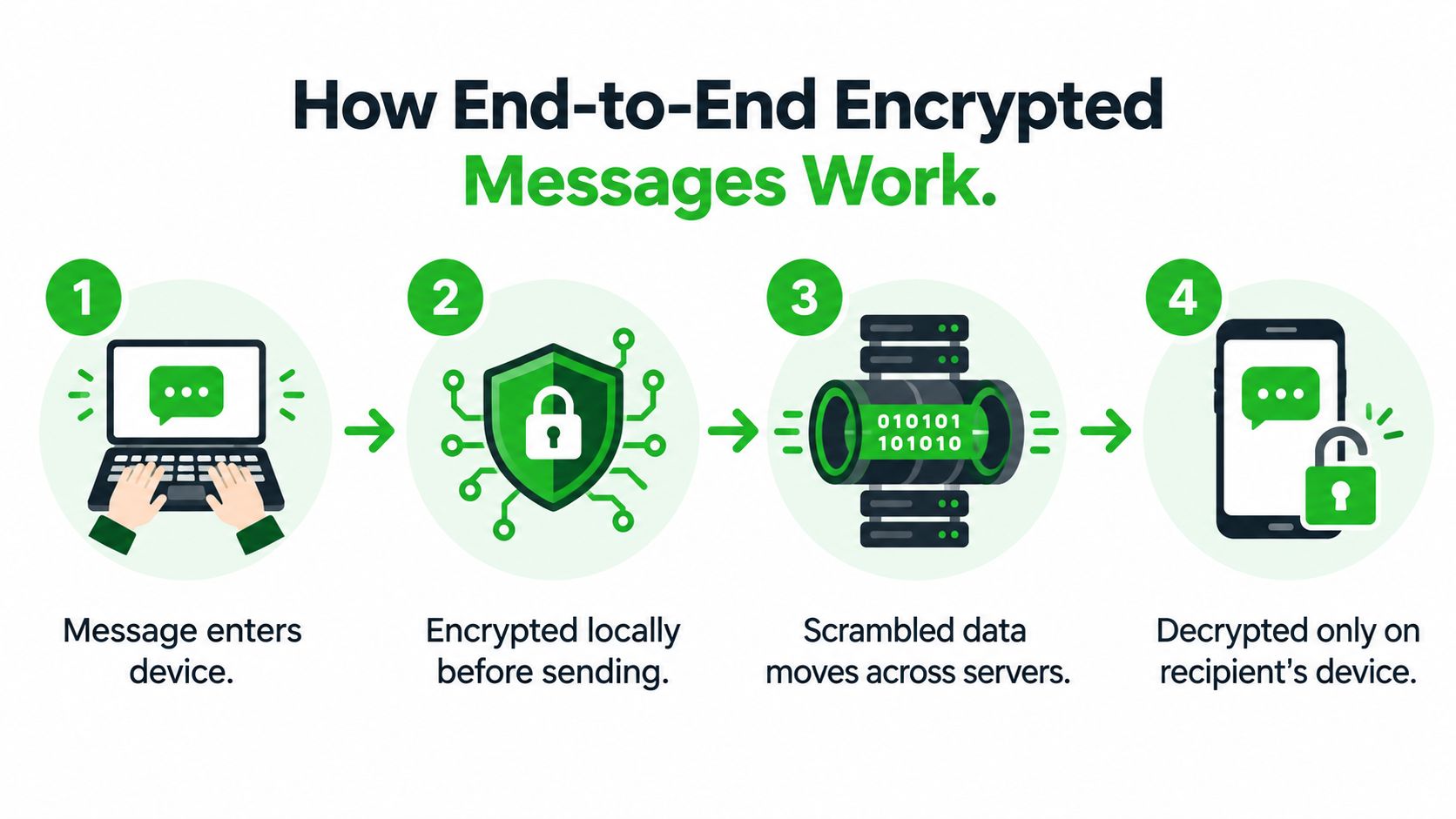
1. The sender encrypts locally
Suppose a journalist types, “The document is ready.” In an E2EE system, the browser or app turns that readable text into ciphertext on the journalist's device. The plaintext should cross the encryption boundary only after the client has protected it.
In a system such as Ciphar, the browser performs the encryption and retains the usable keys locally. The relay receives an encrypted payload rather than the original sentence. This also applies to other protected objects, such as files or voice data, when the product encrypts them at the client.
2. The network carries ciphertext
The encrypted payload travels across networks and servers. A transport layer can add protection against interception of the connection, but the defining E2EE property is that the relay still lacks the message key.
A server can route a packet, associate it with a channel, and enforce delivery or expiry rules without learning the plaintext. That design limits what a server breach reveals, although it doesn't eliminate metadata or endpoint risk.
3. The relay stores or forwards opaque data
The provider acts like a postal sorting center that cannot open the envelope. It may need to handle ciphertext, initialization vectors, authentication tags, salts, timestamps, or routing information, depending on the protocol. Those elements support delivery and decryption, but they shouldn't provide the provider with the ability to reconstruct readable content.
This is why guidance on sending encrypted messages should distinguish client-side encryption from ordinary server-side storage protection. Encrypting a database is useful, but it doesn't create E2EE if the application server can decrypt every record.
4. The recipient decrypts locally
The intended recipient's device uses the appropriate key to authenticate and decrypt the ciphertext. If the ciphertext or its authentication data has been altered, a correctly implemented authenticated-encryption scheme should reject it instead of displaying manipulated text.
The recipient can still copy the message, photograph the screen, or have it exposed by malware. E2EE controls the path between endpoints. It can't control everything a trusted endpoint does after decryption.
For a visual explanation, the following video can help newcomers connect the abstract boundary to the message path:
Key Concepts Behind the Encryption
The technical vocabulary matters because each mechanism solves a different failure mode. Treating “encryption” as one undifferentiated feature makes it harder to evaluate whether an implementation is sound.
Client-side encryption and key derivation
Client-side encryption means the transformation from plaintext to ciphertext occurs in the sender's browser or app. The server can coordinate delivery, but it isn't the place where readable content becomes protected.
A human-readable channel access key usually isn't suitable as a raw AES key. A key-derivation function turns that input into a cryptographic key while making guessing more expensive. Ciphar's specified design uses PBKDF2-HMAC-SHA-256 with 100,000 iterations and a unique salt for each channel. The salt prevents an attacker from reusing a precomputed table across channels, but it doesn't make a weak access key unpredictable.
That distinction is important. PBKDF2 slows guesses. It can't rescue an access key that users choose from a small, obvious set. OWASP currently recommends 600,000 iterations for PBKDF2-HMAC-SHA-256 when PBKDF2 is required, so a design using 100,000 iterations should receive a deliberate security review and browser-performance assessment. The comparison is documented in OWASP's password storage guidance.
For a deeper explanation of the relationship between passwords, derived keys, and encryption operations, see how encryption keys work.
AES-GCM protects secrecy and authenticity
AES-256-GCM supplies confidentiality and integrity together. Confidentiality hides the message. Integrity lets the recipient detect unauthorized changes through an authentication tag.
If an attacker modifies the ciphertext, associated data, or tag, decryption should fail. That prevents a relay or interceptor from changing a message while hoping the recipient accepts the altered result as genuine.
GCM also depends on disciplined nonce management. NIST recommends 96-bit IVs for interoperability, efficiency, and security bounds, and the same IV must never be reused with the same key. Each message, file, and voice frame therefore needs a fresh IV. NIST's GCM specification also explains that security weakens as more data is protected under one key, which is why short-lived channels and per-channel keys can reduce exposure.
Associated data binds context
Some information doesn't need encryption but still needs authentication. A channel type, sequence number, or expiry context can be supplied as associated data. The recipient verifies it alongside the ciphertext, even though the data remains separately available to the protocol.
That binding helps prevent message reordering, cross-context substitution, or replaying a valid ciphertext in the wrong channel. The design goal is not merely to hide words. It is to ensure that the recipient receives an authentic message in the correct context.
Where the Threat Model Breaks Down
Encryption protects a message while it travels between trusted endpoints. It does not make the people, devices, records, or signals around that message invisible. A useful threat model therefore asks what an observer can learn without reading plaintext, and where readable copies appear during the message's lifecycle.
Adoption does not guarantee understanding. A 2018 USENIX study surveyed 125 participants and found that 90% currently used, or had previously used, at least one end-to-end encrypted tool. It also found that 89% had used a tool frequently advertised as encrypted, while 55.5% had used an encrypted tool that was not primarily marketed around encryption. The findings in the USENIX study on user understanding of encrypted messaging point to a practical risk: people may choose a tool for its encryption label without knowing what that label excludes.
Follow the clues an observer can still collect
Metadata can support inference even when ciphertext remains unreadable. Consider a source and journalist who begin exchanging messages after a long silent period. An observer records the connection times, packet sizes, delivery events, and network locations. The observer then compares those patterns with the journalist's public schedule or the source's workplace hours. Repeated timing matches can suggest a relationship without revealing a single sentence.
A 2025 study of metadata and encrypted messaging describes how traffic correlation in encrypted calling can expose relationships under a passive ISP-level threat model. The same reasoning applies to message systems: encryption hides content, while timing, routing, and activity patterns may remain available to a provider or network observer.
Content privacy is not relationship anonymity.
Ephemeral deletion changes what may remain stored after a channel expires. It cannot retract traffic already observed, and it cannot stop a recipient from copying a message before deletion.
Test the lifecycle, not only the cipher
A security review should trace readable data through each stage: composition, encryption, delivery, display, storage, backup, and deletion. A compromised browser can capture plaintext before encryption or after decryption. An open phone can expose a conversation. Notifications, screenshots, exports, synchronized devices, and cloud backups can create additional copies outside the original E2EE path.
The Electronic Frontier Foundation's explanation of encrypted chat backups explains why backup protection may differ from protection applied to the original conversation. Teams assessing secure social media API workflows should ask the same lifecycle questions: where can readable data exist before sending, during processing, after receipt, and after deletion?
This approach produces a clearer decision than asking whether a service is “encrypted.” It identifies which observer is being considered, which evidence that observer can collect, and which controls must operate outside message encryption.
Ciphar as a Practical Example
A practical design makes the boundaries easier to inspect. Ciphar is a browser-based, zero-knowledge encrypted chat application for short, identity-free conversations. It creates temporary channels without requiring an account, phone number, email address, or installation.
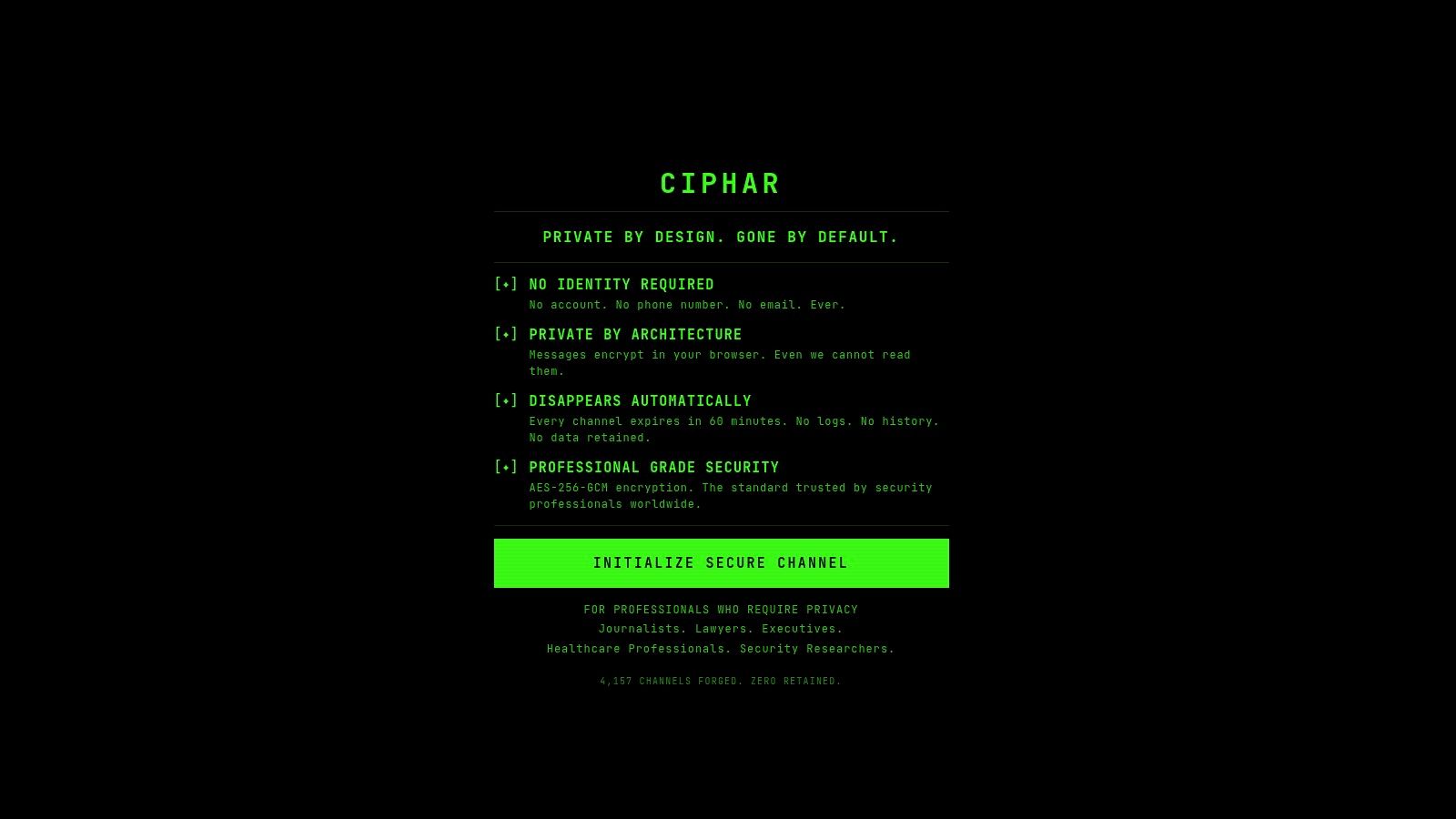
From channel creation to expiry
A participant creates a channel in the browser and receives a human-readable channel name and a per-channel access key. The participants share the access key out of band, which means they use a separate trusted route rather than placing the key inside the channel itself.
The browser derives the encryption key and encrypts messages, files, replies, edits, and voice frames with AES-256-GCM. The server is designed as a relay that stores opaque ciphertext together with the data needed for protocol operation, such as IVs, authentication tags, salt, and expiry timestamps. It doesn't hold the decryption key.
Access verification uses an encrypted test blob. A participant with the correct key can satisfy the check, while failed attempts produce in-channel intrusion notices and are rate-limited. That doesn't make guessing impossible, so the access key still needs sufficient unpredictability.
Ephemerality has operational consequences
Channels have a hard 60-minute lifetime enforced server-side. There is no archive, recovery option, or extension, and participants can burn a session manually before the timer expires. Voice rooms are relayed over WebSocket without recordings or transcripts.
Those constraints solve a specific problem: reducing the amount of sensitive content retained by the service. They don't solve endpoint compromise, screenshots, screen recording, or a participant's decision to preserve the conversation elsewhere.
Ciphar therefore illustrates a broader engineering principle. A secure system is shaped not only by its cipher, but also by key handling, identity collection, retention rules, access feedback, and what the product refuses to store.
Who Should Use End-to-End Encrypted Ephemeral Chat
The strongest use case is not “every conversation.” It is a conversation that matters now, should not require a permanent relationship, and creates additional risk if retained indefinitely.
A journalist and a confidential source may need a first conversation without exchanging phone numbers. A lawyer may need to discuss an initial matter before deciding whether a long-term client channel is appropriate. A security researcher and an incident responder may need to coordinate during an active disclosure without creating another durable account history.
Healthcare professionals and executives can face similar decisions, although professional, legal, and organizational requirements vary. A temporary encrypted channel can reduce unnecessary retention, but it must not replace a system that an organization is required to archive, audit, or preserve.
Match the tool to the conversation
Use an ephemeral E2EE channel when these conditions describe the exchange:
- Short-lived purpose: The discussion concerns an immediate decision, introduction, incident, or handoff.
- No identity exchange: Participants don't need to create a persistent account or disclose a phone number.
- Retention creates exposure: Keeping a searchable archive would increase risk rather than provide useful continuity.
- Separate key sharing is practical: Participants can exchange the access key through a trusted route.
- The endpoints are managed: Devices are updated, access-controlled, and unlikely to be shared or compromised.
Traditional messengers may be a better fit for ongoing relationships. They support contact discovery, persistent history, device synchronization, and recovery, all of which can be valuable when continuity matters more than rapid destruction.
Understand the trade-offs
Ephemerality can make mistakes harder to recover from. If a participant forgets an important detail, the system may offer no archive or recovery path. A short-lived channel also isn't suitable for long-term file storage, ongoing group collaboration, or communications that require an audit trail.
A regulated team should involve its compliance and legal functions before using any disappearing-message system for professional records. Healthcare professionals should avoid treating a temporary channel as permission to bypass applicable handling rules. Security teams should also decide where incident notes belong before starting the conversation.
Choose deletion as a policy decision, not as a substitute for endpoint security.
The product model described by ephemeral messaging guidance is useful when the communication itself is temporary and the participants understand the consequences. The access key should be shared carefully, participants should verify who is present, and sensitive files should not be assumed safe merely because the channel will expire.
A simple decision test helps. If you need a durable relationship, searchable history, recovery, or formal records, choose a system designed for those needs and secure its backups. If you need a temporary, identity-free exchange and accept that the recipient's device remains part of the security boundary, an ephemeral E2EE channel may fit.
Ciphar provides browser-based, client-side encrypted channels for short, identity-free conversations, with encrypted messages, files, and voice frames, server-enforced expiry, and no archive or recovery path. Review the security model and use-case limits, then visit Ciphar to decide whether a temporary encrypted channel matches your next sensitive exchange.