You open a browser-based encrypted chat, share the access key with a source through a separate channel, and start typing. The interface shows a lock icon, the server appears to relay only unreadable data, and the conversation feels temporary. Yet the cipher is only one part of the security model. The browser must generate safe nonces, preserve or intentionally discard keys, authenticate every message, and keep the relay from learning more than the design allows.
That's the practical question behind AES-256-GCM online tools. AES-256-GCM is a strong authenticated-encryption construction, but a careless implementation can undermine it through nonce reuse, fragile key handling, or revealing metadata. A secure deployment is less about checking “AES-256” on a feature list and more about auditing what happens during refreshes, concurrent sessions, failed decryptions, and channel expiry.
Why Browser-Based Encryption Fails Beyond the Cipher
A journalist opens a browser-based encrypted chat after sending a source the channel link and access key through Signal. They exchange documents without accounts. The relay returns ciphertext that looks meaningless, and the interface shows no warning.
That reassuring workflow hides several security decisions. The browser must create a unique initialization vector for every encryption operation, load or derive the intended key, bind each message to its channel, and reject altered ciphertext. A page reload creates another test: the application must recover the key safely or clearly expose that the session has ended.

The browser is part of the trust boundary
Client-side encryption can keep plaintext away from the relay, while the endpoint remains a separate security concern. A compromised device, malicious browser extension, injected script, or altered application bundle can read messages before encryption or after decryption. The access key also requires protection, since anyone who obtains it may be able to join the conversation.
The useful architectural question is what the server can read, store, or forward. A sound review also examines key creation, nonce allocation, exposed metadata, and behavior after authentication failure. A cipher can remain correctly implemented while these surrounding controls create practical exposure.
Practical rule: Treat the browser code, key lifecycle, nonce management, and relay behavior as part of the encryption system. The algorithm name alone cannot establish safety.
For short-lived communication, an online tool may fit when its security model is documented and its behavior is predictable. That judgment depends on implementation details, including storage, recovery, logging, and failure handling. Two tools can call the same Web Crypto API yet provide different protection because they make different operational choices.
The deployment review should therefore follow the data through the whole session, from key entry to refresh, message rejection, and channel expiry. Browser-based encryption succeeds only when those transitions receive the same attention as the cipher configuration.
How Authenticated Encryption Actually Works
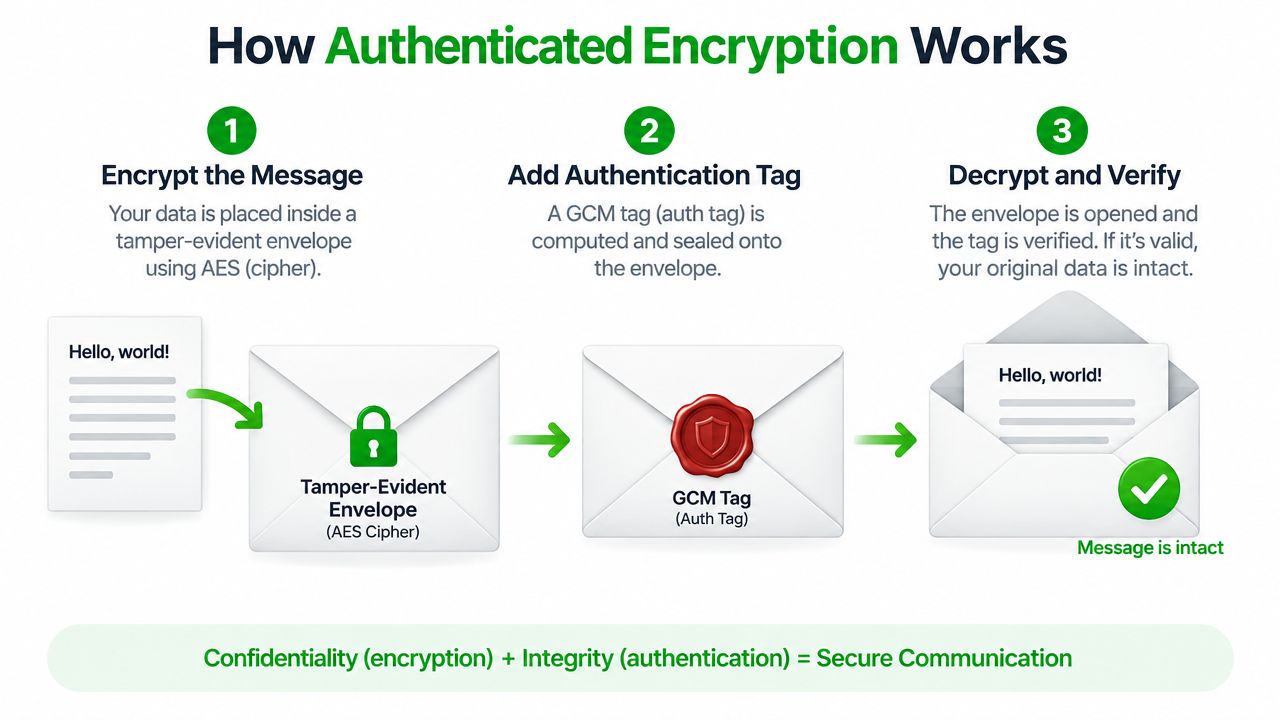
AES-256-GCM combines a 256-bit key, a unique initialization vector, or IV, for each encryption operation, and an authentication tag that rejects altered data. The plaintext is encrypted, while optional associated data can bind visible context such as a channel identifier or message type to the ciphertext.
GCM returns ciphertext with an authentication tag. During decryption, the recipient verifies that tag before accepting any plaintext. A change to the ciphertext, IV, or authenticated context should cause verification to fail rather than produce modified content as if it were genuine.
NIST published Special Publication 800-38D in November 2007, defining GCM around a 128-bit block cipher such as AES and documenting a construction that provides encryption and integrity protection (NIST Special Publication 800-38D).
What the tag changes in practice
Encryption alone can hide a message without proving that it remained intact. AEAD, or authenticated encryption with associated data, combines confidentiality and integrity. GCM produces ciphertext and a tag, allowing the recipient to detect tampering before the application processes manipulated content.
AES-GCM commonly uses a 128-bit authentication tag. Web Crypto supports tag lengths of 32, 64, 96, 104, 112, 120, or 128 bits, with 128 bits as the browser API default. Tag length directly affects resistance to forgery (GCM specification materials). For a short-lived confidential chat, retaining the full tag gives the strongest authenticity setting available through that interface.
A failed tag check can mean a wrong key, altered data, mismatched channel context, or an active attack. The application should discard the message, expose no partially decrypted plaintext, and record enough diagnostic information to distinguish routine mismatch from abuse without logging secrets.
The surrounding implementation matters as much as the API call. Wonderment Apps encryption solutions provides related material on encryption approaches and application security. A concrete encrypted message example is useful for checking whether error handling, context binding, and key handling receive the same attention as successful decryption.
A browser-based implementation typically follows this sequence:
- The browser obtains the intended key and a fresh IV.
- It encrypts the plaintext and authenticates associated data.
- It sends or stores the IV, ciphertext, and tag together.
- The recipient verifies the tag before accepting the plaintext.
The construction is strong when the key and IV relationship remains safe. Online tools often make that relationship difficult to audit, especially across refreshes, tabs, retries, and client-side state.
The Hidden Failure Modes of Online Tools
The most dangerous failures in browser encryption usually come from lifecycle assumptions rather than from a broken AES primitive. A page can use AES-256-GCM correctly in a unit test and still fail when two tabs encrypt at the same time, a user refreshes during a conversation, or a relay exposes more metadata than the team expected.
Nonce reuse destroys the safety margin
GCM requires a unique key and IV pairing. Reusing the same pair can reveal relationships between plaintexts and enable tag forgery, which is why nonce reuse is the most important underserved question for AES-256-GCM online tools (analysis of AES-GCM and nonce reuse).
This isn't solved by saying “the IV is random.” Random generation can be suitable when collision risk is managed correctly, but browser applications also have refreshes, duplicated tabs, offline queues, retries, workers, and multiple relay nodes. A design that generates an IV in each tab without coordinating the encryption state may create collisions under the same channel key.
A safer design assigns nonce state deliberately. It can use a coordinated counter, a reliable per-message allocation mechanism, or a fresh derived key strategy that prevents accidental reuse. The implementation must also define what happens after a crash, because a persisted counter that rolls back can repeat values.
Reloads expose the key-management compromise
Keeping an ephemeral key only in browser memory limits persistence and can reduce the amount of recoverable material. It also means a refresh, tab closure, browser crash, or device change may make ciphertext permanently unreadable. That can be an intentional property, but users need to understand it before they depend on the channel.
The unsafe alternative is a silent fallback. If the key disappears and the application generates a new key, the user may see an empty conversation or send messages that the other participant can't decrypt. If the tool sends the key to the server to restore convenience, its zero-knowledge claim changes substantially.
A lost key should produce a clear failure, not an invisible downgrade to a weaker trust model.
Metadata still describes the conversation
Ciphertext doesn't hide every observable detail. A relay may still receive or store IVs, authentication tags, salts, message timing, channel identifiers, expiry information, and message sizes. That metadata may not reveal the text, but it can expose communication patterns or help an observer correlate participants and events.
A privacy-focused design should document exactly what the relay sees and how long it retains it. It should separate routing data from content, minimize timestamps and identifiers where possible, and avoid retaining unnecessary access attempts or message history. “The server can't decrypt messages” is useful, but it isn't the same as “the server sees nothing.”
For developers reviewing IV behavior, how an IV works provides a practical basis for asking whether the value is unique, transmitted with the ciphertext, and managed consistently across the application's full lifecycle.
AES-256-GCM vs ChaCha20-Poly1305 in Browsers
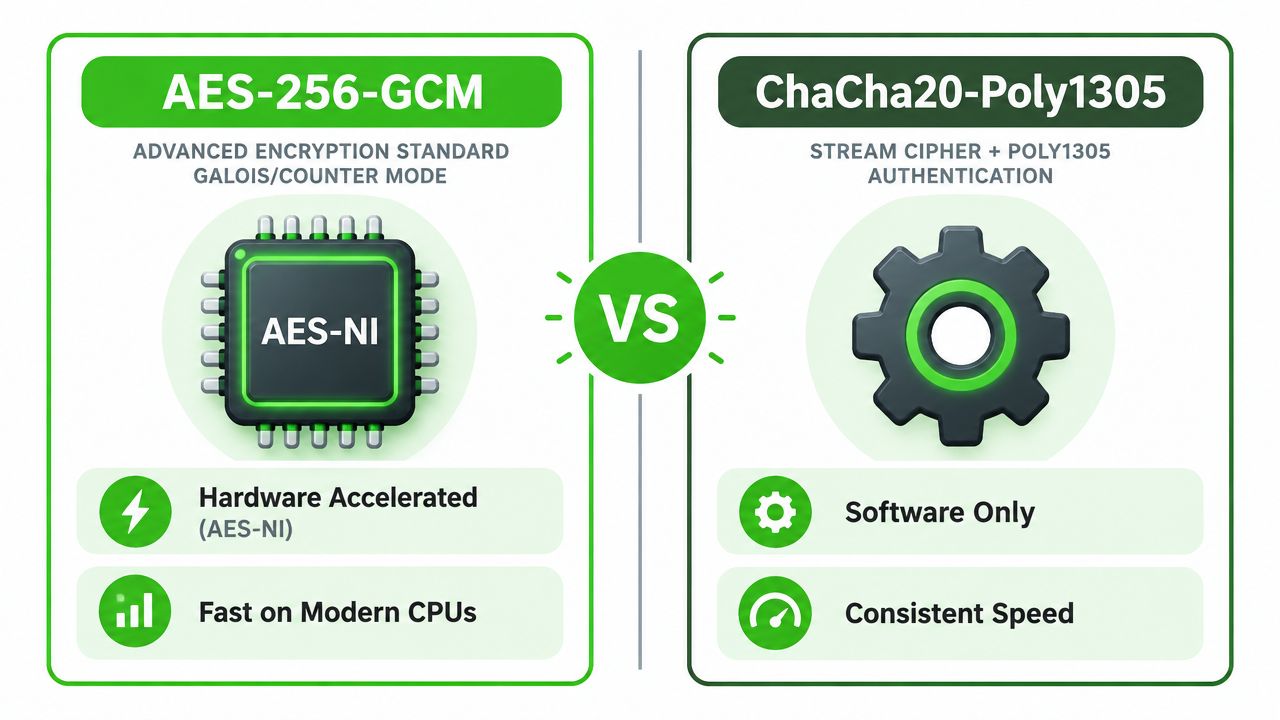
AES-256-GCM is often the natural browser choice because modern Web Crypto implementations support it directly and many systems benefit from hardware acceleration. That advantage depends on the client. AES instructions are common on modern CPUs, but ARM phones and other devices may not provide the same acceleration path.
ChaCha20-Poly1305 takes a different approach. It performs consistently in software and can be a better fit for mobile or lower-end hardware. Recent 2026 comparisons report roughly a 3x speed advantage for ChaCha20-Poly1305 on ARM, while describing AES-256-GCM's main trade-off as implementation complexity and hardware dependence rather than cryptographic weakness (2026 AES-GCM and ChaCha20-Poly1305 comparison).
The trade-off depends on the device mix
For a desktop-heavy internal tool, AES-256-GCM may deliver excellent latency and efficient CPU use. For a global chat application with many mobile ARM clients, battery consumption and responsiveness deserve equal attention. A cipher that benchmarks well on a developer workstation may feel different on an older phone running several browser tabs.
| Criterion | AES-256-GCM | ChaCha20-Poly1305 |
|---|---|---|
| Browser fit | Broad native support through Web Crypto | Support depends more on the library or platform API |
| Hardware behavior | Very fast when AES acceleration is available | Strong software performance without AES-specific hardware |
| ARM and mobile | Can be slower when acceleration isn't available | Recent comparisons report roughly a 3x advantage on ARM |
| Integrity model | Authenticated encryption with a GCM tag | Authenticated encryption with Poly1305 |
| Main operational concern | Nonce coordination and hardware dependence | Library quality, API support, and nonce coordination |
| Selection principle | Strong choice for compatible accelerated clients | Strong alternative for software-first and mobile-heavy clients |
The table doesn't eliminate the need for testing. Measure encryption and decryption on the devices your users carry, including battery impact, large attachments, voice frames, and background-tab behavior. Also verify that the chosen API rejects authentication failures and doesn't convert them into empty or partial messages.
Neither construction fixes poor key exchange or compromised JavaScript. Both require disciplined nonce handling and a fail-closed design. The right decision is therefore a platform decision, not a contest to identify the “strongest” label.
Building a Safer Client-Side Implementation
A safer browser implementation begins with a written trust boundary and a deployment checklist. Encrypt content before it reaches the relay, then define which values the relay may receive for routing, expiry, or abuse controls. Record each plaintext field, ciphertext field, identifier, timestamp, and recovery artifact. This inventory exposes accidental data leaks before they become protocol behavior.
The construction standard is only the starting point. The engineering work lies in key derivation, state management, storage, upgrades, and failure handling. NIST SP 800-38D (November 2007) describes the authenticated-encryption construction, while the application must make its surrounding decisions explicit.

Key derivation and channel separation
A passphrase is not an AES key. Derive key material with a password-based key derivation function such as PBKDF2, using a fresh, randomly generated salt for every channel and a work factor selected through benchmarks on the oldest supported devices. Store the salt with the channel parameters. It is public context, but the recipient needs it to reproduce the same key.
Keep the derivation settings with the encrypted record: algorithm name, hash function, iteration setting, salt encoding, and derived-key length. Without those fields, a future client may interpret the same passphrase differently. Separate keys by purpose as well. Derive independent material for message encryption, authentication of protocol metadata, and any export format instead of reusing one key everywhere.
Out-of-band key exchange still matters. Send access material through a separate trusted path, not in the same URL or message controlled by the relay. Treat copied links as bearer credentials and avoid placing secrets in query strings, browser history, analytics events, or error reports.
State and failure handling
As noted in the failure modes above, nonce allocation, reload behavior, and metadata exposure require explicit controls. The implementation checklist should assign one component ownership of encryption state, define how retries receive their message identity, and specify what happens after a tab crash or service-worker restart. Test duplicated requests, delayed delivery, restored sessions, and two browser contexts operating at the same time.
Authentication failure must be a terminal result for that ciphertext. Do not display partial plaintext, not retry with altered parameters, or fall back to another cipher. Log only an event identifier and the minimum diagnostic data needed to investigate, never decrypted content or raw key material.
Storage, upgrades, and burn controls
Memory-only keys reduce persistence but make reload recovery impossible. A protected export or recovery path can improve continuity when the threat model permits it. Ordinary browser storage offers convenience while increasing exposure to local compromise, so document the choice and its deletion behavior.
Use controls that can be tested in staging:
- Failed-access alerts: Rate-limit invalid attempts and notify participants without revealing which key detail failed.
- Explicit expiry: Enforce channel destruction at the relay, rather than relying only on client-side deletion.
- Immediate burn controls: Let a participant terminate a sensitive session when conditions change, and make the command idempotent.
- Minimal relay data: Retain only routing and expiry fields, with protected content stored as opaque ciphertext.
- Protocol versioning: Include a version, algorithm identifier, key-derivation settings, and encoding rules so upgrades cannot create ambiguous decryption behavior.
These controls do not secure a compromised endpoint or make an unverified web page trustworthy. They give the protocol observable states, deliberate recovery behavior, and testable boundaries. That is the difference between selecting a strong cipher and deploying a safer client.
When Online AES-256-GCM Tools Are Safe to Use
AES-256-GCM is a credible choice for browser encryption when the implementation handles its surrounding protocol correctly. IEEE 802.1AEbn added GCM-AES-256 as an option alongside GCM-AES-128, with the amendment published in 2011, showing that AES-256-GCM had entered a security-sensitive standards ecosystem (IEEE 802.1AEbn).
That history doesn't answer the online-tool question by itself. The browser still owns key access, the application still controls nonce allocation, and the relay still sees whatever metadata the protocol leaves exposed. The cipher isn't usually the weak link. The context around it is.
A practical decision framework
Use a browser-based AES-256-GCM tool for a short-lived conversation only when you can answer these questions clearly:
- Does encryption occur before content reaches the relay?
- Does the server ever receive or recover the decryption key?
- How does the application guarantee unique key-IV pairs across tabs and retries?
- Does a failed authentication check discard the message completely?
- What survives a refresh, and what happens if the key is lost?
- Which metadata does the relay retain?
- Does the channel expire through an enforced server-side rule?
- Can the provider explain its algorithm choice and failure handling?
Avoid tools that hide key storage, create replacement keys without disclosure, or describe AES-256-GCM without explaining nonce management. Prefer implementations with public documentation, explicit expiry behavior, transparent relay storage, and a clear out-of-band key exchange model.
For journalists, lawyers, researchers, and incident responders, Ciphar provides browser-based, identity-free channels with client-side AES-256-GCM encryption, opaque relay storage, access verification, intrusion alerts, and enforced short-lived channel expiry. It should still be evaluated against your own threat model, especially endpoint security and key-sharing procedures.
The right conclusion is measured: AES-256-GCM online can be safe when implemented and operated correctly, but the algorithm doesn't rescue a fragile browser workflow. Verify the lifecycle, not just the lock icon.
Ciphar offers one-time, browser-based encrypted chat for short, identity-free conversations, with client-side encryption and a relay that doesn't hold the decryption key. Review the Ciphar security model and use it when your communication needs a temporary channel rather than a persistent messenger.