A seller has just sent a draft term sheet to a buyer. The buyer's lawyer has it, the finance lead has it, and someone has already forwarded it to an adviser whose name wasn't on the distribution list. The commercial conversation still feels private, but the information boundary has already become unclear. If the parties later disagree about what was promised, confidentiality may protect the conversation while making the agreement harder to verify.
A disciplined private negotiation treats secrecy as an operating system, not a preference. You need a defensible reason for restricting information, a clear record of authorized decisions, secure communication habits, and an expiry process that removes unnecessary copies without destroying evidence you may need to prove the deal. The practical challenge is balancing discretion with accountability.
The Hidden Dangers of Standard Negotiation Tactics
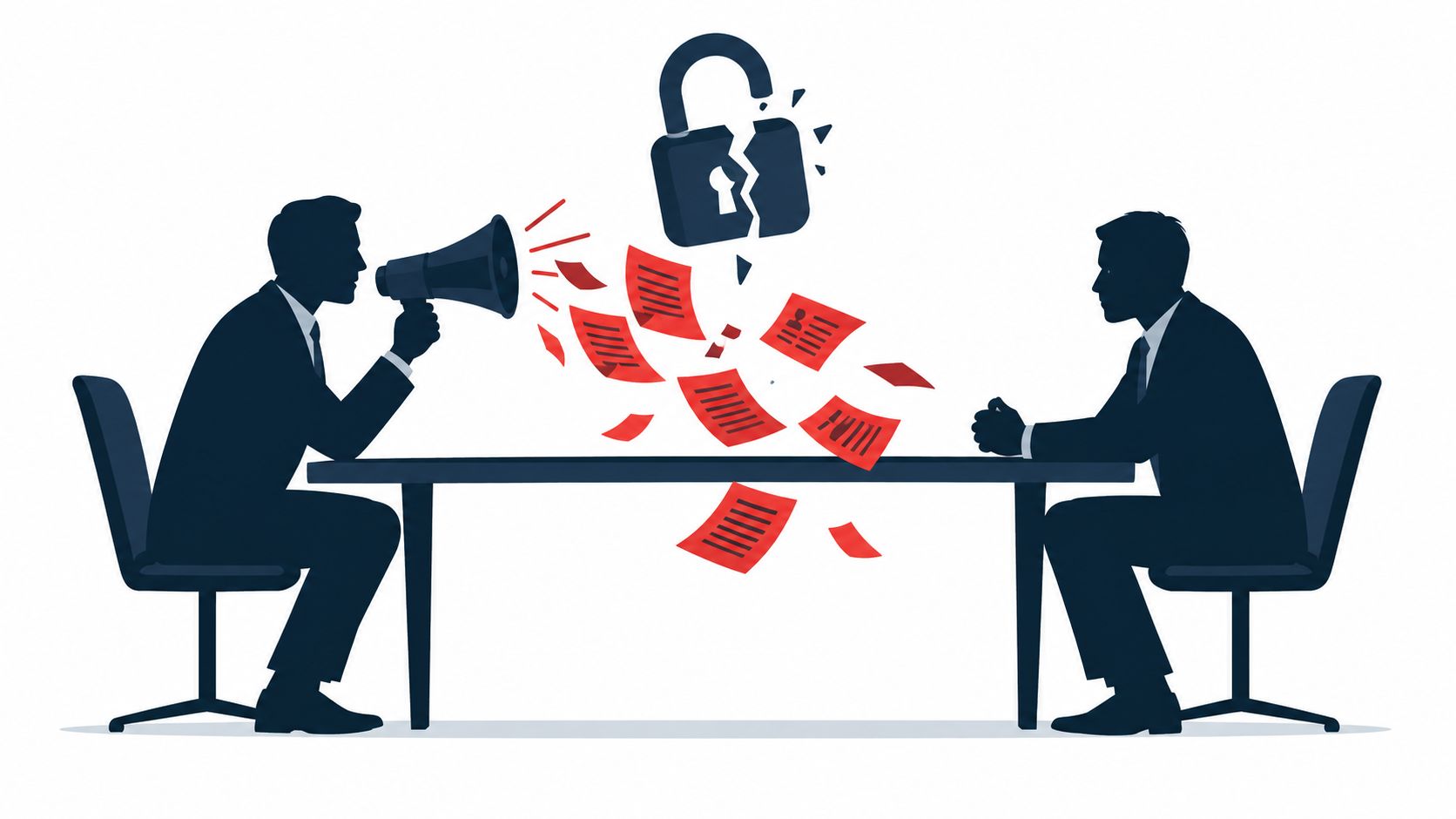
A conventional negotiation often rewards visible pressure. One side signals that alternatives are available, introduces urgency, hints at competing offers, and uses broad circulation to create internal momentum. Those tactics can work when publicity is part of the advantage. In a confidential deal, they can disclose more than the speaker intended before the first formal offer is made.
A seller who casually mentions “other interested parties” may reveal the size of the process, the timing of internal approvals, or the seller's need for liquidity. A buyer who shares a draft with too many colleagues can expose its valuation range and preferred structure. Even an apparently harmless calendar invitation can identify the participants, subject matter, or expected timing.
Why ordinary leverage can become evidence
Open-bargaining habits also create a trust problem. If one party discovers that the other exaggerated its alternatives, selectively quoted a discussion, or used an unauthorized intermediary, the dispute may concern process integrity rather than price. The counterpart may stop sharing information, move to positional bargaining, or insist on formal protections that slow the transaction.
Digital traces widen the exposure. Document properties, filenames, revision history, tracked changes, recipient lists, and message previews can reveal authorship, internal comments, or earlier positions. Teams should understand what metadata means before treating a polished PDF as a clean disclosure.
The risk isn't limited to accidental forwarding. Negotiation behavior itself can leak information. The Apple research on behavioral privacy in agentic negotiation reports that a privacy-preserving mechanism reduced adversarial inference accuracy by 43% to 50% across 3,000 synthetic bilateral negotiations, while success rates and utility remained above 90%. The implication is practical: encryption protects content, but the rhythm, sequence, and structure of exchanges can still expose priorities or constraints.
Replace performance with controlled signals
Public negotiation tactics often aim to make the other side react. Confidential work requires signals that are narrower and easier to substantiate. Instead of implying that an unnamed competitor has made a better offer, state the decision rule you can defend: “We can proceed if the structure meets these conditions and approval is complete by the agreed date.”
That change improves both negotiating power and credibility. It reduces theatrical pressure, limits unnecessary disclosure, and gives the other party something concrete to evaluate. In a private setting, controlled information flow beats dramatic signaling because every leak can alter the bargaining relationship long after the meeting ends.
Preparing for Secure Private Negotiations
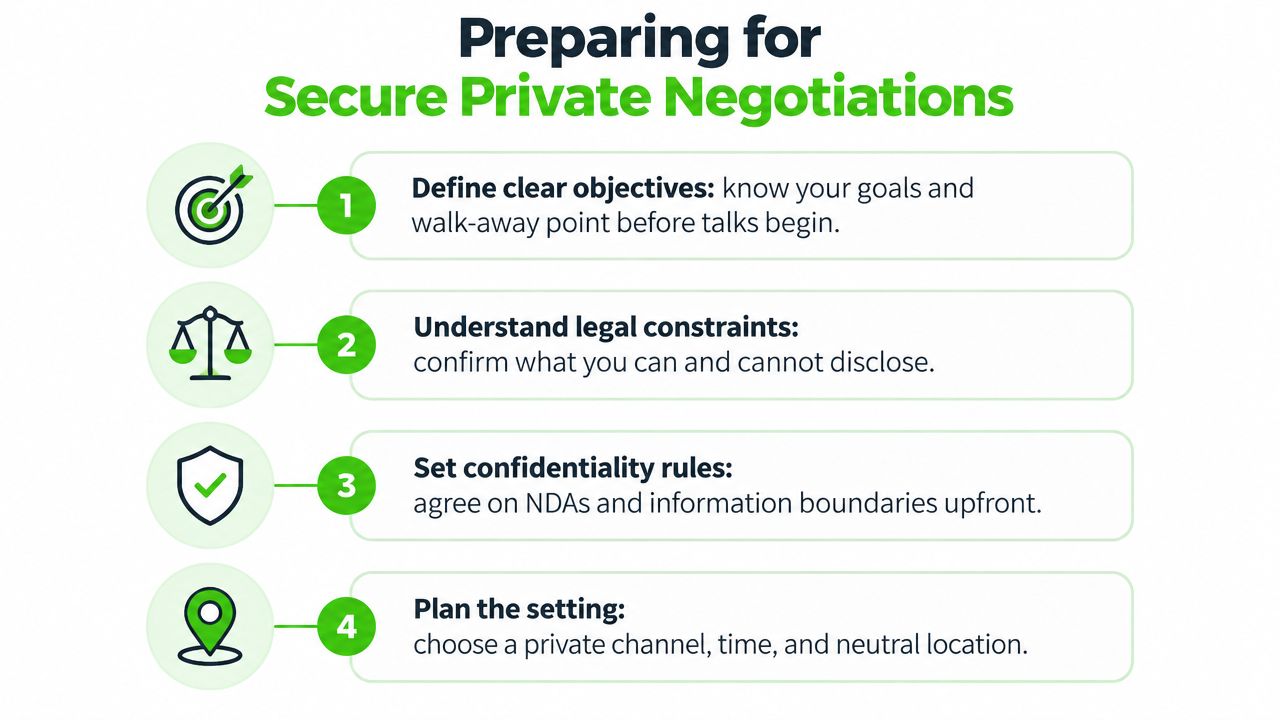
Preparation starts before anyone sends an opening message. The aim isn't merely to decide what you want. It's to establish what may be disclosed, who may disclose it, where the conversation may occur, and what happens to the records afterward.
Set the commercial and legal boundaries
Write down three positions before contact:
- Target outcome: The result that makes the transaction worthwhile, including price, timing, scope, liability, and implementation terms.
- Acceptable range: The room available for trade-offs, with each concession tied to something you receive.
- Walk-away point: The condition that ends the discussion rather than triggering another round of discounting.
A practitioner study summarized by the Professional Photographers Association of America found that top performers were 3.1 times more likely to hit their pricing target, 12.5 times more likely to be very satisfied, and 3.5 times more likely to feel extremely confident. The reported method is straightforward: define your BATNA, quantify target and walk-away ranges, and build a value-based justification before opening.
Legal review should happen alongside commercial preparation. Identify privileged material, personal data, trade secrets, regulated information, antitrust sensitivities, and promises that require board or government approval. An NDA can establish duties, but it doesn't replace access controls or a decision about what should never be shared.
Verify people, not just email addresses
A familiar domain doesn't prove that the person is authorized. Confirm each participant's role through a trusted, separate route, then record who may receive documents, attend calls, approve terms, or brief others. Treat advisers, translators, assistants, and technical contractors as part of the confidentiality perimeter.
Use a narrow distribution list. If someone needs only a summary, don't send the full model. If a lawyer needs the agreement but not operational data, separate those materials. A smaller group makes accountability clearer and reduces the chance that a later disagreement turns into a dispute over who knew what.
Establish the channel and the device
Choose communication tools according to the sensitivity and lifespan of the exchange. Keep identity verification and access-key sharing out of the same channel where possible. Use managed devices, current software, screen-lock protection, and a private physical setting. Disable automatic previews and avoid shared meeting rooms, personal cloud folders, and unmanaged recording tools.
For attachments, remove unnecessary comments and revision history before sending. If a PDF contains sensitive terms, teams can encrypt a PDF before emailing, then share the password through a separate trusted route. That step won't solve a compromised endpoint, but it prevents a forwarded attachment from being immediately readable.
Use an opening protocol that everyone understands:
- Confirm identity and authority.
- Restate the purpose and confidentiality limits.
- Agree on who may attend and what may be recorded.
- Confirm the approved channel.
- Establish how decisions will be documented and when temporary material will expire.
For a short exchange involving sensitive messages, files, or voice, Ciphar offers browser-based encrypted temporary channels with client-side encryption, access keys, manual burn control, and enforced expiry. It's a tool for transient conversations, not a substitute for a formal contract, regulated recordkeeping, or a secure document-management system.
Tactical Approaches for Confidential Contexts
Confidentiality changes the value of information. In an open process, revealing an interest may attract a useful counteroffer. In a private process, the same disclosure may become a permanent bargaining signal with no audience to correct the other party's interpretation.
The most reliable approach is to distinguish interests from positions. A position is “the price must be this.” An interest may be approval certainty, delivery timing, risk allocation, control, or protection from reputational exposure. Ask questions that uncover the interest without demanding unnecessary proof of internal weakness.
Integrative bargaining versus positional bargaining
| Approach | Where it helps | Confidentiality risk | Better practice |
|---|---|---|---|
| Positional bargaining | Establishes a firm boundary when the issue is narrow | Encourages anchoring, bluffing, and premature disclosure of limits | State the condition and rationale without inventing alternatives |
| Integrative bargaining | Creates trades across price, timing, scope, liability, and control | Requires selective disclosure and disciplined verification | Share interests in layers and exchange concessions conditionally |
| Hybrid bargaining | Preserves a clear reservation point while exploring value | Can become confusing if informal options look like commitments | Label proposals, options, and agreed terms separately |
Uncertainty deserves special handling. An experimental study reported that natural language increased agreement probability to 97.2%, compared with 90.0% under a more constrained interaction mode, and produced faster convergence. The same evidence is summarized in the research on natural-language negotiation. Plain language helps, but clarity doesn't mean unrestricted disclosure.
Use a staged exchange. First establish shared facts and decision criteria. Then test options. Only after the other side demonstrates reliability should you provide sensitive details that materially affect valuation or implementation.
Practical rule: Never trade a confidential fact for a vague expression of interest. Trade it for a defined action, a reciprocal disclosure, or a documented commitment.
Control the conversation without manufacturing pressure
A strong private negotiator doesn't need to bluff about competing bidders. Set an agenda, distinguish exploratory discussion from commitment, and give each proposal an expiry condition. “This option remains available until approval on the stated date” is more credible than an invented deadline.
Use conditional language for every concession. “If you accept the narrower warranty, we can improve the delivery schedule” preserves the relationship between terms. Avoid unilateral movement because the recipient may treat it as a new baseline.
Information may also need translation. Legal, technical, and commercial meanings can shift through an intermediary, especially when the subject is confidential. If translation is necessary, reduce risk with vetted linguists by confirming confidentiality duties, access limits, retention rules, and the handling of working files before the exchange begins.
When the other side presses for your bottom line, answer with structure rather than evasion: “We can discuss the range once we agree on scope and liability.” That response protects your reservation point while showing a path forward. Good private negotiation is not silent or secretive at every moment. It is deliberate about which information moves, why it moves, and what the recipient must do with it.
Managing Evidence and Expiry Procedures
A private negotiation needs records. The objective isn't to preserve every message forever. It's to maintain enough reliable evidence to establish authority, decisions, disclosures, approvals, and final terms, while removing redundant material that creates avoidable exposure.
Start with a single controlled record for the negotiation. Assign an owner, define the access list, and use version labels that distinguish draft, proposal, accepted term, and execution copy. After each substantive exchange, record the date, participants, issues discussed, decisions reached, open points, and any follow-up owner.
Separate proof from working material
Not every note has equal value. Preserve materials that prove what the parties agreed or relied on:
- Authority records: Who represented each side and what approval they held.
- Disclosure records: Which confidential materials were shared, with whom, and under what restrictions.
- Decision records: The wording of accepted terms, conditions, and unresolved issues.
- Execution records: Signed agreements, schedules, attachments, and evidence of delivery.
- Incident records: Access failures, suspected disclosure, containment steps, and notifications.
Financial support deserves particular care. A concise guide on why financial evidence is critical reinforces the operational point: a deal record must let an authorized reviewer understand how figures were prepared, checked, and connected to the agreed terms. Keep source data and calculations in a controlled repository, with access logs and a named owner.
Don't treat screenshots as the primary record. They can omit context, lack reliable timestamps, and be difficult to authenticate. Prefer exports from approved systems, signed documents, contemporaneous decision notes, and a clear chain of custody.
Design expiry before the first exchange
An expiry procedure should answer four questions:
- What expires? Temporary chat, access keys, draft files, working notes, or links.
- When does it expire? After a meeting, after a decision, at contract execution, or at the end of a defined retention period.
- Who confirms expiry? Assign a responsible person rather than relying on general policy.
- What survives? Preserve the authoritative agreement, legal hold material, approval evidence, and records required by applicable obligations.
Self-destructing messages can reduce residual exposure, but they aren't a universal deletion strategy. The operational implications of self-destructing messages are easiest to manage when the parties first decide which evidence must be captured elsewhere.

Burning a conversation doesn't erase photographs, copied text, downloaded files, backups, or a participant's memory. Before deletion, reconcile the evidence register, confirm that no legal hold applies, retrieve the final authoritative documents, and record what was destroyed, by whom, and under which rule. The record of deletion can be more valuable than an unsupported claim that nothing remains.
Incident Response and Audit Trails
Assume that a private negotiation will eventually face an anomaly. Someone joins from an unrecognized account, a document appears in the wrong inbox, a participant loses a device, or a draft surfaces outside the approved group. The response should be defined before the incident, while people can still make decisions without panic.
Contain first, interpret second
Pause disclosure immediately. Revoke access, stop active links, preserve relevant logs, and notify the designated owner and counsel through an alternative trusted channel. Don't confront the suspected source with speculation, and don't delete evidence just because it looks embarrassing.
Then classify the event. Did an unauthorized person access content, or did a participant merely send it to the wrong recipient? Was the material a draft, privileged advice, personal data, pricing information, or an executed term? The answer determines notification, remediation, and whether the negotiation can continue.
A useful incident record captures:
- Observed fact: What happened and how it was detected.
- Time and scope: When the event occurred and which materials may be affected.
- Access picture: Who had legitimate access and which access attempt failed or succeeded.
- Containment action: What was disabled, recalled, isolated, or preserved.
- Decision authority: Who approved the next step.
- External communication: What was disclosed to the counterparty, client, regulator, or insurer.
- Follow-up: Which controls, terms, or participants must change.
Make the audit trail proportionate
An audit trail shouldn't become a second leak. Store it separately from the negotiation workspace, restrict access, and avoid copying sensitive content into incident notes when a precise reference will do. Record hashes, version identifiers, approval events, and access changes where your systems support them, but don't collect unnecessary personal data.
The legal and operational records should agree without being identical. Counsel may need privileged analysis. The deal team may need a commercial decision log. Security staff may need access events. A clear retention map prevents each group from creating its own uncontrolled archive.
Trust after a private negotiation depends on more than the original promise of confidentiality. Research on secret diplomacy highlights the gap that arises when privately agreed terms later diverge from public statements, while work on information sharing emphasizes balancing internal transparency with external confidentiality. The practical answer is a controlled verification path: define who can confirm the agreement, which document governs, what may be disclosed, and how disputes will be resolved.
Essential Checklists and Sample Scripts
A concise operating pack turns judgment into repeatable behavior. Keep it beside the matter file, not in a general team chat.
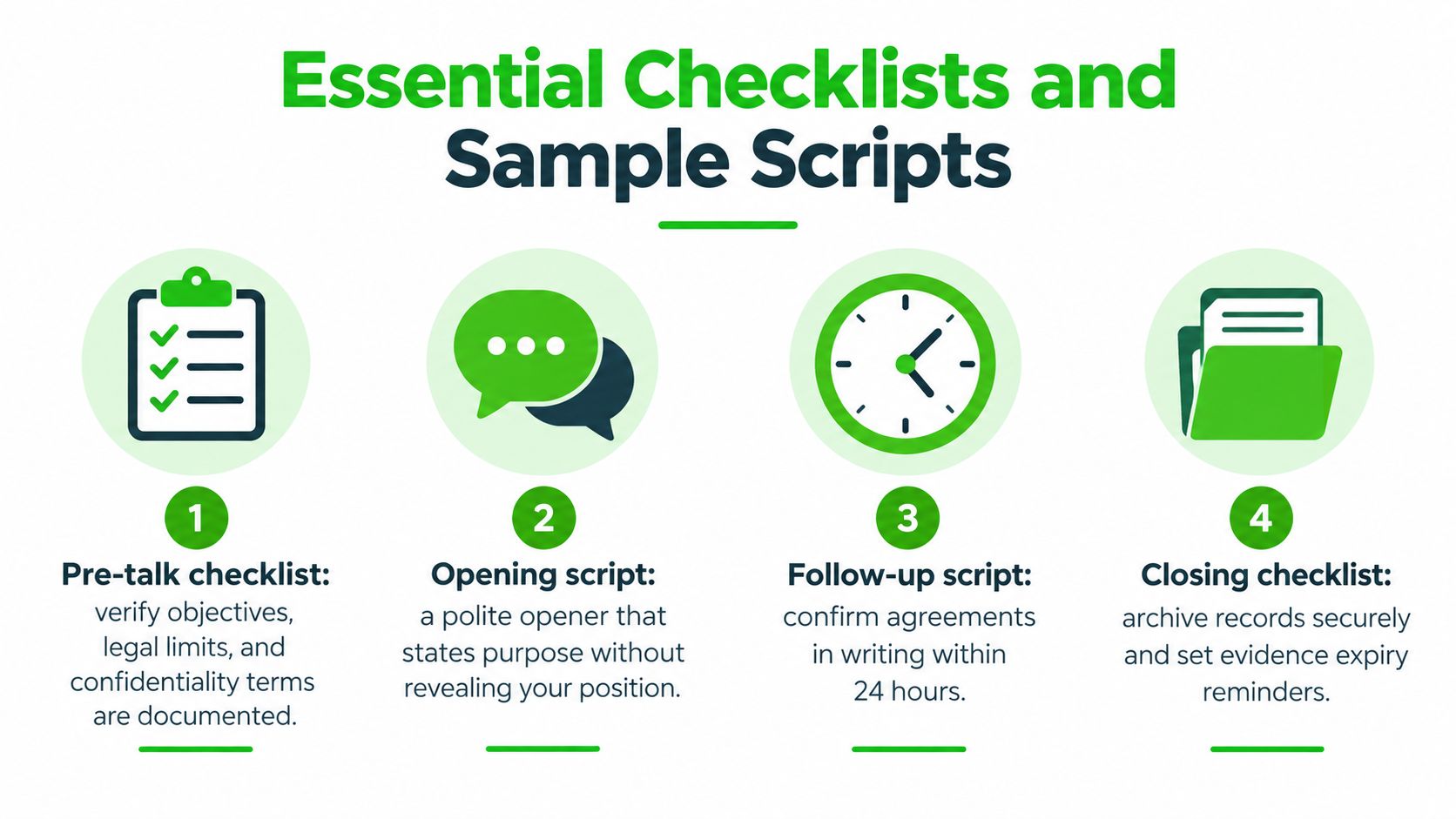
Before the conversation
- Authority: Confirm each participant, role, approval limit, and alternate contact.
- Boundaries: Record the BATNA, target, walk-away point, legal restrictions, and confidentiality terms.
- Channel: Approve the device, meeting location, communication method, and attachment process.
- Evidence: Decide what must be recorded, where it will live, and who owns the record.
- Expiry: Set deletion, burn, review, and legal-hold rules before sharing temporary material.
Scripts that protect the process
Opening: “I'm authorized to explore the commercial and legal structure, but nothing is binding until the agreed approval and signature process is complete. Let's confirm participants, confidentiality limits, and the record we'll use.”
Boundary: “I can't disclose that information at this stage. I can explain the decision criterion and discuss what reciprocal information would allow us to evaluate the option.”
Conditional concession: “If you accept the revised scope and liability allocation, we can consider movement on timing. I'm not treating that movement as agreed until both points are confirmed in writing.”
Incident: “We've identified a possible access issue. We're pausing further disclosure while we verify scope and containment. Please preserve the relevant materials and use the alternate channel for urgent contact.”
Use deal communication principles to keep the written follow-up precise. Send a short confirmation that separates agreed terms, proposals, open questions, owners, and deadlines. Never turn a polite summary into an accidental acceptance.
After the negotiation, archive the authoritative record securely, remove redundant working copies under the approved policy, and set reminders for expiry or review. If a disagreement later emerges, you should be able to prove not only what was said, but who was authorized to say it, what was accepted, and which version governs.
Ciphar supports short, identity-free conversations through temporary browser channels with client-side encryption, encrypted messages, files, and voice, plus manual burn and enforced expiry. For a focused confidential exchange that shouldn't become a permanent chat archive, visit Ciphar and review whether its limited, transient model fits your negotiation protocol.