If a message disappears from your chat, where else might it still exist? The timer on your screen tells you when the app should remove something, not whether a notification, backup, recipient, or another system has already kept it.
Disappearing messages are a retention tool, not a promise that every copy vanishes. To use them safely, separate the visible countdown from the less visible layers: server storage, encryption keys, device copies, and preservation obligations. Each layer answers a different question about what survives.
Disappearing Messages Timers Compared Across Apps
How long does a disappearing-message timer give you? The answer depends on the app and on what the timer applies to: an individual message, a conversation, or an entire channel.
Disappearing message timers by app
| Service | Timer options | Expiry enforced by | Notes |
|---|---|---|---|
| 24 hours, 7 days, 90 days | Client app, per chat | Check the active setting before sending | |
| Signal | 30 seconds, 1 minute, 5 minutes, 30 minutes, 1 hour, 4 hours, 8 hours, 1 day, 1 week, or 4 weeks | Client app, per conversation | Available durations may vary by platform |
| Ciphar | Fixed 60 minutes, no extension | Server-side relay; browser handles local access | Channel and associated ciphertext are deleted at expiry |
WhatsApp's 24-hour, seven-day, and 90-day options were available by 2023, following its introduction of a seven-day disappearing-message period in November 2020, according to the WhatsApp privacy study. The study also reports that 30% of respondents in a Singapore-focused survey used disappearing messages for private WhatsApp group chats.
A service's available options do not tell you which timer is active in a particular conversation. Check the conversation setting before sending.
Compare the setting, not just the service
A per-message countdown, a conversation timer, and a channel-wide deadline work differently. Check three details:
- When the clock starts: It may begin when a message is sent or read, or when a channel is created.
- Who controls the setting: Find out whether another participant can change it.
- What expires: Removal from a device and deletion of stored server data are separate actions.
For example, with a channel-wide deadline, a message sent near the end of the channel's lifetime has less time available than one sent soon after creation. The deadline applies to the channel, not to each new message.
Before sending: Read the active timer in the conversation. An app's available options do not show which setting is in effect.
A shorter timer leaves less time to read or retrieve messages. Choose a duration that gives participants enough time to take part in the exchange.
How Disappearing Messages Expire Behind the Scenes
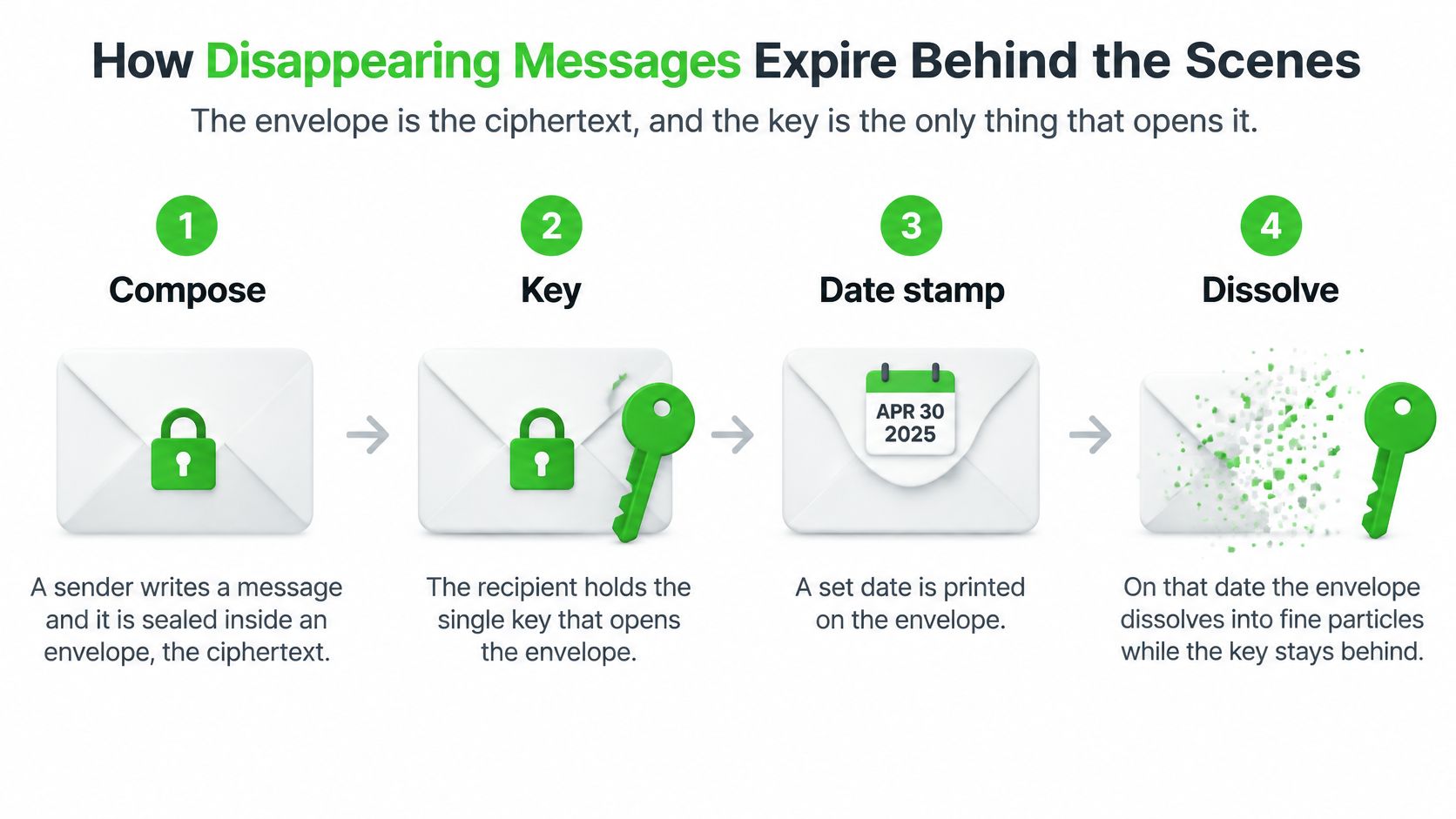
Think of an encrypted message as a sealed envelope scheduled to dissolve. The envelope represents ciphertext, the unreadable form of the message, while the encryption key lets a participant open it.
The analogy has a limit: destroying an envelope and destroying its key are separate operations. A secure design must account for both, rather than assuming the countdown accomplishes everything.
The illustration shows the basic relationship between readable content, its encrypted container, and a deadline.
Follow the message through its lifetime
Encrypt before transmission. This prevents the relay from receiving readable content in the first place. In our browser-based process, messages, file metadata, replies, and edits are encrypted on the device before they leave it.
Store only what delivery requires. The relay needs encrypted material and the technical information required to handle it, not the secret needed to decrypt it. Our relay stores ciphertext, an initialization vector, an authentication tag, salt, and an expiry timestamp, with no keys, plaintext, or logs.
End local access at the deadline. Participants' apps must stop displaying expired content and address their own stored copies. A server cannot, by deleting its database entry alone, clean up every browser or device that previously received a message.
Remove the server's stored material. Our relay deletes the channel and every associated encrypted blob 60 minutes after channel creation. That cleanup includes the verification blob, message buffer, salt, and any voice state, so continued client activity doesn't extend server retention.
Address the encryption key separately. A strong ephemeral design clears the relevant keys from client memory and persistent browser storage at expiry or manual termination. That step must be implemented and tested; server deletion alone doesn't establish that it happened.
Understand cryptographic erase
The NIST Guidelines for Media Sanitization describe cryptographic erase as sanitizing encrypted data by destroying its encryption key while leaving ciphertext on the storage medium. NIST also cautions that verifying this process operationally can be difficult.
A useful distinction follows: deleting a database entry removes ordinary application access, while destroying the appropriate key can make remaining encrypted material computationally unusable. Neither action proves that a recipient never saved readable text elsewhere.
For developers and security reviewers, the practical work is specific. Inspect browser caches and local storage, test key cleanup, and document which artifacts remain after expiry, including encrypted blobs and technical metadata.
For users, a visible countdown isn't evidence of those tests. Look for documentation that distinguishes server retention, local cleanup, and key lifecycle, rather than treating them as synonyms.
Why Expiry Is Not the Same as Deleting
Start with who still holds a copy. Choosing delete for me affects your view, timed expiry instructs participating apps to remove content, and enforced expiry adds a server-side deadline. An immediate burn control brings that deadline forward.
Ordinary deletion versus enforced expiry
| Criterion | Ordinary deletion | Timed expiry | Enforced expiry with burn |
|---|---|---|---|
| Who removes the message | The user choosing local deletion | The app on each device | The server and participating client, on a clock or immediately |
| Recipient's copy | Stays until they remove it | Scheduled for removal by their app | In-app access ends; independently saved copies remain outside that control |
| Server-side copy | Local deletion doesn't establish its status | Requires a separate server-retention policy | Stored ciphertext is deleted under the enforced policy |
| Recovery after removal | A backup may retain it | Backups and notifications may retain content | No channel recovery path, but external copies aren't recalled |
Our BURN CHANNEL control ends the conversation immediately, with no confirmation prompt, no undo, and no waiting for the timer. Deleted channels and their stored blobs cannot be recovered.
The visual comparison helps separate removal from the active conversation from copies held elsewhere.
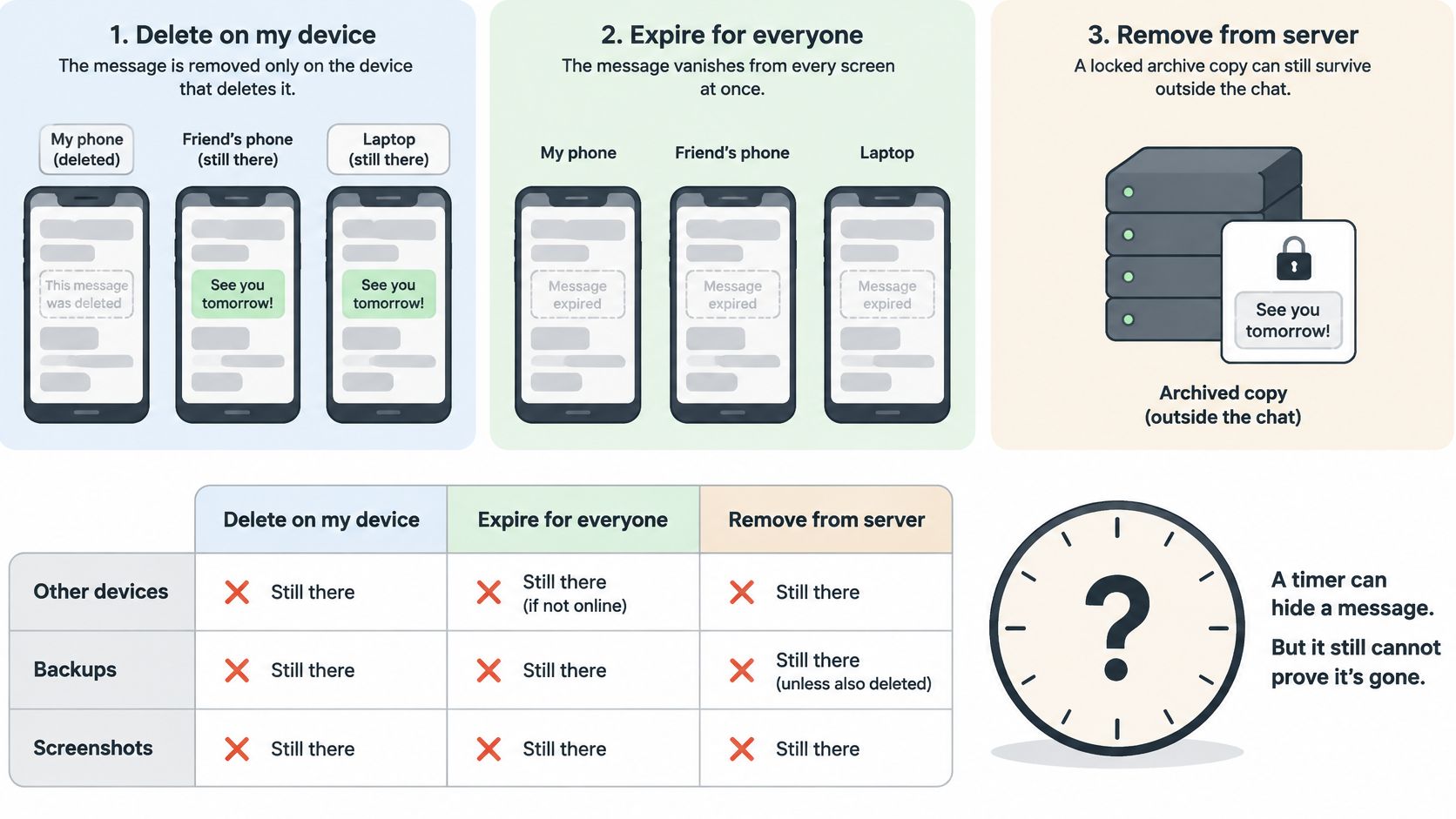
A timer isn't proof that evidence is gone
In a controlled WhatsApp analysis covering forwarded, quoted, media, offline-recipient, call-history, and unread-message cases, researchers recovered 83.33% of examined messages from backups and notification logs, with the remainder unrecovered because backup files were unavailable, according to the forensic analysis published through Kyushu University's repository.
That result belongs to the examined WhatsApp scenarios. It isn't a recovery score for every messenger, but it demonstrates a concrete problem: readable content can leave the primary message store before its timer finishes.
Consider a recipient who copies a passage into a document. Deleting the chat doesn't edit that document. If a team later needs to share a PDF containing the passage, Lighthouse Legal's comparison of Foxit versus Acrobat for redacting PDFs is relevant to that separate document-handling task, not a substitute for message expiry.
Treat every independently saved copy as a separate retention problem.
Our explanation of secure deletion distinguishes removing access from eliminating recoverable material. The defensible claim is bounded: enforced expiry can shrink retained application data, but it can't retract a screenshot, photograph, copied passage, or export created beforehand.
What Disappearing Messages Protect and What They Miss
A recipient can photograph a message while it's visible. That's the clearest boundary: expiry controls the application's retention, not another person's behavior.
Other exposures are less obvious. A notification preview may show text outside the conversation, while a server breach raises different questions depending on whether the operator possesses readable content or decryption keys.
What disappearing messages protect against
| Scenario | Covered by expiry? | Why |
|---|---|---|
| Phone or browser left open after the timer ends | Yes, within the cleaned-up app | The expired message is no longer displayed |
| Lost or shared device after the chat expires | Yes, for the removed chat content | No active chat message remains to browse |
| Provider keeps a permanent archive | Yes, if the design has no archive | Expired stored blobs are deleted rather than archived |
| Server breach or compelled disclosure | Partly | Key possession, plaintext access, and surviving data determine exposure |
| Lock-screen notification preview | Partly | Preview text can exist outside the chat |
| Recipient takes a screenshot | No | A separately captured image isn't controlled by the timer |
| Backup taken before expiry | No | The backup may retain its own copy |
| Forwarded or quoted copy in another chat | No | The new conversation has its own retention behavior |
| Legal hold or discovery order | No | Technical expiry doesn't remove preservation obligations |
Read the affirmative answers narrowly. They describe the removed content inside an application that has completed its cleanup, not a guarantee about the entire device.
Match the protection to the exposure
Say you share a browser with a family member and don't want an old conversation available in its chat history. Expiry can help with that specific concern. It won't solve a different problem, such as a participant deliberately saving your words.
Likewise, content privacy and metadata privacy aren't identical. A service may conceal message text while handling information about the exchange differently; our guide to metadata privacy explains that distinction.
For healthcare teams, channel choice also belongs within a broader confidentiality process. PracticeReady's guide to AHPRA-aligned confidentiality practices is a useful companion when considering how staff handle sensitive information, rather than relying on a timer alone.
Use the video as another prompt to examine the scope of the protection you're relying on.
Before choosing an app, ask these questions:
- Locate the keys. Does the server possess anything that can decrypt content?
- Inspect previews. Can sensitive text appear outside the protected chat?
- Review backups. Are message copies excluded from backup systems?
- Confirm termination. Can a participant end the session immediately?
These are evaluation questions, not a blanket verdict on any service.
When Disappearing Messages Conflict With Legal Duties
Disappearing doesn't mean legally safe to delete. A privacy-preserving tool can still be unsuitable for communication that must be retained for litigation, an investigation, or a regulated workflow.
Ephemeral messages can remain discoverable electronically stored information, and preservation instructions should explicitly address ephemeral platforms and suspending automatic deletion when obligations arise, according to Redgrave LLP's guidance on preserving and collecting mobile-device data. Short lifetimes and encryption make preservation harder, not unnecessary.
What changes when preservation becomes necessary?
When does a legal hold override auto-deletion? As soon as an applicable preservation duty arises, the responsible team must act to preserve relevant information. Ask counsel to determine the scope and timing rather than waiting for someone to request a particular message.
Who is responsible for preserving it? The party subject to the duty needs an operational preservation process. That means identifying participants, devices, platforms, and settings, then assigning people to carry out and verify the required actions.
What if the system has no archive? Don't assume the provider can produce a replacement later. If automatic deletion can't be suspended, move relevant communications to an approved retained channel and obtain instructions for preserving anything still available.
Appropriate-use boundary: Privacy protection and records compliance are different requirements. A tool designed not to retain records can't serve as your records archive.
Our operator can provide only encrypted blobs available under the one-hour expiry clock in response to lawful process. We hold no plaintext, keys, or message history, and there's no archive, soft delete, or recovery path after a channel is deleted.
Those limits describe what the operator possesses. They don't excuse a participant from an independent preservation obligation, and they don't establish that no relevant information exists on another device.
Choose the recordkeeping process before the conversation
An employment discussion, for example, may belong in an approved personnel-record system rather than an ephemeral exchange. A guide to employment records retention requirements provides context for evaluating that workflow without treating all workplace messages alike.
Lawyers and clients should also distinguish confidentiality, privilege, and retention. Our discussion of privileged communication addresses a separate question from whether a message must remain available.
When instructions, decisions, or evidence need to be produced later, use a channel designed for that purpose. Don't create a preservation conflict and expect a deletion feature to resolve it.
How Recipients and Teams Should Use Disappearing Chats
Expiry is a coordination constraint, not only a security feature. A sender may welcome a clean slate while a recipient needs time to check an instruction, complete a handoff, or understand why something vanished.
A preregistered experiment with 210 participants found that people shown deleted-message notices experienced worse mood and greater threats to belonging, self-esteem, meaningful existence, and control than included participants, according to the study indexed by APA PsycNet. That finding concerns deletion notices, not every disappearing-chat experience, but it supports treating removal as a communication event.
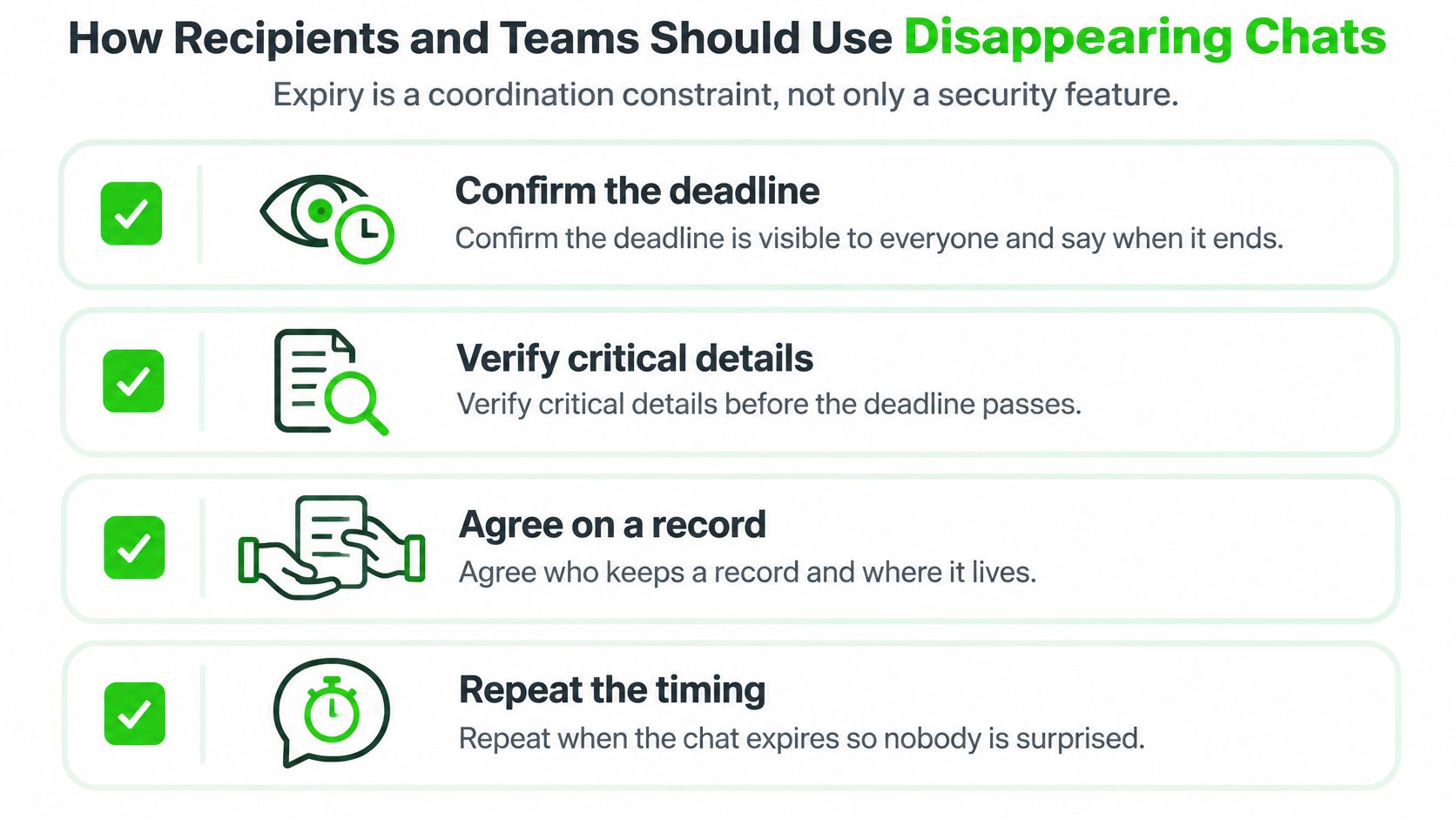
Use this checklist to agree on the workflow before anyone starts sharing sensitive details.
Make the deadline part of the conversation
- State the ending time. Give participants a clear deadline and time zone so nobody mistakes a temporary exchange for an ongoing inbox.
- Verify critical instructions. Confirm important details before the conversation ends, then use an approved durable record when the task requires one.
- Plan missed-message handling. Agree on a separate way to request follow-up rather than assuming a late participant can retrieve the thread.
- Assign handoffs. Name who will act on the outcome and where any permitted record belongs.
- Agree on early termination. Explain who may end the session and what participants should do if access stops unexpectedly.
- Explain meaningful removals. If someone will see a deletion notice, say what changed and why without unnecessarily repeating sensitive content.
In our joining process, the recipient doesn't need an account. The sender shares the channel link and access key over a separate trusted medium, and the recipient opens the link and pastes the key.
Late arrivals after expiry see “Channel not found”. Arrange the meeting before creating the channel, rather than leaving an invitation for someone who may not read it until much later.
No server archive doesn't mean nobody can remember or independently record the exchange. Agree on expectations, but don't mistake that agreement for technical control over the other person.
Decide Whether a Disappearing Chat Fits Your Conversation
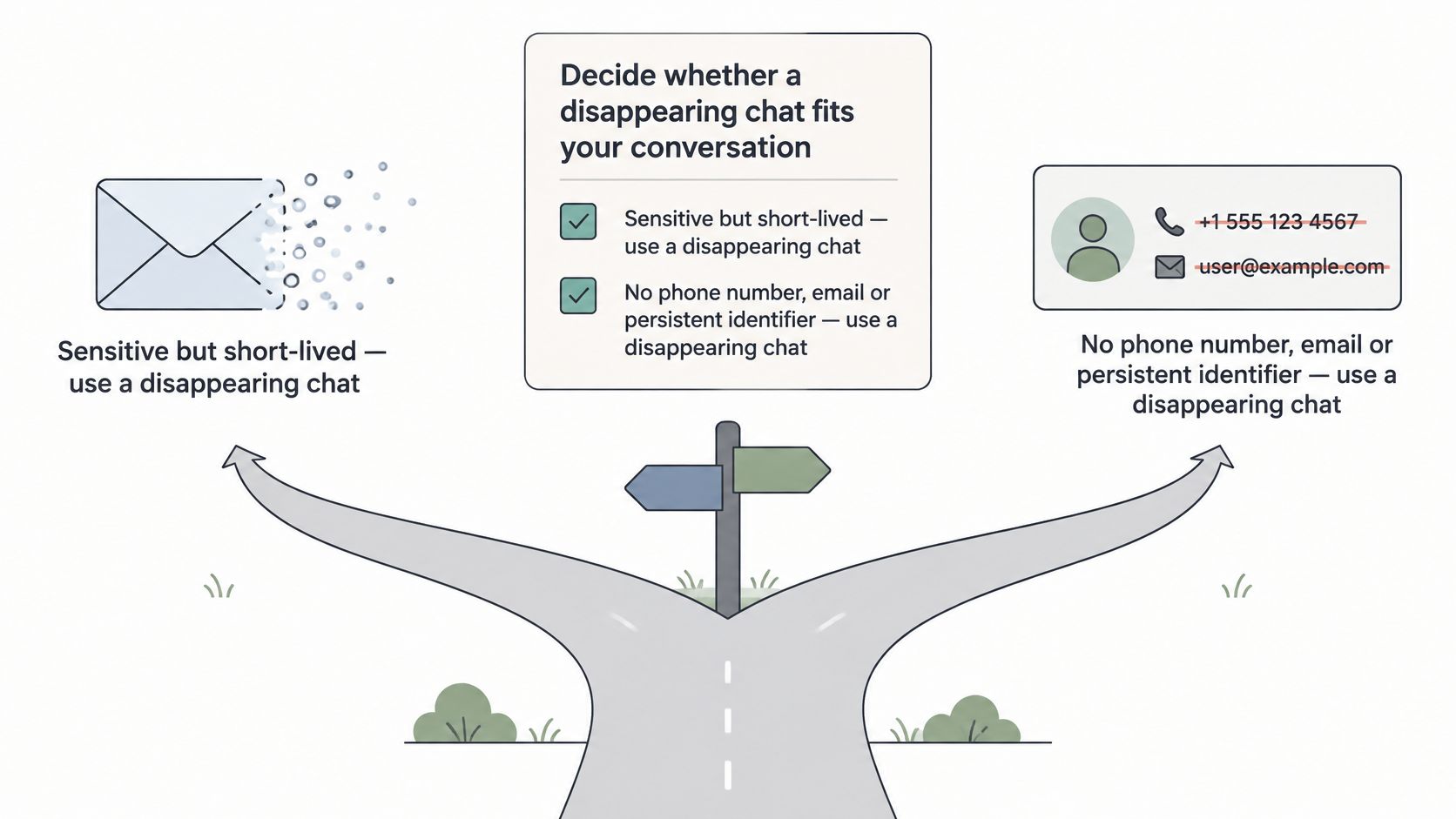
Ask yourself: Does this exchange need to remain available later? Can everyone complete it within the channel's lifetime? If the answer requires a lasting record or an uncertain handoff, choose a retained channel.
A disappearing chat fits a different job: a sensitive, short-lived exchange where participants understand the deadline and no retention or preservation duty applies. It can also suit first contact when people don't want to exchange phone numbers, email addresses, or persistent account identities.
The decision is about the conversation's purpose, not whether temporary messaging sounds more private.
Choose the channel that matches the outcome
- Use an ephemeral exchange for a bounded discussion whose useful life ends with the session.
- Choose a retained workflow for approvals, auditable instructions, regulated communications, or material that may need preservation.
- Separate discussion from the official outcome only when policy permits it and participants know exactly what must be recorded.
Our process is designed for short, anonymous conversations under a hard self-destruct, not ongoing relationships. The immediate burn option lets a participant end the session rather than leave it running until scheduled expiry.
Before sending, inspect the deadline and termination controls, agree on how the exchange ends, and check whether anyone needs an authorized record. If you're unsure about the legal position, resolve that uncertainty before placing the information in a temporary channel.
The right choice isn't always the shortest retention period. It's the shortest period that still respects the conversation's operational and legal needs.
Ciphar offers browser-based, identity-free encrypted conversations with a fixed one-hour lifetime and an immediate burn control. For a short sensitive exchange that doesn't require retention, visit Ciphar, create a channel, and share its access key through a separate trusted medium after agreeing on the deadline.