Encrypted packet features alone let researchers identify the served model with 97.7% balanced accuracy and classify prompt categories with 76.7% mean accuracy in a large benchmark described in this encrypted-traffic analysis paper. Those results concern cloud AI traffic, not private chat, but they challenge a dangerous assumption: unreadable traffic isn't necessarily uninformative traffic. Metadata privacy starts where message encryption stops.
Encrypted Chat Still Leaves a Trail
You send a source a message from your browser. The words are encrypted before they leave your device, and the service can't decrypt them. Yet someone watching the connection may still see when you connected, which service you contacted, and how much traffic passed between you.
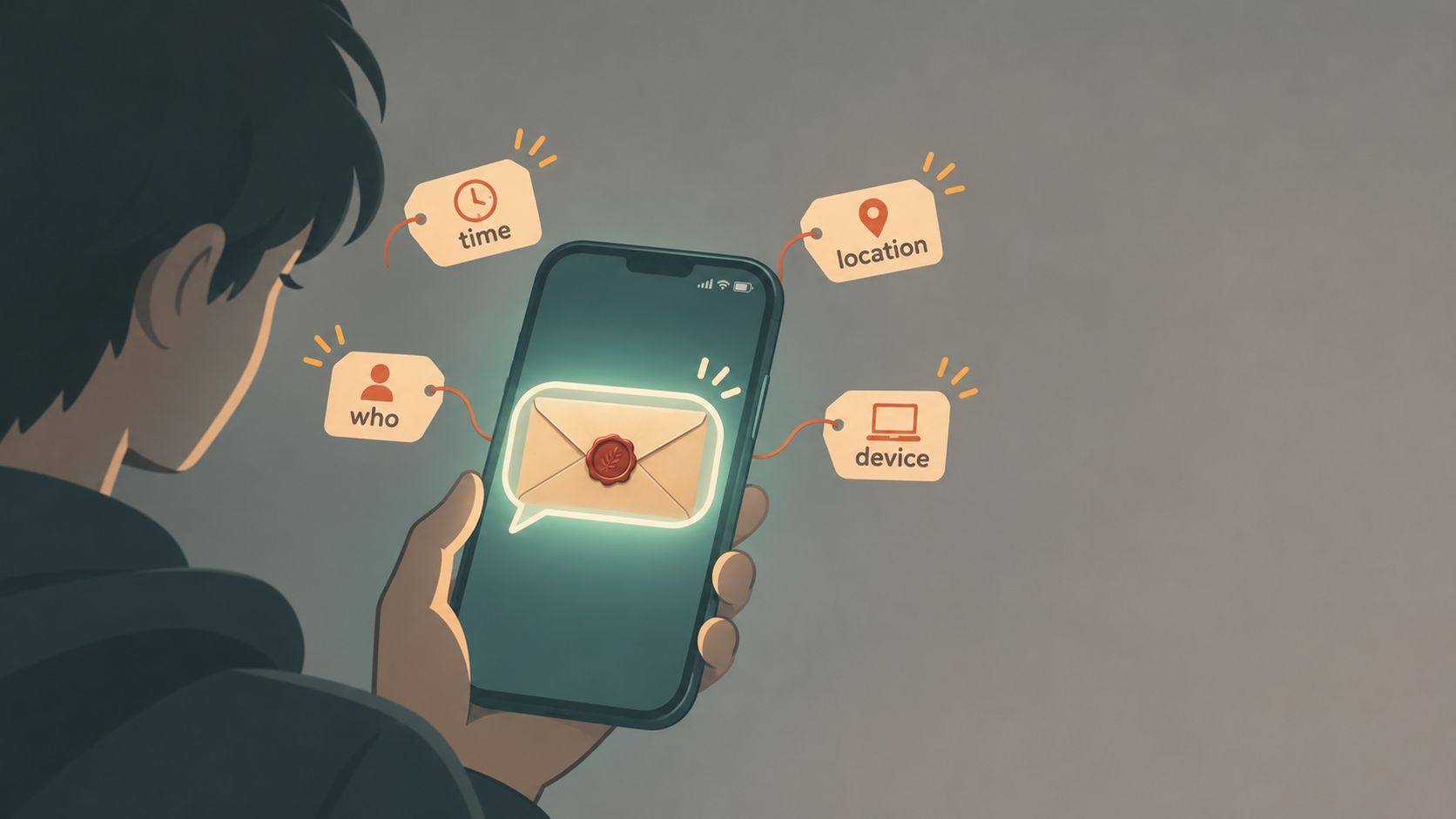
Metadata is the context around content. It includes participant identifiers, timestamps, connection duration, network information, device signals, and traffic size or frequency. Encryption seals the letter; the address, postmark, and weight may remain visible.
That distinction matters whenever contact itself is sensitive. A journalist doesn't need to publish a source's words for an observer to become interested in the relationship. A lawyer, clinician, or incident responder may face the same problem.
Start with the observer
A lock icon answers a narrow question about the connection or content protection. It doesn't tell you whether the service maintains a contact graph, whether the network can recognize your activity, or whether your browser is trustworthy. Understanding Messaging Layer Security helps separate protocol protection from those surrounding operational questions.
Apply the same scrutiny to adjacent workflows. If a conversation involves experimental records, reviewing how Verbal Experiment handles lab notes is a useful prompt to examine the privacy policy of the place where supporting material lives, not just the chat window.
Start with a person or system: Who are you trying to prevent from learning what?
A later copy of a server database, a live internet service provider, the other participant, and a compromised device present different problems. Your choice of protection should follow that distinction.
Message Secrecy and Relationship Secrecy
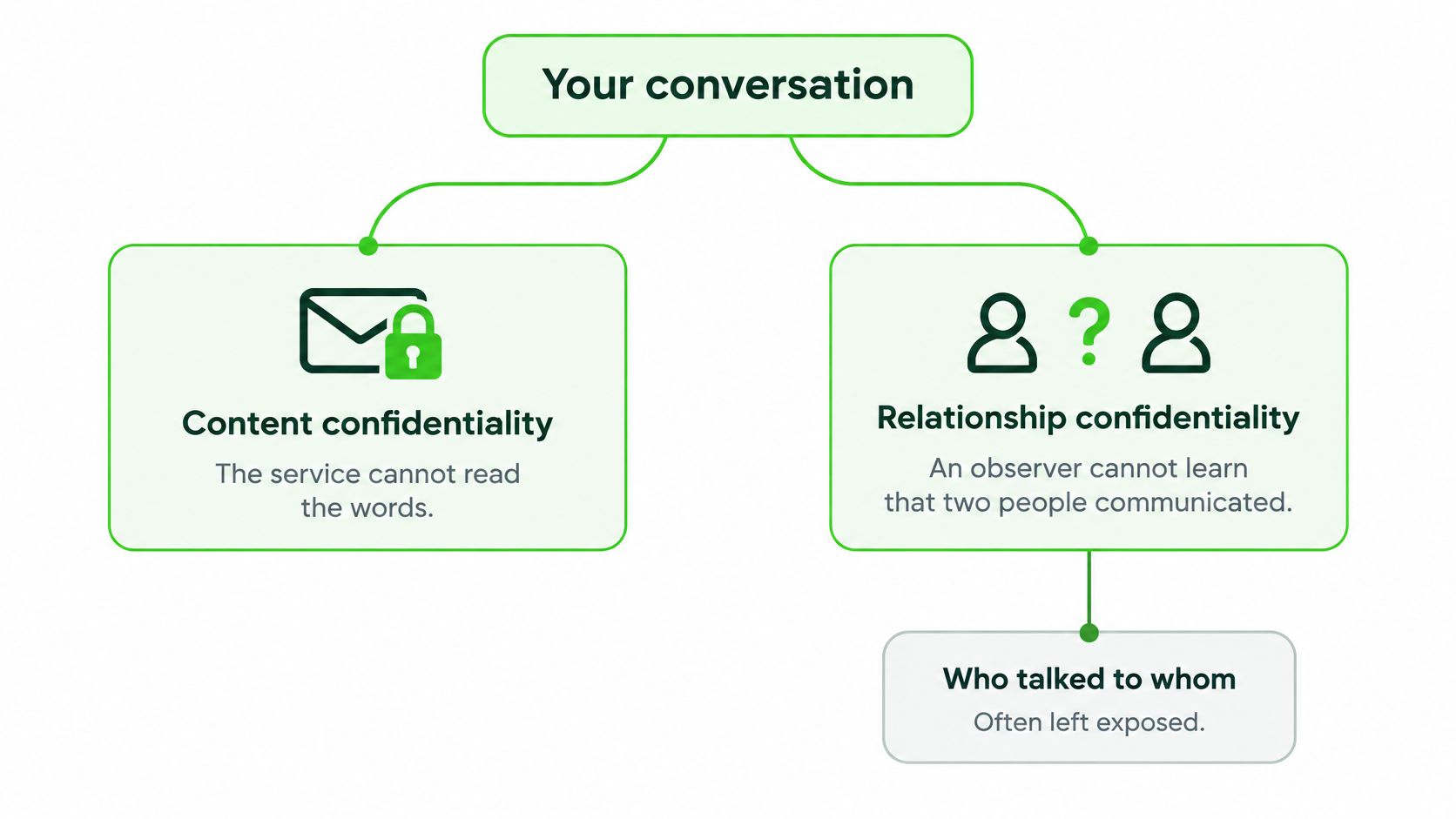
A locked message doesn't guarantee a hidden relationship. Content confidentiality means unauthorized parties can't read the words. Relationship confidentiality means an observer can't establish that particular people communicated, when they did so, or what pattern their contact followed.
These protections require different engineering. A service can encrypt every payload correctly while leaving connection records available to its operator. A network observer may not need access to the service at all.
The distinction is easier to see when the conversation is separated from its surrounding signals.
Untraceable to whom?
A 2025 qualitative study of 189 participants found that many participants interpreted untraceability as concealing identities from other participants rather than from network observers. That's a consequential mismatch: hiding your name from a chat partner isn't the same as hiding the connection from your employer's network.
Browser-based encryption doesn't remove every observable signal:
- Connection endpoints: An observer may recognize the service receiving traffic.
- IP addresses: The relay needs a network connection, even if it doesn't retain the address.
- Packet sizes and timing: Bursts and pauses can distinguish an upload from a sustained voice conversation.
- Participation patterns: Connections starting and ending together can provide evidence of coordination.
Not every observer sees every field. An ISP, relay operator, browser extension, and participant occupy different positions, so their available evidence differs.
What can an observer infer from an encrypted session even when the server cannot read it?
That question is more useful than asking whether a service is private.
The fact of contact can be sensitive
Say a source contacts a reporter shortly after an internal meeting. An observer who can correlate those events may narrow the possible source pool without reading the message. Encryption protects the disclosure's contents, not necessarily the circumstances surrounding it.
For a legal client, repeated contact with a specialist firm may expose the existence of a dispute. For patient coordination, participation in a particular call can disclose an association that the participants intended to keep confidential. An incident bridge can reveal when an organization began responding and which outside responders became involved.
These are scenarios, not proof that every encrypted conversation can be identified. Traffic classification results don't transfer automatically between applications, network conditions, or observers. The mechanism is plausible; the accuracy must be tested for the actual system.
A responsible privacy claim therefore names its boundary. Client-side encryption addresses readable content at the relay. Relationship protection requires separate decisions about identifiers, routing, traffic patterns, and retention. Neither a padlock nor an anonymity label should substitute for that explanation.
What Each Kind of Metadata Reveals
| Metadata field | What it can reveal | Who typically holds it |
|---|---|---|
| Phone number, account, or email | Who contacted whom, even if the words are encrypted | Carrier, app, or identity provider |
| Timestamps, frequency, and duration | Routines, relationships, and when contact happened | Carrier, app, or server logs |
| IP address and network path | ISP, rough location, and which network was used | Service, ISP, or local network |
| Packet size, direction, and timing | Message length, file transfer, or voice activity | Network observer or relay |
| DNS queries and connection endpoints | Which service or site was contacted | Resolver, ISP, or browser |
| Session or channel lifetime | That a conversation existed and how long it lasted | Service, even after content deletion |
| Device and browser signals | A persistent identity across sites or sessions | Browser, embedded scripts, or real-time APIs |
Read the fields as a combined record
Participant identifiers provide the obvious starting point. A phone number or email address can connect a communication record to an existing identity. Even a pseudonymous account becomes useful for linkage if you reuse it across contexts.
Timestamps, frequency, and duration add behavior. A recurring call after a shift ends is more revealing than an isolated timestamp. Patterns can suggest a relationship, although they don't establish what the participants discussed.
IP addresses and network paths supply network context. Treat location estimates cautiously: an address may represent a shared workplace, mobile carrier, VPN exit, or household rather than a specific person. It's a clue, not a precise physical locator.
Packet size, direction, and timing describe activity without requiring readable text. A large outbound transfer suggests something different from alternating short bursts. Compression, buffering, and protocol overhead complicate interpretation, so observers work with patterns rather than a perfect transcript.
DNS queries and endpoints can identify a destination service. Encrypting a DNS query changes who can read that query; it doesn't automatically conceal every other connection signal. The browser, resolver, and network operator don't necessarily have the same view.
Session lifetime survives independently of message content if the operator records it. Deleting the words while retaining channel creation and closure events still leaves evidence that a session existed.
Device and browser signals can reconnect otherwise separate visits. Removing an account doesn't remove every means of recognizing a browser. This is why identity-free access and unlinkable access aren't interchangeable promises.
Why removing names isn't enough
A 2015 analysis published in Science, using three months of credit-card records covering 1.1 million people, found that four spatiotemporal points uniquely reidentified 90% of individuals; coarse information still offered limited anonymity, and women were more reidentifiable than men in that dataset.
Those were transaction records, not chat logs. The relevant lesson is the uniqueness of ordinary combinations: places and times can distinguish people without a name field or purchase description. Communications records offer their own combinations of identifiers and events.
A 2016 PNAS study covered by TechCrunch collected telephone metadata from more than 800 volunteers and combined it with public information, including business directories, Yelp, Google Places, and social-network data; telephone metadata plus public business-location information correctly predicted the Facebook-listed current city of 57% of participants.
The researchers could also infer sensitive relationships and personal characteristics from calling patterns. The outside information wasn't an exotic intelligence resource. Public directories helped turn phone records into information about people.
Audit the relationships you disclose
The operational mistake is evaluating each field alone. A timestamp may look harmless until someone joins it to a public event, a business number, and a repeated network location. A unique routine can act like an identifier.
The same principle applies to ordinary email. Before coordinating a sensitive group, review how to avoid exposing your member list with Listava's explanation of CC and BCC. Recipient visibility is relationship disclosure, even when the message contains nothing confidential.
For your messenger, mark each table row with whether the service collects it, retains it, or merely encounters it while routing traffic. An unanswered retention question deserves attention before the conversation begins.
How Services Collect and Retain Metadata
A message creates opportunities for observation as it travels. The browser opens a connection, a network routes packets, a relay associates traffic with a destination, and the recipient retrieves it. Those operations require some transient state, but transient processing doesn't require a permanent activity history.
Account systems can add stable identifiers, device tokens, and sign-in records. Infrastructure can add reverse-proxy logs, error reports, monitoring events, and backups. Reviewing only the application's message database misses these other stores.
Separate necessary state from convenient logging
Academic work on communication metadata describes how sender–recipient relationships and transmission volume or timing can remain exposed despite encryption. A ciphertext-only relay can still encounter channel-creation events, connection duration, ciphertext lengths, and voice traffic patterns.
An encrypted chat server should therefore be evaluated as an operational system, not merely a cryptographic component. Useful controls include suppressing access logs, avoiding persistent participant identifiers, limiting expiry records, and keeping sensitive channel labels out of URLs and referrers.
Auxiliary services deserve the same review. Understanding what spam filtering services record, as documented by Gini Help, illustrates the right habit: inspect each service that handles a communication workflow rather than assuming its privacy boundary matches the main application.
| Practice | What it removes | What can remain |
|---|---|---|
| End-to-end encryption | Readable message text at the server | Timing, sizes, IPs, and who connected |
| No account or phone number | A required identity field | Browser, network, and session traces |
| Short retention and no archive | Accumulating server-side message history | Live observation during the session |
| VPN or Tor | The ISP's direct view of the destination | Endpoint compromise and the other party |
| No analytics or tracking | Profiles built from product telemetry | Operational connection metadata |
Retention determines the later target
Long-lived logs give an intruder or someone seeking records more historical material. Expiry reduces that retrospective evidence, provided deletion also covers replicas, exports, and diagnostic systems.
Lawful requests can seek metadata as well as content. The practical question isn't whether encrypted text is readable, but what associated records exist when a request arrives. Legal obligations differ, so retention claims shouldn't be mistaken for legal advice.
Database-copy test: If someone copied the operator's storage tomorrow, which fields could still connect this conversation to you?
Ephemerality improves that answer. It doesn't prevent an observer from recording traffic while the session happens, and it doesn't erase records held by another operator.
How to Shrink Metadata When You Communicate
Use a repeatable routine rather than collecting privacy tools without a threat model. The strongest-looking setup isn't necessarily the right setup, especially if its friction drives a participant back to ordinary email.
This checklist starts with the observer, not the application.
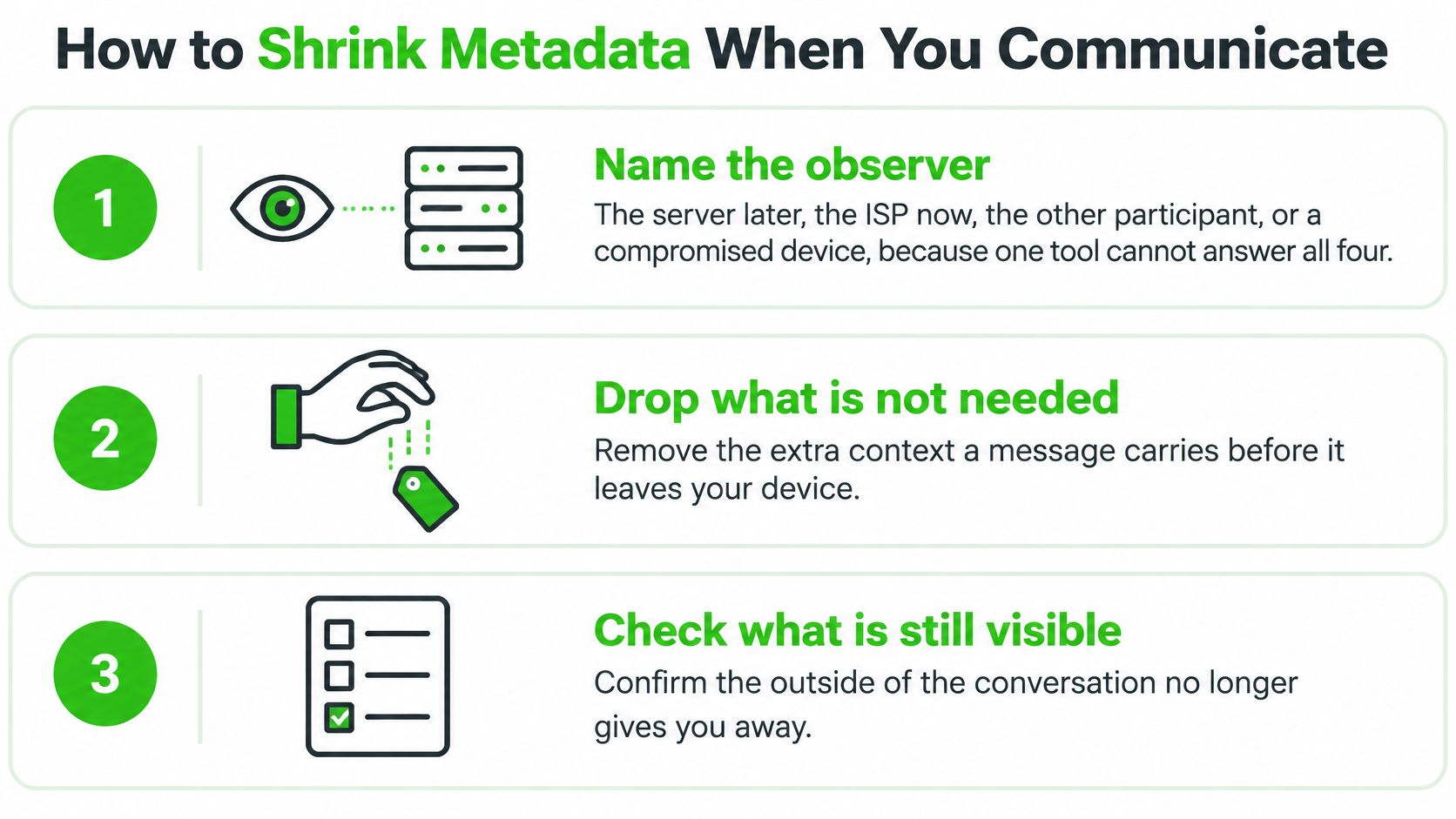
Choose protections in threat order
Name the observer. Write down whether you're concerned about the server later, the ISP now, the other participant, or a compromised device. If you name several, give each a separate control. The cost is preparation, but it prevents buying network privacy when your actual problem is an untrusted endpoint.
Drop unnecessary persistent identity. For a one-off exchange, don't supply a phone number, email, or reusable account when a session link will do. Avoid reusing the same alias across unrelated sensitive contexts. You'll lose convenient contact recovery, which may be the intended trade-off.
Choose a known expiry instead of an archive. Agree beforehand on what must survive and what should disappear. Don't defeat an ephemeral channel by copying its contents into a shared notebook automatically. Where professional obligations require records, use an approved recordkeeping workflow instead.
Treat the browser as part of the exposure. A 2025 cross-platform WebRTC measurement of Chrome, Brave, Firefox, and Tor found that ICE could disclose internal or public network information, with Chrome described as the most leakage-prone and other browsers exposing different identifiers. Review extensions, site permissions, and the actual transport used. WebRTC findings don't establish that a WebSocket-only voice implementation has the same ICE exposure.
Change the network path when the network is the threat. A VPN shifts trust toward its operator; Tor offers a different routing model and may introduce more friction or connectivity problems. Neither makes an infected device safe. Test the intended browser and network combination before asking a source to depend on it.
Add traffic-shaping defenses only when justified. Padding, uniform file chunks, batching, and bounded timing jitter can make activity less distinctive when the application implements them. They also consume bandwidth or delay delivery. You can't reliably bolt these properties onto an arbitrary chat service merely by changing a browser setting.
Separate access delivery from conversation delivery. Share the access secret through a separately trusted path, verify the recipient, and end the session when its purpose is complete. The extra coordination costs convenience. It also reduces the chance that a forwarded invitation alone gives someone everything needed to join.
Test the workflow before it matters
A clean browser profile can reduce extension and stored-state exposure, but it isn't proof of anonymity. Close unrelated sensitive tabs, remove unnecessary permissions, and confirm that both participants understand what disappearing messages do and don't erase. The recipient can still copy material.
For a broader cleanup routine, use the guide to reducing your digital footprint alongside these session-specific decisions.
Use the following video as a prompt to review your own communication setup before a sensitive exchange.
Before sending the invitation, confirm three things: you aren't supplying an unnecessary identity, you know when the session ends, and your network path matches the observer you're trying to frustrate.
Pick a Conversation That Leaves Less Behind
Choose by situation, not by brand. An ongoing team discussion, a large group, or a matter requiring a durable archive needs a different workflow from a short confidential first contact. Keep an appropriate encrypted messenger or approved communications system when continuity and recordkeeping are part of the job.
A short exchange between people who don't want to swap phone numbers is a narrower case. Here, reducing identity collection and enforcing an end point can matter more than searchable history, account recovery, or permanent membership.
Where our short-session model fits
Ciphar fits that short, no-account case. Our browser creates the channel name and access key locally, and messages leave the device as ciphertext. Each channel is a one-time session that expires 60 minutes after creation, with no extension or archive.
Our retention policy is explicit: we keep no logs, no history, and no retained data. During an active session, the relay holds the encrypted material needed to operate it. In response to lawful process, we can provide only encrypted blobs still inside the expiry window because we hold no plaintext, keys, or message history.
Those properties don't hide IP addresses from the network or make the browser immune to compromise. We aren't a long-term messenger, and we're the wrong choice for regulated communications requiring audit trails or message archival. Our security model and privacy policy document the weaknesses rather than promising universal anonymity.
A conversation can leave less evidence without becoming invisible to every observer.
Make the ending part of the agreement
Before starting, agree on what you're trying to accomplish and whether either participant needs an authorized record. If mandatory retention applies, don't use disappearance as a substitute for compliance. Healthcare and legal contexts require that decision before sensitive material is shared.
For an appropriate short exchange, the workflow is direct: create the channel, share the access key through a separate trusted path, talk, then burn the channel or allow it to expire and close the tab. Read the written threat model before relying on it for a high-stakes contact.
The useful outcome isn't a sweeping claim of anonymity. It's a deliberate reduction in the identities collected, the history accumulated, and the evidence left with the operator.
Ciphar offers browser-based, encrypted conversations without an account or phone-number exchange, with a fixed expiry rather than a permanent archive. Visit Ciphar to review the security model and create a short-lived channel when minimizing retained metadata fits your next conversation.