57.6% of surveyed IT and security professionals said they'd been instructed to keep a breach confidential even when they believed it should be reported, according to Bitdefender's global cybersecurity survey. That finding exposes an important distinction: confidentiality can protect people, but secrecy alone doesn't establish responsible security.
A security communication platform should make its protections inspectable. Who can read the conversation? What records survive? Can someone identify the participants without reading a message? Those questions matter more than an encrypted badge, especially when the fact of contact is itself sensitive.
What a Security Communication Platform Protects
A security communication platform is a service for exchanging encrypted messages, files, and voice, ideally built around participant-controlled content, minimal retained records, and minimal identity collection. Think of a sealed courier bag: the courier transports it without opening it or keeping a copy. The analogy has a limit, though. A courier might still observe the sender, destination, and delivery time.
Verizon's 2025 Data Breach Investigations Report executive summary analyzed 22,052 security incidents, including 12,195 confirmed breaches, found human involvement in approximately 60% of breaches, and reported that third-party involvement doubled from 15% to 30%. Those findings support a practical design principle: don't make confidentiality depend entirely on careful users or an uncompromised supplier.
The illustration captures the separation between possessing encrypted material and possessing the means to open it.
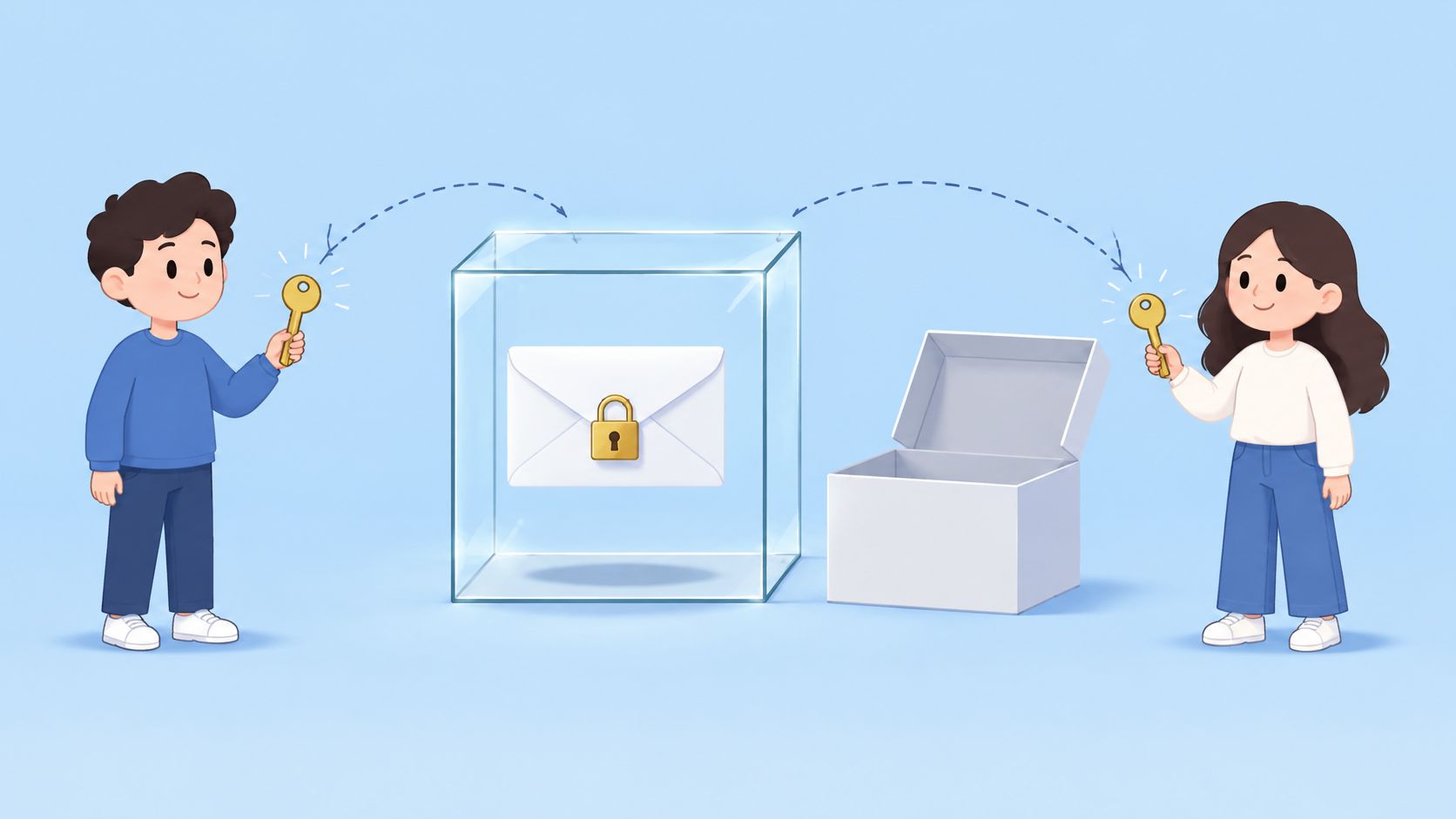
Core protections and the risk each one reduces
The following controls describe our short-lived channel model, not a checklist that every service calling itself secure necessarily satisfies.
| Protection | How It Works | Risk It Reduces |
|---|---|---|
| End-to-end encryption | Messages are encrypted in the browser with AES-256-GCM before leaving the device | Reading content in transit or at the server |
| Integrity tags | An authentication tag is checked during decryption | Silent tampering with messages, files, or voice frames |
| Identity minimization | No account, email, phone number, or persistent identifier is required | Directly linking a conversation to a real-world identity through registration records |
| Ciphertext-only relay | The server holds ciphertext, IVs, tags, expiry information, and a channel salt, not decryption keys | Plaintext exposure after a server breach or legal demand |
| Fixed expiry | The channel self-destructs after 60 minutes without an archive | Long-term retention of conversation records |
| Manual burn | Any participant can wipe the channel immediately | Continued server-side exposure after suspected compromise |
Transport encryption isn't the same as end-to-end encryption. A protected connection to a server doesn't, by itself, prevent that server from reading content. In our model, the server doesn't hold the key, so it can't hand cleartext to an employee, attacker, or court.
Our design goal is that a database leak, theft, subpoena, or state-actor exfiltration yields nothing useful. Treat that as a design objective, not a guarantee that stolen ciphertext has no analytical value.
Match the control to the adversary
For a stolen server database, prioritize key separation and retention limits. For unwanted identity disclosure, examine registration requirements and connection metadata. For a compromised device, neither server deletion nor encryption can protect text while an attacker watches the screen.
Network administration remains a separate responsibility. Purple's guide to securing corporate wireless networks is a useful companion for teams evaluating the network carrying their communications, rather than treating application encryption as a replacement for network security.
How a Secure Channel Works From Start to Finish
A secure channel resembles a locked room whose key is handed over privately. The room's address tells someone where to go; possession of the correct key determines whether they can enter. Keeping those functions separate is central to using the channel safely.
This workflow shows the participant-facing sequence before the underlying cryptography becomes relevant.
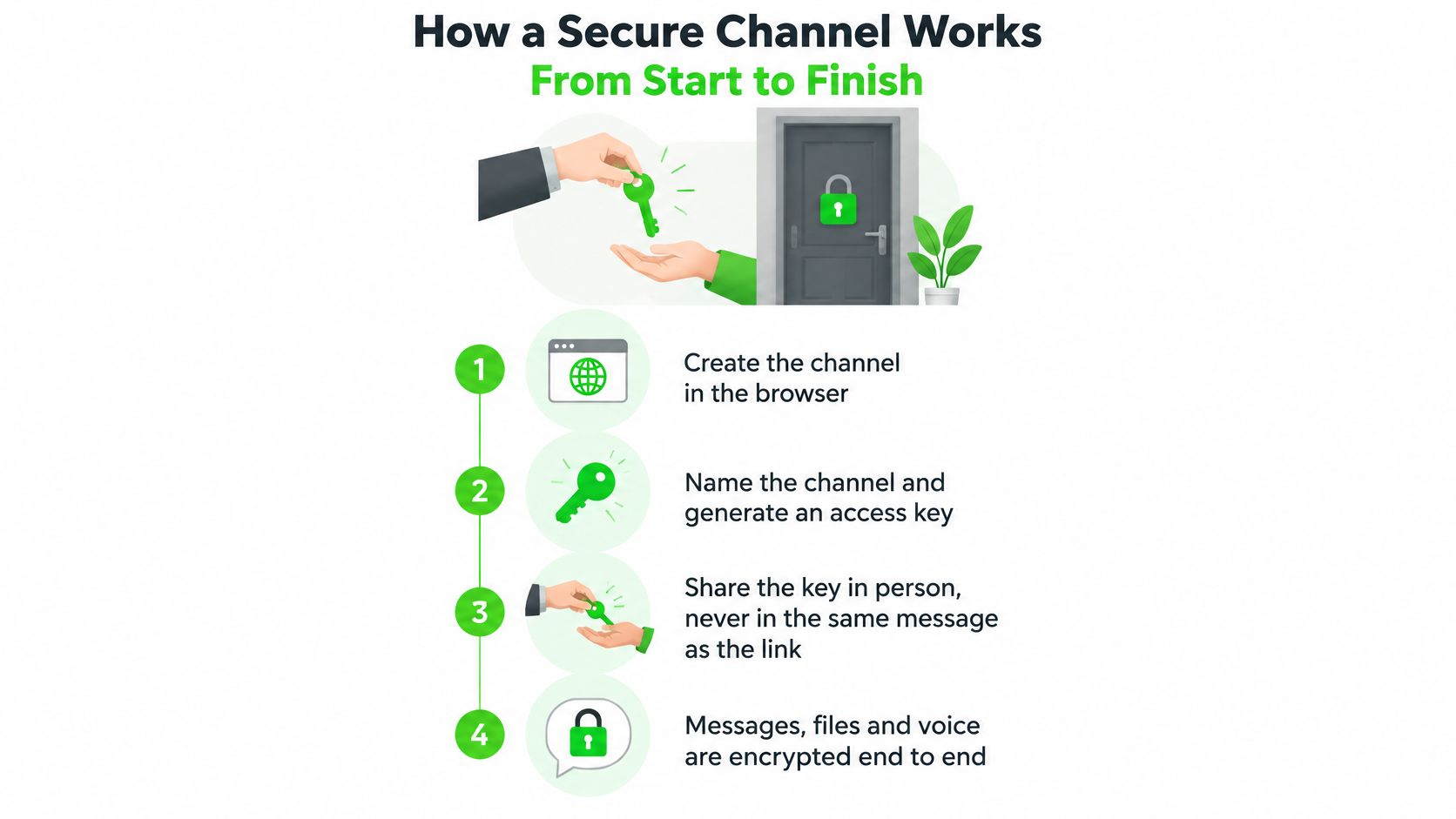
From initialization to verified delivery
Create the channel in the browser. Click Initialize Secure Channel, choose a human-readable channel name, and establish an access key. Use a neutral name rather than a client name, medical condition, or investigation title.
Separate the invitation from the secret. Share the channel link and access key through different trusted media, preferably handing over the key in person when practical. If the recipient receives an unexpected invitation, they should verify it before proceeding.
Derive and verify the encryption key locally. Each browser uses PBKDF2-HMAC-SHA-256 with 100,000 iterations and a per-channel salt to derive the AES key. Admission requires successfully decrypting an encrypted test blob, so a wrong key doesn't admit the participant.
Encrypt each item before transmission. Messages, files, replies, edits, and voice frames use AES-256-GCM with a fresh, unique initialization vector, or IV, for each encryption under the same key. IV reuse can undermine confidentiality and authentication, as the mechanism specified in NIST's GCM recommendation makes clear.
Relay opaque data rather than readable content. The relay holds encrypted material and the information needed to deliver and expire it, including IVs, tags, salt, and expiry timestamps. Passwords, derived keys, and cleartext messages or files never reach it.
Authenticate before displaying. The receiving browser must verify the authentication tag before releasing plaintext. A failed verification must result in rejection, not a best-effort display of possibly modified content.
End the session deliberately. The channel ends at its fixed deadline or when a participant burns it. There's no recovery mechanism, so confirm any necessary next steps before ending the exchange.
What participants and implementers should check
A healthy session means the intended recipient joins, a harmless test message arrives correctly, and both sides understand when access ends. Unexpected admission failures or unreadable content are reasons to stop and verify the invitation, not to bypass a warning.
Implementers should also authenticate context such as channel identity, message type, sequence, and expiry alongside ciphertext. That helps prevent undetected movement of encrypted material between contexts; encryption alone shouldn't be mistaken for complete replay protection.
For teams testing application traffic, the GoReplay guide to safe traffic replay provides related context for distinguishing encryption from masking. Don't move sensitive production conversations into debugging or replay systems because the original transport was encrypted.
The accompanying video provides another way to review the workflow.
Metadata and Access Keys
Content confidentiality doesn't equal relationship confidentiality. Encryption can conceal a message while an observer still learns that someone connected, how frequently they returned, and whether their activity coincided with another person's.
The UC Berkeley secure-communications panel recap identifies communication frequency and traffic correlation as informative, while noting the technical cost of stronger protection against identifying communicants. For a journalist, lawyer, or healthcare professional, that distinction can change the threat assessment even when the message encryption works perfectly.
Threats, what they can see and what remains exposed
| Threat | What It Can See | What Limits Exposure | What Remains Open |
|---|---|---|---|
| Breached relay | Ciphertext, IVs, tags, salts, and expiry times | No keys or plaintext on the server | Timing and connection patterns observable during compromise |
| Compelled operator | Retained encrypted blobs only | No plaintext, keys, or readable message history; blobs expire on a one-hour clock | Records held by networks, invitation services, or participants |
| Network observer | Connection timing, volume, and frequency | End-to-end content encryption | Inferences about who communicates with whom and how often |
| Stolen ciphertext with offline guessing | Test blob, salt, and encrypted material | PBKDF2 derivation and high-entropy access keys | Weak or predictable human-chosen keys |
| Malicious participant | Everything shared with them in the channel | Admission requires successful key verification | Screenshots, copies, recordings, and external notes |
A breached relay and a compelled operator face the same central content limitation: neither receives a decryption key through the intended workflow. Our lawful-process response can therefore provide only the encrypted blobs still present, not cleartext or a recoverable conversation archive. That doesn't control what another service retained when participants distributed the invitation.
A network observer poses a different problem. Removing registration records doesn't hide endpoint connections or prevent correlation of simultaneous activity. Our explanation of what metadata means helps distinguish those observable traces from message contents.
Why access-key strength matters
An attacker with stolen ciphertext doesn't necessarily need to contact the live service. They can derive candidate keys and use the authentication result to check guesses against the encrypted test blob.
Our derivation setting is a compatibility baseline, not a high-assurance benchmark: OWASP's Password Storage Cheat Sheet lists 600,000 iterations for PBKDF2-HMAC-SHA-256 when FIPS-validated PBKDF2 is required, compared with our current 100,000. Higher work factors should be evaluated on representative mobile browsers, with versioned parameters allowing upgrades.
Generate a high-entropy access key. A memorable channel name isn't a substitute, and online rate limits don't materially stop offline guessing. A malicious participant, meanwhile, already has legitimate access; stronger derivation won't prevent them from copying what they receive.
No telemetry and enforced deletion reduce retained evidence. They aren't proof of anonymity.
Operational choices outside the chat deserve equal scrutiny. If meeting coordination includes live location, consult the 3rd-i live location setup guide as a separate workflow and decide whether sharing location is necessary at all.
Our security model and privacy policy document weaknesses rather than treating zero knowledge as a universal guarantee. Use neutral channel names, inspect previews and recordings, and consider trusted networks or lawful privacy tools when contact itself needs protection.
Choosing Between Ephemeral, Messenger and Archived Tools
Identity, retention, and recordkeeping determine which category fits. Start with the workflow you need, not the encryption label.
| Platform Type | Identity Needed | Message Retention | Best Fit | Poor Fit |
|---|---|---|---|---|
| Identity-free ephemeral channel | No registration identity; access key shared separately | Deleted at 60 minutes or on burn | One-off sensitive exchanges | Ongoing relationships and groups |
| Consumer end-to-end messenger | Usually a phone number or account; requirements differ by service | On devices, often with optional disappearing timers | Everyday private chat with known contacts | First contact requiring no account exchange |
| Enterprise archived messaging | Corporate account | Retained under organizational policy and legal hold | Regulated records and audit trails when appropriately configured | Source protection from organizational administrators |
| PGP-style encrypted email | Email address and key pair | Persistent in mailboxes unless removed | Asynchronous exchanges with established contacts | Non-technical users needing quick setup |
These are category-level patterns, not promises about every implementation. A consumer messenger may support usernames, for example, while an enterprise deployment still needs appropriate configuration before it can meet an organization's recordkeeping requirements.
The cost of having no archive
An ephemeral channel removes a persistent destination for future conversation. That can be useful when exchanging identity creates unnecessary exposure, but it also removes continuity, recovery, and a convenient shared record.
Suppose an incident responder needs to hand over a sensitive finding before moving remediation into an approved ticketing system. A temporary channel may suit that initial exchange. It won't replace the ticket containing assigned owners, decisions, and evidence needed for follow-up.
Our service isn't a long-term messenger, group chat, file store, or collaboration tool. Those exclusions matter: a workflow requiring searchable decisions or continuing group coordination needs a different category, not a workaround around deletion.
Decision rule: Choose deliberate disappearance only when losing the conversation is an acceptable outcome.
For a broader category comparison, our encrypted messaging guide considers alternatives rather than assuming that the shortest retention always wins.
Questions that change the choice
- Identity: Do I need the other person's established identity for this exchange?
- Records: Must I preserve the conversation or its attachments?
- Continuity: Will we need an ongoing conversation in the same place?
As a practical screening heuristic, multiple yes answers point toward a different category. A need to authenticate the recipient doesn't itself require a persistent account, but recurring identity checks and continued work can make an established messenger more suitable.
Use an identity-free, short-lived channel when exchanging identity adds risk, the content is sensitive but brief, and no archive is required. Don't choose it for regulated communications needing audit trails or archival. Our platform hasn't been formally assessed against HIPAA, GDPR data processing agreements, PCI-DSS, or similar regimes, and isn't compliant with them.
Identity-Free Conversations in Real Professional Work
A journalist receives an offer from a source who won't share a phone number. The journalist supplies a neutral channel link; the source receives the access key through a separately trusted route. They discuss how to validate a document without creating a new account-based connection.
The useful protection is narrow but meaningful: neither person needs to disclose a registration identity to the chat service. The invitation's original delivery route may still establish contact, so the journalist should avoid identifying labels and agree beforehand on what can be retained. If reporting continues beyond the session, they need a separate plan for further contact rather than assuming the channel will remain available until publication.
This illustration shows the intended exchange, not a promise that an outside observer can't infer contact.
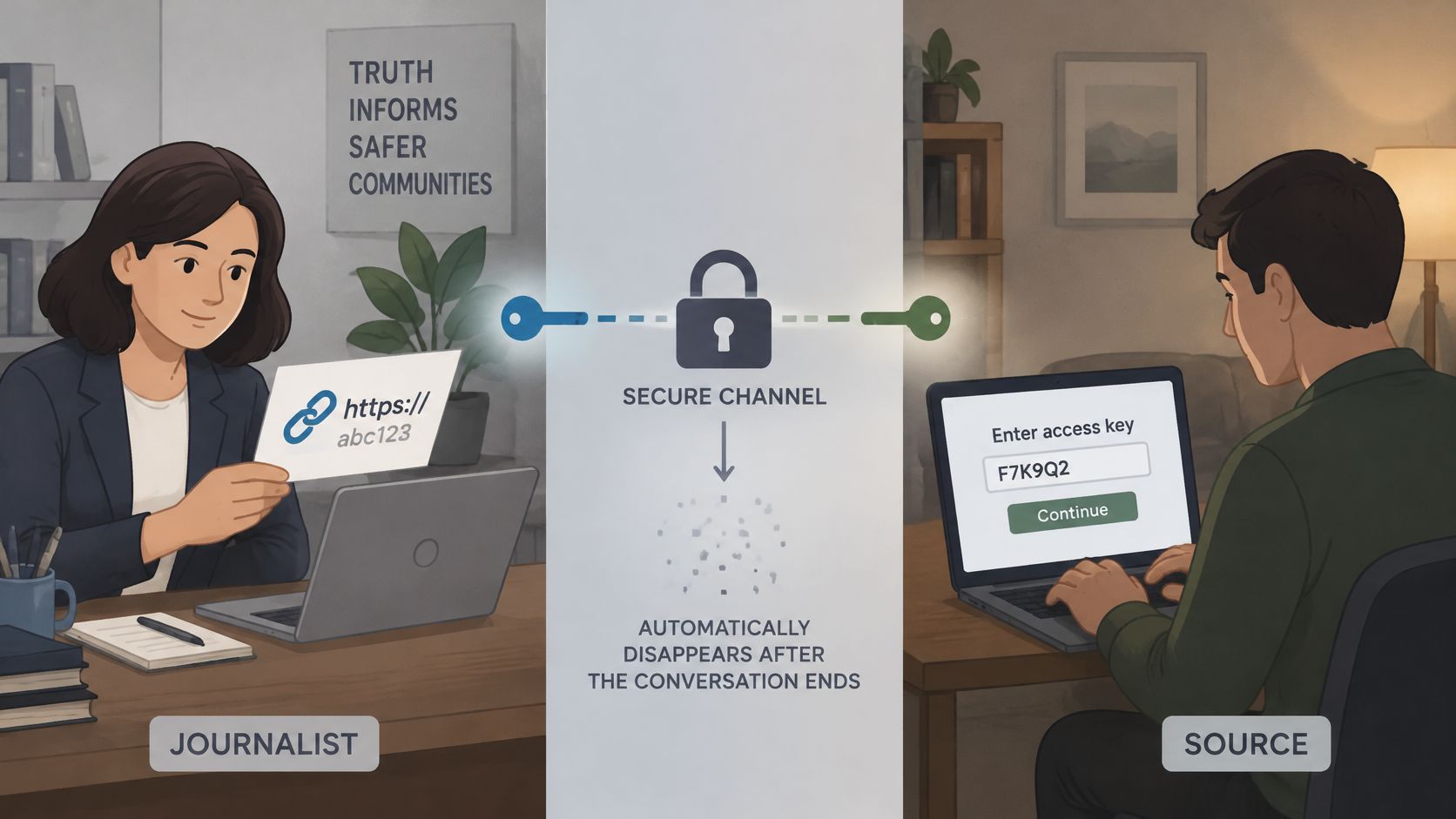
Different professions, different boundaries
For a lawyer briefing a client, the immediate need might be to explain a sensitive development without inviting the client into a persistent consumer account relationship. Before sharing the invitation, the lawyer should authenticate the client through an established method and decide which advice or instructions belong in the authorized matter file. A temporary conversation doesn't determine privilege or remove professional recordkeeping duties.
For a healthcare professional, a difficult-case discussion may involve details that shouldn't be distributed broadly. Identity-free access doesn't establish that a recipient is authorized, and removing names doesn't automatically make the exchange suitable for a regulated clinical workflow. The practical step is to obtain organizational approval for the communication method first; where compliant records are required, use the approved clinical system instead.
For a security researcher, a temporary exchange can help clarify a vulnerability with a verified recipient before formal disclosure. A technical contact might discuss the affected component without uploading an entire production dataset. The researcher should minimize the sample and agree on an authorized disclosure record, rather than interpreting a disappearing session as an off-the-record agreement.
Protect the next action too
Our listed use cases include journalists and sources, lawyers and clients, healthcare professionals, and security researchers. The underlying purpose also includes moments when a person under threat reaches out for help, where the recipient should consider whether notifications, a shared device, or the invitation itself could increase danger.
- For source contact: Use our journalist source-protection guidance to plan the invitation and follow-up, not just the conversation.
- For sensitive coordination: Decide what happens after the exchange before sending confidential material.
- For other professions: Apply the same suitability test: short, sensitive, and no required conversation archive.
Human Mistakes and a Pre-Use Checklist
A rushed participant can defeat a sound cryptographic design without breaking the encryption. The ACM human-factors study examines factors including stress, cognitive overload, trust, persuasion, and organizational culture, reinforcing why usable security instructions belong in the protection model.
Mistakes to prevent before sending
- Sending the key with the link: Anyone who obtains that message has both entry requirements. Send the key through a different trusted medium.
- Posting an invitation publicly: Unintended people can attempt access. Share only with a verified recipient and use a fresh, unpredictable key.
- Treating expiry as recovery time: Deletion doesn't leave an opportunity to retrieve forgotten material. Identify required records before starting and preserve them only in an authorized system.
- Assuming encryption blocks screenshots: A recipient can capture visible content. Agree on handling expectations, but don't mistake agreement for technical enforcement.
- Delaying a burn: Suspected compromise is a reason to terminate the channel immediately. If a device is compromised, move to a trusted device before establishing another session.
- Ignoring a failed-access alert: The notice shows that an access-key guess happened, not who made it. Our alerts contain no IP address, fingerprint, or identifier; verify with the intended recipient before deciding whether to continue.
The checklist visual highlights behaviors that need deliberate attention under pressure.
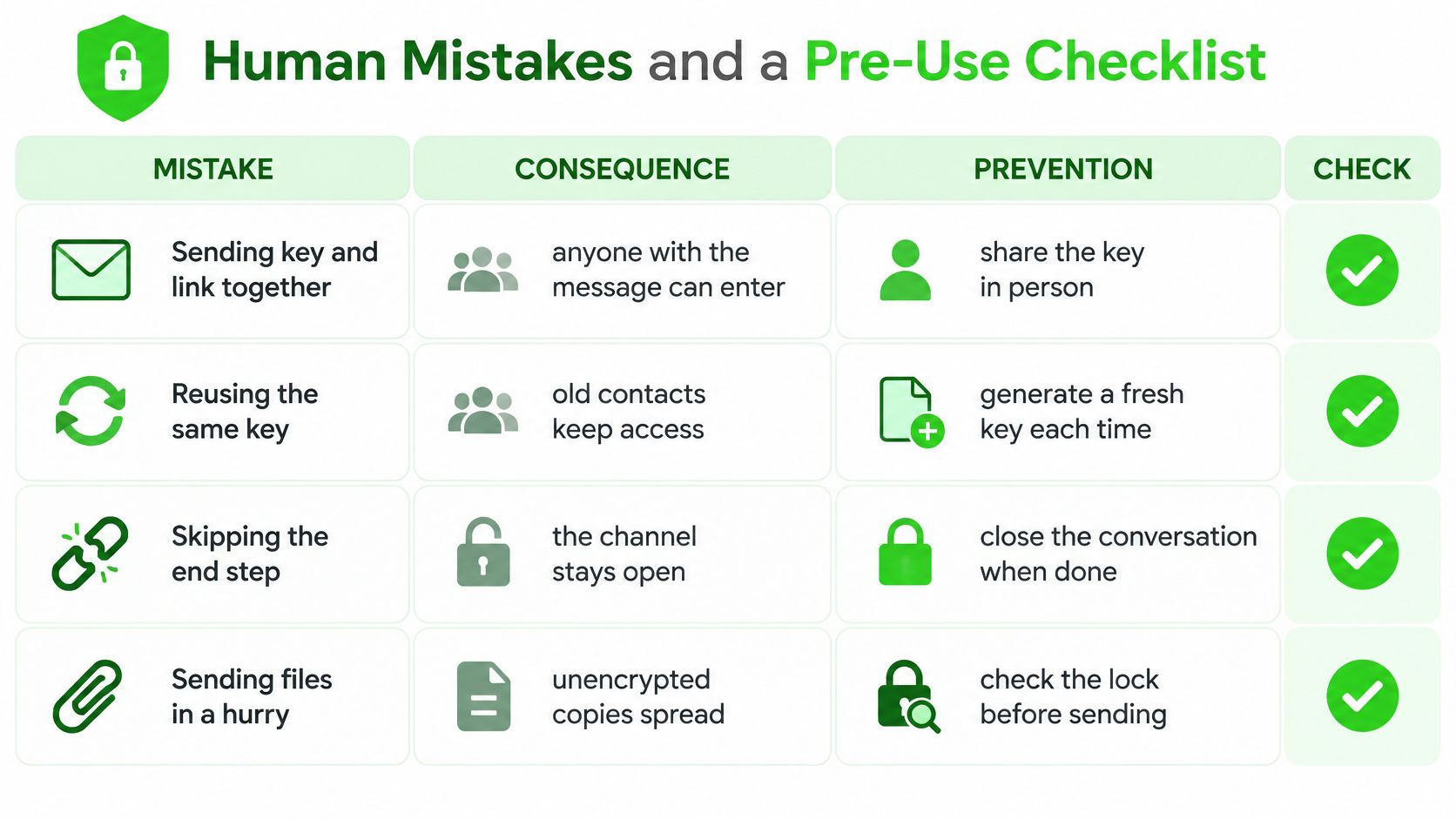
Closing a browser tab isn't the same as burning the channel. Likewise, a file's encryption during transfer doesn't remove copies already stored on either participant's device.
Run a low-stakes rehearsal
- Verify the recipient through an established contact method before sending the access key.
- Identify required records and the approved place to preserve them separately. If the conversation itself must be archived, choose another tool.
- Agree who will burn the channel and what event should trigger immediate termination.
- Send the access key separately from the invitation link, using a different trusted medium.
- Test before disclosing. Open the channel initialization page, exchange a harmless message, and confirm with the recipient that it arrived correctly. Send sensitive material only after that test succeeds.
Ciphar offers browser-based, identity-free conversations with client-side encryption and a fixed self-destruct deadline, designed for brief exchanges that don't need an archive. Visit Ciphar to rehearse the invitation, separate-key sharing, and test-message workflow before relying on it for a sensitive conversation.