Consent-based SMS analytics and covertly reading someone else's private messages are not the same product category. A campaign platform can report delivery, clicks, replies, and attributed purchases because subscribers opted into communication. A surveillance app may expose texts, locations, photos, or browsing activity without the device owner's knowledge. Treating both as “text tracking” is the most popular advice on this topic, and it's also the fastest way to choose the wrong tool.
This comparison focuses on what each platform tracks and how teams implement that tracking: delivery and click visibility, attribution depth, developer control, implementation effort, audience fit, data exposure, and compliance responsibility. The list includes marketer-friendly platforms, developer-first messaging APIs, ecommerce attribution suites, and specialized tools for fundraising and political communication.
Text tracking apps don't automatically become appropriate for personal surveillance because they offer read receipts, location features, or message history. The text message campaign tracking guide is useful for understanding campaign measurement, but sensitive conversations need a different design goal. When identity exchange and permanent message history create unnecessary risk, a short-lived, identity-free encrypted channel can be safer than adding another monitoring layer.
1. SimpleTexting
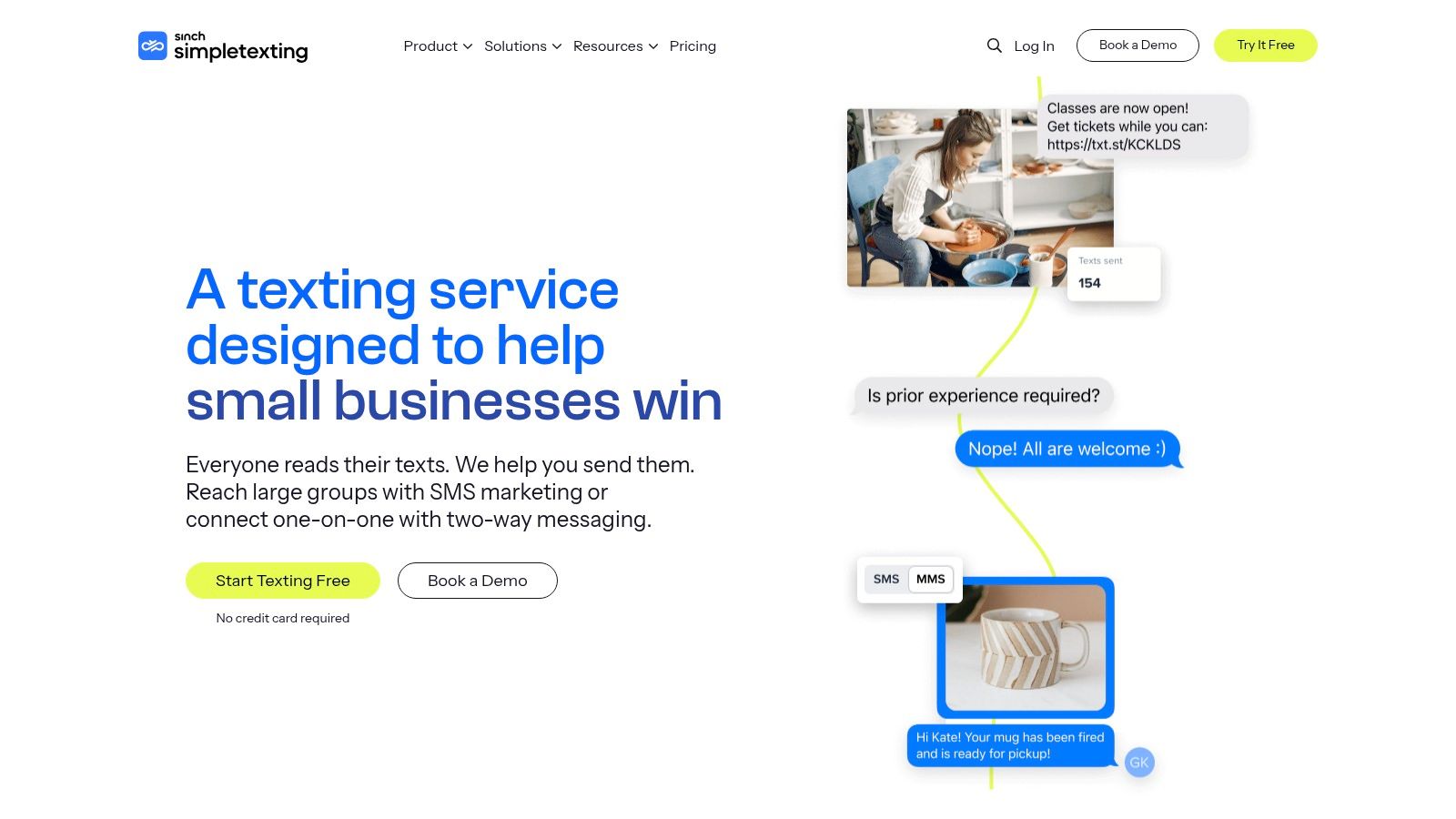
SimpleTexting is a practical starting point for small and midsize teams that want campaign reporting without building a messaging system. Its tracking model is primarily campaign analytics: marketers can use trackable shortlinks, review delivery and click activity, monitor replies, and segment lists. The two-way inbox adds conversational context, while automations support recurring or event-triggered communication.
That combination makes the platform easier to operate than a raw communications API. A non-technical team can create a campaign, attach a tracked link, compare response activity, and continue the conversation from the same interface. The REST API gives developers a route to programmatic sending, although the product is still oriented toward marketer-controlled workflows rather than highly customized application logic.
What it tracks and what it exposes
SimpleTexting can help answer whether a campaign reached recipients, whether they clicked, and whether they replied. That's useful for measuring engagement, but a click isn't proof that a person read the full message, understood it, or gave valid consent. The platform's inbox and analytics also create an operational record that should be governed with retention and access rules.
- Best fit: SMB marketing, customer updates, event reminders, and two-way campaigns.
- Main limitation: Credit-based billing may require careful forecasting, and developer customization is less extensive than with a CPaaS.
- Implementation checkpoint: Define which links need tracking, who can access replies, and when campaign-level metadata should be deleted.
For scheduled outreach, teams should separate sending time from tracking policy. A workflow described in this guide to sending a text at a certain time can help with timing decisions, but scheduling shouldn't become an excuse to retain message data indefinitely.
2. SlickText
SlickText puts audience growth and ease of use ahead of deep developer control. Its trackable links can use the platform's short domain or a custom domain, and campaign dashboards provide visibility into clicks and list activity. Keyword-based growth tools, autoresponders, MMS support, and a mobile app make it accessible to teams that don't want to manage a complex implementation.
The important distinction is that SlickText mostly measures campaign response, not the contents of a person's private message history. A marketer can associate a click or reply with an opt-in campaign, but that doesn't justify collecting unrelated conversations or using engagement data to infer sensitive personal behavior.
Where the simplicity helps
SlickText's onboarding model suits organizations that need to launch quickly and train occasional users. A team can create a keyword acquisition flow, connect an autoresponder, and inspect campaign performance without first building a data pipeline. Nonprofit discounts and tiered plans may also make planning easier for smaller organizations, though teams should still review the current terms before committing.
Its limits appear when attribution becomes more complicated. Heavy ecommerce programs may need richer revenue paths, custom event schemas, or more extensive API control than the native reports provide. The platform can show that a recipient clicked, but connecting that action to an offline purchase or a multi-touch customer journey may require additional systems.
Practical rule: Use a tracked link to measure an intentional campaign action, not as a justification for monitoring unrelated personal behavior.
- Best fit: Non-technical SMB teams focused on list growth and straightforward campaigns.
- Main limitation: Advanced ecommerce attribution and enterprise controls may require workarounds.
- Implementation checkpoint: Test custom-domain redirects, opt-out handling, and the exact data passed into downstream analytics.
3. TextMagic
TextMagic is suited to organizations that send messages across changing volumes or regions and want a relatively direct path from setup to reporting. It supports delivery, response, and click or open tracking through a web app and API. Virtual numbers, email-to-SMS workflows, and global coverage make it useful for operational communication as well as marketing.
Its tracking model spans delivery visibility and engagement measurement. Delivery reports can indicate whether the carrier accepted or failed a message, while click and response data show what happened after delivery. Those signals should remain separate in reporting. A delivered message isn't necessarily opened, and an opened or clicked message doesn't establish that the recipient's identity was verified.
Why usage patterns matter
Pay-as-you-go options can suit irregular senders that don't want a large fixed commitment. The trade-off is that per-country rate cards and sender requirements need review before an international program goes live. Teams should also avoid assuming that a global interface creates uniform deliverability across every geography or carrier.
TextMagic's simpler segmentation and automation may be enough for alerts, appointment communication, and modest campaigns. Teams building advanced lifecycle journeys may eventually need a dedicated customer data layer or a platform with stronger ecommerce integrations.
- Best fit: Irregular senders, international outreach, and teams that need both a web interface and API access.
- Main limitation: Advanced segmentation and automation are less developed than in specialist ecommerce suites.
- Implementation checkpoint: Run delivery tests by destination and sender type, document country-specific rules, and decide how long response and click records remain available.
For high-priority alerts, an overall delivery average can conceal regional failures. A commercial benchmark across eight SMS platforms reported rates from 96.4% to 99.1%, a spread equivalent to about 1,350 additional undelivered messages per 50,000 sends at the lower rate, so teams should validate methodology and monitor performance by carrier and geography rather than treating one average as universal (commercial SMS platform benchmark).
4. Twilio Programmable Messaging
Twilio Programmable Messaging is best understood as an event-delivery layer, not a finished text-tracking app. Its status callbacks can send queued, sent, delivered, and failed events to a webhook. Messaging Services, sender options, console logs, and compliance documentation then let engineering teams route those events into internal tools.
That architecture supports delivery tracking and application instrumentation. A team can connect a failed message to an incident system, CRM record, or operations dashboard, then define a retry or operator alert. These signals confirm transport progress, however they do not establish that a recipient read, understood, or acted on the message. Engagement measurement and revenue attribution require application events, links, conversions, or CRM logic built around the messaging layer.
Twilio also places retention decisions with the customer. An implementation may store recipient identifiers, timestamps, message bodies, webhook payloads, and campaign metadata unless engineers limit collection and access. Webhook control therefore improves observability while creating more internal locations where personal communications can be exposed. It should support campaign analytics, not become a general-purpose system for surveilling private conversations.
Best fit: Engineering-led organizations that need custom notification, transactional, or workflow messaging with delivery events in their own systems.
Main limitation: Development work is required for reporting, attribution, retention controls, and campaign operations. It is not a turnkey marketer interface.
Implementation checkpoint: Make webhook handling idempotent, redact message content from logs, restrict console permissions, and document carrier registration requirements before launch. Store state transitions instead of full conversations where possible.
Teams assessing an enterprise communications solution should separate this programmable delivery layer from a secure alternative such as Ciphar for short-lived, identity-free conversations. That boundary reduces the incentive to retain sensitive exchanges just because the infrastructure can capture them.
Twilio can report that a message reached a carrier or failed. It cannot verify comprehension, sender authority, or whether a private exchange should be retained. Those decisions remain organizational and legal responsibilities.
5. Plivo Messaging
Plivo Messaging is built for teams that want messaging data inside their own systems. Delivery report webhooks, console logs, reporting endpoints, CSV exports, and high-throughput APIs expose message-state data without requiring marketers to work entirely in a vendor dashboard.
Its clearest signal is transport status, not business impact. A sent, delivered, or failed event can feed operational monitoring. Custom application events can then associate a message with a support case, appointment, or workflow. Revenue attribution, audience segmentation, and campaign orchestration remain application responsibilities.
Plivo suits organizations that value control over a polished marketer interface. Developers can shape the event model around existing processes, but that flexibility shifts reporting and campaign work to the engineering team.
Pricing may appear attractive for some US sending patterns, yet a headline rate does not define the final operating cost. Carrier fees, sender registration, number requirements, message type, and geography all affect implementation and budgeting.
Best fit: Developers building custom notification, support, or transactional messaging systems.
Main limitation: Marketing logic and attribution are not turnkey. Small teams may need development support before they can launch and analyze complex campaigns.
Before launch, define failure categories and test delivery callbacks during retries or delayed carrier responses. Export only the fields required for the operational use case, and decide whether logs need message content at all.
Plivo also demonstrates why delivery tracking isn't engagement tracking. Delivery events support reliability analysis, while clicks, replies, conversions, and consent require separate event definitions. Combining these signals into one performance measure can conceal failures and encourage unnecessary collection of personal data.
For short-lived, identity-free conversations, teams can evaluate Ciphar as a separate secure alternative rather than retaining private exchanges in a campaign system. That separation keeps legitimate campaign analytics distinct from personal-message monitoring.
6. EZ Texting
EZ Texting suits small and midsize businesses that want to launch SMS or MMS campaigns without building a reporting system. Its visual tools cover delivery status, clicks, replies, keywords, signup flows, and campaign management through web and mobile interfaces. That makes it useful for broadcast promotions and basic two-way communication, though its tracking remains focused on campaign activity rather than deep attribution.
A delivery report answers whether a message reached its destination. Click and reply reports show engagement. Neither signal proves a purchase, and neither justifies retaining unrelated personal conversations.
EZ Texting lowers setup effort through built-in messaging, segmentation, and billing workflows. The trade-off appears in forecasting: credit systems and add-ons can make costs less predictable when MMS and other message types use different consumption rules. Teams should model their actual message mix before committing to a recurring process.
The platform fits Best fit: local businesses, service providers, and SMB teams running straightforward SMS or MMS campaigns. Its Main limitation: developer controls are narrower than those offered by API-first communications providers, which can restrict granular webhooks, custom event schemas, and carrier-level diagnostics.
Use this Implementation checkpoint: document each keyword, opt-out route, reply destination, and conversion event before launch. Test reply routing, confirm who can export reports, and decide whether campaign logs need message content or only event status. If revenue attribution matters, connect campaign links or replies to a separate conversion record instead of treating clicks as sales.
For short-lived, identity-free conversations, Ciphar can serve as a separate secure alternative. Keeping those exchanges outside campaign analytics helps distinguish legitimate engagement measurement from invasive personal-message monitoring. The smallest useful data set is usually the safest: retain the delivery, click, or reply fields needed for the campaign, then apply a defined retention rule.
7. Telnyx Messaging
Telnyx Messaging targets technical teams that need messaging APIs, delivery receipts, number inventory, and carrier-oriented controls. Webhooks expose delivery events, while local, toll-free, and short-code senders support different communication models. WhatsApp and email extend the platform beyond SMS.
The product tracks operational events well: whether a message was accepted, delivered, failed, or answered. It can also pass inbound activity into internal systems for engagement measurement. That does not make it a campaign analytics suite. Click, conversion, and revenue attribution require separate links, event schemas, and reporting logic.
Infrastructure visibility creates implementation work
Machine-readable pricing and carrier-level visibility help teams examine routing and forecast usage. The same flexibility shifts responsibility to developers. They must configure consent and opt-out flows, define segmentation, connect conversion events, and decide whether logs should contain message bodies or only delivery status.
- Best fit: Technical organizations managing routing, sender identities, webhooks, and custom messaging workflows.
- Main limitation: Campaign dashboards, engagement analysis, and attribution must be built or connected separately.
- Implementation checkpoint: Map the path from send and inbound reply to report. Remove unnecessary identifiers, test sender behavior by destination, and verify webhook retries and access permissions.
Telnyx suits infrastructure-led programs more than teams seeking an immediate marketing dashboard. Its broader channel support can help when SMS shares a system with WhatsApp or email, although each channel still needs its own delivery and conversion definitions.
Keep campaign analytics separate from personal-message surveillance. Review which identifiers, callback payloads, message bodies, and access logs enter internal systems, who can retrieve them, and when they are deleted. For short-lived, identity-free conversations, Ciphar provides a separate secure alternative, reducing the need to retain personal content in campaign tooling.
8. Attentive
Attentive serves ecommerce organizations that need to connect SMS activity with commercial outcomes. It combines branded shortlinks, UTM management, rolling attribution windows, revenue reporting, segmentation, two-way messaging, and orchestration across SMS, email, push, and RCS. Data exports and postbacks can carry results into a broader marketing stack.
Its central measurement is attribution depth. Attentive can help teams examine whether a message preceded a click, session, or purchase within a configured window. That makes it different from tools focused mainly on delivery monitoring or carrier diagnostics. The result still depends on the measurement model. Attribution can allocate credit to a message without proving that the message caused the transaction.
The practical question is who sets the rules.
Before reading a revenue dashboard, an ecommerce team should document the attribution window, conversion event, and crediting method. A broad window, or several messages sent to the same customer, can produce commercial credit that a finance or analytics team would assess differently. Clear rules improve interpretation, but they do not establish individual intent, comprehension, or consent.
Attentive fits upper-midmarket and enterprise ecommerce teams running multiple channels with mature data operations. Quote-based pricing and the implementation work make it less suitable for small programs. The implementation checkpoint is specific: reconcile reported conversions with store data, record the chosen attribution rules, and restrict access to customer-level reports.
Identity handling also requires review. Teams can consult this guidance on phone number privacy when campaign reporting may expose more personal information than measurement requires. For short-lived, identity-free conversations, Ciphar offers a separate secure alternative.
Attentive can measure commercial response. It should remain campaign analytics, not a system for monitoring private messages. Its revenue reports should not be treated as evidence of a customer's private motivations.
9. Postscript
Postscript is designed for Shopify merchants that connect SMS activity with store data. It supports segmentation, automation, branded shortlinks, configurable attribution windows, and revenue reporting. Popups and compliance tools also support list growth and consent workflows within the Shopify ecosystem.
Delivery and click events show whether a message reached a recipient and generated engagement. Postscript adds a commercial layer through store-linked attribution, helping merchants assess whether an SMS interaction coincided with Shopify activity. That makes it more relevant to retention and revenue teams than to organizations seeking carrier diagnostics or general notification infrastructure.
Shopify creates both the product fit and its boundary. Customer and purchase context already sit in the merchant's primary commerce system, which can reduce integration work. Businesses using another commerce platform, selling mainly offline, or coordinating several systems through a neutral communication layer may gain less from the specialization.
Best fit: Shopify merchants measuring SMS-driven revenue and retention activity.
Main limitation: Its usefulness declines outside Shopify, and carrier fees may be passed through separately.
Implementation checkpoint: Reconcile reported attribution with Shopify orders, set a defensible conversion window, and review which customer fields enter campaign reports.
The measurement model still needs boundaries. Attributed revenue records a purchase after, or in relation to, a message. It does not prove that the message caused the purchase, nor that a click shows the recipient read every word. Teams should separate delivery tracking, engagement measurement, and commercial attribution rather than treat them as equivalent evidence.
Postscript is a focused ecommerce tool, not a general text-tracking app or a system for monitoring personal messages. Its value rests on connecting SMS events to Shopify data. For short-lived, identity-free conversations, Ciphar provides a separate secure alternative.
10. Tatango
Tatango targets large-scale texting programs, especially nonprofits and political campaigns. Its focus is high-throughput sending, fundraising workflows, donation and engagement reporting, campaign services, and compliance guidance. Guided onboarding may suit organizations that need operational support for a large program rather than a self-serve interface.
Tatango's strongest measurement use case is campaign performance in a fundraising context. Teams can examine engagement, donation activity, and responses to campaign appeals. Those signals answer whether an opted-in campaign is reaching and motivating supporters. They should remain separate from delivery tracking, which records message status, and from message surveillance, which concerns monitoring private conversations without a defined organizational purpose.
The fit is specific. A nonprofit or political organization with fundraising or mobilization goals may benefit from workflows built around supporter operations. A small business sending occasional promotions may find the sales-quoted model, specialized setup, and credit-based billing harder to justify. Before forecasting a campaign, confirm how SMS and MMS consume credits.
Best fit: Large nonprofit and political texting programs with fundraising or mobilization goals.
Main limitation: The platform may be overbuilt for general promotional messaging, and pricing is not publicly listed.
Implementation checkpoint: Confirm consent and jurisdictional requirements, map donation attribution, and establish role-based access to supporter data.
Tatango's value depends on whether its reports answer a specific fundraising question. More fields do not automatically improve decisions if they expose additional supporter information without a clear use. Set retention limits and restrict access to campaign data.
For short-lived, identity-free conversations, Ciphar offers a separate secure alternative. That use case should remain distinct from opted-in campaign analytics and from monitoring personal messages.
Top 10 Text Tracking Apps Comparison
| Provider | Core features ✨ | Target audience 👥 | UX/Quality ★ | Pricing/value 💰 | Unique selling point 🏆 |
|---|---|---|---|---|---|
| SimpleTexting | Trackable shortlinks, campaign analytics, 2‑way inbox, API | 👥 SMB marketers, non-technical teams | ★★★★, marketer-friendly UI | 💰 Credit-based tiers, SMB-focused | 🏆 Clear reporting + strong support |
| SlickText | Trackable links (custom domains), autoresponders, mobile app | 👥 SMBs focused on list growth | ★★★★, very easy onboarding | 💰 Tiered pricing; nonprofit discounts | 🏆 Simple growth tools & app |
| TextMagic | Delivery/click tracking, virtual numbers, web app, API | 👥 Low/spiky volume senders, global SMBs | ★★★, straightforward start-up | 💰 Pay-as-you-go or monthly | 🏆 Quick international, usage-based billing |
| Twilio Programmable Messaging | Webhooks/status callbacks, Messaging Services, scalable APIs | 👥 Developers, engineering teams | ★★★★★, enterprise-grade telemetry | 💰 Usage + carrier/registration fees | 🏆 Most flexible CPaaS & ecosystem |
| Plivo Messaging | Delivery webhooks, console logs, high-throughput APIs | 👥 Developers seeking cost savings | ★★★★, utilitarian but reliable | 💰 Competitive US rates, clear docs | 🏆 Cost-competitive CPaaS alternative |
| EZ Texting | Campaign analytics, MMS, keywords, web/mobile apps | 👥 Small–mid businesses, marketers | ★★★★, turnkey visual reporting | 💰 Credit systems + add-ons | 🏆 Easy to operate for non-technical teams |
| Telnyx Messaging | Delivery receipts, number inventory, machine-readable pricing | 👥 Technical teams optimizing cost | ★★★★, developer-focused UX | 💰 Transparent a‑la‑carte pricing | 🏆 Carrier-grade pricing transparency |
| Attentive | Branded shortlinks, revenue attribution, multi-channel | 👥 Enterprise/upper‑mid ecommerce | ★★★★★, deep analytics & ROI tools | 💰 Quote-based, premium cost | 🏆 Ecommerce-first, revenue attribution |
| Postscript | Branded links, Shopify segmentation, store-driven automations | 👥 Shopify merchants | ★★★★, tight Shopify UX | 💰 Shopify-centric pricing; carrier pass-through | 🏆 Native Shopify integration & attribution |
| Tatango | High-throughput sends, fundraising reports, campaign services | 👥 Nonprofits & political campaigns | ★★★★, scale & compliance focused | 💰 Sales-quoted; credits model | 🏆 Specialized mass-texting expertise |
Choose Tracking Without Losing Control
The right tool depends on the event you need to observe. If the question is whether an opted-in campaign reached people, use a marketer-friendly platform such as SimpleTexting, SlickText, TextMagic, or EZ Texting. These tools make campaign links, replies, list activity, and basic reporting accessible without requiring a full engineering team.
If your operational system needs precise message states, choose a CPaaS such as Twilio, Plivo, or Telnyx. Their webhooks and APIs can report events such as sent, delivered, or failed, but your developers must build the surrounding logic. That includes retries, idempotency, access control, redaction, consent handling, and retention. A delivery callback is not a read receipt, and a read or click event isn't proof that someone understood the message.
For ecommerce revenue analysis, Attentive offers broader multi-channel attribution, while Postscript is more tightly suited to Shopify. These platforms can connect SMS activity to commercial outcomes, but attribution windows and credit rules need documentation. A purchase after a message isn't automatically an incremental purchase, and customer-level reporting can reveal more identity and behavior than a team needs.
Tatango fits a specialized sending model for nonprofit and political fundraising. Its niche support may justify a more guided implementation, while its sales-led approach and specialized workflows make it less suitable for ordinary SMB promotion. Choosing a niche platform only makes sense when its audience, reporting, and sending requirements match your organization.
Every implementation should begin with consent and data minimization. Tell recipients what they're opting into, provide a usable opt-out path, limit collection to the measurement question, protect report access, document retention, and delete records when the purpose ends. App-store privacy labels can help users understand broad categories of collection, but Apple describes them as disclosures about data use, not independent technical audits. Teams should also inspect permissions, background behavior, network destinations, encryption, deletion, and monitoring visibility through the Apple privacy and data-use documentation.
The safety distinction matters because covert surveillance can create a second privacy risk for the person being monitored. The FTC has described surveillance products that secretly collected texts, photos, web histories, locations, and physical movements, and it alleged that SpyFone failed to protect collected information from hackers and identity thieves (FTC enforcement discussion of stalkerware). A legitimate family, care, or enterprise tool needs visible operation, verifiable consent, clear scope, revocation, and deletion. Secret installation and indefinite retention don't become safe because a dashboard calls them tracking.
For short, sensitive exchanges, a different architecture may be more appropriate. Ciphar provides browser-based, identity-free channels that require no account, phone number, email, or installation. Its messages, files, replies, edits, and voice frames are encrypted client-side with AES-256-GCM, the server holds opaque ciphertext rather than decryption keys, and channels self-destruct after a hard 60-minute lifetime. It isn't a long-term messenger, group chat, file store, or regulated-communications tool, and it doesn't replace systems that must preserve records for legal or clinical obligations.
The decision is therefore simple but not simplistic. Choose campaign analytics for consented outreach, a CPaaS for application-level delivery states, an ecommerce suite for defined revenue attribution, and a specialized platform when the audience and sending model justify it. Choose an ephemeral encrypted channel when a conversation should avoid phone-number exchange and persistent history, then make sure that choice fits your legal, professional, and safety requirements.
Ciphar offers short-lived, identity-free encrypted conversations without accounts, phone numbers, email addresses, or installation, with channels that expire after 60 minutes. If your text exchange doesn't need campaign analytics or a permanent message trail, visit Ciphar to create a browser-based channel and share its access key out of band.