You've just received a message that could change someone's career, case, or safety. You open a familiar chat app, see a lock icon, and assume the conversation is protected. That assumption may be partly right, but it can also hide the most important questions: who can identify the participants, what communication records remain, and what happens if one device is already compromised?
Secure chat isn't “chat with encryption.” It's a communication system designed around a particular threat model, with decisions about message confidentiality, identity, metadata, storage, device security, and recovery. End-to-end encryption can keep a provider from reading message content, but it won't automatically hide who contacted whom or protect a compromised phone.
A Conversation Worth Protecting
A journalist receives an unsolicited tip through a contact form. The source doesn't want to share a name, phone number, or workplace, and asks for a private conversation. The journalist opens a familiar messenger, sends a short reply, and notices the app uses end-to-end encryption. The exchange feels safe enough to continue.
But the lock icon answers only one question: can outsiders read the message while it travels between the participants? It may not answer whether the service stores account details, records connection times, retains contact relationships, exposes IP addresses, or displays message previews in notifications. If the journalist's phone is seized, unlocked, or infected with spyware, encryption in transit won't protect the text after it reaches the screen.
A lawyer faces a similar decision during a first call with a prospective client. The client wants to describe a sensitive dispute before deciding whether to retain counsel. A standard messenger may protect the content from network interception, but the lawyer still needs to think about retention, backups, access permissions, screenshots, and whether the conversation should create a durable record.
The scale of this issue has changed. A 2026 CSIS analysis of encrypted messaging says more than 2 billion people globally use end-to-end encrypted messaging applications, and identifies WhatsApp as the largest E2EE messaging app by users. The same analysis says WhatsApp enabled default E2EE in April 2016, a milestone in moving secure chat from an optional privacy setting toward a mainstream communication standard.
The practical question isn't “does this app have a lock?” It's “what can still be learned, accessed, or recovered if something goes wrong?”
That distinction matters for anyone handling a source, client, patient, research finding, or incident. To understand what secure chat really provides, separate the protected message from the surrounding system.
Defining Secure Chat and the Threat Model
Start with the least protected form of communication. A plaintext message is like a postcard. It may pass through multiple networks and servers, and intermediaries can read it while routing it.
Encrypted transport improves the situation. A protocol such as TLS creates a protected connection between your device and a service, similar to placing the postcard inside a tamper-evident envelope for the courier journey. The service can still open the envelope when it receives it, so transport encryption protects the connection, not necessarily the message from the provider.
End-to-end encryption, or E2EE, changes who can open the message. The sender's and recipient's devices encrypt and decrypt the content, while the relay server handles ciphertext. In the sealed-letter analogy, the courier carries an envelope that only the intended recipient can open. The provider may deliver the letter, but it shouldn't possess the key.
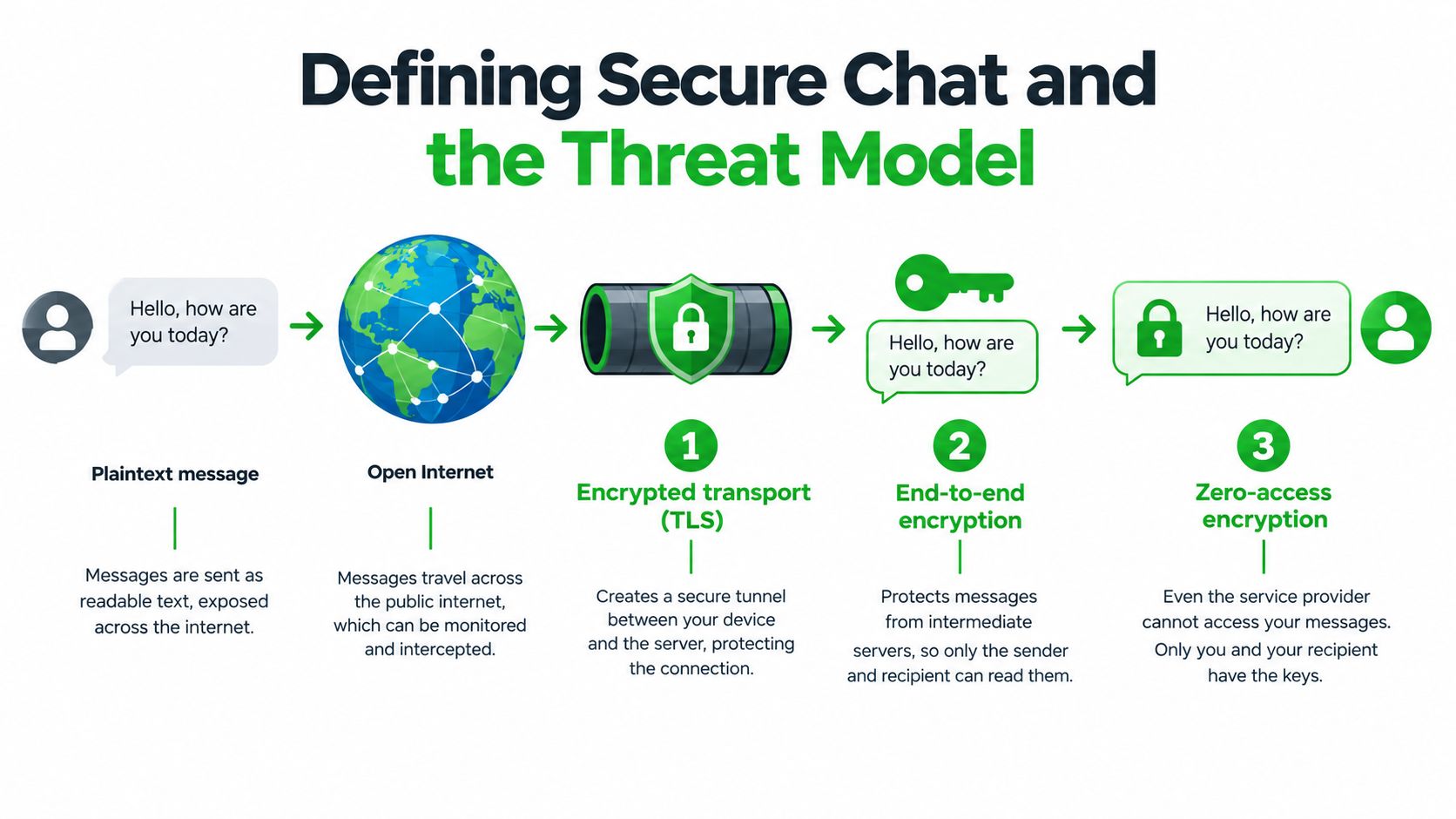
The phrase zero-knowledge relay describes a stronger service-side position. The relay can forward encrypted data without holding the decryption keys, readable identity records, or a durable conversation archive. That doesn't make the endpoints trustworthy automatically, but it reduces what the server can provide if breached or compelled.
For readers comparing infrastructure or researching where messages travel, it can help to browse data center directory terms and understand the difference between a hosting facility, a relay service, and an endpoint. The physical location of servers can affect jurisdiction and operations, but location alone doesn't tell you whether a provider can decrypt content.
Threat modeling makes “secure” specific
A threat model asks a direct question: who are you protecting the conversation against? A curious network administrator, a subpoenaed provider, a thief with a stolen phone, malware on a participant's device, and an intelligence service don't create the same problem.
Your answer changes the design you need:
- Network interception calls for protected transport and authenticated connections.
- Provider access makes end-to-end encryption and key ownership central.
- Identity exposure requires careful handling of accounts, identifiers, and contact discovery.
- Device compromise requires endpoint protection, not just stronger server cryptography.
- Traffic analysis requires reducing metadata and limiting retention.
A useful companion is this explanation of security models and how to reason about them. Secure chat is not a single feature. It's a collection of choices matched to an adversary and a consequence.
End-to-End Encryption vs Zero-Knowledge Relay
End-to-end encryption and zero-knowledge relay overlap, but they aren't identical. In an E2EE messenger, the sender and recipient devices hold the message keys, while the service relays encrypted content. The provider may be unable to read the message body, yet it can still operate accounts, maintain delivery state, collect metadata, or retain other service records.
A zero-knowledge relay narrows the server's role further. The service forwards ciphertext while the users retain the keys, and the architecture can avoid persistent accounts, readable contact lists, and long-lived session history. That can reduce exposure under a breach or legal demand, although it also reduces recovery and administrative control.
Consider the journalist's source. If the provider uses only transport security, the service may receive readable content and could potentially disclose it. With E2EE, the provider receives scrambled data rather than the source's name. With a zero-knowledge design, the system may also avoid maintaining the account and conversation structure that links the participants over time.
For readers who want a technical foundation, this overview of public-key cryptography, PKI, and TLS explains how systems establish trust and protect connections. The key question for product evaluation isn't the impressive-sounding cipher name on a marketing page. It's whether the service can decrypt your messages.
| Architecture | Who Holds the Keys | What the Server Can See | Subpoena Exposure |
|---|---|---|---|
| Plaintext messaging | The service and endpoints | Readable messages and service records | Potentially broad content exposure |
| Encrypted transport | The service and endpoints | The service can generally read delivered content | Content may remain available to the provider |
| End-to-end encryption | User endpoints | Ciphertext, delivery information, and possibly metadata | Message content should be unavailable to the relay, but other records may remain |
| Zero-knowledge relay | User endpoints only | Opaque ciphertext and limited relay state | Lower content exposure, with fewer recovery and moderation options |
How to test the promise
Look for a published security model that names what the provider can and cannot access. Open-source clients can make implementation review easier, while independent audits can reveal whether the documented behavior matches the deployed system. Transparent key handling also matters. Users need a way to recognize the intended recipient and detect suspicious key changes.
A useful explanation of the distinction between server-held encryption and user-held keys appears in this guide to zero-knowledge encryption. Treat “the server can't read your messages” as a claim to verify, not a conclusion supplied by an icon.
What Encryption Does Not Protect
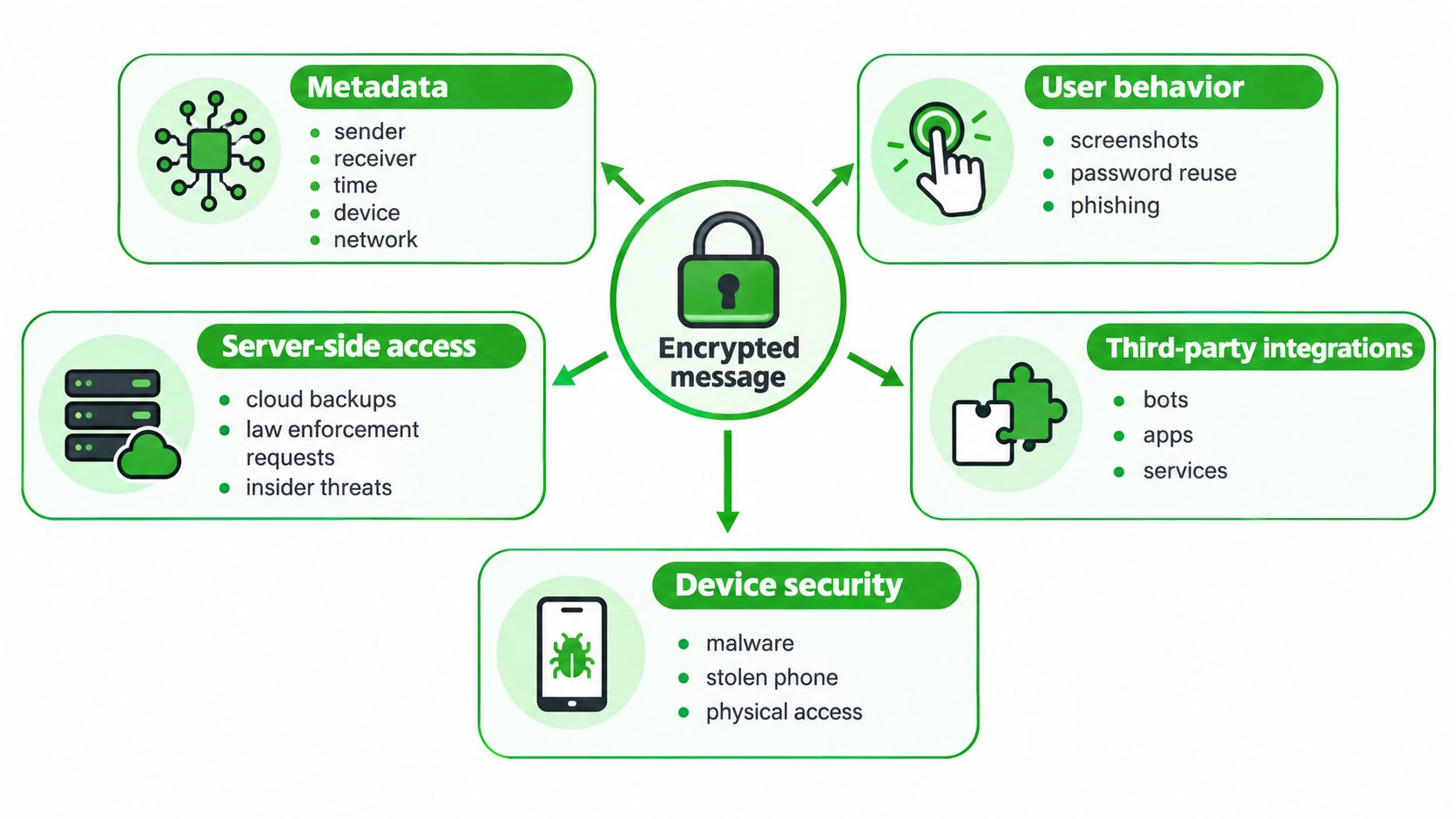
A strongly encrypted message can still carry a revealing trail. A 2024 Cambridge handbook chapter on mobile messaging notes that messaging apps may collect unencrypted metadata such as sender and recipient identifiers, message size, location data, time data, IP addresses, hardware model, and browser information. Providers may retain that information on servers for unclear periods.
Suppose an investigator can't read a lawyer's messages. They may still learn that a particular device contacted a particular account repeatedly, at distinctive times, from a particular network. That pattern can reveal a relationship, a meeting schedule, a source network, or the existence of an investigation without exposing a single sentence.
The conversation pattern can reveal more than the conversation content.
Metadata protection is a separate engineering problem. Research on metadata-protecting communication systems distinguishes content confidentiality from protection against inferences about relationships and traffic. Encrypting the payload doesn't necessarily conceal that a conversation exists, who participates, or when communication occurs.
The endpoint remains part of the system
Encryption protects data before and during delivery. It doesn't stop a recipient from taking a screenshot, forwarding a message, photographing a screen, or copying text into an unprotected application. It also can't prevent malware from reading a message after the legitimate device decrypts it.
Notifications create another exposure. A message preview can appear on a locked screen, and local operating-system storage may preserve notification data even after the user clears it. Backups, browser history, third-party integrations, and attached files can all create copies outside the encrypted conversation.
For high-risk communication, treat these as first-class design questions:
- Metadata minimization: Does the service need persistent identifiers, contact graphs, timestamps, or location data?
- Retention control: How long do servers, clients, backups, and notifications keep artifacts?
- Endpoint hygiene: Are devices updated, locked, and free from suspicious software?
- Identity verification: How do participants know they're speaking to the intended person?
Encryption remains essential, but it solves only the message-content portion of the threat model.
Ephemerality as a Design Choice
Ephemerality means that messages and related artifacts exist for a bounded period, then disappear by design. It isn't the same as asking users to remember to delete a conversation. The system sets a lifetime and enforces removal, which can reduce the amount of material available after a server, account, or device compromise.
Secure chat tools generally take different approaches. A fixed read timer starts after a recipient views a message. A sliding expiry window keeps a conversation available briefly after activity, then removes it. An ephemeral-by-default system avoids creating a durable archive in the first place.
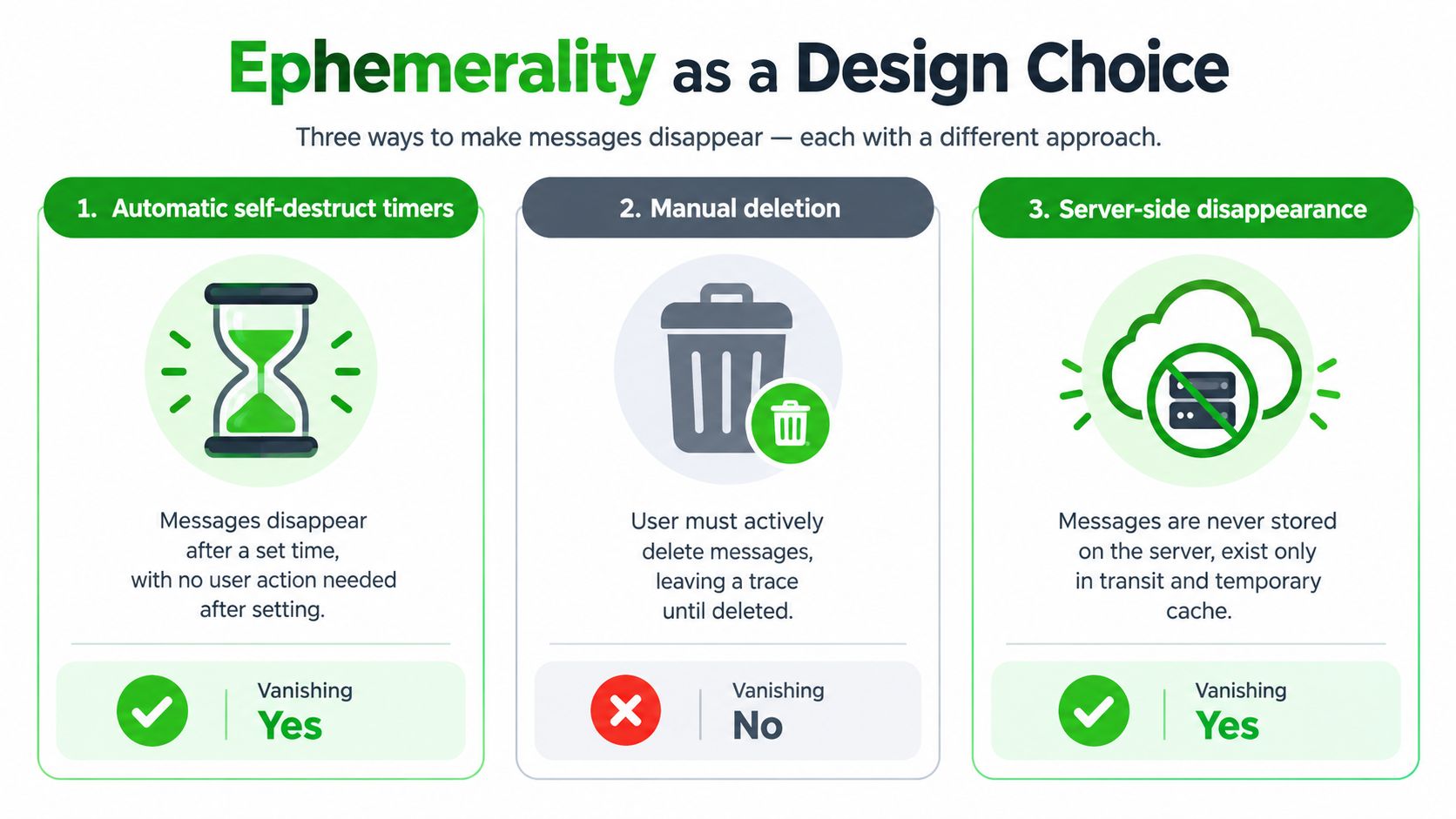
Each model accepts a different cost. Timers reduce reliance on manual cleanup, but users can lose information before they finish using it. Manual deletion offers control, yet leaves the message present until someone acts. Server-side disappearance reduces retained exposure, but it can make later recovery impossible.
A disappearing channel can also create evidence problems. If a dispute, clinical decision, or incident requires reconstruction, the absence of history may hinder accountability. A malicious participant can also delete or preserve information on their own device, so server deletion doesn't guarantee that every copy has vanished.
Ciphar treats ephemeral messaging as an architectural constraint, rather than a timer added to a persistent archive. That model suits short, sensitive exchanges where reducing the future blast radius matters more than search, continuity, or account recovery. It isn't a universal replacement for durable collaboration.
Who Uses Secure Chat and Why
There isn't one “secure user.” A journalist, lawyer, clinician, and incident responder may all need encrypted chat, but their risks and acceptable compromises differ.
| Audience | Primary Concern | Critical Properties | Trade-Off Accepted |
|---|---|---|---|
| Journalists and sources | Source identification and device seizure | Identity-light access, content protection, metadata reduction, out-of-band verification | Less convenience and weaker recovery |
| Lawyers and clients | Confidentiality and controlled retention | Verified participants, access controls, documented retention policy | More administration when records must be preserved |
| Healthcare teams | Patient privacy and authorized access | Strong encryption, role-based access, compliance boundaries, appropriate auditability | Less anonymity and more formal governance |
| Incident responders | Coordination during active compromise | Fast onboarding, authenticated participants, low-friction encrypted exchange, limited retention | Reduced archive and fewer familiar workflow features |
Journalists need more than encrypted text
A reporter handling a first contact may want the source to avoid revealing a phone number or account identity. The workflow could involve an identity-light channel, a separately verified access key, and careful control of notifications and screenshots. The journalist must still consider whether the source's device is safe and whether the communication pattern itself could expose the relationship.
Legal and clinical work needs policy
Lawyers need clear expectations about who can access message history and whether a conversation should be retained under professional or legal obligations. Healthcare teams face an even stronger need to define authorized participants, access controls, and compliance boundaries. An anonymous, disappearing channel may protect confidentiality while failing a requirement for documented records or controlled handoff.
Incident response prioritizes speed
During a breach, responders need a channel the suspected intruder can't monitor. Fast access and minimal setup can matter more than a polished archive, especially when ordinary corporate tools may already be exposed. The team should agree in advance on how to verify participants, share indicators safely, and preserve only the evidence that needs preservation.
Each workflow reflects a different threat model. Choosing the strongest-looking encryption without matching retention, identity, and accountability to the work can create a different kind of failure.
Honest Limitations of Ephemeral Tools
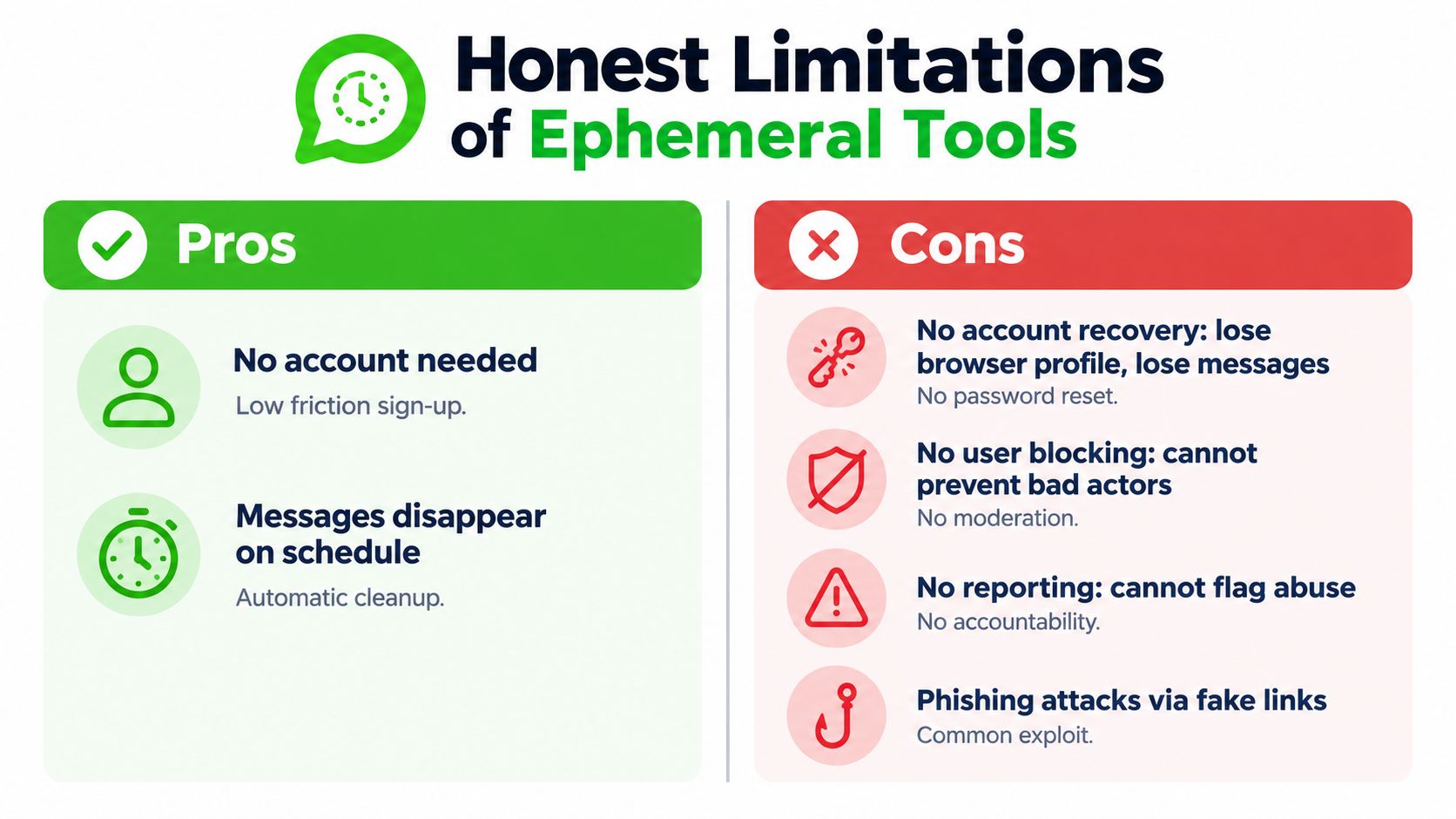
Identity-free, browser-based chat can reduce onboarding and persistent records, but it creates hard limits. If access depends on a browser profile, channel key, or temporary link, losing that material may mean losing the conversation. There may be no account recovery process, password reset, or support team that can restore access without weakening the design.
Moderation also becomes more difficult when the system doesn't maintain persistent identities or message history. A platform may have fewer records to surrender, but it may also have fewer tools to block repeat abusers, investigate reports, or establish accountability. That trade-off matters for public communities and open collaboration, where safety controls often depend on durable identity and audit trails.
Where the model becomes inconvenient
Ephemeral tools aren't well suited to long-running projects that depend on searchable history. Teams may struggle to find an earlier decision, hand work to someone covering a shift, or build a shared knowledge base. Enterprise platforms intentionally preserve records for compliance, discovery, training, and continuity. Those features aren't flaws in that context, but they create a larger retention surface.
A disappearing message also can't stop a participant from copying it. The tool can control its own storage, not the recipient's behavior. A camera, screenshot, transcription, or second device can preserve information outside the system.
Device trust still matters
Ephemerality won't protect a compromised endpoint. Malware can read plaintext after the browser decrypts it, capture keystrokes, or record the screen. A stolen device with an active session can expose an active session even if the server holds only ciphertext.
Use ephemeral chat when the cost of retained records is high and the loss of recovery is acceptable. Don't use it as a substitute for endpoint security, participant verification, or a policy that explains what information must be preserved.
Choosing the Right Tool for Your Situation
Start with the adversary, not the brand. Ask who might attack, compel, steal, or observe the conversation, then decide whether the priority is message content, participant identity, metadata, or some combination.
Three questions usually clarify the choice:
- What are you protecting? A healthcare team may prioritize controlled access and durable records, while a journalist may prioritize source confidentiality and minimal identity collection.
- What does the metadata reveal? Check whether the service exposes contacts, timing, device details, network information, or persistent account relationships. E2EE doesn't answer this by itself.
- How long should the record exist? Compliance work may require retention and auditability. A first-contact conversation may be safer without an archive, provided participants accept the loss of recovery.
A service with strong E2EE and durable accounts can fit an ongoing team. A zero-knowledge, identity-light relay can fit a short sensitive exchange. Neither architecture is automatically right for every user, and a tool that removes records may be inappropriate when an organization needs evidence, oversight, or continuity.
When evaluating unfamiliar systems, review the security model, key handling, audit material, notification behavior, retention policy, abuse controls, and endpoint assumptions. Resources that explain access infrastructure, such as Splash Access at Cisco Live, can provide broader context about connected environments, but the final decision should come from the communication's threat model rather than the surrounding technology brand.
Secure chat is best understood as a fit between content protection, metadata exposure, identity design, endpoint trust, and retention. Compare those pillars against the conversation you're about to have, and document the trade-off before sensitive information is sent.
Ciphar provides browser-based, zero-knowledge encrypted channels for short, identity-free conversations, with client-side encryption, no account requirement, and enforced message expiry. If that model matches a conversation where minimal retention matters more than recovery or long-term collaboration, visit Ciphar to review how its secure chat design works.