You're copied into an urgent thread, someone's asking for a decision, and you can't tell if the mailbox you're replying to is still private. A source, a client, or a colleague in an incident could face that same doubt right now, with far higher stakes. Out of band communications exist for that moment. They don't mean opening a second app and hoping for the best. They mean moving the sensitive step onto a path that doesn't depend on the channel you no longer trust, and deciding in advance what that path may keep.
What Out-of-Band Communications Actually Do
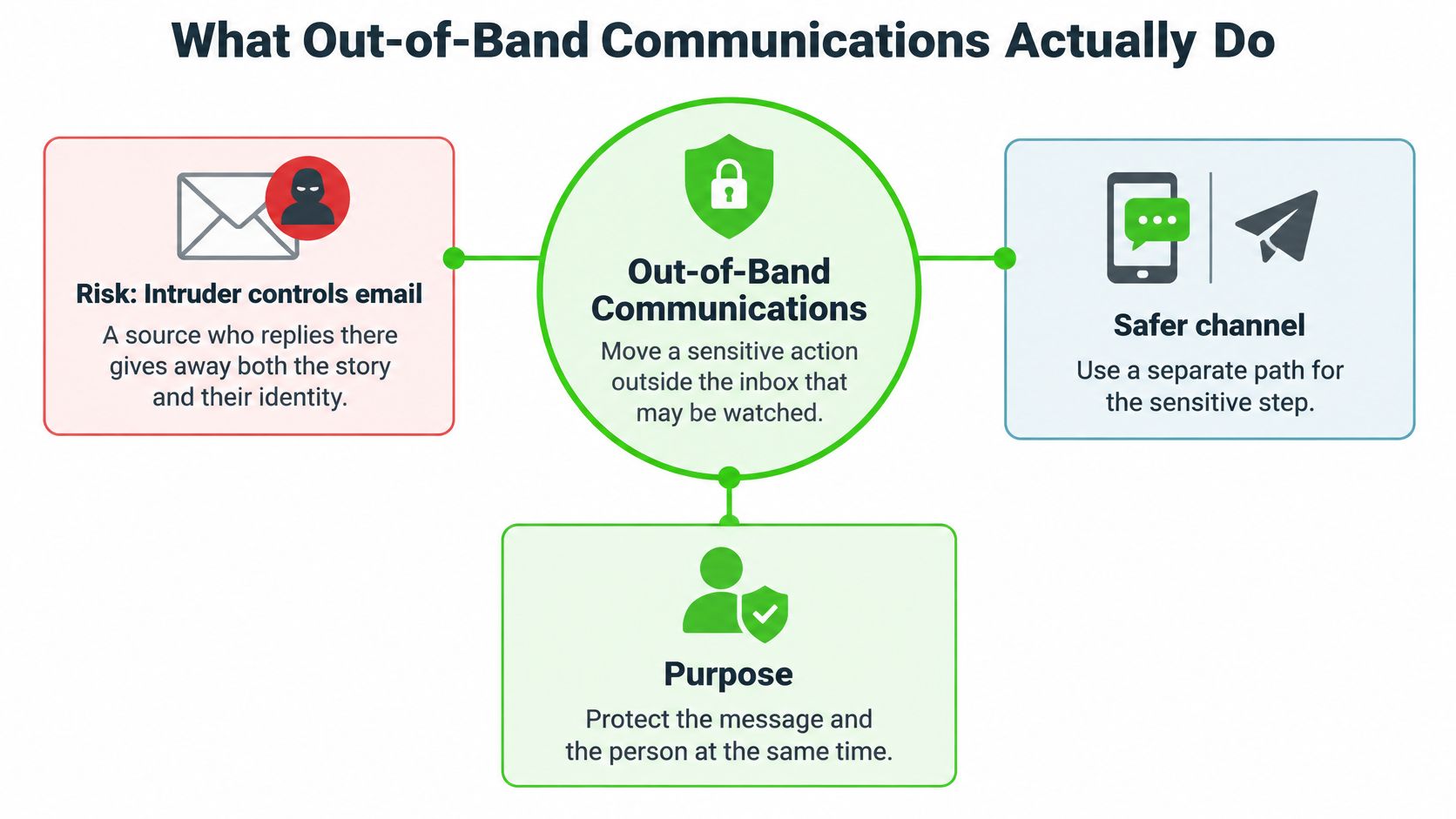
Say an intruder already controls a newsroom's email. A source who replies there gives away both the story and their identity in one message. Telling that source to be careful in the same inbox doesn't fix anything, because the inbox is the problem.
That's the core job of out of band communications. You move a sensitive action, such as proving identity, handing over a key, or coordinating a response, onto a path that doesn't depend on the channel being protected, checked, or restored. The primary channel may carry the ordinary activity. The separate path carries the step that would be dangerous if the first channel is watched or broken.
The NIST model in plain words
The National Institute of Standards and Technology authenticator guidance defines an out-of-band authenticator as using a private communication channel separate from the channel being authenticated, helping establish that a claimant controls a particular device. The verifier creates a short-term secret and delivers it through that independent channel. Owning the primary session isn't enough to finish the action, because the attacker also needs the second path.
Teams designing that second factor often want control over the login flow itself, which is why authentication without vendor lock-in appeals to builders who need to swap methods without rebuilding their stack. Whatever tool you pick, the principle stays the same. Separation, not novelty, creates the protection.
Four jobs for an out-of-band path
| Job | What is at risk | What the separate path carries | Example independent path |
|---|---|---|---|
| Prove control of a device | Primary login session may be stolen | Short-term secret or push approval | Hardware token, authenticator app, or callback on a known number |
| Run an incident | Corporate email and chat may be watched | Roles, containment steps, and a bridge key | Prearranged voice or chat bridge outside the breached tenant |
| Restore during an outage | Primary network and its management plane are down | Status and restore commands | Cellular, satellite, radio, or a physically separate management network |
| Make confidential first contact | Phone numbers and accounts would identify the parties | Link plus a high-entropy access key | In-person exchange or a previously trusted device |
For confidential first contact, an access key shared face to face or through a previously trusted device reduces the risk that one compromised account exposes both the conversation and its credentials.
The independence test: the second path must differ in provider, identity, power, and credentials, or it's only a second copy of the same risk.
In-Band and Out-of-Band Side by Side
Think of in-band communication as sending instructions through the same road an attacker is blocking. You and the attacker share the route, the signs, and the fuel. If that road closes, your instructions close with it.
Out-of-band communication uses a different road. It doesn't share the blocked driver or fuel supply, so reaching your destination doesn't require the first road to be safe or even open.
What stays in-band, and what should not
In-band isn't wrong. Everyday mail, team chat, and ticket updates belong there because they're convenient and the risk is ordinary. The trouble starts when you keep verification, commands, and content on a session that is itself the outage or the compromise.
Out-of-band moves one sensitive piece elsewhere. That piece might be an authentication code, a restore command, or a key. An attacker who controls the primary session then needs both paths, and an operator who has lost the primary network can still reach the equipment.
In-band versus out-of-band
| Criterion | In-band | Out-of-band |
|---|---|---|
| Path | Same session, identity, or network as the activity | A channel that does not depend on that session |
| Good fit | Everyday mail, chat, and ticket updates | Authentication codes, incident bridges, key delivery, backup management |
| Failure | Compromise or outage takes the control path with it | Still fails if the second path shares provider, identity, device, or power |
| Attacker needs | Control of one channel | Control of both independent paths |
| Secret handling | No separate short-term secret | Verifier sends a short-term secret on the secondary channel; encrypt it and rate-limit short secrets |
Why redundancy gets underfunded
The redundancy row is where many plans fall short without anyone noticing. In the Opengear survey of 500 global IT leaders, 43% were increasing network resilience through additional automation and 42% were enhancing monitoring, while only 36% were focusing on network redundancy. The same source cites Aberdeen Research's estimate that a typical company loses approximately $260,000 for every hour of downtime.
Those numbers describe a common pattern. Teams invest in detecting and managing failure faster, but they don't build enough independent connectivity to recover. Monitoring tells you the road is blocked. It doesn't give you another road.
A spare chat app on the same identity provider, the same laptop, and the same office power is not out-of-band. If the identity provider is compromised, both apps fall. If the laptop is seized or infected, both apps fall. If the building loses power and network, both apps fall.
A management link with its own power, credentials, connectivity, and procedure is different. So is a prearranged bridge outside a suspect tenant, reached from a clean device. When someone proposes a backup, label it accurately. Is it independent, or is it merely a duplicate wearing a different logo?
Why a Second Channel Can Still Fail
A second channel isn't automatically safer. That assumption causes real harm, because it encourages people to move a secret onto a weaker path and call the move an upgrade.
If you send an out-of-band secret over an unencrypted or unauthenticated path, someone can intercept it. Someone can also phone the recipient, sound helpful, and talk them into reading it aloud. The NIST security considerations for authenticators warns that out-of-band secrets can be intercepted on an unencrypted channel and that attackers can socially engineer recipients into disclosing them, and it recommends avoiding unauthenticated or unencrypted channels for secret delivery.
The relay problem
Separation also doesn't stop a relay attack. An attacker phishes a short code from the user, then types that code into their own session. The verifier sees a valid secret, but it's attached to a session the user doesn't control.
That's why the secondary channel needs encryption, why secrets should be short-lived, and why short secrets need rate limiting against guessing. A code that lives for hours and accepts unlimited tries isn't a control. It's an invitation.
Before you choose any second path, write down who you're defending against and what they already control. A short guide to building a threat model before you pick tools helps you name those assumptions instead of guessing.
Threat model for a second channel
| Threat | Effect on primary channel | Separate path response | Residual risk |
|---|---|---|---|
| Primary session takeover | Attacker reads and replies in email or chat | Short-term secret sent on a separate path | Secret relayed if phished and typed into the attacker's session |
| Intercepted secret | Secret crosses an unencrypted or unauthenticated path | Encrypted secondary channel with short-lived secret and rate limiting | Wrong recipient if identity is never confirmed |
| Phone-based delivery | Number reassigned or messages forwarded | Restricted for authentication; use in-person or trusted-device exchange | Voice and SMS paths carry SS7 weakness |
| Compromised shared tenant during an incident | Bridge, roles, and key are visible to the attacker | Prearranged bridge outside the tenant | Unmanaged responder device or reused key |
Phone delivery deserves special caution. Numbers get reassigned to new people. Messages get forwarded. The underlying signalling system has known weaknesses. Those are concrete reasons SMS and voice are restricted for authentication, not matters of taste.
Apply that to first contact between two people who've never exchanged numbers. If the link comes from a compromised mailbox and the key arrives by SMS to a number an attacker can forward, the attacker receives both halves. You've used two channels and protected nothing.
What must be true instead? The second path must not share the suspect account. You confirm the recipient through a signal that doesn't reveal the secret. People already in the session can see a wrong guess and act on it.
The key is only as strong as the weakest path that carried it, not as strong as the encryption used after everyone is inside.
How to Hand Off a Secret Safely
First contact is where vague advice breaks down. Two people may have no shared account, no safe way to swap phone numbers, and no prior meeting to rely on. They need a protocol, not a slogan.
Six moves for a safe handoff
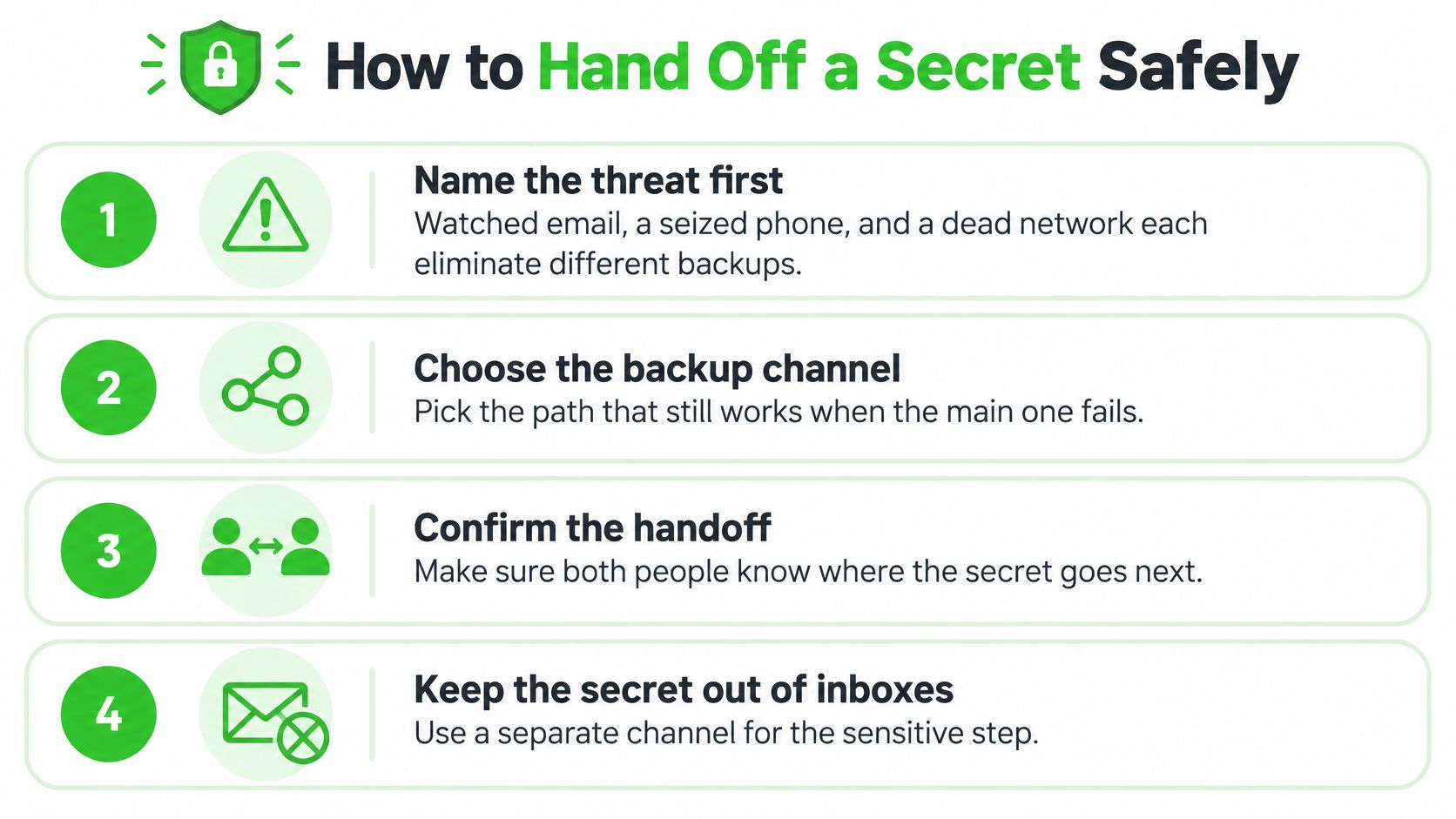
Name the threat first. Watched email, a seized phone, and a dead network each eliminate different backups. If the phone may be seized, a path tied to that phone number fails with it. If the network is dead, a cloud app on the same connection won't save you.
Create the session on a path that asks for no account, and keep the key out of that session. An account requirement forces both people to hand over persistent identifiers before they've agreed to talk. Skipping it removes that exposure. Don't paste the key into the room it opens.
Deliver the link and the key on separate trusted media when you can. Put one in person or on a prior trusted call, and the other from a different device. One leak then doesn't open the room. Sending both in a single email collapses the whole design into that email.
Confirm the recipient with a detail they already know. Use something from a prior conversation or a shared context that an impersonator wouldn't have. Never ask them to paste the key back to prove they received it, because that retransmits the secret over a channel you may not trust.
Treat a failed entry as a signal, not a nuisance. Let either person destroy the session immediately rather than waiting to see what happens. A practical walkthrough of how access keys gate entry to a channel shows why a wrong attempt should change your behaviour at once.
Don't reuse the key, and don't turn the short session into the long-term record. A reused key links separate conversations and stays useful to anyone who captured it earlier. A temporary room that becomes your archive inherits risks it was never built to carry.
What the relay can and cannot see
In a zero-knowledge design, the other participant doesn't need an account. The sender shares the channel link and access key over a separate trusted medium, and the recipient opens the link and pastes the key. A new participant is admitted only if their browser derives the same key and successfully decrypts the channel's test blob. Otherwise they never enter.
The relay can see the channel name and the approximate timing of activity, but not access keys, message contents, file contents, or voice audio. That boundary matters. Anyone moving documents through this kind of workflow should also explore secure file transfer protocols so the file step gets the same scrutiny as the chat step.
Testing your own channel in good faith is reasonable. Guessing against someone else's isn't the goal, and alerts exist so participants can end a session when guessing starts.
Run a ten-minute drill
Do this with a colleague before a real incident. One person creates the session, hands off the key by the agreed separate path, and confirms the other person without asking for the key back. The second person deliberately enters a wrong key once, so both of you see the alert and practise who ends the session. Agree out loud who holds the key, who's allowed to end the session, and what you'll do if the first path dies mid-conversation.
Implementation Best Practices
A protocol you invent during an incident will compete with panic, fatigue, and missing contact details. Turn it into standing practice while things are calm, using these six controls as policy.
A standing checklist for out of band communications
Test every independent path on a fixed schedule, at least quarterly. Log how long it took to connect and whether each participant could enter without the link being resent through the primary system.
Onboard each participant before any incident. Record a name, a device, and a verified recovery contact on an offline roster, and confirm each person can reach the path from a clean device.
Rotate the access key after every use and immediately after any suspected access attempt. Never reuse a key across two conversations, even with the same people.
Write a failure escalation in advance. One failed entry triggers an alert in the room, two failed entries trigger a burn, and any unexplained participant triggers an immediate burn plus a call on the independent voice path.
Handle unmanaged devices explicitly. A responder joining from a personal device gets a limited role, sees no credentials, and is confirmed by a second signal before receiving the key.
Name two people who may burn a channel. The decision must never depend on one person who may be asleep, travelling, or locked out.
Review these rules after each drill and after any incident. Fold changes into the incident plan rather than leaving them buried in chat history, where the next responder won't find them.
Workflows for Journalists Lawyers and Responders
Different professions share a shape here. The conversation is sensitive, it's short, the parties don't want to exchange persistent identifiers, and an archive would cause harm. The boundaries differ, so look at each stop line.
A journalist and a source
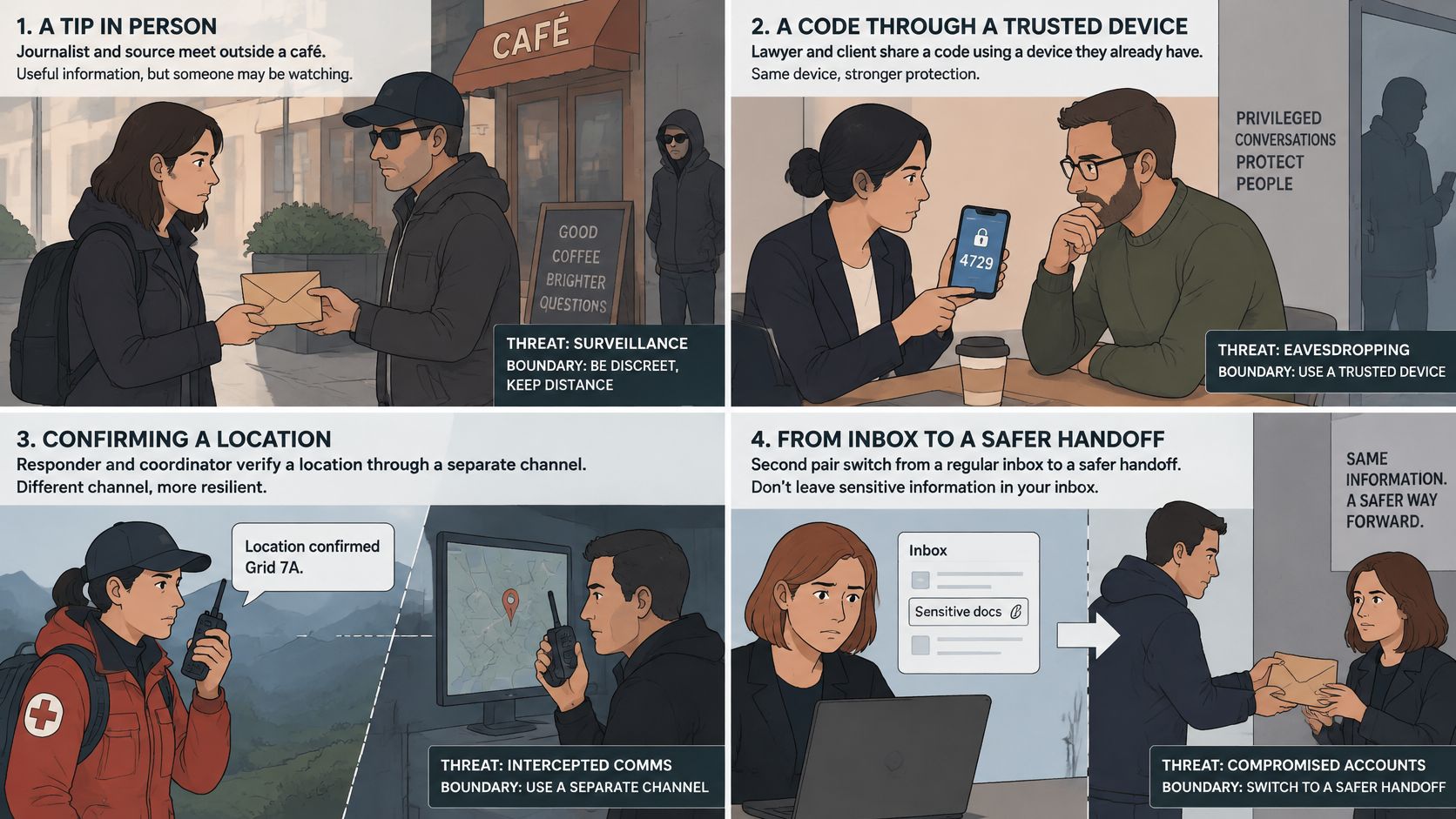
A source has a tip that must not live in either person's inbox. The journalist passes a key face to face or through a device they already trust, they talk briefly, and the room expires. Nothing in the newsroom mailbox links the source to the story. For a deeper treatment of that relationship, see the guidance on protecting journalist and source communications.
A lawyer and a new client
A prospective client needs a privileged first call, but adding them to the firm tenant creates accounts, invites, and records before engagement is settled. Use the short channel for a conflict check and scheduling. Then put retained advice where it belongs, in the matter file. The stop line is clear. The side channel arranges the relationship, it doesn't become the legal record.
A clinician coordinating a handoff
A clinician needs to coordinate a sensitive handoff quickly, perhaps confirming who's available and when a bed opens. Diagnosis and orders stay in the regulated system, because a side channel must not become a second medical record. Use the separate path only for logistics that can safely disappear.
A responder in a ransomware week
A responder treats email and team chat as hostile until proven otherwise. According to Wire's ransomware response reporting, in the first quarter of 2025 ransomware attacks increased 126% compared with the same period in 2024, averaging 275 incidents per day. At that pace, the bridge and its key must exist before a tenant is locked, not after.
Roles and live coordination stay on the independent path. Evidence and decisions that need an audit get written into the incident system after the call, by a named owner. Executives fit the same pattern when a board update can't wait for new accounts to be provisioned. Coordinate briefly outside the suspect systems, then record the decision in the governed place.
Choosing Retention and Next Steps
Decide retention before you open any room. Choosing afterwards usually means the tool's default chose for you, and defaults rarely match your legal or safety obligations.
Ephemeral channels improve confidentiality and shrink what a breach or subpoena can recover. They also remove continuity, audit, and evidence. Indefinite archives reverse that trade. They help accountability and later reconstruction, but they enlarge breach exposure and legal discovery.
The MITRE mitigation for out-of-band communications frames the capability as an alternative path for communication failures, data-integrity attacks, and adversary-in-the-middle situations, including validating primary-channel data and maintaining communications when systems are unavailable. That framing raises the harder question. What must be tested, retained, and destroyed so the alternate channel stays usable without becoming a permanent retention system?
Retention matched to the conversation
| Need | Identity | Retention | Where it belongs |
|---|---|---|---|
| Live coordination while the main tenant is untrusted | Callsign or no account | Minutes to one hour, with immediate burn | Ephemeral channel outside the tenant |
| Record a regulator, court, or clinician must keep | Named accounts | Policy archive and audit trail | Matter system, clinical record, or incident ticket |
| Move a decision out of the side channel | Minimal first, then named owners | Summary only; raw chat is not copied | Durable system, written after the call |
Map each conversation to one row. If a regulator, court, or clinical record must keep it, use named accounts in a system built to archive. The handoff row means participants write decisions, owners, and times into the durable system, and they never paste the raw side-channel transcript.
Make the provider limit concrete
Our relay deletes a channel and every encrypted blob associated with it 60 minutes after the channel is created, including verify blobs, message buffers, salts, and voice state. In response to lawful process, we can provide only encrypted blobs that expire on that one-hour clock, since we hold no plaintext, keys, or message history. That makes this the wrong place for communications that legally require an audit trail, and we state plainly that Ciphar is not appropriate for regulated communications requiring audit trails or message archival.
For the vanishing branch only, a browser channel fits when parties shouldn't exchange numbers. The access key travels on a separate path, and the burn control deletes the channel immediately. Finish by recording in your incident plan who may burn a channel and which system receives the summary.
When your primary inbox or tenant can't be trusted, Ciphar gives you a browser-based, identity-free channel for a short, encrypted conversation, with the access key shared separately and everything deleted after sixty minutes or the moment you burn it. Open a channel before your next drill, hand off the key out-of-band, and practise the handoff while the stakes are low.