A confidential source is ready to talk, but they don't want to give you their phone number. You don't want to add them to your contacts, either. Before sending a link, you need to decide something more consequential than which app has the strongest-looking lock icon: what should remain when the conversation ends?
A text message encryption app can protect a conversation while it travels between devices and still leave readable copies somewhere else. Choosing safely means looking at the entire path, including the server, the participants' screens, backups, and the recovery process.
What a Text Message Encryption App Actually Protects
Consider a journalist arranging a first interview with someone who fears being identified. The immediate problem is getting a private message through. The harder problem is avoiding a durable connection between the source's identity and the conversation.
A lawyer handling an initial inquiry might face a similar decision. So might an incident responder contacting a researcher who hasn't yet disclosed a vulnerability. These are hypothetical situations, but they expose a useful distinction: private delivery, identity protection, and limited retention are different requirements.
Encryption protects a path, not an entire phone
Transport encryption protects content on its journey to a service. If the service decrypts that content to process it, the provider remains inside the trust boundary.
End-to-end encryption puts usable decryption capability at the communicating endpoints instead. The relay carries encrypted content without needing readable messages. That difference matters more than whether a product merely advertises that it uses encryption.
Practical rule: Ask who can decrypt the message, not just whether the connection is encrypted.
Neither arrangement makes a phone safe to hand to someone else. If a participant can read the screen, that participant can also reveal what it says. Choosing an app therefore starts with the person and device at each end, not just the network between them.
Decide what the conversation needs
Different professional exchanges create different requirements:
- Confidential reporting: A source may want contact without exchanging persistent identifiers.
- Privileged legal discussions: Counsel must consider confidentiality alongside preservation obligations.
- Sensitive clinical coordination: Privacy needs must coexist with required documentation.
- Vulnerability disclosure: Participants may need a temporary working space without creating another archive.
- Executive decisions: A sensitive discussion may need restricted access, but organizational retention rules still apply.
The right choice depends on whether continuity is helpful or dangerous. An ongoing messenger supports a continuing relationship; a disappearing browser room serves a narrower purpose. Neither is automatically safer for every conversation, and identity-free access shouldn't be mistaken for proof that a participant is trustworthy.
How Encrypted Text Messaging Became the Default
Modern encrypted messaging inherited its most important ideas from protocol development, not from disappearing-message timers. The central change was moving trust away from a server that could read conversations and toward endpoints that handled their own cryptographic secrets.
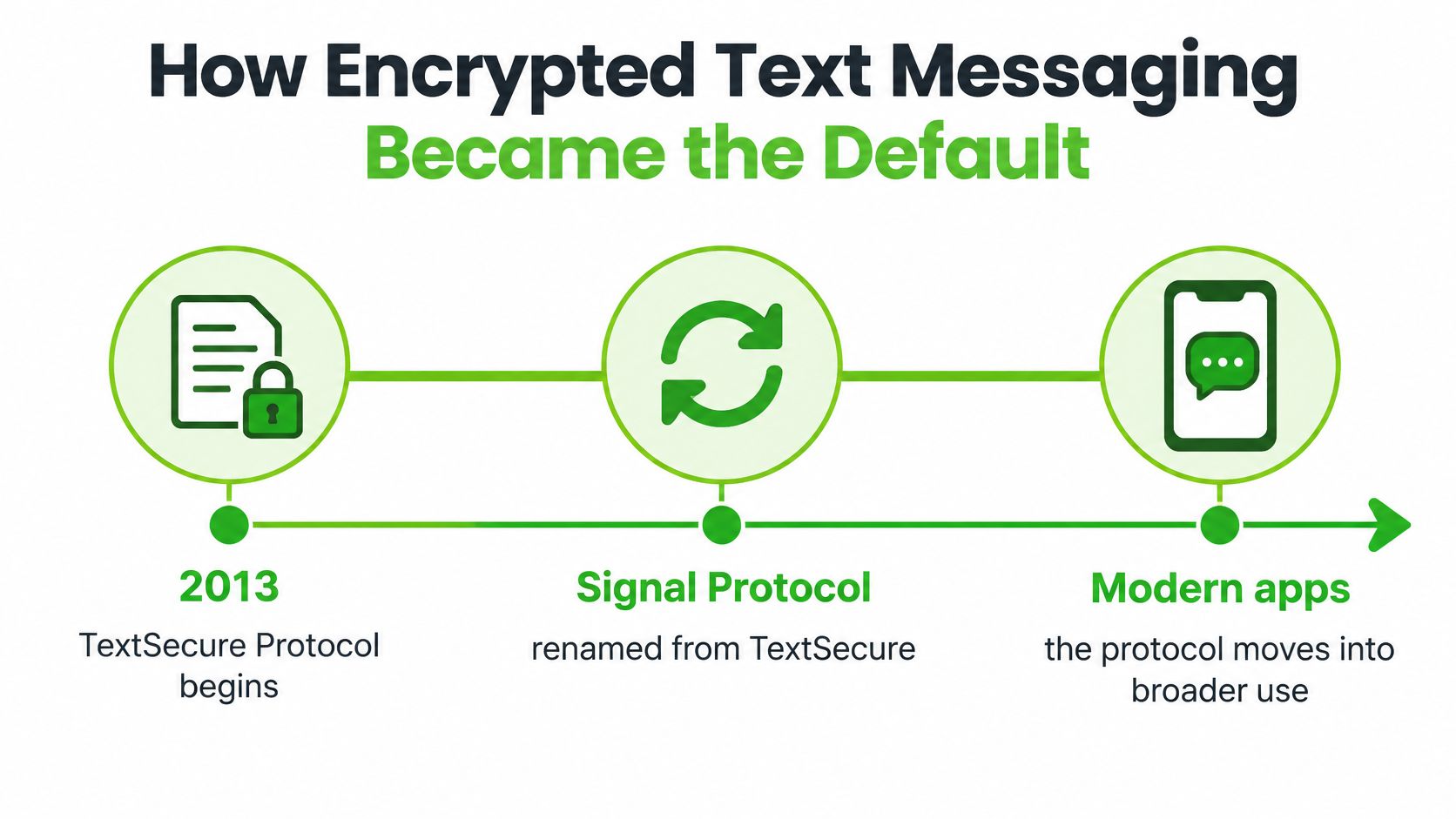
This timeline summarizes that progression.
From encrypted texts to a broader protocol
Open Whisper Systems began developing the TextSecure Protocol in 2013; TextSecure expanded beyond SMS into internet messaging, groups, attachments, and media, while TextSecure v2 introduced the Axolotl ratchet in February 2014, TextSecure and RedPhone merged into Signal in November 2015, and the protocol adopted the Signal Protocol name in March 2016, as documented in the Signal Protocol history.
The ratchet matters because conversation keys shouldn't remain static indefinitely. Changing session keys strengthens protection over time, rather than making every message depend on an unchanged secret.
The same historical account describes an October 2016 formal analysis by researchers from Oxford, Queensland University of Technology, and McMaster University that found the protocol cryptographically sound, while recognizing the continuing importance of implementation and device protection. That distinction remains essential: a sound protocol isn't a guarantee about every application that implements it.
Default encryption reached ordinary conversations
During April 5–7, 2016, WhatsApp completed default end-to-end encryption for more than 1 billion monthly active users, covering private messages, photos, videos, files, voice messages, groups, and calls, according to the Electronic Frontier Foundation's account of the rollout.
The significance wasn't merely scale. People didn't have to reserve encrypted communication for a special security mode or a specialist audience.
- Endpoint encryption addressed whether the provider needed readable content.
- Default coverage addressed whether ordinary users received that protection.
- Broader content support made the model useful beyond typed messages.
For a visual companion to the subject, watch the following video.
Identity-free access and a fixed room lifetime answer additional product questions. They don't replace endpoint encryption, changing-key designs, or careful implementation.
Client-Side Keys and Self-Destructing Rooms
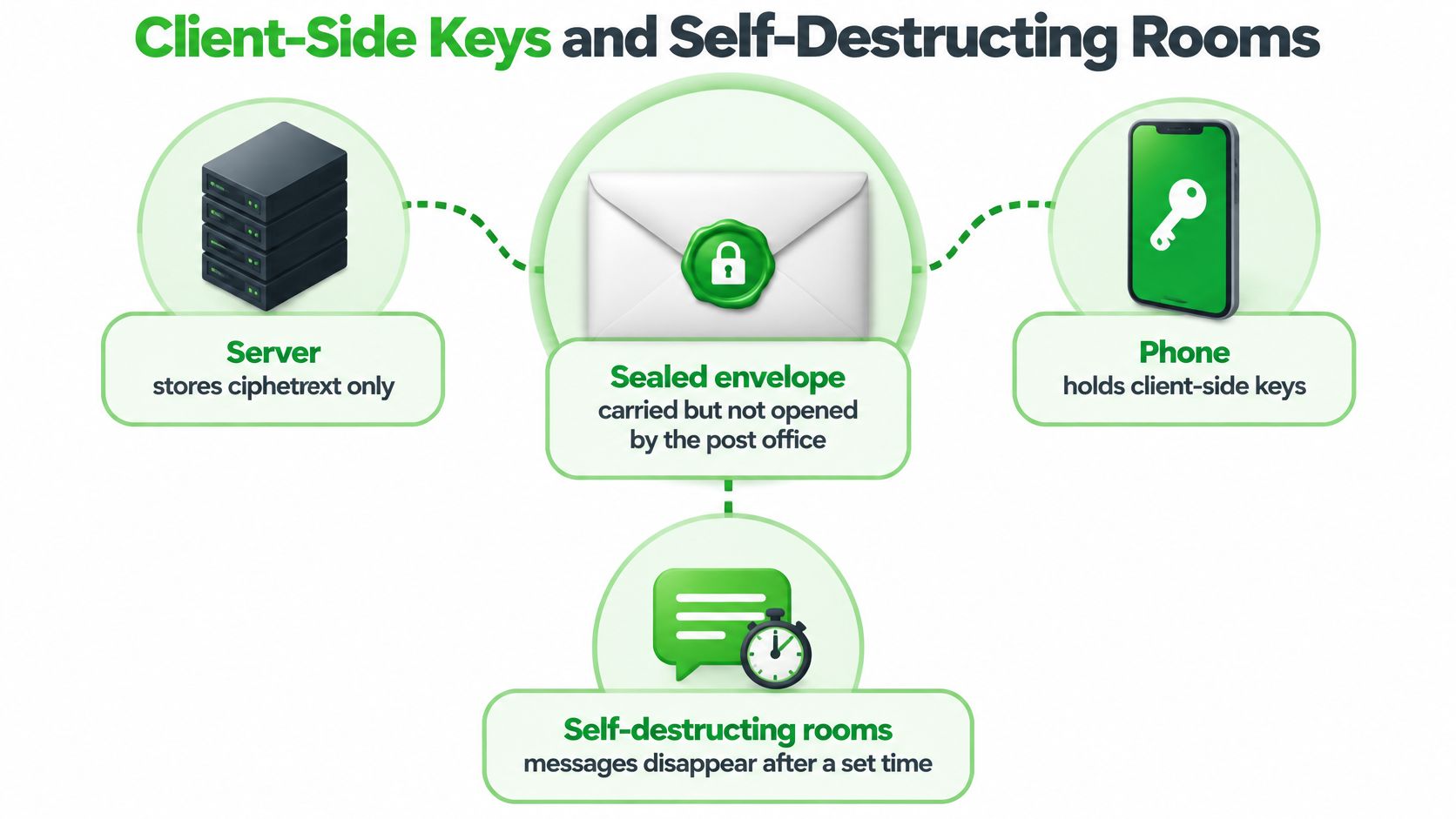
Think of a sealed envelope that a post office can carry but cannot open. In a client-side encrypted system, the browser seals the contents before sending them, and the relay handles the encrypted package rather than its readable contents.
The analogy has limits. A relay still needs operational information to deliver and expire records. Unreadable content doesn't mean an invisible interaction, and a storage policy isn't a complete description of everything a service might observe while handling a connection.
The diagram separates the participants' responsibilities.
Confidentiality and tamper detection work together
AES-256-GCM combines confidentiality with integrity: decryption must authenticate the tag before releasing plaintext, and NIST specifies tag lengths of 96, 104, 112, 120, or 128 bits, while warning that assurance declines as more data is processed under a key, in its GCM specification.
In plain language, the recipient shouldn't accept a modified message without verification. The same requirement applies to an attachment, reply, or encrypted voice frame.
GCM also requires a unique initialization vector, commonly called an IV or nonce, for every encryption operation under the same key. Reusing one can compromise both secrecy and authentication, even if nobody has stolen the key itself.
Voice makes this an important engineering concern because it produces encrypted frames much faster than a person types messages. Designers must prevent counter exhaustion, collisions, and reuse across participants, rather than assuming that a nonce strategy suitable for occasional text will automatically suit audio.
Who can read and how long it lasts
A minimal relay can retain:
- Ciphertext and verification material: Encrypted records, IVs, and authentication tags.
- Derivation information: A salt used when participants derive their channel key.
- Lifecycle information: An expiry timestamp needed to enforce deletion.
The guide to how encryption keys work provides useful background for distinguishing a channel's access secret from the key derived on a device.
Client-side encryption answers who can read. Ephemerality answers how long the service retains the conversation.
Per-channel keys and enforced expiry limit the amount of material handled under a particular key. They don't automatically provide the same changing-key properties as a ratcheting protocol, erase copies participants made, or replace independent security review.
Threat Models Beyond Live Chat Encryption
The most revealing question in an encrypted-app comparison may be: what happens when someone restores the phone? A conversation can be well protected during delivery and later become accessible through a different storage or recovery system.
The Electronic Frontier Foundation explains that backups may not receive the same protection as encrypted chats and can expose contents to a cloud provider or legal requests in its guide to encrypted chat backups. Don't infer backup protection from a live-chat encryption label.
Follow the readable copies
Start with the person who might want the conversation. A remote intruder, someone holding a phone that is not locked, an authorized participant, and an investigator seeking stored records have different opportunities.
Then work through the actual environment:
- Device access: Could someone seize or open a participant's phone while the conversation is visible?
- Backup and restoration: Where could a restored copy reappear, and who controls access to it?
- Secondary surfaces: Could notifications, screenshots, or linked devices expose the contents?
- Server-held records: What could a breach, insider, or lawful demand obtain from the provider?
The plain-language explanation of a threat model is useful when these questions feel too broad. The objective isn't to defend against every imaginable adversary; it's to identify the exposures that would harm the participants.
For workplace conversations, the review should include managed devices, backup settings, and incident procedures. Organizations needing help coordinating those controls can consider Wisely's cybersecurity support for businesses alongside their messaging assessment.
No recovery is a deliberate trade-off
A browser room designed to expire without an archive reduces the persistent conversation material available for later restoration. That can be valuable when the principal concern is a retained history, rather than a participant actively copying the exchange.
But zero recovery also means zero continuity. A lost connection, missed detail, or later dispute can become a serious problem when nobody can restore the original discussion.
Recovery test: If losing the conversation would harm the client, patient, investigation, or organization, irreversible deletion may be the wrong requirement.
Server compulsion and access guessing deserve separate attention. A ciphertext-only relay can't hand over a decryption key it never held, but that doesn't answer every question about operational records or future interference. Likewise, someone attempting to join a room is an access-control problem, not evidence that the underlying encryption has failed.
Features That Matter for Short-Lived Chats
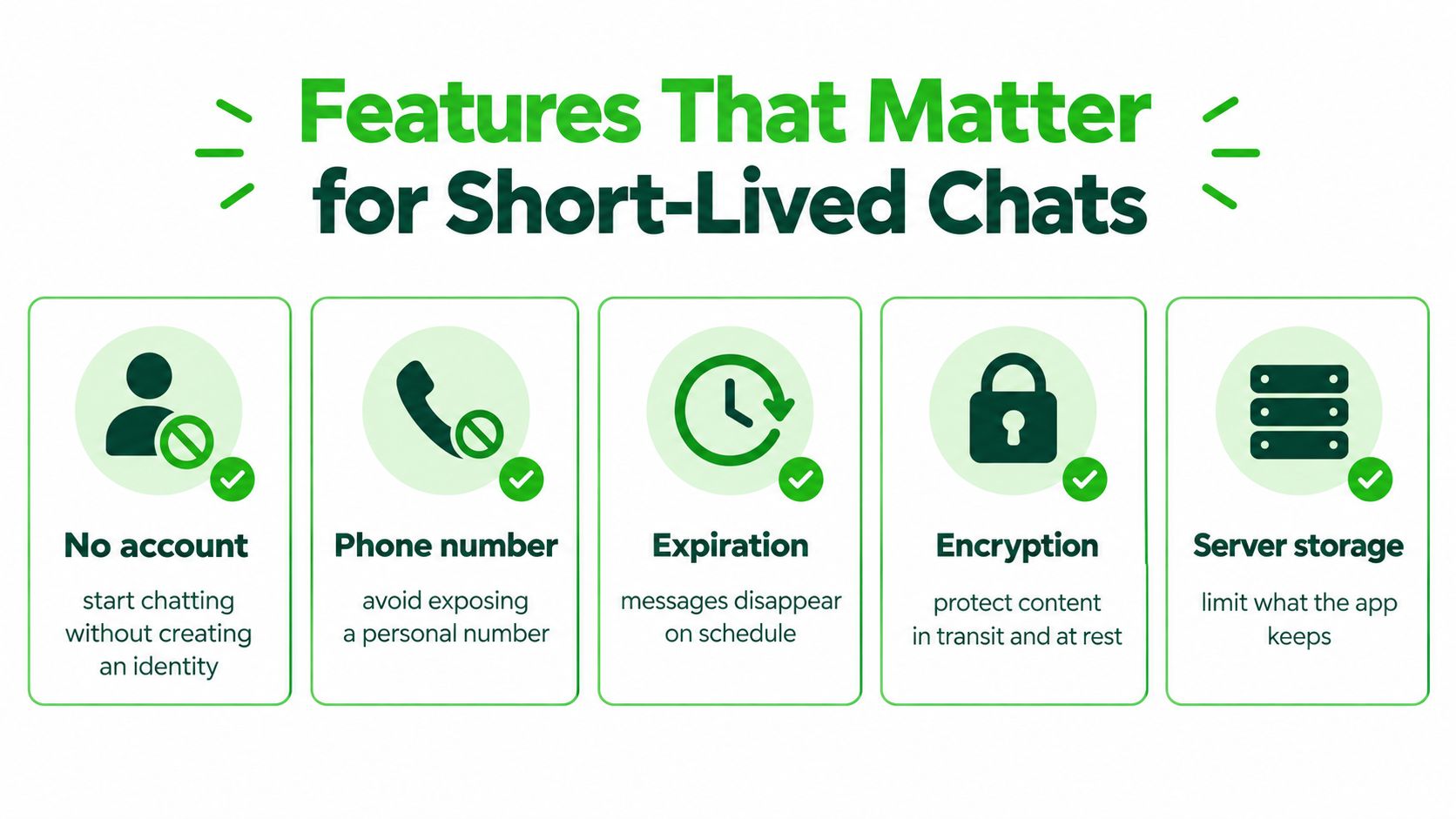
Evaluate a short-lived chat by checking observable properties and documented limits. A feature list should tell you what the service retains, how access works, and what happens when the session ends, rather than just naming an algorithm.
Use the checklist as a starting point, then ask how each promise is implemented.
Check identity, storage, and session controls
- Entry requirements: Can participants join without an account, phone number, or email? Keep identity-free entry distinct from a promise of complete anonymity.
- Local encryption: Does the browser derive keys and encrypt content before uploading anything readable?
- Access verification: Is the test for a correct key authenticated and unambiguous, rather than dependent on loosely parsed text?
- Restricted storage: Does the documented relay model limit retained records to opaque ciphertext and the supporting cryptographic and expiry material?
- Lifecycle controls: Is expiry enforced by the server, and can a participant manually burn the room?
- Voice handling: Are recordings and transcripts absent by design, rather than merely disabled through a preference?
- Failed-access visibility: Will participants receive a useful warning when someone unsuccessfully tries to join?
A manual burn is useful only within its scope. It should terminate the service-held session, not be presented as a way to retract screenshots or information another participant already learned.
Understand what key stretching can't fix
PBKDF2-HMAC-SHA-256 with 100,000 iterations increases the work required for each guessed secret; NIST explains that iteration counts should be as large as users can tolerate in its password-based key derivation guidance. That setting should be reassessed as equipment and browser performance change, not treated as a permanent guarantee.
A per-channel salt prevents attackers from reusing the same precomputed derivation work across channels. It doesn't make a predictable phrase unpredictable.
If an attacker obtains the salt and ciphertext, an authenticated test record may let them check guesses offline. Online rate limiting and failed-access alerts won't stop that process because the attacker no longer needs to ask the service whether a guess worked.
Ask for high-entropy access secrets shared through a separate, trusted route. Also ask whether derivation remains tolerable on a low-end mobile browser. A design that pressures users into choosing weaker secrets for convenience undermines its own protections.
Situations Where Identity-Free Chat Fits
A journalist receives an initial approach from a source who won't share a phone number. A temporary browser room could support a short interview without making a persistent contact relationship part of the exchange. The journalist should still authenticate important claims separately and decide beforehand whether any notes must be retained.
A lawyer faces a different constraint: a prospective client wants to explain a sensitive matter privately. A disappearing conversation may suit preliminary discussion only if counsel has checked the relevant preservation and professional obligations. Privacy doesn't create an exemption from recordkeeping.
Match the working session to the obligation
A healthcare professional considering temporary coordination should distinguish logistics from the clinical record. If the exchange contains information that must be documented, the approved records process still needs to capture it. An ephemeral room isn't a regulated records system.
A security researcher and incident responder might need a brief working session before formal disclosure. They could discuss immediate coordination in a temporary room while preserving the advisory, remediation decisions, and evidence through their authorized process. An executive faces the same boundary when a confidential discussion leads to a decision the organization must record.
These examples share several practical conditions:
- Limited purpose: Participants know what they need to resolve and when the exchange should end.
- Minimal identity exchange: They don't need to add each other to a permanent directory.
- Low onboarding tolerance: Installing software or creating an account would obstruct the contact.
- Deliberate retention choices: They've separated disposable discussion from material they must preserve.
The guide to phone number privacy can help readers think through whether exchanging a personal number is necessary for the relationship.
Use a bounded flow
Initialize the channel, verify the intended recipient through an appropriate separate route, and share the access secret out of band. Agree on the purpose before discussing sensitive details, then allow expiry or terminate the session if the participants' confidence changes.
That flow doesn't suit every task. Ongoing relationships, collaborative groups, durable file storage, and conversations that must be recoverable belong in systems built for those needs. If participants expect to search the discussion later, they shouldn't choose a tool whose central promise is that there will be nothing to search.
Choosing a Text Message Encryption App
Choose the conversation model before choosing the product. A persistent encrypted messenger and an identity-free browser room solve different problems, even when both protect live content.
For a continuing relationship, evaluate an ongoing messenger such as Signal or WhatsApp against your device, backup, and retention requirements. For a bounded exchange, evaluate a temporary room against its access and deletion controls. Don't assume every mode within every messaging product provides identical protection.
Which Private Chat Fits the Job
| Need | Better fit | Why |
|---|---|---|
| Regular conversations with trusted contacts | Persistent encrypted messenger | Continuity matters more than eliminating the archive |
| Sensitive first contact without identifier exchange | Identity-free browser room | Participants can communicate without creating a lasting contact relationship |
| A message rather than a discussion | Single-use encrypted note | A live room may add unnecessary complexity |
| Clinical documentation or another regulated record | Approved communications and records system | Encryption alone doesn't satisfy retention and governance requirements |
| Evidence preservation | A system with authorized retention and export | Irreversible expiry conflicts with later verification |
Healthcare teams evaluating phone-based workflows can use the PatientNotes guide to HIPAA phone tools to frame the questions they should take to their compliance lead. A privacy feature shouldn't be treated as a compliance determination.
Demand clear boundaries
For a temporary browser option, look for a documented security model covering messages, files, replies, edits, and voice, not just typed text. Check that the provider explains key handling, failed-access notices, server storage, and what manual deletion does.
Also ask what the product deliberately refuses to provide. No archive, no extension, and no recovery can be useful constraints, but they're unsuitable when participants need device migration, later review, or institutional records.
The deciding question is straightforward: would restoring this conversation be a safety feature or an exposure? If restoration is necessary, favor a persistent encrypted messenger with carefully reviewed backup settings. If restoration is the risk, a bounded room may fit, provided everyone understands the endpoint and preservation limits.
For a short exchange that shouldn't become a recoverable archive, visit Ciphar, which offers an identity-free browser room with client-side encryption and a fixed one-hour lifetime. Create a channel and share its access key through a separate trusted path only after confirming that everyone can accept irreversible expiry; if the relationship needs continuity, choose a persistent encrypted messenger instead.